


The sensation commonly described as 'the wall' is not a mere failure of willpower; it is a sophisticated physiological preservation mechanism triggered by the central nervous system to prevent catastrophic metabolic collapse. While many athletes understand the term in a general sense, few can precisely articulate what does hitting the wall feel like running until they are confronted by the sudden, systemic shutdown of their primary energy pathways. This state of profound glycogen depletion represents a critical threshold where the body's homeostatic balance tilts toward survival rather than performance.
You've likely encountered this unpredictable performance drop during a marathon or long-distance event, perhaps accompanied by the gastrointestinal distress often associated with inferior synthetic energy gels. This guide offers a rigorous investigation into the biochemical triggers of 'the wall' and provides scientific criteria for selecting superior intra-workout fuelling. By understanding the role of quantified bioactives and the natural glucose-fructose ratio within a honey-based matrix, you'll learn a protocol to maintain glycaemic stability and bypass the sensory mechanisms of fatigue throughout elite competition.
Key Takeaways
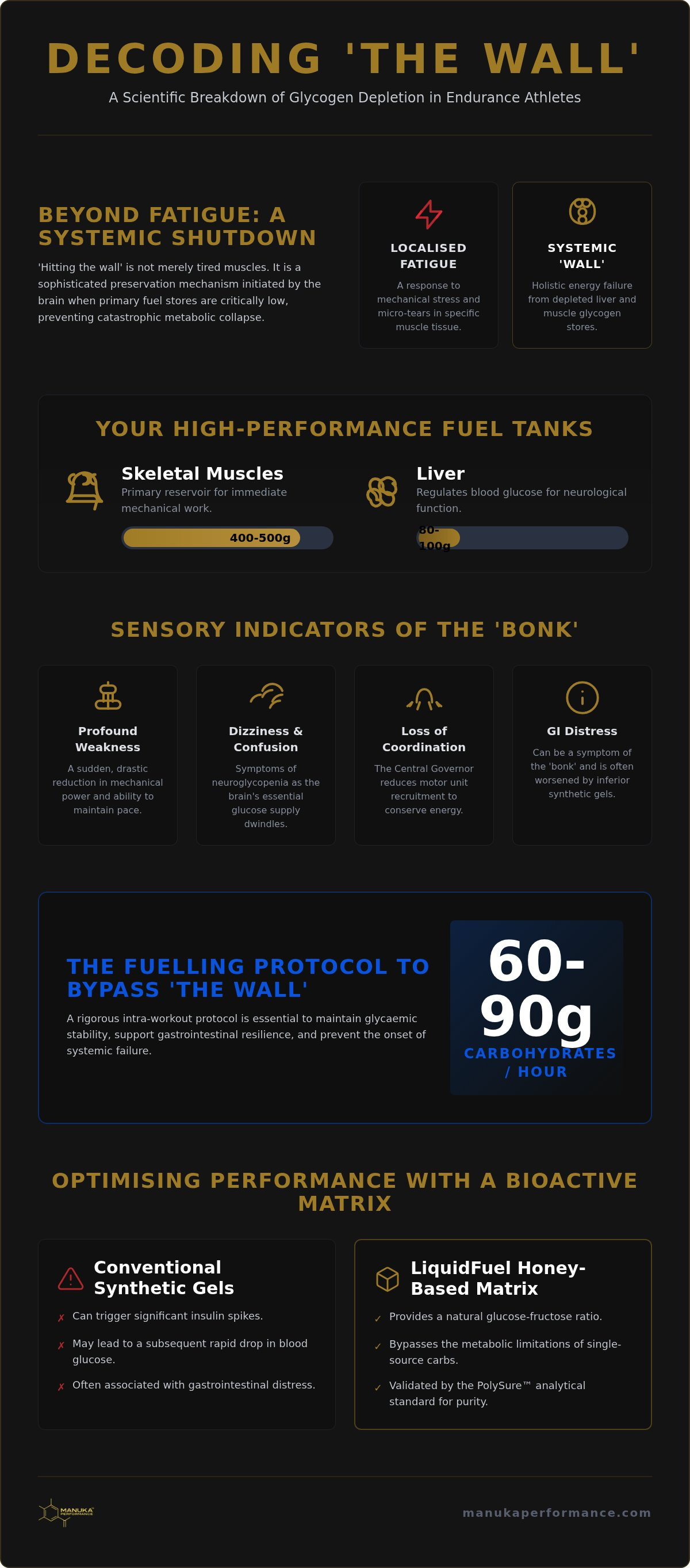
- Establish the clinical distinction between localised muscular fatigue and systemic glycogen depletion, identifying the liver and skeletal muscles as the primary reservoirs for essential glycogen storage.
- Identify the specific sensory indicators and neurological symptoms of neuroglycopenia to accurately recognise what does hitting the wall feel like running during high-intensity endurance events.
- Implement a rigorous intra-workout fuelling protocol that targets 60 to 90 grams of carbohydrates per hour to maintain glycaemic stability and support gastrointestinal resilience.
- Utilise the LiquidFuel honey-based matrix, validated by the PolySure™ analytical standard, to provide a natural glucose-fructose ratio that bypasses the metabolic limitations of synthetic energy gels.
Defining 'The Wall': A Clinical Perspective on Systemic Failure
To understand Hitting the wall, one must distinguish between localised peripheral fatigue and the systemic metabolic crisis often termed 'bonking'. While muscle soreness is a localised response to mechanical stress and micro-tears in the tissue, the 'wall' represents a holistic failure of energy homeostasis. This phenomenon occurs when the body's primary fuel reservoirs, specifically the skeletal muscles and the liver, reach a critical state of depletion. The skeletal muscles store approximately 400 to 500 grams of glycogen for immediate mechanical work, while the liver maintains a smaller reserve of roughly 80 to 100 grams to regulate blood glucose levels for neurological function. Many athletes find themselves questioning what does hitting the wall feel like running until the moment their systemic capacity to oxidise carbohydrates vanishes, leaving them in a state of profound physiological vulnerability.
Glycogen vs. Lipid Metabolism
Carbohydrate oxidation is the preferred pathway for high-intensity endurance as it yields ATP at a significantly faster rate than lipid metabolism. During efforts maintaining 70-80% of VO2 max, the body relies on these limited glycogen stores to sustain the power output required for competitive pacing. Fat oxidation, though nearly inexhaustible in terms of total energy stored, is a slower process that requires more oxygen per unit of ATP produced. It's simply unable to meet the rapid energy demands of an elite pace once the body has exhausted its high-octane fuel. The metabolic shift is the precise moment when the depletion of glycogen forces the body to rely predominantly on lipid oxidation, resulting in a mandatory and drastic reduction in mechanical power.
The Role of the Central Governor
The brain acts as a 'Central Governor', a concept that reframes the wall as a regulatory protective mechanism rather than a simple mechanical failure. As blood glucose levels drop and glycogen stores dwindle, the brain perceives a threat to vital organs and initiates a systemic slowdown to preserve homeostasis. It achieves this by reducing motor unit recruitment, effectively limiting the number of muscle fibres the athlete can consciously activate. This evolutionary survival mechanism ensures that the body retains enough energy to maintain basic biological functions, even if it means sacrificing the athlete's performance goals. It's a sophisticated override that prioritises long-term survival over the immediate demands of competition. Understanding what does hitting the wall feel like running requires acknowledging that your brain is actively preventing you from causing permanent damage to your internal systems.
The Bio-Analytical Reality of Glycogen Depletion
Quantifying the metabolic requirements of endurance reveals the inevitability of energy deficits during unmanaged competition. For an athlete maintaining an intensity of 70-80% of VO2 max, the rate of carbohydrate oxidation is exceptionally high, often exceeding the body's ability to mobilise stored fuel. A well-conditioned 70kg athlete typically possesses a total glycogen reservoir of approximately 600 grams, comprising 500 grams in skeletal muscle and 100 grams in the liver, which equates to roughly 2,400 kilocalories. Since a marathon typically demands between 2,500 and 3,500 calories depending on pace and efficiency, this inherent shortfall makes strategic carbohydrate loading the primary defence against premature depletion.
While the liver can attempt to bridge this gap through gluconeogenesis, the synthesis of glucose from non-carbohydrate precursors like glycerol and amino acids, this pathway is biochemically limited. It's simply unable to produce glucose at a rate sufficient to match the oxidation demands of elite pacing. When these stores reach a critical nadir, the athlete encounters the systemic failure they've been warned about. Understanding what does hitting the wall feel like running starts with recognising this mathematical certainty: without exogenous fuelling, the system eventually defaults to a lower power output to prevent total metabolic collapse.
Blood Glucose Stability and Performance
Sustained power output is fundamentally linked to the maintenance of stable blood glucose levels. Many traditional, high-glycaemic synthetic gels trigger significant insulin spikes, which can lead to a rapid subsequent drop in blood sugar, known as rebound hypoglycaemia. This instability disrupts the metabolic rhythm and accelerates the onset of fatigue. Maintaining a steady-state glycaemic profile through a complex carbohydrate matrix is essential for performance longevity. For those seeking to optimise this balance, exploring advanced bioactive fuelling solutions can provide the necessary stability to avoid these disruptive insulin fluctuations.
Cellular Energy Production (ATP)
Efficient energy production via the Krebs cycle depends on the availability of glucose-derived intermediates, specifically oxaloacetate. In the absence of sufficient carbohydrates, the cycle's ability to process fatty acids for ATP production is severely compromised. This metabolic bottleneck is often described as fat burning in a carbohydrate flame; without the 'fire' of glucose, the fat 'smoke' cannot be converted into useful energy efficiently. When ATP production rates plummet, the cellular environment shifts, leading to impaired muscle contraction and the characteristic sensation of leaden limbs that defines the late stages of a race.
Sensory Indicators: How Your Body Signals the 'Bonk'
The transition from metabolic efficiency to systemic failure is marked by a distinct shift in sensory perception. While previous sections detailed the mathematical depletion of glycogen, the lived experience of an athlete is often defined by a sudden, exponential increase in the Rating of Perceived Exertion (RPE). This isn't a linear progression of fatigue. It's a threshold event. The effort required to maintain a specific pace becomes disproportionate to the mechanical output. Understanding what does hitting the wall feel like running requires a precise categorisation of these signals, ranging from peripheral muscular heaviness to the more insidious cognitive disruptions of neuroglycopenia.
Early warning signs often manifest as subtle shifts in gait and a diminishing capacity to maintain technical form. Unlike acute dehydration, which typically presents with increased heart rate and specific thirst cues, or electrolyte imbalances that cause sharp, localised muscle spasms, the 'bonk' is a comprehensive systemic shutdown. Recognising these precursors allows for immediate intervention before the Central Governor initiates a total reduction in motor unit recruitment. Key indicators include:
- A sudden loss of technical running form and economy.
- Increased irritability or emotional volatility.
- A sharp rise in perceived exertion despite a constant or decreasing pace.
- Loss of mental focus and peripheral awareness.
Physical Manifestations of Depletion
The characteristic sensation of 'leaden' or 'heavy' legs is a direct consequence of reduced neuromuscular signalling efficiency. As glycogen levels in the skeletal muscles drop, the electrochemical gradient required for muscle contraction becomes harder to maintain. This metabolic stress can also trigger secondary muscle cramping, though these are distinct from the cramps caused by sodium loss. ATP production rates are insufficient to support the high-frequency firing of motor neurons, resulting in a physical experience where the limbs feel as though they are moving through a viscous medium.
The Psychological 'Wall'
Neuroglycopenia, or the deficiency of glucose in the brain, is perhaps the most debilitating aspect of the wall. Since the brain relies almost exclusively on blood glucose for energy, a drop in systemic levels leads to immediate cognitive decline, manifest as a loss of focus and impaired decision-making. Athletes often describe a 'fight or flight' response, where the instinct to survive overrides the desire to compete, leading to a profound sense of hopelessness. Mental resilience is heavily dependent on maintaining cerebral glucose availability; without it, the psychological capacity to manage the sensory load of elite competition effectively vanishes. Your brain isn't just tired. It's starving. Understanding what does hitting the wall feel like running means acknowledging that your psychology is fundamentally tied to your blood glucose stability.
Strategic Protocols to Bypass the Physiological Wall
Managing the metabolic demands of elite endurance requires more than a reactive approach to hunger or thirst. By the time an athlete experiences what does hitting the wall feel like running, the systemic depletion is often too advanced for immediate reversal. A rigorous intra-workout fuelling protocol, targeting a carbohydrate ingestion rate of 60 to 90 grams per hour, is essential to sustain the oxidation rates required for competitive pacing. This volume of intake must be supported by high levels of gastrointestinal resilience, a physiological state that must be cultivated through deliberate gut training during long-duration preparation runs to ensure the digestive system can process high carbohydrate loads under mechanical stress.
Strategic pacing also plays a pivotal role in glycogen preservation. Since the rate of glycogen utilisation increases exponentially with intensity, maintaining a steady-state effort below the anaerobic threshold preserves high-octane fuel for the final stages of the race. Testing these fuelling and pacing strategies during training is not optional; it's a bio-analytical necessity to determine individual absorption limits and metabolic efficiency. To implement this protocol effectively, consider the Mānuka Performance LiquidFuel range, which is specifically engineered to provide an optimal carbohydrate ratio with minimal systemic load.
The Glucose-Fructose Matrix Advantage
Total carbohydrate absorption is limited by the saturation of the SGLT1 glucose transporters, which typically occurs at approximately 60 grams per hour. To exceed this threshold, athletes must utilise dual-transportable carbohydrates that leverage the GLUT5 pathway. The natural fructose found in a honey-based matrix provides this secondary channel, allowing for higher total energy delivery without the osmotic stress often associated with maltodextrin-heavy synthetic formulations. These synthetic alternatives frequently lead to gastric emptying delays and subsequent distress, whereas a natural matrix facilitates more efficient transit and absorption.
Precision Timing and Frequency
A 'little and often' strategy is critical for maintaining glycaemic stability throughout the event. Rather than large, infrequent boluses that cause insulin fluctuations, consuming 20 to 30 grams of carbohydrates every 20 minutes ensures a steady supply of exogenous glucose. This protocol must commence early, typically within the first 30 minutes of the race, before endogenous glycogen stores are significantly reduced. Establishing this consistent fuelling rhythm also provides a psychological benefit, reducing the perceived sensory load and helping to prevent the brain from initiating a protective metabolic shutdown.
Optimising Performance via Honey-Based Bioactive Matrices
To mitigate the metabolic crisis and the resulting sensory shutdown described in the preceding sections, the selection of a fuelling matrix must move beyond simple caloric replacement. Mānuka Performance LiquidFuel represents a sophisticated bio-analytical advancement in endurance nutrition, utilising a New Zealand honey-based matrix to deliver a precise, natural glucose-fructose ratio. This dual-pathway delivery is critical for bypassing the transporter saturation limits that often lead to systemic failure. By providing a steady influx of exogenous fuel that mirrors the body's natural requirements, athletes can effectively delay or entirely avoid the state where they learn what does hitting the wall feel like running, thereby maintaining performance integrity under extreme physiological stress.
The use of natural bioactives allows for a transition away from synthetic compromises that often plague traditional sports nutrition. Rather than relying on isolated, highly processed sugars, the LiquidFuel matrix leverages the inherent complexity of its source material to support systemic resilience. This approach ensures that energy delivery is not only rapid but also remarkably stable, preventing the glycaemic volatility that can trigger early-onset fatigue. Identifying what does hitting the wall feel like running is a necessary diagnostic step for any serious athlete, but the ultimate goal is the deployment of a fuel source that maintains homeostasis without the synthetic load of conventional alternatives.
Bioavailability and Absorption
Honey-based energy gels are inherently more bioavailable than synthetic formulations, particularly during high-exertion states where digestive capacity is reduced. The presence of naturally occurring enzymes, such as diastase and invertase, facilitates the efficient breakdown of carbohydrates into readily absorbable units. This enzymatic assistance reduces the metabolic burden on the gastrointestinal tract, which often suffers from reduced blood flow during intense competition. A clean label approach further enhances this resilience by excluding artificial thickeners and preservatives that frequently contribute to osmotic stress and subsequent gastric distress. This focus on purity ensures that the fuel is processed with maximum efficiency and minimal systemic friction.
The PolySure™ Difference
The PolySure™ analytical standard represents a commitment to rigorous validation, ensuring that every batch of LiquidFuel contains quantified levels of seven naturally occurring polyphenols. These bioactives play a vital role in managing the oxidative stress and systemic inflammation that characterise ultra-endurance events, providing a level of support that traditional gels cannot match. By bridging the gap between natural provenance and biotech innovation, Mānuka Performance provides a high-end, laboratory-validated solution for elite athletes. To optimise your fuelling strategy and secure your performance longevity, explore the Mānuka Performance LiquidFuel range for your next competition.
Advancing Beyond the Metabolic Threshold
Understanding the clinical mechanisms of glycogen depletion transforms the experience of 'the wall' from an unpredictable failure into a manageable biological variable. While the sensory data of what does hitting the wall feel like running can be overwhelming, it's essentially a signal that your homeostatic reserves have reached a critical nadir. By transitioning to a fuelling protocol that prioritises systemic stability, you move beyond the limitations of traditional, synthetic endurance products that often compromise performance through gastrointestinal distress.
The integration of a naturally occurring glucose-fructose matrix allows for higher carbohydrate oxidation rates while maintaining elite gastrointestinal resilience. Mānuka Performance products are validated by the PolySure™ analytical standard to ensure quantified bioactive content that supports your body through the most demanding phases of competition. You don't have to accept the systemic shutdown as an inevitability of long-distance events. Optimise your endurance fuelling with Mānuka Performance LiquidFuel and maintain your competitive edge with scientific precision. Every kilometre is an opportunity to validate your preparation and surpass your previous physiological limits.
Frequently Asked Questions
Is hitting the wall the same as bonking?
Yes, 'hitting the wall' and 'bonking' are interchangeable terms describing the same systemic physiological failure. Both terms refer to the point where glycogen stores in the liver and skeletal muscles are depleted, forcing the body to transition to less efficient lipid metabolism. While 'bonking' is often used in cycling and 'the wall' in running, both describe the same metabolic crisis where the brain initiates a protective shutdown to preserve blood glucose levels.
Can you recover from hitting the wall during a race?
Recovery during the event is extremely difficult once total glycogen depletion has occurred. While consuming high-glycaemic carbohydrates can provide a temporary lift in blood glucose, it's rarely sufficient to restore the power output required for competitive pacing. The most effective strategy is a proactive protocol that prevents the depletion from reaching critical levels. Once the Central Governor has reduced motor unit recruitment, the systemic slowdown is largely irreversible until significant rest and re-fuelling occur.
Do you hit the wall in a half marathon or only full marathons?
While the wall is classically associated with the 30-kilometre mark of a marathon, it can occur in a half marathon if the intensity is sufficiently high. A well-conditioned athlete typically has enough glycogen for about 90 to 120 minutes of high-intensity effort. If a half marathoner is running at a very high percentage of their VO2 max without exogenous fuel, they may experience what does hitting the wall feel like running toward the final kilometres of the race.
How many grams of carbohydrates per hour are needed to prevent hitting the wall?
Current sports science research recommends an intake of 60 to 90 grams of carbohydrates per hour for events lasting longer than two hours. To reach the upper end of this range, athletes must utilise a dual-transportable carbohydrate matrix, such as the glucose-fructose ratio found in New Zealand honey. This approach leverages multiple intestinal transporters, allowing for higher absorption rates without the gastric distress often caused by overloading a single pathway with synthetic maltodextrin.
What are the first signs that I am about to hit the wall?
Early indicators often manifest as a sudden increase in the Rating of Perceived Exertion (RPE) despite maintaining a constant pace. You might notice a loss of technical running form, increased irritability, or a subtle cognitive haze known as neuroglycopenia. Recognising these precursors is vital, as they signal that the brain is beginning to monitor declining blood glucose levels. If you wait until the legs feel leaden, the metabolic shift has already progressed beyond the point of easy correction.
Why do synthetic energy gels often cause stomach issues when I'm trying to fuel?
Synthetic gels frequently rely on high concentrations of maltodextrin, which can increase the osmotic pressure in the gut and lead to gastric emptying delays. This often results in nausea or bloating during high-exertion states. In contrast, a natural honey-based matrix provides a more bioavailable glucose-fructose ratio. This facilitates rapid transit through the digestive system, promoting gastrointestinal resilience and ensuring that the carbohydrates are absorbed and utilised by the muscles rather than sitting in the stomach.
Does 'carbo-loading' really prevent the wall?
Strategic carbohydrate loading increases the baseline glycogen stores in the muscles and liver, providing a larger initial fuel reservoir. Research suggests consuming 10 to 12 grams of carbohydrates per kilogram of body weight in the 36 hours prior to a race can maximise these stores. However, even maximised stores are often insufficient for the total caloric demands of a marathon. Carbo-loading extends the time until depletion but must be paired with intra-race fuelling to bypass the wall entirely.
Is there a difference in how men and women experience hitting the wall?
Physiological differences in substrate utilisation suggest that women may actually be more efficient at oxidising fats at higher intensities than men. This metabolic flexibility can potentially delay the onset of glycogen depletion. However, the sensory experience of what does hitting the wall feel like running remains broadly similar across genders, characterised by systemic fatigue and cognitive decline. Regardless of gender, maintaining glycaemic stability through a quantified bioactive matrix remains the most effective protocol for sustaining performance.