


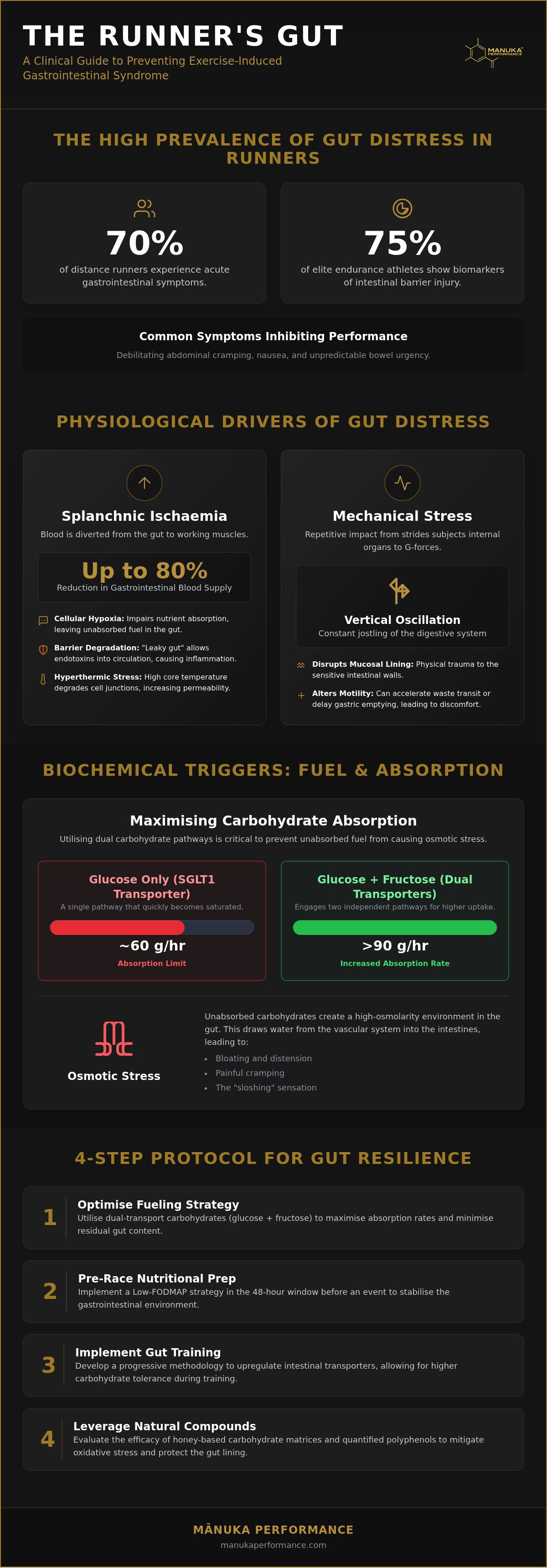
Recent clinical assessments indicate that up to 70% of distance runners experience acute gastrointestinal symptoms, with 75% of participants in high-level endurance events showing measurable biomarkers of intestinal barrier injury. You likely recognise these physiological disruptions as the primary inhibitors of your performance, manifesting as debilitating abdominal cramping, nausea, or unpredictable bowel urgency during sustained efforts. This article provides a comprehensive clinical analysis of the underlying mechanisms, such as splanchnic hypoperfusion and osmotic imbalances, to facilitate a rigorous protocol for avoiding runners stomach issues.
By examining the biochemical properties of carbohydrate absorption and the role of quantified polyphenols, we establish a data-driven framework for achieving systemic digestive resilience during high-intensity intervals and long-duration efforts. We will explore how a refined intra-workout strategy, centred on bioavailable energy sources with a natural 1:1 glucose to fructose ratio, can maintain gastrointestinal integrity without the necessity for synthetic fillers or high-osmolar loads. This analysis transitions from the fundamental causes of gut distress toward a sophisticated methodology for optimising nutrient delivery and protecting the intestinal lining under significant physiological stress.
Key Takeaways
- Identify the physiological mechanisms of exercise-induced gastrointestinal syndrome and how splanchnic ischaemia compromises digestive function by diverting blood flow to working muscle groups.
- Implement a research-led protocol for avoiding runners stomach issues by utilising dual-transport carbohydrates to manage osmotic pressure and maximise nutrient absorption rates.
- Master the application of a Low-FODMAP nutritional strategy and systematic trigger elimination to stabilise the gastrointestinal environment during the critical 48-hour window before an endurance effort.
- Develop a progressive gut-training methodology designed to upregulate intestinal transporters, facilitating higher carbohydrate oxidation without compromising the integrity of the intestinal barrier.
- Evaluate the clinical efficacy of honey-based carbohydrate matrices and quantified polyphenols in mitigating oxidative stress and maintaining systemic gastrointestinal resilience during high-intensity performance.
Understanding the Physiological Drivers of Runner's Stomach
Runner's stomach, clinically classified as Exercise-Induced Gastrointestinal Syndrome (EIGS), represents a complex interplay of physiological stressors that compromise the integrity of the digestive tract. While recreational athletes often dismiss these symptoms as mere discomfort, clinical research indicates that high-intensity efforts can trigger significant pathological changes. Understanding these drivers is the first step in avoiding runners stomach issues and maintaining peak performance during endurance events.
The Role of Splanchnic Ischaemia in Digestive Failure
The primary driver of EIGS is splanchnic ischaemia, a condition where blood flow is diverted from the mesenteric circulation to the peripheral musculature and skin for thermoregulation. During peak exertion, the gastrointestinal tract can experience a reduction in blood supply of up to 80%. This acute hypoperfusion results in several critical failures:
- Cellular Hypoxia: Oxygen deprivation impairs the active transport mechanisms required for nutrient absorption, leading to unabsorbed carbohydrates in the gut.
- Barrier Degradation: The Physiology of Exercise-Induced Nausea often stems from this ischaemic state, as the stomach becomes unable to process contents efficiently.
- Hyperthermic Stress: Elevation of core body temperature degrades the tight junction proteins between epithelial cells, increasing intestinal permeability.
This "leaky gut" state allows endotoxins to enter the systemic circulation, triggering a pro-inflammatory response that manifests as acute nausea or systemic fatigue. When the intestinal barrier's integrity is compromised, the body's ability to regulate fluid and electrolyte balance is severely diminished.
Mechanical Stress and Gastrointestinal Motility
Beyond vascular shifts, the physical nature of running introduces mechanical trauma. Vertical oscillation, the repetitive impact of each stride, subjects the internal organs to significant G-forces. This constant jostling disrupts the mucosal lining and alters gastrointestinal motility, often accelerating the transit of waste or delaying gastric emptying. High-intensity intervals typically correlate with lower rates of stomach clearance. It means that any unabsorbed fuel sits in the gut, increasing osmotic pressure and drawing water into the intestines.
For athletes already predisposed to dietary sensitivities, these mechanical factors amplify the risk of distress. Developing a robust strategy for avoiding runners stomach issues must account for these forces, ensuring that fueling remains bioavailable and low-residue to minimise the physical load on the digestive system. When intensity increases, the tolerance for complex fibres or slow-digesting fats decreases exponentially, necessitating a shift toward more refined, bioavailable energy matrices.
The Biochemistry of Nutrient Absorption and Osmotic Stress
While the physiological shifts discussed previously establish the environment for distress, the biochemical composition of intra-workout fueling determines the severity of the gastrointestinal response. Central to avoiding runners stomach issues is the strategic utilisation of dual-transport carbohydrates. Glucose relies on the sodium-dependent SGLT1 transporter, which typically reaches saturation at approximately 60 grams per hour. By introducing fructose, which utilises the independent GLUT5 transporter, athletes can increase total carbohydrate oxidation rates toward 90 grams or more per hour. Research into the Etiology and Nutritional Recommendations for Runners highlights that a failure to engage these multiple pathways often leads to residual substrate in the intestinal lumen.
Unabsorbed carbohydrates create a high-osmolarity environment within the small intestine. Through the process of osmosis, this concentration gradient draws water from the vascular system into the gut, resulting in distension, bloating, and the "sloshing" sensation familiar to many endurance athletes. This osmotic stress is particularly pronounced with synthetic formulations. Maltodextrin, while having a high molecular weight, is often combined with artificial thickeners and preservatives that increase the overall digestive load and delay gastric emptying.
SGLT1 and GLUT5: Optimising Carbohydrate Transport
The saturation limits of the SGLT1 transporter represent a significant bottleneck in endurance nutrition. When glucose intake exceeds the transporter's capacity, the excess remains in the gut, contributing to osmotic pressure. Utilising a natural 1:1 or 2:1 ratio of glucose to fructose is critical for reducing this "gut lag." A New Zealand honey-based matrix provides these sugars in a naturally occurring ratio that aligns with the body's transport capacities, facilitating rapid absorption without the necessity for complex enzymatic breakdown. By selecting bioavailable energy sources that avoid synthetic fillers, runners can maintain gastrointestinal integrity even during high-intensity intervals.
Managing Osmolality in Intra-Workout Nutrition
Osmolality refers to the concentration of particles in a solution. In the context of sports nutrition, a solution that is significantly hypertonic, meaning it's more concentrated than blood, will trigger water secretion into the intestines. This physiological response causes immediate discomfort and accelerates dehydration. Clean-label alternatives typically exhibit lower osmotic pressure compared to heavily processed gels. The benefits of these highly bioavailable sources include:
- Reduced Gastric Load: Natural matrices require less water for processing, minimising stomach distension.
- Enhanced Absorption: Immediate engagement of SGLT1 and GLUT5 transporters reduces the duration of substrate transit.
- Stability: Lower risk of the "rebound" effect where unabsorbed sugars ferment and cause late-stage urgency.
Transitioning toward a strategy that prioritises natural carbohydrate matrices allows for higher energy intake while effectively avoiding runners stomach issues caused by osmotic imbalances.
Strategic Nutritional Protocols for Mitigating GI Distress
Transitioning from biochemical theory to clinical application requires a structured approach to nutrient timing and selection. Avoiding runners stomach issues is most effectively achieved by implementing a low-residue, low-FODMAP (fermentable oligosaccharides, disaccharides, monosaccharides, and polyols) strategy in the 24 to 48 hours preceding a high-intensity effort. This protocol reduces the volume of undigested material in the colon and limits the presence of fermentable substrates that contribute to gas production and osmotic shifts. Athletes should prioritise the systematic elimination of high-fibre and high-fat triggers, as these substances significantly delay gastric emptying and increase the mechanical load on a compromised digestive system.
The clinical timeline for pre-performance intake is equally critical. A primary meal should be consumed three to four hours before exercise to ensure adequate gastric clearance and blood glucose stabilisation. This window allows the mesenteric circulation to process nutrients before the onset of splanchnic ischaemia. Within the final 60 minutes, any top-up fueling must consist of highly bioavailable, low-osmolar carbohydrates that require minimal enzymatic breakdown.
Pre-Performance Dietary Refinement
Dietary refinement involves identifying specific high-residue foods, such as those containing skins, seeds, or complex husks, which can cause mechanical irritation of the intestinal wall during vertical oscillation. Individual tolerance for caffeine also requires precise calibration. While caffeine is a proven ergogenic aid, it accelerates gastrointestinal motility and can exacerbate urgency in sensitive individuals. A habitual diet serves as the baseline for gut resilience. Athletes who maintain a consistent nutritional profile are less likely to experience acute disruptions compared to those who introduce novel substrates on race day. Sudden shifts in nutrient density or chemical composition often overwhelm the established transport mechanisms, leading to immediate digestive failure.
Intra-Workout Hydration and Fueling Synchronisation
Intra-workout success depends on the synchronisation of fluid volume and carbohydrate concentration. The "sloshing" sensation, or gastric distension, typically occurs when the volume of fluid in the stomach exceeds its emptying rate. Maintaining a consistent gastric volume through small, frequent sips is more effective than bolus ingestion. Electrolyte balance, particularly sodium concentration, is essential for facilitating the active transport of glucose across the intestinal lumen. Guidelines suggest that sodium levels should be sufficient to stimulate the SGLT1 transporter without creating a hypertonic environment. When hydration and carbohydrate intake are correctly aligned, the osmotic gradient remains favourable, ensuring that fuel is absorbed rapidly into the bloodstream rather than accumulating in the gut.
How to Organise a Progressive Gut-Training Protocol
Systematic conditioning of the gastrointestinal tract is as fundamental to endurance performance as aerobic development. The gut is a highly adaptable organ, capable of significant functional shifts when subjected to progressive carbohydrate loading. This process is essential for avoiding runners stomach issues, as it reduces the volume of unabsorbed substrate that triggers osmotic distress and mechanical irritation. Clinical evidence suggests that the gut can be trained to increase its gastric emptying rate and absorption capacity, provided the stimulus is consistent and progressive.
Upregulating Carbohydrate Transporters
The density of SGLT1 transport proteins is not a static physiological trait. Research indicates that consistent exposure to high carbohydrate concentrations stimulates the synthesis of these proteins on the apical membrane of enterocytes. To facilitate this upregulation, athletes should implement a 6 to 10 week conditioning block. Begin with a baseline of 30 to 40 grams of carbohydrate per hour (g/h) during long-duration sessions. Every fortnight, increase this load by 10 to 15 g/h until you reach your target race-day intake, which may be as high as 90 g/h for sustained efforts. High-carbohydrate training days are necessary to ensure the metabolic pathways remain efficient at processing exogenous fuel while blood flow is diverted away from the digestive system. Incorporating a clinically validated honey-based matrix during this phase provides a bioavailable foundation that supports transport upregulation without the systemic stress of synthetic fillers.
Simulating Race-Day Intensity and Nutrition
Digestion at a recovery heart rate differs fundamentally from digestion at lactate threshold. As heart rate increases, the degree of splanchnic ischaemia intensifies, further compromising the body's ability to process nutrients. Testing your nutrition during high-intensity intervals or 'brick' sessions is vital for validating gastrointestinal resilience under specific race-day conditions. This allows you to identify the exact point where mechanical stress and intensity intersect with your fueling limits. A structured documentation process is essential for refining this strategy. During these sessions, you should record:
- Total Carbohydrate Intake: Document the precise grams per hour and the ratio of glucose to fructose.
- Fluid and Electrolyte Volume: Note the total millilitres consumed and the concentration of sodium.
- Subjective Comfort Scores: Rank bloating, nausea, and urgency on a scale of 1 to 10.
- Exertion Correlation: Analyse how digestive symptoms fluctuate relative to heart rate zones and vertical oscillation.
By practicing the specific race-day plan under high-intensity stress, you can identify and mitigate potential failures long before the event. This rigorous approach to avoiding runners stomach issues ensures that your nutritional strategy is a performance enhancer rather than a limiting factor.
Leveraging Natural Honey Matrices for Superior Digestive Tolerance
The selection of an appropriate carbohydrate matrix is the final, critical component in achieving gastrointestinal resilience. While synthetic gels frequently utilise high-molecular-weight maltodextrin combined with artificial thickeners, these formulations often increase the gastric load and delay nutrient transit. A New Zealand honey-based matrix offers a clinically superior alternative by providing a natural 1:1 glucose to fructose ratio. This specific alignment with the SGLT1 and GLUT5 transporters is fundamental to avoiding runners stomach issues, as it ensures maximal absorption with minimal residual substrate in the intestinal lumen.
The Phytochemical Advantage: Beyond Simple Sugars
The efficacy of a honey-based matrix extends beyond its primary carbohydrate profile. Naturally occurring polyphenols, validated through the PolySure™ analytical standard, provide a systemic advantage by mitigating the oxidative stress associated with exercise-induced ischaemia. When blood flow is diverted from the gut, the resulting hypoxia triggers an inflammatory response that can degrade the intestinal barrier. The Natural Honey-Based Energy Gels: A Performance Analysis highlights how these bioactive compounds support the integrity of the tight junction proteins. By protecting the gut lining from oxidative damage, these seven quantified phytochemicals reduce the risk of systemic endotoxaemia and the associated performance-limiting symptoms.
LiquidFuel: A Bio-Analytical Approach to Fueling
LiquidFuel represents a rigorous application of biotechnology to endurance nutrition. This flagship gel is formulated to leverage the natural bioavailability of honey without the inclusion of synthetic thickeners like xanthan or gellan gum. These additives are often implicated in delayed gastric emptying and increased osmotic pressure. By removing these obstacles, LiquidFuel maintains a low-viscosity profile that facilitates rapid clearance from the stomach. It's a clean-label solution that reduces the systemic load on the athlete, allowing for more efficient nutrient partitioning during high-intensity intervals.
In a high-performance endurance strategy, the practical application of LiquidFuel involves consistent dosing that aligns with the upregulated transport capacity established during the gut-training phase. It ensures that the energy supplied is immediately accessible for oxidation. This bio-analytical approach to fueling provides the precision required for avoiding runners stomach issues during sustained, high-intensity efforts. It bridges the gap between natural provenance and measurable clinical efficacy, ensuring that the digestive system remains an asset rather than a liability.
Advancing Toward Systemic Gastrointestinal Resilience
Achieving peak endurance performance requires a synthesis of physiological understanding and bio-analytical nutrition. By addressing the mechanisms of splanchnic ischaemia and implementing a progressive gut-training block, athletes can significantly enhance their capacity for carbohydrate oxidation. Central to avoiding runners stomach issues is the transition from high-osmolar synthetic formulations toward bioavailable matrices that respect the integrity of the intestinal barrier.
The application of phytochemical research from New Zealand has resulted in a sophisticated methodology for protecting the gut lining against oxidative stress. Our LiquidFuel gel leverages a natural honey-based glucose-fructose matrix, ensuring rapid absorption through multiple transport pathways without the systemic load of artificial thickeners. This approach is rigorously validated by the PolySure™ analytical standard, providing a level of precision previously unavailable in sports nutrition. It's a strategy that moves beyond simple caloric intake to prioritise systemic health and performance longevity.
Explore the science of LiquidFuel and PolySure™ for superior gut resilience.
With a refined protocol and the right biological tools, you can transform your digestive system into a resilient engine that supports your highest athletic ambitions.
Frequently Asked Questions
What is the primary cause of runner's stomach during long-distance events?
The primary cause is splanchnic ischaemia, where up to 80% of blood flow's diverted from the gastrointestinal tract to the working muscles and skin for thermoregulation. This reduction in mesenteric circulation impairs nutrient transport and compromises the intestinal barrier. Combined with vertical oscillation and mechanical trauma, this vascular shift triggers symptoms of exercise-induced gastrointestinal syndrome. Understanding these drivers is the first stage in avoiding runners stomach issues; it's a vital step for high-intensity efforts.
Can I train my gut to handle more carbohydrates per hour?
Gastrointestinal adaptation's achievable through a progressive conditioning protocol that stimulates the synthesis of SGLT1 and GLUT5 transport proteins. By consistently exposing the gut to increasing carbohydrate concentrations during training, you'll expand your absorption capacity from 30 grams to over 90 grams per hour. This upregulation reduces the volume of unabsorbed substrate in the lumen, effectively mitigating the osmotic pressure and mechanical distress that often limit endurance performance.
Why do synthetic energy gels often cause bloating and nausea?
Synthetic formulations often rely on high concentrations of maltodextrin and artificial thickeners like xanthan gum, which significantly increase the osmolality of the gastric environment. These hypertonic solutions draw water into the intestines through osmosis, leading to distension and bloating. If they don't have a balanced glucose-to-fructose ratio, residual sugars ferment in the gut. This process accelerates digestive failure and contributes to acute nausea during high-intensity intervals.
How does the glucose-to-fructose ratio affect my digestive comfort?
The glucose-to-fructose ratio determines the efficiency of carbohydrate oxidation by engaging independent transport pathways. Glucose utilises the SGLT1 transporter, while fructose utilises GLUT5; a natural 1:1 ratio ensures neither pathway reaches premature saturation. This balance is fundamental to avoiding runners stomach issues, as it facilitates rapid clearance from the stomach. When these ratios're misaligned, unabsorbed sugars accumulate, increasing osmotic pressure and triggering the "sloshing" sensation experienced during long-duration efforts.
Should I avoid fibre completely before a marathon to prevent stomach issues?
While fibre's essential for habitual health, a low-residue diet's recommended for the 24 to 48 hours preceding a marathon. Eliminating complex fibres and high-fat triggers reduces the total volume of undigested material in the colon and minimises mechanical irritation caused by vertical oscillation. It's a temporary dietary refinement that stabilises the gastrointestinal environment, ensuring the digestive system isn't overloaded with slow-moving bulk when splanchnic blood flow's compromised.
What role do polyphenols play in an athlete's gastrointestinal health?
Quantified polyphenols act as bioactive agents that protect the intestinal barrier from oxidative stress caused by exercise-induced ischaemia. These phytochemicals help maintain the integrity of tight junction proteins between epithelial cells, reducing the risk of increased intestinal permeability. By mitigating the inflammatory response to hypoxia, polyphenols support systemic resilience and prevent the entry of endotoxins into the bloodstream. They're vital for athletes seeking to maintain gastrointestinal function during prolonged physiological stress.
Is honey a more bioavailable energy source than maltodextrin for runners?
Honey provides a naturally occurring matrix of glucose and fructose that's highly bioavailable and requires minimal enzymatic breakdown compared to synthetic maltodextrin. Its natural 1:1 ratio aligns precisely with the body’s dual-transport capacities, allowing for more efficient carbohydrate oxidation without the necessity for artificial additives. Because it doesn't have the heavy thickeners found in processed gels, a honey-based matrix maintains a lower gastric load and facilitates faster emptying.
How many weeks does it take to effectively 'train the gut' for racing?
Developing significant gastrointestinal adaptation typically requires a structured conditioning block of six to ten weeks. This timeline allows for the progressive upregulation of intestinal transporters and the stabilisation of gastric emptying rates under various heart rate zones. Initial adaptations are often observed within two weeks, but achieving the systemic resilience necessary for high-intensity race-day loads requires consistent exposure. It's essential to practice your specific nutrition plan during this period.