


The pursuit of peak athletic performance often necessitates a calculated compromise between physiological efficacy and gastrointestinal stability, particularly when managing the complex demands of endurance racing. Athletes who don't prioritise gastrointestinal resilience alongside caloric intake often experience acute gastric distress or a debilitating metabolic collapse at a critical competitive juncture, effectively negating months of rigorous training. By understanding the rigorous scientific parameters of natural energy for runners before a race, one can transition from speculative supplementation to a nutritional protocol grounded in biochemical validation and superior gastrointestinal resilience.
This comprehensive guide explores the precise mechanisms through which naturally occurring carbohydrate matrices, specifically those derived from high-purity honey-based sources, optimise glycogen stores while maintaining systemic equilibrium throughout the duration of an event. We shall examine the analytical standards required to verify bioactive purity and the specific glucose-to-fructose ratios that ensure your pre-race strategy remains both efficacious and clinically sound, providing the confidence necessary for elite-level competition.
Key Takeaways
- Identify the physiological advantages of transitioning from synthetic maltodextrin-based gels to bio-available natural matrices to mitigate gastrointestinal distress during high-intensity efforts.
- Understand the dual-transport carbohydrate absorption mechanism that utilises a specific 1:0.8 glucose-to-fructose ratio for optimised glycogen delivery and systemic equilibrium.
- Master a rigorous framework for selecting natural energy for runners before a race based on absorption efficiency and clinical purity rather than simple caloric density.
- Evaluate the role of PolySure™ validated polyphenols as secondary metabolites that support athletic resilience and systemic oxidative stress management.
- Implement a data-driven pacing strategy using the LiquidFuel 10-Pack to ensure sustained metabolic output and superior gastrointestinal resilience during endurance events.
The Evolution of Pre-Race Energy: Why Runners are Favouring Natural Solutions
The biological demands of endurance performance are undergoing a fundamental transition as athletes move away from the synthetic paradigms of the previous decade. This shift is driven by an increasing recognition that traditional sports nutrition principles, while effective for basic caloric replacement, often neglect the complex biological requirements of the human gastrointestinal tract. Consequently, the demand for natural energy for runners before a race has evolved from a niche preference for "clean eating" into a sophisticated requirement for bio-available, laboratory-validated matrices. Elite competitors now prioritise systemic harmony over the erratic energy delivery of 20th-century formulations.
In 2026, the standard for athletic fuel has moved beyond the "clean label" marketing of the past. It's no longer enough for a product to simply exclude artificial ingredients; it must demonstrate clinical-grade efficacy through quantified bioactive markers. This new era of performance nutrition is defined by analytical standards that validate the presence of specific polyphenols and secondary metabolites. These compounds don't just provide fuel; they support the body's natural resilience against the physiological rigours of high-intensity running, ensuring that the transition from rest to peak output is metabolically seamless.
The Limitations of Traditional Synthetic Gels
Traditional energy gels frequently rely on maltodextrin and artificial sweeteners to achieve high caloric density. While these ingredients are effective for rapid glucose delivery, they often create significant osmotic pressure within the small intestine. This pressure draws water into the gut, frequently resulting in the acute gastrointestinal distress that can terminate a race prematurely. The reliance on highly processed simple sugars often induces a "spike and crash" cycle, where rapid insulin responses lead to mid-race metabolic instability. Long-term athletic health is also a concern, as chemical preservatives and artificial additives have been scrutinised for their potential to disrupt gut microbiome resilience over time.
The Rise of Functional Food Biotechnology
Modern science is now unlocking the latent potential of New Zealand honey through advanced functional food biotechnology. We're seeing a transition from raw, unrefined ingredients toward precisely measured bioactive formulations that offer superior carbohydrate absorption. Provenance is a critical factor in this evolution; the unique phytochemical profile of New Zealand’s floral sources provides a natural matrix that synthetic alternatives cannot replicate. By focusing on the intersection of nature and biotechnology, researchers have developed honey-based gels that provide a stable, dual-transport carbohydrate delivery system. This approach ensures sustained energy levels and superior gastrointestinal resilience, allowing runners to maintain clinical confidence in their nutrition strategy from the starting line to the finish.
Biochemical Mechanisms: Understanding the Natural Glucose-Fructose Matrix
The biochemical efficacy of pre-race nutrition is fundamentally dictated by the rate of intestinal absorption rather than the volume of ingestion. For athletes seeking natural energy for runners before a race, the primary objective is to bypass the rate-limiting barriers of the human digestive system. This is achieved through the dual-transport mechanism, which utilises two distinct pathways for carbohydrate uptake: the SGLT1 transporter for glucose and the GLUT5 transporter for fructose. By leveraging both channels simultaneously, a runner can increase their carbohydrate oxidation rate significantly beyond the 60 grams per hour ceiling typically associated with glucose-only sources.
A natural 1:0.8 glucose-to-fructose ratio, as found in specific honey-based matrices, provides a distinct physiological advantage by preventing the saturation of individual gut transporters. When a runner consumes a single-source carbohydrate, the SGLT1 transporters quickly become overwhelmed, leading to a "bottleneck" effect where unabsorbed sugars remain in the intestine. This residual sugar increases osmotic pressure, drawing water into the gut and causing the distress often termed "runners stomach". Natural honey matrices also contain active enzymes such as diastase and invertase, which facilitate the pre-digestion of complex saccharides, thereby reducing the metabolic load on the athlete during the critical pre-race period.
Optimising Glycogen Resynthesis Before the Starting Gun
The timing of the pre-race bolus is essential for ensuring peak blood glucose availability without inducing rebound hypoglycaemia. Consuming a honey-based matrix approximately 15 to 30 minutes before the start allows the naturally occurring bioactives to synergise with the dual-transport system for rapid uptake. The glucose-fructose matrix serves as the definitive dual-fuel system for endurance, facilitating simultaneous absorption through independent intestinal pathways. This strategic delivery ensures that glycogen stores are topped up precisely when the metabolic demand begins to escalate.
Bioavailability and Intestinal Transit
Bioavailability is a measure of how efficiently a substance enters the systemic circulation, and honey-based gels demonstrate superior gastric emptying rates compared to the viscous, synthetic pastes common in the industry. These natural formulations are typically more isotonic, which accelerates their passage through the stomach and reduces the risk of "sloshing" or nausea. By prioritising high-bioavailability fuels, athletes are more successful at avoiding runners stomach issues while maintaining stable energy levels. Those who require clinical precision in their pacing strategy often rely on validated honey-based solutions to ensure their natural energy for runners before a race is both sustained and systemic. This sustained release of natural sugars provides a defensive buffer against the "bonk," maintaining blood glucose equilibrium through the first phase of the race.
Beyond Carbohydrates: The Role of Quantified Polyphenols in Performance
The physiological utility of natural energy for runners before a race extends significantly beyond the mere provision of glucose and fructose. While carbohydrate saturation is essential for glycogen maintenance, the presence of specific secondary metabolites known as polyphenols provides a critical layer of systemic support for the endurance athlete. These phytochemical compounds are instrumental in managing the acute oxidative stress induced by high-intensity aerobic activity, which can otherwise lead to cellular fatigue and diminished performance levels. For a competitive athlete, the inherent variability found in standard raw honey is unacceptable; true performance requires a validated extract where the phytochemical density is quantified and consistent across every dose.
Clinical research into endurance physiology suggests that the measurement of seven specific polyphenols is essential for predicting the efficacy of a natural fuel source. These compounds act as biological modulators that support the body's internal organisation during the transition from homeostasis to peak exertion. By prioritising a high phenolic density, runners can ensure their pre-race protocol addresses both the metabolic demand for fuel and the systemic demand for oxidative protection. This dual-action approach is what distinguishes a scientifically formulated bioactive matrix from a simple whole-food alternative.
The PolySure™ Analytical Standard Explained
Mānuka Performance utilises the PolySure™ analytical standard to move beyond the traditional MGO (Methylglyoxal) rating, which primarily measures antibacterial properties rather than athletic utility. By quantifying the concentration of seven specific polyphenols, this protocol ensures that each serving provides a consistent bioactive profile for the athlete. For a deeper understanding of these metrics, one should investigate the evidence regarding do honey energy gels work at a clinical level. The data indicates that total phenolic content is the superior metric for predicting a fuel's impact on systemic resilience and long-term athletic health.
Phytochemical Synergy in Pre-Race Preparation
These bioactives work in synergy to support vascular function, which is critical for enhancing nutrient delivery to the working musculature during the pre-race phase. Unlike standard table honey, which lacks analytical validation and often suffers from heat-induced degradation, these quantified extracts ensure the athlete receives a potent concentration of secondary metabolites. This pharmaceutical-grade precision allows for a more predictable physiological response during competition. PolySure™ is the scientific fingerprint of performance-led nutrition. By integrating these quantified bioactives into a nutrition strategy, runners can achieve a level of clinical confidence that raw ingredients simply cannot provide.
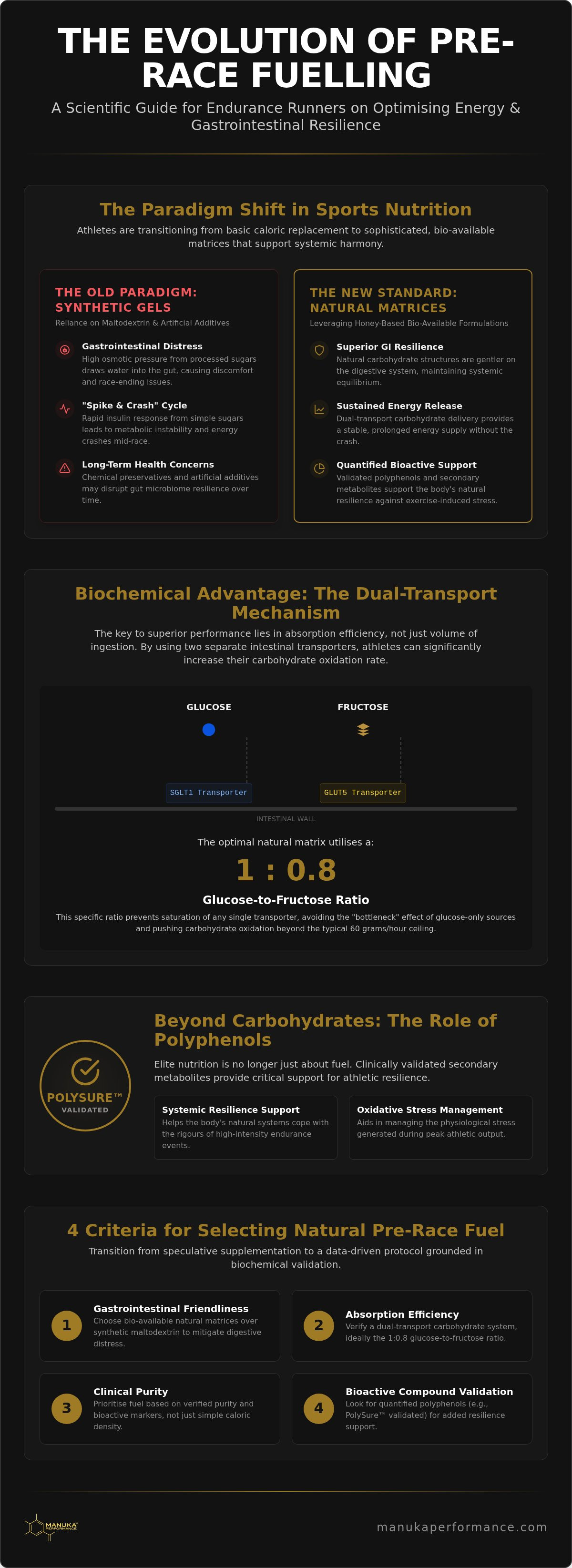
4 Criteria for Choosing a Natural Pre-Workout for Runners
This focus on clinical precision and systemic support often extends to an athlete's entire lifestyle; for those who value mindful self-care, Avin & Holy Glow provides a guide to premium beauty products that complement a high-performance routine.
Selecting an effective source of natural energy for runners before a race requires a transition from subjective preference to a rigorous, data-driven framework. In the 2026 competitive landscape, athletes must prioritise the metabolic utility of their fuel over simple caloric volume. For athletes seeking to expand their nutritional protocol, Earthbound offers a selection of organic supplements and pre-workout options that align with these rigorous clean-label requirements. A high-performance nutrition strategy is built upon four specific pillars: bio-analytical validation, matrix precision, gastrointestinal resilience, and logistical efficiency. By evaluating potential supplements against these criteria, runners can eliminate the variables that frequently lead to mid-race metabolic collapse or acute digestive distress.
Criterion 1: Bio-Analytical Validation
The first parameter for any endurance supplement is the presence of third-party quantification. Athletes should avoid products that rely on "proprietary blends," as these often obscure the actual concentration of active metabolites. Instead, look for clinical-grade standards like PolySure™, which provides a verifiable fingerprint of bioactive density. This level of transparency is essential for those seeking a Gu energy gel alternative that offers consistent performance without synthetic additives. Validation ensures that the phytochemical profile is potent enough to support systemic resilience under the heavy oxidative load of a race.
Criterion 2: The Carbohydrate Matrix
Absorption efficiency is more critical than raw caloric density. A scientifically sound natural energy for runners before a race must feature a balanced glucose-to-fructose ratio to optimise the dual-transport absorption pathways. While whole-food sources like bananas are inherently natural, they lack the engineered precision required to prevent transporter saturation. Furthermore, the matrix must be free from high-FODMAP ingredients; these are fermentable carbohydrates that frequently trigger bloating and osmotic imbalances in the lower intestine during high-intensity efforts.
Criterion 3: Gastrointestinal Resilience
The osmolality of a pre-race fuel dictates how quickly it clears the stomach. High-osmolality synthetic pastes often linger, causing "gut slosh" and nausea. Liquid-state natural fuels are superior for rapid gastric emptying, ensuring that nutrients reach the bloodstream without a heavy digestive burden. Additionally, the pH balance of a gel is a frequently overlooked factor. A neutral or balanced pH supports both digestive comfort and dental health, which is a vital consideration for endurance athletes who consume high-carbohydrate fuels frequently over long training cycles.
Finally, logistical considerations such as shelf-stability and ease of consumption under duress cannot be ignored. A fuel that is difficult to open or requires specific temperature control is a liability on race day. For those ready to implement a clinically validated nutrition programme, you can explore the Mānuka Performance range to secure a fuel source that meets these rigorous bio-analytical standards.
The Mānuka Performance Solution: LiquidFuel and the Future of Racing
The culmination of bio-analytical research and endurance physiology is realised in the formulation of LiquidFuel, a product that serves as the clinical benchmark for natural energy for runners before a race. Unlike standard offerings that treat honey as a simple sweetener, this solution integrates the PolySure™ standard to ensure that every sachet delivers a quantified concentration of bioactive compounds. This commitment to phytochemical innovation allows athletes to move beyond the unpredictability of raw ingredients, providing a standardised matrix that supports both metabolic output and systemic resilience during the most demanding phases of competition. By prioritising a research-led approach, Mānuka Performance has transitioned from a standard consumer goods model to a biotech-driven innovator in the sports nutrition sector.
Engineered by Nature, Validated by Science
The unique structural properties of the New Zealand honey-based matrix within LiquidFuel facilitate a superior rate of carbohydrate oxidation by leveraging the dual-transport pathways previously discussed. Professional athletes are increasingly transitioning to PolySure™ validated nutrition because it provides a level of clinical certainty that is absent in conventional sports nutrition. To understand the technical superiority of these formulations, one may examine a detailed honey based energy gels NZ performance analysis, which highlights how New Zealand provenance contributes to a superior phenolic profile. This research ensures that the fuel is not only clean-label but also biochemically optimised for elite endurance requirements.
Implementing LiquidFuel into Your Race-Day Protocol
Implementing LiquidFuel into a race-day protocol requires a methodical approach to ensure glycogen saturation and sustained blood glucose equilibrium. For an optimal pre-race loading phase, athletes should consume one sachet approximately 20 minutes before the starting gun, allowing the natural glucose-to-fructose ratio to initialise the absorption transporters. The LiquidFuel 10-Pack is specifically designed for this logistical transition, providing sufficient volume for both the initial bolus and subsequent intra-race maintenance every 30 to 45 minutes. This systematic pacing strategy ensures that the athlete maintains a consistent metabolic trajectory, effectively mitigating the risk of energy crashes or gastrointestinal instability. By adopting this validated framework, runners can secure a definitive competitive advantage through superior nutritional precision. You can optimise your pre-race energy with LiquidFuel to ensure your next performance is supported by the intersection of nature and biotechnology.
Advancing Athletic Potential Through Bio-Analytical Precision
The transition toward scientifically validated, natural energy for runners before a race represents a fundamental shift in endurance nutrition. By moving away from synthetic stimulants and toward a New Zealand honey-based carbohydrate matrix, athletes can achieve a level of gastrointestinal resilience that was previously unattainable with conventional gels. It's essential to recognise that the dual-transport mechanism and the PolySure™ analytical standard provide a rigorous framework for metabolic optimisation. These developments ensure that your pre-race protocol is not merely a matter of caloric intake, but a calculated strategy for sustained performance and systemic protection.
Securing your competitive advantage requires a commitment to nutrition that is as rigorous as your physical training. When you prioritise bio-analytical purity and absorption efficiency, you eliminate the variables that lead to mid-race instability. We invite you to Explore the LiquidFuel 10-Pack: The Scientifically Validated Pre-Race Fuel to integrate these clinical standards into your next event. Your pursuit of professional excellence deserves a fuel source that operates at the intersection of nature and advanced biotechnology. Run with precision and clinical confidence.
Frequently Asked Questions
Is honey really a better pre-workout for runners than synthetic gels?
Honey is superior because it offers a bio-available dual-transport carbohydrate matrix that aligns with human digestive physiology. Unlike synthetic alternatives that rely on maltodextrin, a natural energy for runners before a race utilises the synergistic relationship between glucose and fructose. This specific ratio reduces osmotic pressure in the small intestine, which effectively minimises the risk of acute gastrointestinal distress while providing a stable, clinical-grade fuel source for high-intensity efforts.
How long before a race should I consume a natural energy gel?
Optimal timing for consumption is approximately 15 to 30 minutes before the starting gun. This window ensures that the naturally occurring saccharides are absorbed through the SGLT1 and GLUT5 transporters exactly as the metabolic demand increases. Consuming the gel too early may lead to a premature insulin response, while taking it too late might result in unabsorbed carbohydrates sitting in the stomach during the initial, high-stress phase of the race.
Will a natural honey-based gel cause a blood sugar crash during the race?
A blood sugar crash, or rebound hypoglycaemia, is significantly less likely with a honey-based matrix than with processed simple sugars. The presence of secondary metabolites and enzymes in LiquidFuel facilitates a more controlled entry of glucose into the bloodstream. This sustained-release profile ensures that blood glucose levels remain equilibrated, providing a consistent metabolic trajectory that prevents the erratic "spike and crash" cycle often associated with low-quality synthetic endurance supplements.
Can I use natural pre-workouts if I have a sensitive stomach?
Athletes with sensitive gastrointestinal tracts often find natural energy for runners before a race to be far more tolerable. These formulations are generally free from artificial sweeteners, chemical preservatives, and high-FODMAP ingredients that are known to trigger bloating or nausea. Because the honey-based matrix is more isotonic, it moves through the gastric system with less resistance, supporting superior gastrointestinal resilience and allowing for consistent pacing without digestive interruption.
What makes PolySure™ different from standard honey certifications?
PolySure™ is a rigorous analytical standard that quantifies seven specific polyphenols within the finished product to ensure consistent bioactive density. Most standard honey certifications, such as MGO, focus exclusively on antibacterial markers which have limited relevance to athletic performance. PolySure™ provides a scientific fingerprint of the phytochemical profile, ensuring that every batch meets the clinical requirements for managing oxidative stress and supporting vascular function during endurance events.
How many grams of carbohydrates should a natural pre-workout provide?
A high-performance pre-workout should provide between 20 and 30 grams of carbohydrates per serving to effectively top up glycogen stores. This volume is sufficient to prime the dual-transport system without causing an overwhelming osmotic load on the gut. For longer events, runners should aim for a total intake of 30 to 60 grams of carbohydrates per hour, which can be achieved by combining the pre-race bolus with regular intra-race maintenance.
Are natural pre-workouts suitable for ultra-endurance events?
Natural pre-workouts are exceptionally well-suited for ultra-endurance events where long-term gut health is the primary factor for success. Over several hours, the accumulation of synthetic additives can lead to systemic intolerance and metabolic collapse. Honey-based matrices provide a sustainable, bio-available fuel source that maintains its efficacy throughout the duration of the event. This allows athletes to maintain their nutritional protocol without the cumulative gastrointestinal distress common with synthetic pastes.
Do natural energy gels require water for consumption?
While the liquid-state formulation of LiquidFuel is designed for easy ingestion, consuming the gel with approximately 100 to 150 millilitres of water is recommended. This practice ensures that the carbohydrate concentration remains in an isotonic range, which facilitates the most rapid gastric emptying rate. Proper hydration synergy allows the fuel to bypass the stomach quickly, ensuring that the glucose and fructose reach the intestinal transporters without causing any local discomfort.