


Recent clinical data suggests that as many as 70 per cent of endurance athletes encounter significant gastrointestinal distress during competition, a figure that highlights the systemic limitations of traditional synthetic energy products. You've likely experienced the debilitating onset of metabolic exhaustion where your physiological output fails to meet the demands of your objective. Determining how to prevent bonking on a long run is not merely a matter of caloric volume; it's a complex challenge of optimising absorption rates and maintaining glycogen homeostasis through precise biochemical interventions.
This guide serves as a comprehensive bio-analytical resource designed to help you master the mechanisms of glycogen sparing and dual-source carbohydrate transport. We'll examine the clinical evidence supporting a transition from synthetic formulations to bioactive, honey-based matrices validated by the PolySure™ analytical standard. By the conclusion of this analysis, you'll possess the technical knowledge required to maintain a consistent pace across any distance while successfully mitigating the risk of gastrointestinal volatility and total metabolic collapse. Our investigation spans the latest 2026 guidelines on carbohydrate titration and the physiological advantages of natural glucose-fructose ratios for superior intestinal absorption.
Key Takeaways
- Identify the physiological triggers of exercise-induced hypoglycaemia and the metabolic shift toward inefficient lipid oxidation that signals the onset of systemic exhaustion.
- Discover how to prevent bonking on a long run by implementing a "Strategic Carbohydrate Loading" phase and a proactive fueling protocol initiated before the first hour of exertion.
- Master the science of dual-source carbohydrate absorption to optimise the saturation of SGLT1 and GLUT5 transporters for maximum energy bioavailability.
- Transition from synthetic maltodextrin-based energy sources to bioactive honey matrices to mitigate gastrointestinal distress and support the integrity of the gut lining.
- Understand the role of the PolySure™ analytical standard in validating the presence of essential phytochemicals that enhance metabolic resilience and endurance performance.
Defining 'The Bonk': A Physiological Analysis of Glycogen Depletion
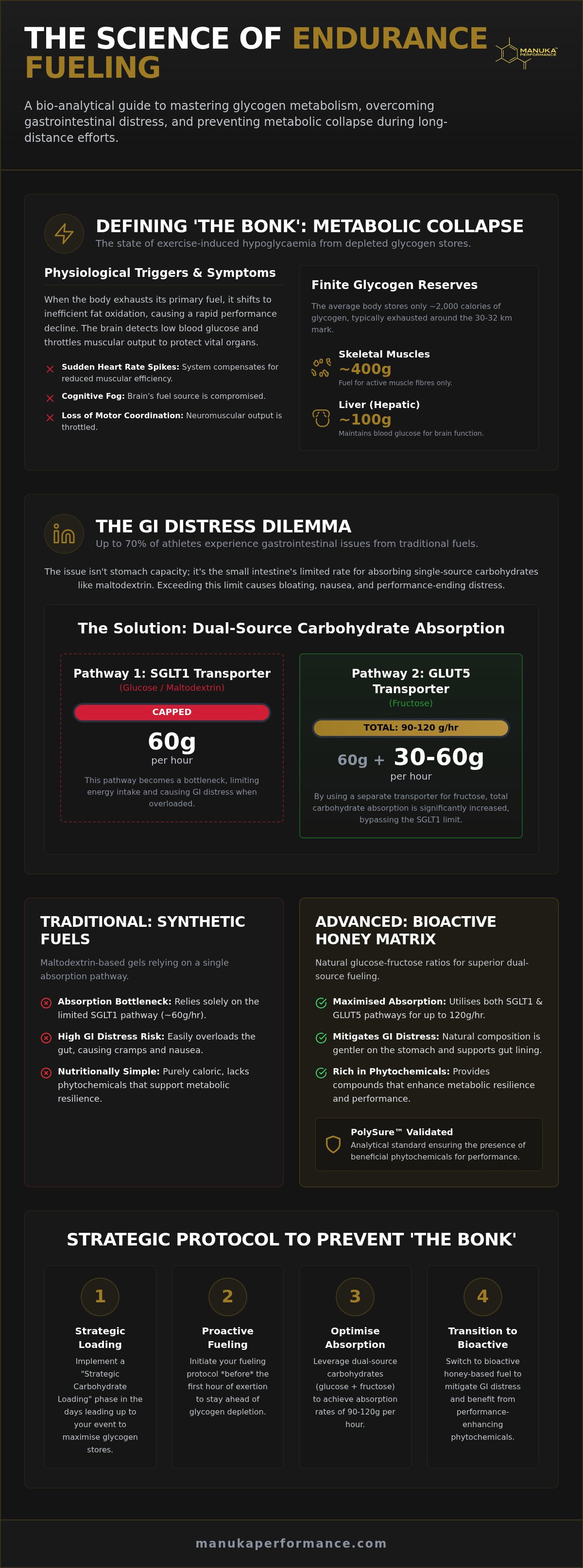
In the context of high-performance endurance, the term 'bonking' identifies a state of exercise-induced hypoglycaemia where systemic glycogen stores are effectively exhausted. This Physiological Analysis of Glycogen Depletion reveals that once the body’s primary fuel source is diminished, it must transition from efficient aerobic carbohydrate metabolism to lipid oxidation. While fat stores are technically vast, the rate of energy release through beta-oxidation is significantly slower and less efficient than glycolysis, meaning your intensity cannot be maintained. This metabolic failure typically manifests around the 30 to 32 kilometre mark in marathon-distance efforts, as the average human body can only store approximately 2,000 calories of glycogen. At this critical juncture, the central governor in the brain detects falling blood glucose and proactively throttles neuromuscular output to preserve vital organ function.
The Role of Hepatic and Muscular Glycogen
The body's glycogen reserves are sequestered in two primary compartments: the skeletal muscles, which hold roughly 400 grams, and the liver, which contains approximately 100 grams. While muscular glycogen is utilised exclusively by the specific muscle fibres in use, hepatic glycogen serves the critical purpose of maintaining blood glucose levels to support neurological and cognitive functions. During a long run, the metabolic pathway of glycogenolysis works to liberate these glucose units, but its capacity is finite. When hepatic stores drop below a critical threshold, the brain’s primary fuel source is compromised, leading to the rapid degradation of performance. Learning how to prevent bonking on a long run necessitates a strategy that preserves these internal stores through consistent exogenous intake.
Symptoms of Metabolic Collapse
The onset of metabolic collapse is marked by distinct physiological indicators that suggest the body has entered a catabolic state. Athletes often report sudden heart rate spikes as the cardiovascular system compensates for reduced muscular efficiency, alongside a pronounced loss of motor coordination and the arrival of cognitive fog. In extreme scenarios, the body may even begin to metabolise muscle tissue through gluconeogenesis to provide substrate for the brain. Attempting to "push through" this state without exogenous carbohydrate intervention is physiologically counterproductive, as the systemic deficit cannot be rectified by willpower alone. Effective endurance management relies on preventing this biochemical crisis before the central nervous system initiates a protective shutdown. Understanding how to prevent bonking on a long run is therefore a matter of proactive substrate management rather than reactive recovery.
The Bio-Analytical Mechanism of Carbohydrate Absorption
The primary bottleneck in exogenous energy delivery isn't gastric capacity but rather the rate-limiting step of intestinal absorption. When athletes investigate how to prevent bonking on a long run, they must account for the saturation points of specific transport proteins located in the small intestine. If carbohydrate intake exceeds these thresholds, unabsorbed saccharides remain in the intestinal lumen. Here, they undergo osmotic shifts and bacterial fermentation, a process that frequently results in the gastrointestinal distress reported by up to 70 per cent of endurance runners. This biochemical "traffic jam" is the root cause of the nausea and bloating that often derail performance during high-intensity efforts.
SGLT1 vs. GLUT5: The Duel-Transport Pathway
Glucose and fructose utilise distinct pathways for transmucosal absorption. Sodium-dependent glucose transporter 1 (SGLT1) handles glucose and maltodextrin, but its capacity is physically capped at approximately 60 grams per hour. Fructose relies on the GLUT5 transporter, which operates independently of the glucose pathway. By leveraging a dual-transport matrix, athletes can bypass the SGLT1 bottleneck to achieve oxidation rates of 90 to 120 grams per hour. This synergistic approach significantly increases the energy available for muscular work, provided the ratio is precisely balanced to avoid transporter saturation. Implementing a protocol that includes gut training is a sophisticated strategy for those seeking how to prevent bonking on a long run through systemic adaptation.
Bioavailability and Osmolality in Sports Nutrition
Osmolality refers to the concentration of particles in a solution, a factor that dictates the rate of gastric emptying. Synthetic polymers often possess high molecular weights that can delay transit times, whereas natural honey-based matrices offer a bioavailable profile that aligns more closely with human digestive physiology. Maintaining Gastrointestinal Resilience: A Scientific Guide to Avoiding Runner's Stomach Issues is essential for sustaining high-intensity efforts without systemic disruption. Recent research into gut training suggests that consistent exposure to these high-carbohydrate loads can upregulate transporter expression, further enhancing absorption efficiency over time. This adaptive process allows the body to tolerate the increased intake required for elite performance. To explore how these biochemical principles are applied in functional nutrition, you can examine the research at manukaperformance.com.
A Strategic Fueling Protocol for Long-Distance Endurance
Implementing a robust nutritional framework requires a fundamental shift from reactive consumption to proactive titration. Maximising baseline stores via a dedicated Strategic Carbohydrate Loading: A Bio-Analytical Protocol for Endurance Athletes ensures that muscular and hepatic glycogen levels are saturated prior to the first kilometre. Understanding how to prevent bonking on a long run involves more than mid-race supplementation; it begins with a 48 hour loading window where carbohydrate intake is increased to 8 to 12 grams per kilogram of body mass. This preparatory phase creates a metabolic buffer that delays the onset of glycogen depletion during the initial phases of exertion.
The "Early and Often" principle is the cornerstone of successful endurance management, requiring athletes to initiate fueling within the first 30 to 45 minutes of activity. Waiting for the arrival of fatigue signals a failure in substrate management, as the body cannot rectify a significant caloric deficit while simultaneously managing the stress of high-intensity movement. It's essential to recognise that exercise intensity directly dictates the body's ability to process exogenous fuel. As heart rate climbs and blood is diverted from the splanchnic region to the working skeletal muscles, gastric emptying rates naturally decline, making the timing of intake critical for maintaining systemic stability.
The 15-Minute Micro-Dosing Strategy
While the 48 hour pre-race window focuses on supersaturation, the post-run phase is equally critical for long-term metabolic resilience. The 30 minute period immediately following exertion represents a "metabolic window" where glycogen resynthesis rates are at their highest due to increased insulin sensitivity and glucose transporter activity. Consuming 1.0 to 1.2 grams of carbohydrate per kilogram of body weight during this interval is essential to prevent systemic fatigue and accelerate the restoration of energy stores. This disciplined approach to recovery ensures that the body remains prepared for subsequent training loads, effectively solving the problem of how to prevent bonking on a long run across an entire training cycle. To further support your performance and daily health, you can check out Zenutri Personalised Vitamins.
Overcoming Gastrointestinal Distress on the Trail
Gastrointestinal volatility represents a primary barrier to successful fueling, with research indicating that between 30 per cent and 70 per cent of endurance athletes experience significant digestive disruption. This systemic failure often stems from the use of synthetic maltodextrin-based gels, which can exert high osmotic pressure within the intestinal lumen. In the demanding climatic conditions often found across the Tasman, elevated core temperatures exacerbate splanchnic hypoperfusion, a state where blood flow is diverted away from the gut to the working muscles and skin for thermoregulation. When blood flow to the digestive system is compromised, the absorption of complex synthetic polymers slows, leading to the fermentation of unabsorbed sugars and the subsequent onset of "runners stomach". Understanding how to prevent bonking on a long run requires a fueling strategy that prioritises intestinal integrity and rapid transmucosal transport.
Synthetic Additives vs. Natural Matrices
Traditional energy products frequently incorporate artificial flavours, preservatives, and thickeners such as xanthan gum to maintain shelf stability and texture. These additives can act as mucosal irritants, particularly when the intestinal barrier is stressed by prolonged exertion. Conversely, natural honey-based matrices provide a cleaner phytochemical profile that aligns with human physiology. Naturally occurring enzymes within honey, such as diastase and glucose oxidase, assist in the initial breakdown of saccharides, reducing the metabolic load on the small intestine. A liquid-gel consistency is also technically superior during periods of heavy breathing, as it requires less mastication and facilitates faster gastric emptying than viscous, synthetic alternatives. To optimise your intake with a scientifically validated formulation, you can explore the PolySure™ certified range at manukaperformance.com.
Hydration and the Sodium-Glucose Co-Transport
The efficacy of carbohydrate absorption is inextricably linked to hydration status and electrolyte balance. The SGLT1 transporter is a sodium-dependent mechanism, meaning that sodium ions are required to pull glucose molecules across the intestinal wall into the bloodstream. Without adequate sodium, even the most sophisticated carbohydrate matrix remains sequestered in the gut. Furthermore, a 2025 study of marathon participants published by the American Physiological Society found that 75 per cent of runners displayed biomarkers for intestinal barrier injury, a condition exacerbated by dehydration. Maintaining fluid balance is therefore critical for preventing hyponatremia and ensuring nutrient delivery.
To maintain systemic equilibrium during ultra-endurance events, consider this physiological checklist:
- Sodium Titration: Aim for 500mg to 700mg of sodium per litre of fluid to support the co-transport mechanism.
- Osmotic Balance: Avoid hypertonic solutions that draw water out of the bloodstream and into the gut.
- Intestinal Permeability: Minimise the use of NSAIDs, which can increase the risk of intestinal damage during long-distance efforts.
By addressing these biochemical requirements, you can effectively resolve the challenge of how to prevent bonking on a long run while maintaining total gastrointestinal comfort.
Leveraging Bioactive Honey Matrices for Metabolic Resilience
The transition from rudimentary caloric intake to the application of bioactive precision represents the current frontier in endurance science. While traditional sports nutrition focuses almost exclusively on the volume of carbohydrates, the PolySure™ analytical standard introduces a rigorous benchmark for functional efficacy. This standard validates the presence of critical secondary metabolites within a New Zealand honey matrix, ensuring that the fuel provided is not merely a source of glucose and fructose but a sophisticated medium for metabolic support. When athletes refine their strategy on how to prevent bonking on a long run, they must consider the role of these bioactive compounds in maintaining systemic homeostasis under the extreme physiological stress of prolonged exertion.
A primary factor in metabolic decline is the accumulation of oxidative stress, which can impair mitochondrial function and accelerate the onset of muscular fatigue. Naturally occurring polyphenols found in specific honey varieties serve as potent antioxidants that assist in mitigating this oxidative damage. By incorporating these bioactives into a fueling protocol, runners can support their cellular resilience, allowing for sustained performance beyond the point where synthetic alternatives often fail. This biotechnological approach to nutrition ensures that every gram of substrate delivered is optimised for both energy release and physiological protection.
The PolySure™ Difference: Quantified Polyphenols
The PolySure™ standard provides analytical validation for seven naturally occurring polyphenols that are integral to the Mānuka Performance formulation. These compounds, including syringic acid and methyl syringate, are precisely quantified to ensure consistent bioactive density in every serving. Unlike generic honey products, this research-driven standard guarantees that the functional properties of the matrix are preserved and measurable. These bioactives contribute to systemic resilience by supporting the body's natural recovery processes during the activity itself. For a deeper investigation into this shift, refer to The Evolution of Sports Nutrition Biotechnology: From Synthetic Sugars to Bioactive Precision.
Why LiquidFuel is the Professional Alternative
The LiquidFuel 10-Pack Running Gel is engineered to leverage the naturally occurring 1:1 ratio of glucose and fructose found in New Zealand honey, providing a bioavailable energy source that aligns with the intestinal transport mechanisms discussed previously. This clean-label formulation eliminates the need for synthetic thickeners and artificial preservatives, reducing the chemical load on the athlete's system. For those seeking how to prevent bonking on a long run, moving away from synthetic supplementation toward research-led functional nutrition offers a clear path to superior performance. This transition ensures that the athlete's fueling strategy is as scientifically rigorous as their training load, prioritising long-term metabolic health with the Bogdana RNF Rejuvenating Nutritional Formula alongside immediate endurance outcomes.
Advancing Metabolic Performance Through Bio-Analytical Precision
Mastering the physiological intricacies of substrate oxidation and intestinal transport represents the definitive solution for those seeking how to prevent bonking on a long run. This analysis has detailed the necessity of leveraging dual-transport carbohydrate pathways and the clinical advantages of transitioning from synthetic polymers to bioactive natural matrices. By integrating a structured titration protocol with the metabolic support of validated polyphenols, you can effectively mitigate the risk of systemic exhaustion and gastrointestinal volatility. It's a transition that ensures your fueling strategy remains as scientifically rigorous as your training load.
Our proprietary biotech research has culminated in a formulation that prioritises both energy bioavailability and long-term gut resilience through a PolySure™ validated New Zealand honey-based matrix. We invite you to explore the LiquidFuel 10-Pack Running Gel for Bio-Analytical Fueling and experience the precision of functional nutrition. We look forward to supporting your pursuit of professional excellence and metabolic resilience on the trail.
Frequently Asked Questions
What exactly is bonking and why does it happen to runners?
Bonking is a state of exercise-induced hypoglycaemia that occurs when your body's glycogen stores are depleted. This metabolic crisis forces a shift from efficient aerobic carbohydrate metabolism to slower lipid oxidation. Because the brain relies on blood glucose for function, it throttles performance to preserve vital organs. Most athletes hit this wall around 30 to 32 kilometres once their approximate 2,000-calorie glycogen reserve is exhausted.
How many grams of carbohydrates should I consume per hour during a long run?
Current guidelines suggest an intake of 30 to 120 grams of carbohydrates per hour for activities exceeding 75 minutes. For ultra-endurance efforts lasting over 2.5 hours, aiming for 90 to 120 grams is often optimal. Achieving these higher rates requires a dual-source matrix of glucose and fructose to saturate multiple intestinal transporters. Titrating your intake through micro-dosing helps you understand how to prevent bonking on a long run without overwhelming the gut.
Can I prevent bonking just by eating more the night before?
A single meal is insufficient for total glycogen supersaturation; a dedicated 48-hour loading phase is required. During this window, you should consume 8 to 12 grams of carbohydrate per kilogram of body mass. However, even with saturated stores, your internal reserves are finite. You must still initiate exogenous fuelling within the first hour of exertion to maintain blood glucose levels and delay the depletion of hepatic and muscular glycogen.
Why do energy gels often cause stomach cramps or nausea?
Gastrointestinal distress is frequently caused by high osmotic pressure from unabsorbed synthetic sugars like maltodextrin. When blood flow is diverted from the gut to the working muscles, the absorption of these complex polymers slows. Thickeners like xanthan gum and artificial preservatives can further irritate the mucosal lining. This leads to fermentation in the intestinal lumen, resulting in the nausea and cramping reported by up to 70 per cent of endurance athletes.
Is honey a better energy source for runners than synthetic gels?
Honey provides a naturally occurring glucose-fructose matrix that aligns with the body’s dual-transport pathways for superior absorption. Unlike synthetic gels, it contains natural enzymes that assist in saccharide breakdown and bioactive polyphenols that support metabolic resilience. Mānuka Performance utilises a New Zealand honey-based matrix to offer a clean-label alternative that reduces the synthetic load on the digestive system while providing high-density, bioavailable energy for sustained performance.
What are the first signs that I am about to hit the wall?
Early indicators of metabolic collapse include cognitive fog, irritability, and a noticeable loss of motor coordination. You might observe a sudden spike in heart rate as your cardiovascular system compensates for reduced muscular efficiency. These symptoms signal that hepatic glycogen is low and the brain is beginning to throttle output. Once these signs manifest, it's difficult to rectify the deficit, which is why proactive fuelling is essential to success.
How does hydration affect my ability to absorb carbohydrates?
Absorption is inextricably linked to fluid balance because the SGLT1 transporter is a sodium-dependent mechanism. Sodium ions are required to pull glucose molecules across the intestinal wall into the bloodstream. Dehydration also increases intestinal permeability, which can lead to biomarkers of gut injury. Maintaining a sodium concentration of 500mg to 700mg per litre of fluid is a critical component of learning how to prevent bonking on a long run.
What is the PolySure™ analytical standard in sports nutrition?
PolySure™ is a proprietary analytical standard that validates the presence and concentration of seven naturally occurring polyphenols in New Zealand honey. This benchmark ensures that the functional nutrition provided is not just simple calories, but a research-driven formulation with measurable bioactive content. By quantifying these phytochemicals, Mānuka Performance provides athletes with a scientifically rigorous fuel source that supports systemic resilience and performance beyond the capabilities of standard retail honey or synthetic gels.