


The era of relying on generic synthetic sugars to fuel elite performance is rapidly concluding as athletes recognise that these isolated compounds often trigger the very gastrointestinal distress and systemic inflammation that halt progress. As the global sports nutrition market is projected to reach USD 77.8 billion by 2026, the industry focus is shifting away from simple caloric density toward the sophisticated realm of sports nutrition biotechnology. You understand that reaching the podium requires more than just raw effort; it demands a level of transparency and physiological precision that traditional supplements often fail to provide. This article explores how the intersection of rigorous analytical science and natural phytochemicals is redefining endurance performance and recovery for the modern elite athlete. We will analyse the specific biochemical mechanisms of bioactive ingredients, identify scientifically validated natural alternatives to synthetic gels, and demonstrate how to optimise systemic recovery through the application of quantified polyphenols and the PolySure™ analytical standard. By moving beyond basic macronutrient ratios, we can achieve a more nuanced understanding of how targeted biotics facilitate sustained athletic excellence.
Key Takeaways
- Understand how sports nutrition biotechnology facilitates the transition from raw natural ingredients to quantified bio-analytical standards for superior performance outcomes.
- Discover the critical role of standardised polyphenols in managing oxidative stress and accelerating systemic recovery through precise phytochemical innovation.
- Recognise the physiological advantages of using a natural carbohydrate matrix to optimise absorption and maintain gastrointestinal resilience during high-intensity endurance events.
- Learn to critically evaluate the bio-analytical credentials of athletic fuel by identifying key performance standards and validation protocols beyond traditional branding.
- Identify the PolySure™ standard as the benchmark for validating the integrity and concentration of specific bioactive ingredients within functional sports nutrition products.
Defining Sports Nutrition Biotechnology in the Modern Era
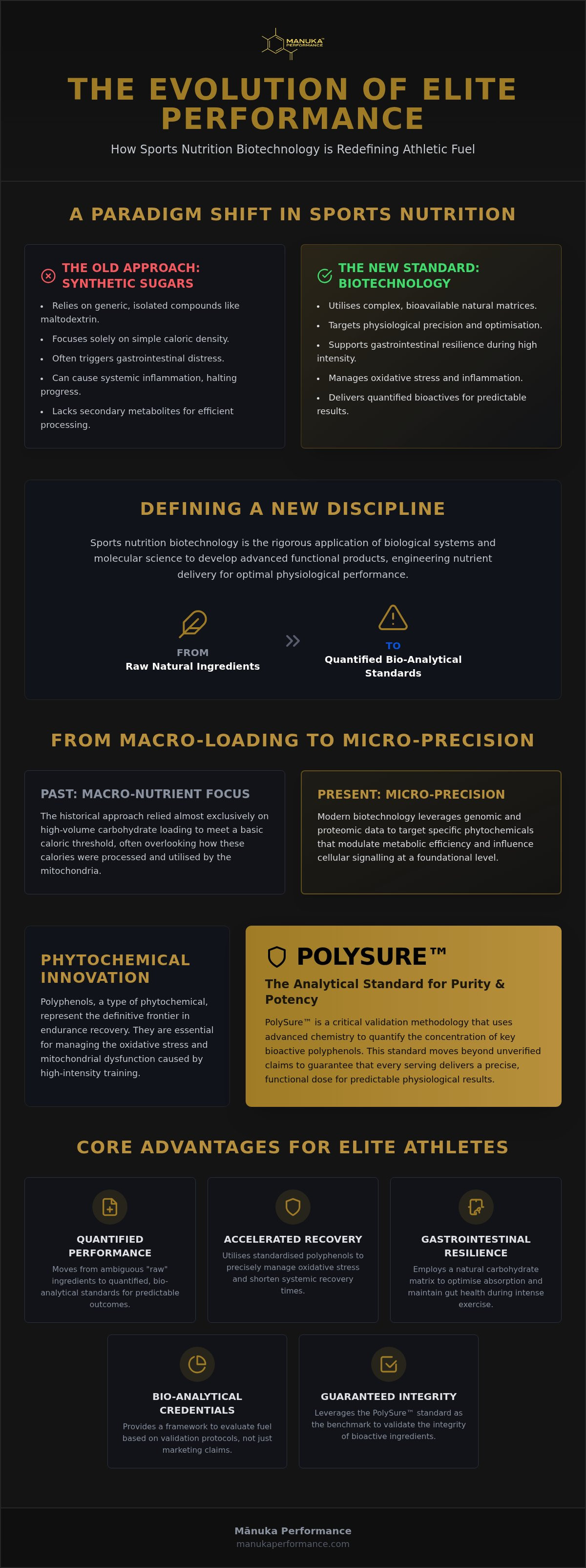
Sports nutrition biotechnology represents the rigorous application of biological systems and molecular organisms to facilitate the development of advanced functional performance products. This discipline focuses on the precision engineering of nutrient delivery for physiological optimisation, moving beyond the simplistic caloric models that once dominated the field. While the historical foundations of sports nutrition were built upon the broad manipulation of macronutrients, the modern era is defined by a transition from "raw" natural ingredients toward "quantified" bio-analytical standards. This evolution reflects a systemic move away from synthetic fillers like maltodextrin, which often lack the secondary metabolites necessary for efficient metabolic processing, in favour of complex, bioavailable natural matrices that support the body's intricate biochemical pathways. By integrating sports nutrition biotechnology into the formulation process, we can ensure that every ingredient is selected based on its measurable impact on human biology.
The Transition from Macro-Nutrient Focus to Micro-Precision
Historically, endurance protocols relied almost exclusively on high-volume carbohydrate loading to sustain output. Modern sports nutrition biotechnology has shifted this focus toward bioactive integration, where the identification of specific phytochemicals allows for the targeted modulation of metabolic efficiency. By leveraging genomic and proteomic data, researchers can now understand how specific nutrients interact with an athlete's unique biological signature. This level of micro-precision ensures that ingredients aren't just present but are functionally active, influencing cellular signalling and energy production at a foundational level. To gain this depth of physiological insight, athletes can utilise advanced metabolic profiling from Spectrum Sciences to identify specific biochemical imbalances. It's no longer enough to simply meet a caloric threshold; the focus has moved to how these calories are processed and utilised by the mitochondria.
The Transition from Macro-Nutrient Focus to Micro-Precision
The integrity of a performance product is inherently linked to its molecular provenance. Through the application of advanced analytical chemistry, biotechnology provides the framework necessary to validate clean-label claims and ensure absolute purity in high-performance environments. This rigorous testing is essential for eliminating contaminants that could compromise an athlete's eligibility or health. New Zealand’s unique ecosystem serves as a critical baseline for this phytochemical innovation, offering a diverse array of bioactive compounds that are meticulously identified and standardised. This analytical approach ensures that every gram of fuel provides a predictable and validated physiological response, establishing a new benchmark for transparency within the global sports supplement industry. By prioritising these clinical standards, athletes can maintain confidence in the safety and efficacy of their nutritional interventions.
Analytical Validation: The Role of Phytochemical Innovation
Phytochemicals, specifically polyphenols, represent the definitive frontier in endurance recovery and the systemic management of oxidative stress. While conventional models focused primarily on glycemic indices, modern sports nutrition biotechnology prioritises the synergistic effect of secondary plant metabolites on cellular health. The Evolution of Sports Nutrition has demonstrated that these bioactives are essential for mitigating the physiological toll of high-intensity training. Oxidative stress, if left unmanaged, leads to mitochondrial dysfunction and prolonged muscle soreness, which compromises the integrity of subsequent training sessions. The inherent variability of natural sources remains a significant hurdle for elite practitioners. Biotechnology addresses this challenge through rigorous standardisation, ensuring every serving delivers a precise, validated concentration of functional compounds designed to support systemic resilience.
PolySure™ and the Quantification of Seven Key Polyphenols
The PolySure™ analytical standard serves as a critical mechanism for validating bioactive content within complex honey matrices. Rather than relying on "raw" or unverified claims, this methodology employs advanced chromatography to quantify seven specific polyphenols. This level of measured content is superior for professional training blocks, as it allows for the exact titration of anti-inflammatory support. The quantification process specifically targets compounds known to modulate the body's primary defence against oxidative damage. You can review the practical application of this precision in our Natural Honey-Based Energy Gels: A Performance Analysis of NZ Innovation. These quantified bioactives directly influence cellular health, providing a predictable biological impact that raw ingredients simply can't guarantee.
Molecular Mapping of New Zealand Bioactives
The application of sports nutrition biotechnology to New Zealand's unique botanical landscape provides a highly complex phytochemical delivery system, particularly through its monofloral honey varieties. The biotech process involves molecular mapping to identify specific markers that drive performance-led nutrition. By establishing laboratory-backed protocols, we ensure every batch maintains absolute consistency, regardless of seasonal fluctuations. This systematic approach transforms a natural resource into a high-performance tool. Elite athletes require this level of clinical certainty to avoid performance plateaus and optimise recovery windows. Integrating these research-driven bioactive ingredients into your regimen ensures your fuel is as technically advanced as your training programme.
The Bio-Analytical Superiority of Natural Carbohydrate Matrices
Endurance performance is fundamentally constrained by the rate of exogenous carbohydrate oxidation and the maintenance of gastrointestinal resilience. While synthetic formulations often rely on isolated maltodextrin, sports nutrition biotechnology has identified that complex natural matrices provide a more efficient mechanism for sustained energy delivery. Honey serves as a sophisticated dual-fuel source. It offers a naturally occurring ratio of glucose and fructose that utilises multiple intestinal transporters for optimised absorption. This synergistic delivery prevents the saturation of single-pathway transporters, effectively mitigating the "hitting the wall" phenomenon that occurs when glycogen stores are depleted. Crucially, natural honey-based gels offer a lower glycaemic response than synthetic alternatives, ensuring a more stable blood glucose profile during prolonged exertion. For a deeper technical evaluation, you can examine our Do Honey Energy Gels Work? A Comparative Bio-Analytical Analysis.
Bioavailability and Gastrointestinal Resilience
The mechanism of nutrient absorption is often the primary point of failure for elite athletes during high-intensity sessions. Synthetic gels frequently trigger "runner’s stomach" because their high molecular weight and artificial additives increase osmotic pressure within the gut. This draws water into the intestinal lumen and causes acute distress. In contrast, natural carbohydrate matrices facilitate a more harmonious transit through the digestive tract. By reducing osmotic load, these bio-analytical formulations preserve the integrity of the gastric lining and ensure that nutrients reach the bloodstream without systemic interruption. Our research into Gastrointestinal Resilience: A Scientific Guide to Avoiding Runner’s Stomach Issues details how these natural structures protect the microbiome while maintaining peak performance capacity.
Optimising Glycogen Resynthesis with Functional Nutrition
The role of **sports nutrition biotechnology** extends beyond active fueling into the acceleration of post-event recovery cycles. Efficient glycogen resynthesis is dependent on the availability of specific phytochemicals that support insulin sensitivity and glucose transport. By integrating research-driven nutritional timing with bioactive-rich honey, athletes can achieve metabolic equilibrium more rapidly after exhaustive training. The synergistic effects of honey bioactives work in tandem with carbohydrate metabolism to reduce the inflammatory markers that typically delay recovery. This clinical approach to functional nutrition ensures that the body's glycogen stores are replenished with precision; furthermore, Muscle Works provides a detailed framework for using whey protein to support hypertrophy and complete systemic repair within these recovery windows.
Athletes must scrutinise the bio-analytical credentials of their fuel rather than succumbing to the high-energy aesthetics of traditional sports marketing. As the field of sports nutrition biotechnology matures, the requirement for transparency has shifted from an optional preference to a mandatory protocol for elite performance. A robust framework for evaluation involves verifying clean-label certifications and demanding absolute phytochemical transparency. This ensures that the bioactive compounds present are not merely traces but are functionally significant concentrations capable of influencing physiological outcomes. Integrating these clinical standards into a carbohydrate loading plan for endurance athletes provides a structured approach to metabolic preparation, ensuring that the body is primed for the oxidative demands of competition.
To effectively evaluate nutritional claims in 2026, practitioners should utilise a rigorous checklist to distinguish between commercial hype and scientific reality:
- Verification of specific bioactive markers through quantified analytical standards.
- Empirical evidence of dual-pathway carbohydrate delivery ratios.
- Third-party validation of clean-label integrity and batch purity to ensure WADA compliance.
- Absence of synthetic fillers such as maltodextrin or artificial sweeteners that compromise gut health.
- Scientific justification for the inclusion of secondary metabolites based on genomic or proteomic data.
Identifying Validated Bioactive Ingredients
A critical distinction must be made between "flavoured" products and those possessing measured bioactive content. While many retail offerings claim to include natural extracts, they often lack the clinical titration required to influence systemic recovery or metabolic efficiency. Elite practitioners should prioritise laboratory reports that specify the exact concentration of phytochemical markers. These markers are vital for long-term athletic health, as they govern the body's ability to manage oxidative stress and cellular inflammation over successive training cycles. Relying on third-party validation certificates ensures that the product meets the stated molecular profile, providing a level of certainty that raw, unquantified ingredients cannot offer.
The Clinical Rigour of New Zealand Innovation
New Zealand’s biotechnology sector is currently leading the global transition toward functional honey solutions. This leadership is rooted in a "Performance-Led" philosophy, where product development is dictated by analytical outcomes rather than retail trends. By understanding these standards, athletes can better incorporate functional nutrition into a periodised training programme. This ensures that the intensity of the fuel matches the physiological demands of each specific training block, from high-volume base phases to anaerobic peaks. For those seeking to elevate their nutritional protocol with validated precision, you can explore our research-driven sports nutrition products to secure a bio-analytical advantage.
Pioneering Functional Nutrition through the PolySure™ Standard
Mānuka Performance sits at the vanguard of the sports nutrition biotechnology revolution, challenging the industry's historical reliance on unverified natural claims. By establishing the PolySure™ standard, we've created a clinical benchmark for phytochemical integrity that ensures every serving of athletic fuel delivers a validated concentration of bioactive compounds. This standard facilitates a transition from general endurance support toward a precise, research-driven bioactive delivery system. The LiquidFuel carbohydrate matrix represents the pinnacle of current phytochemical innovation for runners, providing a dual-pathway energy source that is systematically tested for molecular consistency. Our commitment to this discipline is ongoing; we maintain an active biotech research programme dedicated to New Zealand’s natural flora to identify new secondary metabolites that can further optimise human performance.
The Integration of Nature and Analytical Science
Our methodology maintains a professional distance from casual "health" narratives, focusing instead on rigorous performance data and measurable physiological outcomes. The technical superiority of a honey-based matrix is not merely a result of its origin but is validated through sophisticated molecular mapping. This process allows us to identify and quantify the specific phytochemical markers that influence mitochondrial function and systemic recovery. Elite endurance athletes are transitioning to PolySure™ validated nutrition because it eliminates the uncertainty associated with raw natural ingredients. By applying sports nutrition biotechnology to the unique botanical landscape of New Zealand, we provide a standardised tool that integrates seamlessly into the most demanding training environments, ensuring that the provenance of the material is matched by its clinical efficacy.
Strategic Implementation for Professional Athletes
Professional practitioners should trial bioactive gels during base-building phases to establish a baseline for gastrointestinal resilience and recovery speed. This foundational period provides the ideal environment to observe how quantified polyphenols mitigate the oxidative stress of high-volume training. Leveraging the specific glucose-fructose matrix found in our formulations ensures race-day success by maximising exogenous carbohydrate oxidation while minimising osmotic pressure in the gut. As you periodise your training, the adoption of biotech-led nutrition standards ensures that your fueling strategy is as technically advanced as your physical preparation. We invite you to explore our range of PolySure™ validated sports nutrition products to secure a definitive bio-analytical advantage in your next competition cycle.
Advancing the Frontiers of Athletic Excellence
The transition toward a bio-analytical fueling strategy is essential for athletes seeking to transcend the limitations of synthetic supplementation and gastrointestinal instability. By prioritising the quantification of secondary metabolites and the adoption of natural carbohydrate matrices, you can align your nutritional protocol with the body's complex biochemical requirements. The convergence of New Zealand’s unique botanical resources and rigorous analytical science has established a new benchmark for transparency and efficacy in high-performance environments. Through sophisticated phytochemical mapping and the PolySure™ analytical standard, the ambiguity of raw ingredients is replaced by clinical certainty. This evolution in sports nutrition biotechnology ensures that every training session is supported by validated molecular integrity rather than marketing conjecture. We invite you to explore the research-driven range of PolySure™ validated nutrition at Mānuka Performance to integrate these research-led New Zealand innovations into your periodised programme. Embracing this level of scientific precision will empower you to maintain metabolic equilibrium and achieve sustained professional excellence.
Frequently Asked Questions
What exactly is sports nutrition biotechnology?
Sports nutrition biotechnology is the application of biological systems and molecular organisms to develop functional performance products that optimise human physiology. Unlike traditional supplementation, this discipline focuses on the precision engineering of nutrient delivery to ensure maximum bioavailability and systemic efficacy. It involves identifying and quantifying specific bioactives within natural sources to create standardised fuels that meet the rigorous metabolic demands of elite endurance athletes.
How does the PolySure™ standard differ from regular honey testing?
The PolySure™ standard represents a significant advancement over conventional honey testing, which typically focuses on basic markers like sugar content or antibacterial activity. PolySure™ utilises advanced analytical chemistry to validate the presence and concentration of seven specific polyphenols within the finished product. This rigorous quantification ensures that every batch maintains phytochemical integrity, providing athletes with a predictable concentration of bioactive compounds rather than relying on the inherent variability of raw honey.
Can biotechnology make natural energy gels as effective as synthetic ones?
Biotechnology ensures that natural energy gels meet or exceed the efficacy of synthetic alternatives by optimising the carbohydrate matrix for superior exogenous oxidation. By leveraging a natural ratio of glucose and fructose, these formulations utilise multiple intestinal transporters to prevent the saturation that causes performance plateaus. The integration of sports nutrition biotechnology allows for the inclusion of validated bioactives that support metabolic efficiency, offering a technically superior solution to isolated synthetic sugars.
What are the benefits of quantified polyphenols for endurance runners?
Quantified polyphenols provide endurance runners with a precise mechanism for managing the oxidative stress and systemic inflammation associated with high-intensity training cycles. Unlike raw extracts with variable concentrations, quantified bioactives offer a clinical dose of secondary metabolites that support cellular health and mitochondrial function. This level of precision allows athletes to accelerate their recovery windows and maintain a higher frequency of quality training sessions without the risk of physiological overreach.
Is there scientific evidence supporting honey-based carbohydrate matrices?
Extensive research confirms that honey-based carbohydrate matrices are highly effective for endurance performance due to their naturally occurring dual-fuel composition. Clinical studies indicate that the combination of glucose and fructose in honey facilitates a higher rate of total carbohydrate oxidation compared to glucose alone. This bio-analytical approach to fueling ensures sustained energy delivery and a more stable blood glucose profile, effectively mitigating the risk of glycogen depletion during prolonged exertion.
How does phytochemical innovation help with avoiding runner’s stomach?
Phytochemical innovation addresses the root causes of gastrointestinal distress by developing natural matrices that exert lower osmotic pressure within the gut. Synthetic gels often contain high concentrations of isolated sugars and artificial additives that draw water into the intestinal lumen, leading to acute discomfort. By utilising sports nutrition biotechnology, researchers can formulate gels that maintain gastrointestinal resilience, ensuring that nutrients are absorbed efficiently without triggering the inflammatory responses that cause runner's stomach.
Why is New Zealand at the centre of sports nutrition biotech?
New Zealand’s unique botanical ecosystem provides a foundational baseline for phytochemical innovation that is unavailable elsewhere in the world. The country's monofloral honey varieties contain complex profiles of secondary metabolites that are ideal for functional nutrition applications. By combining these natural resources with a research-led biotech sector, New Zealand has become a global leader in developing performance-led products that prioritise analytical validation and molecular purity for the elite athletic market.