


The conventional reliance on synthetic maltodextrin as the primary ergogenic aid in endurance athletics often overlooks the biochemical superiority of naturally occurring carbohydrate matrices. While many athletes accept gastrointestinal volatility as an inevitable byproduct of high-intensity performance, the physiological reality is that a refined half marathon fueling strategy honey protocol offers a more sophisticated mechanism for systemic energy delivery. You likely recognise the frustration of an optimised training block being compromised by mid-race glycogen depletion or the sudden onset of gastrointestinal distress caused by the malabsorption of industrialised sugars. This article establishes a scientifically validated framework for leveraging the natural glucose-fructose matrix found in honey to stabilise blood glucose and maintain metabolic homeostasis. We will detail the precise biochemical pathways of dual-source carbohydrate absorption and provide a rigorous, minute-by-minute quantification of intake requirements to ensure you achieve a personal best without the systemic interference of gut-related performance inhibitors.
Key Takeaways
- Understand the critical role of glycogen management in avoiding the "90-minute wall" by optimising the transition between aerobic fat oxidation and anaerobic carbohydrate reliance.
- Implement a scientifically validated half marathon fueling strategy honey protocol that utilises dual-pathway transporters to maximise systemic carbohydrate oxidation rates.
- Identify the biochemical advantages of a natural 1:1.2 glucose-to-fructose ratio in minimising gastrointestinal transit times and preventing common runners’ stomach issues.
- Master a precise, minute-by-minute quantification of carbohydrate intake, including the "Pre-Race Prime" required to maintain metabolic homeostasis from the starting gun.
- Discover how the PolySure™ analytical standard ensures the bioactive integrity and purity of honey-based matrices for superior endurance performance.
The Physiology of the Half Marathon: Why Your Fuelling Strategy Matters
The physiological demands of a 21.1-kilometre race necessitate a rigorous understanding of substrate utilisation. Unlike shorter sprints or longer endurance events, the half marathon occupies a metabolic "grey zone" where runners operate at a high percentage of their maximal oxygen uptake (VO2 max). This intensity demands a rapid turnover of adenosine triphosphate, primarily fuelled by muscle glycogen. A comprehensive understanding of The Physiology of the Half Marathon reveals that while fat oxidation contributes to energy production at lower intensities, race-pace efforts shift the metabolic burden onto anaerobic carbohydrate pathways. "Winging it" without a structured plan leads to late-race deceleration as the brain detects falling glucose levels and restricts power output to protect systemic integrity.
Glycogen Depletion and the 21.1km Threshold
Muscle glycogen is a finite resource, typically capped at approximately 2,000 calories in a well-trained athlete. During a sustained race effort, these stores are exhausted at a rate that often outpaces the body's ability to mobilise fatty acids. When glycogen levels fall below a critical threshold, the central nervous system downregulates muscle recruitment to preserve vital organ function. This phenomenon, colloquially known as "bonking", manifests as a sharp reduction in neuromuscular coordination and a significant increase in perceived exertion. Even for elite runners finishing under 90 minutes, implementing a half marathon fueling strategy honey protocol provides the exogenous glucose necessary to spare liver glycogen and maintain cognitive focus during the final five kilometres.
The Limitations of Traditional Synthetic Gels
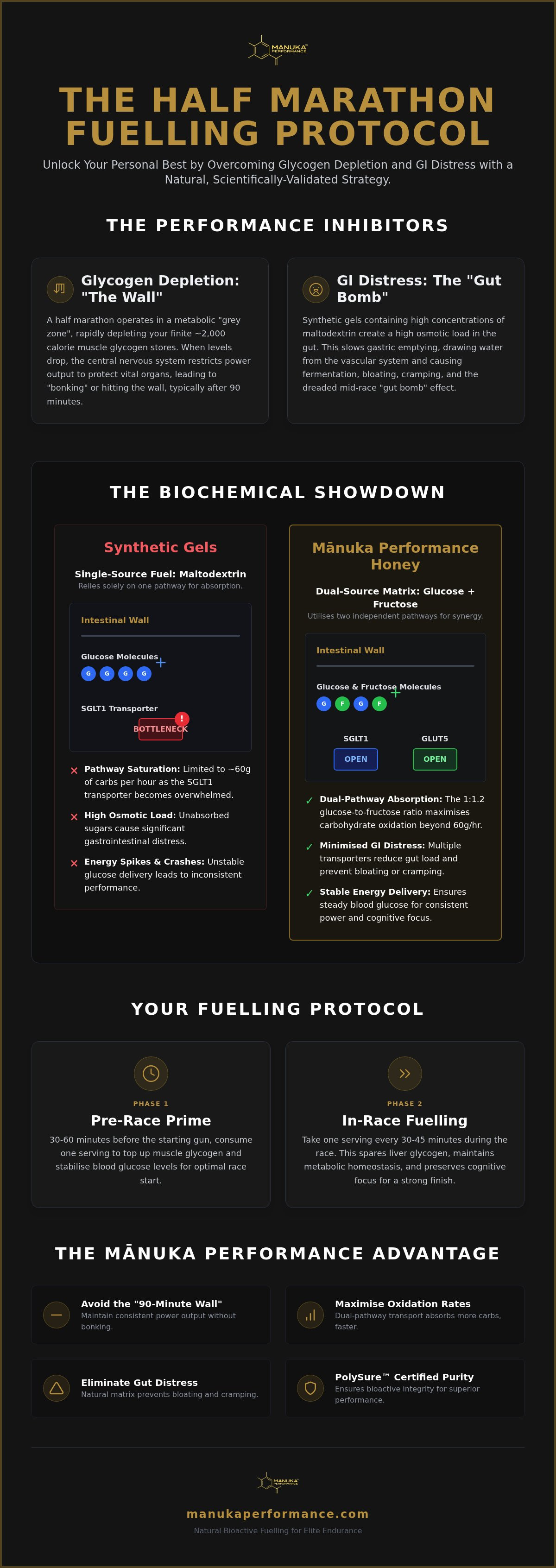
Many athletes attempt to mitigate depletion using synthetic gels, yet these formulations frequently induce gastrointestinal distress. High concentrations of maltodextrin create a significant osmotic load in the small intestine, drawing water from the vascular system and leading to the "gut bomb" effect. This high osmolality slows gastric emptying, leaving unabsorbed solutes to ferment and cause bloating or cramping. The search for a bioavailable alternative focuses on finding a matrix that matches the body's natural absorption capacity without triggering an inflammatory response. A sophisticated half marathon fueling strategy honey leverages a natural glucose-to-fructose ratio to bypass these common digestive bottlenecks, ensuring steady blood glucose stability without the systemic stress of synthetic thickeners.
A truly effective fuelling strategy is not a reactionary measure but a systemic approach to carbohydrate periodicity. It involves precise timing and the selection of materials that align with human biochemistry. By moving away from synthetic compounds and toward natural, enzymatically active matrices, runners can achieve a higher rate of carbohydrate oxidation. This transition ensures that power output remains consistent from the starting gun to the finishing tape, eliminating the risk of metabolic failure in the final stages of the race.
The Biochemistry of Honey: A Superior Matrix for Endurance
While conventional sports nutrition often classifies honey as a rudimentary sweetener, a sophisticated systematic review on honey for exercise suggests it functions as a complex bioactive matrix with unique ergogenic properties. The efficacy of a half marathon fueling strategy honey protocol relies on the precise biochemical arrangement of its carbohydrate constituents. Unlike isolated maltodextrin, which depends solely on the sodium-glucose linked transporter 1 (SGLT1) for intestinal uptake, honey provides a naturally occurring matrix of glucose and fructose. This dual-source composition is critical because the SGLT1 pathway becomes saturated at approximately 60 grams of glucose per hour, creating a physiological bottleneck that often results in gastrointestinal distress. By introducing fructose, which utilises the independent GLUT5 transporter, athletes can increase their total carbohydrate oxidation rates beyond the limitations of single-source sugars.
Dual-Pathway Absorption: Glucose vs. Fructose
The scientific advantage of honey lies in its specific 1:1.2 glucose-to-fructose ratio, a configuration that facilitates simultaneous absorption through distinct transport mechanisms. The synergy of the glucose-fructose matrix in honey ensures optimal intestinal transport by distributing the metabolic load across multiple absorption pathways, thereby maintaining systemic energy availability without compromising gastric comfort. This biochemical efficiency allows for a higher hourly intake of carbohydrates, ensuring that the glycogen sparing effect is maximised throughout the duration of the race.
The PolySure™ Difference: Beyond Simple Sugars
Polyphenols support metabolic resilience. They are frequently omitted from standard nutritional analyses. The PolySure™ analytical standard provides rigorous quantification of seven specific polyphenols to ensure consistent bioactive delivery in every sachet. Unlike generic "table honey" which lacks analytical validation, Mānuka Performance utilises these scientific standards to provide a reliable ergogenic aid. This level of precision is essential for competitive athletes who require a predictable physiological response from their nutrition.
The integration of these quantified bioactives with a dual-pathway carbohydrate system creates a superior nutritional platform for the competitive runner. By prioritising analytical validation over marketing claims, athletes can ensure their fueling strategy is grounded in biochemical reality. This methodical approach to a half marathon fueling strategy honey ensures that metabolic homeostasis is preserved, allowing the runner to maintain target intensity without the risk of systemic energy failure.
Honey vs. Synthetic Gels: Solving the Runners’ Stomach Issue
The transition from synthetic endurance fuels to a half marathon fueling strategy honey protocol is frequently motivated by the need to resolve chronic gastrointestinal distress. Synthetic gels typically utilise high concentrations of maltodextrin, a polysaccharide that, while effective for energy delivery, carries a high osmotic load. This chemical structure often draws significant volumes of water from the vascular system into the intestinal lumen, resulting in the "sloshing" sensation and bloating reported by many competitive runners. In contrast, honey possesses a more complex, naturally occurring carbohydrate profile that exhibits faster gastric transit times. Research into gastrointestinal resilience and avoiding runner’s stomach issues highlights that reducing industrialised additives is paramount for maintaining gut integrity during high-intensity efforts.
Honey’s enzymatic composition provides a distinct physiological advantage over synthetic alternatives. It contains active enzymes such as diastase and amylase, which initiate the breakdown of carbohydrate structures before they reach the lower digestive tract. This innate pre-digestion reduces the metabolic energy required for nutrient absorption, allowing the body to redirect blood flow more effectively to working skeletal muscles. Additionally, clean-label honey-based gels avoid the artificial preservatives and synthetic thickeners that often trigger systemic inflammation and exacerbate intestinal permeability under race-day stress. Many runners don't realise that this inflammatory response is a primary driver of mid-race performance decline.
Osmotic Pressure and Intestinal Comfort
Intestinal comfort depends on the osmolality of the ingested fuel relative to blood plasma. Synthetic gels are often hypertonic, meaning they exceed the body's natural osmotic balance and force the gut to work harder to process the solutes. Honey-based matrices, when consumed with appropriate water intake, behave in an isotonic-like manner. This characteristic facilitates rapid absorption through the intestinal wall, significantly reducing the risk of "the trots" or urgent bowel movements during the final five kilometres of a race. Maintaining this equilibrium is essential. It ensures pace sustainability without the distraction of abdominal cramping.
Bioavailability and Energy Spikes
The glycemic response to honey is characterised by stability rather than the jagged peaks associated with pure dextrose or maltodextrin. While synthetic sugars often trigger a rapid insulin surge followed by a hypoglycaemic crash, honey’s phytochemical profile supports a more sustained release of glucose into the bloodstream. Honey’s bioavailability prevents the insulin over-response often seen with pure dextrose by providing a controlled entry of carbohydrates into the systemic circulation. This steady delivery ensures that the half marathon fueling strategy honey remains effective for the duration of the 21.1-kilometre distance, providing the metabolic fuel necessary for a strong finishing kick.
The implementation of a half marathon fueling strategy honey protocol requires a transition from general endurance principles to precise metabolic quantification. Runners typically require between 30 and 60 grams of carbohydrates per hour to maintain target power output and prevent the premature activation of fatigue-induced downregulation. By adopting a systemic approach to carbohydrate periodicity, athletes can ensure that exogenous glucose and fructose are available for oxidation at the exact moment internal glycogen stores begin to reach a critical threshold. This methodical framework eliminates the variability of "winging it" and provides a reliable physiological basis for sustained performance across the 21.1-kilometre distance.
Pre-Race and Early Stage Fuelling (0–7km)
The "Pre-Race Prime" serves as a critical insurance policy for the second half of the race. Consuming a single honey-based gel approximately 15 minutes before the starting gun allows for the saturation of liver glycogen stores without triggering an excessive insulin response. This early intake facilitates a smoother psychological transition from the start line to race rhythm, ensuring that the central nervous system remains adequately fuelled during the initial high-intensity surge. Establishing this baseline early reduces the metabolic stress encountered during the first seven kilometres, allowing the body to preserve its finite muscle glycogen for the more demanding later stages of the competition.
Mid-Race Execution (7km–15km)
Maintaining a consistent "drip-feed" of carbohydrates is essential for preventing blood glucose dips that lead to cognitive fatigue and pace deceleration. The 7km and 14km markers represent strategic periodicity points for the honey-based gel user, aligning with the typical absorption window required for dual-pathway transport. Taking fuel before the onset of fatigue is a clinical necessity. It ensures that the metabolic machinery has sufficient time to process the glucose-fructose matrix before systemic depletion occurs. Consuming gels at race pace requires a practiced technique to maintain breathing rhythm, ensuring that the intake of bioavailable energy doesn't disrupt neuromuscular coordination.
The Final Push (15km–Finish)
As the athlete enters the final six kilometres, the focus shifts to maintaining mental clarity and systemic power. While many rely on a "Caffeine Kick", the "Bioactive Surge" provided by quantified polyphenols in honey supports sustained cognitive function without the jittery side effects of high-stimulant alternatives. Handling the late-race "Refusal to Fuel" phase requires a cognitive commitment to the protocol, as the brain often signals satiety despite ongoing glycogen requirements. This race-day execution should be viewed as the culmination of a broader carbohydrate loading plan for endurance athletes, ensuring that every stage of the 21.1km distance is backed by rigorous nutritional science.
To ensure optimal intestinal transport and maintain osmotic equilibrium, each 45g honey sachet requires the co-ingestion of approximately 150 to 200 millilitres of water. This hydration synergy prevents the concentration of solutes in the gut and facilitates rapid systemic delivery. You can optimise your race-day periodicity by integrating these scientifically validated protocols into your training programme, ensuring that your fuelling strategy is as refined as your physical conditioning.
The practical application of a half marathon fueling strategy honey protocol culminates in the selection of an ergogenic aid that aligns with the biochemical requirements of high-intensity endurance. Mānuka Performance LiquidFuel 10-Packs are engineered specifically to provide the precise glucose-to-fructose ratio necessary for dual-pathway absorption during the 21.1-kilometre distance. Unlike bulk containers or generic honey, these sachets provide a quantified dosage of carbohydrates in a format that remains stable under the physiological stress of race-pace efforts. The integration of the PolySure™ standard ensures that every sachet delivers a consistent profile of seven naturally occurring polyphenols, providing competitive athletes with the analytical validation required for elite-level performance.
Why LiquidFuel is the Professional Choice
For Australian athletes prioritising systemic purity, the clean-label, New Zealand-made provenance of LiquidFuel offers a distinct advantage over industrialised alternatives. The honey-based matrix is inherently more bioavailable than synthetic thickeners, meaning it doesn't require the ingestion of excessive water volumes to process. This reduced osmotic burden is critical for maintaining gastric comfort when the heart rate is elevated. Additionally, the natural flavour profile of the Mānuka honey matrix prevents the "palette fatigue" often associated with the cloying, artificial sweeteners found in traditional gels. This allows for consistent intake during the final stages of a race when sensory aversion often leads to under-fuelling.
Integrating LiquidFuel into Your Training Block
Success on race day is contingent upon a rigorous "Test and Learn" phase conducted during your training block. Sunday long runs serve as the ideal environment to practice your half marathon fueling strategy honey protocol, allowing the digestive system to adapt to the natural carbohydrate matrix. Building "gut trained" resilience ensures that the SGLT1 and GLUT5 transporters are optimised for maximum throughput under load. This consistent use of natural matrices during training eliminates the risk of unexpected gastrointestinal responses on the starting line. Before your next event, ensure your logistics are as refined as your physiology.
- Carry three LiquidFuel sachets: one for the "Pre-Race Prime" and two for the 7km and 14km periodicity points.
- Store sachets in an accessible race belt or pocket to ensure intake doesn't disrupt your mechanical efficiency.
- Practise opening and consuming the gel at race intensity to master the coordination required without breaking your stride.
Refining your nutritional periodicity is a clinical necessity for those seeking a personal best. You can Organise your race nutrition with Mānuka Performance LiquidFuel to ensure your metabolic requirements are met with pharmaceutical-grade precision and natural integrity.
Advancing Beyond Synthetic Limitations
Transitioning to a scientifically validated half marathon fueling strategy honey protocol represents a shift from reactive supplementation to proactive metabolic management. By prioritising the natural 1:1.2 glucose-to-fructose matrix, runners can bypass the physiological bottlenecks of synthetic maltodextrin. The integration of PolySure™ Validated Bioactives ensures that every effort is supported by rigorous analytical standards rather than anecdotal evidence. This approach has become the Australian/NZ runner approved benchmark for those seeking gastrointestinal resilience without compromising on power output.
The evidence suggests that natural matrices are not only gentle on the stomach but also hard on the pace. Consistently applying these principles during your training block will ensure that your glycogen management is as precise as your pacing strategy. You've done the hard work in training; now it's time to ensure your nutrition is of the same high calibre. Master your race day fuelling with LiquidFuel Energy Gels and experience the difference of clinical-grade natural performance. Your next personal best is within reach.
Frequently Asked Questions
How much honey should I take during a half marathon?
Athletes should aim for 30 to 60 grams of carbohydrates per hour. This typically equates to one LiquidFuel sachet every 45 to 60 minutes, depending on individual sweat rates and intensity. Implementing a half marathon fueling strategy honey protocol ensures that you maintain glycogen stores throughout the 21.1-kilometre distance. Consistent intake prevents the sudden power drop-off often associated with late-race depletion, allowing for a more sustained effort during the final kilometres.
Is honey better than synthetic gels for preventing runners stomach?
Honey offers a significant advantage due to its lower osmotic load compared to synthetic maltodextrin. Synthetic gels often draw water into the gut, leading to bloating or "sloshing". The natural glucose-fructose matrix in LiquidFuel is more bioavailable, facilitating rapid absorption through dual-pathway transporters. This reduced systemic stress is essential for maintaining gastrointestinal resilience, ensuring you don't face the common issues of cramping or urgent bowel movements during high-intensity efforts.
When should I take my first honey gel during a race?
You should consume your first honey gel approximately 15 minutes before the starting gun. This "Pre-Race Prime" tops up liver glycogen and prepares the metabolic pathways for the upcoming exertion. Subsequent fuelling should occur at the 7km and 14km markers. Taking fuel early is a strategic insurance policy. It ensures that the body has processed the carbohydrates before internal stores reach a critical threshold, preventing mid-race deceleration and cognitive fatigue.
Do I need to drink water when consuming a honey-based energy gel?
Yes, co-ingesting water is a clinical necessity for optimal absorption. Consuming approximately 150 to 200 millilitres of water with each sachet ensures the mixture behaves in an isotonic-like manner within the digestive tract. This practice facilitates faster gastric emptying and prevents the concentration of solutes that can cause intestinal discomfort. Without adequate water, the transit time of the carbohydrates increases, potentially delaying the ergogenic benefits when you need them most during the race.
Can I use raw table honey instead of a performance honey gel?
Raw table honey lacks the analytical validation required for competitive athletics. While it contains natural sugars, it hasn't been tested for consistent bioactive levels or batch-tested for WADA-prohibited substances. Mānuka Performance products are validated by the PolySure™ standard to ensure a reliable concentration of seven specific polyphenols. Additionally, performance gels are engineered for a specific viscosity, making them far easier to swallow and digest while running at high intensity or race pace.
Will honey cause a blood sugar crash during a long run?
Honey is unlikely to cause a hypoglycaemic crash due to its balanced glycemic response. Because it contains both glucose and fructose, it provides a steady release of energy rather than the jagged spike and subsequent insulin over-response seen with pure dextrose. This dual-source delivery maintains stable blood glucose levels throughout your effort. It ensures that the half marathon fueling strategy honey remains effective, providing a reliable stream of fuel to working muscles and the brain.
How many grams of carbohydrates are in a Mānuka Performance gel?
Each 45-gram LiquidFuel sachet provides approximately 30 grams of carbohydrates. This dosage is precisely calibrated to meet the upper end of the hourly requirement when consumed in accordance with the recommended periodicity. The New Zealand honey-based matrix ensures that these carbohydrates are delivered alongside quantified bioactives. This combination supports metabolic homeostasis, providing a more sophisticated energy source than simple sugar alternatives that lack analytical validation or the clean-label integrity required by professional athletes.
Should I use honey if I am running a half marathon in under 90 minutes?
Yes, even sub-90 minute runners benefit from exogenous carbohydrate intake. While your internal stores may last the duration, supplementing with honey spares muscle glycogen for the final high-intensity surge. It also provides the glucose necessary to maintain cognitive focus and neuromuscular coordination as fatigue sets in. Taking a gel at the 10km mark can provide the mental clarity and physical power needed to maintain your target pace through the challenging final five kilometres.