


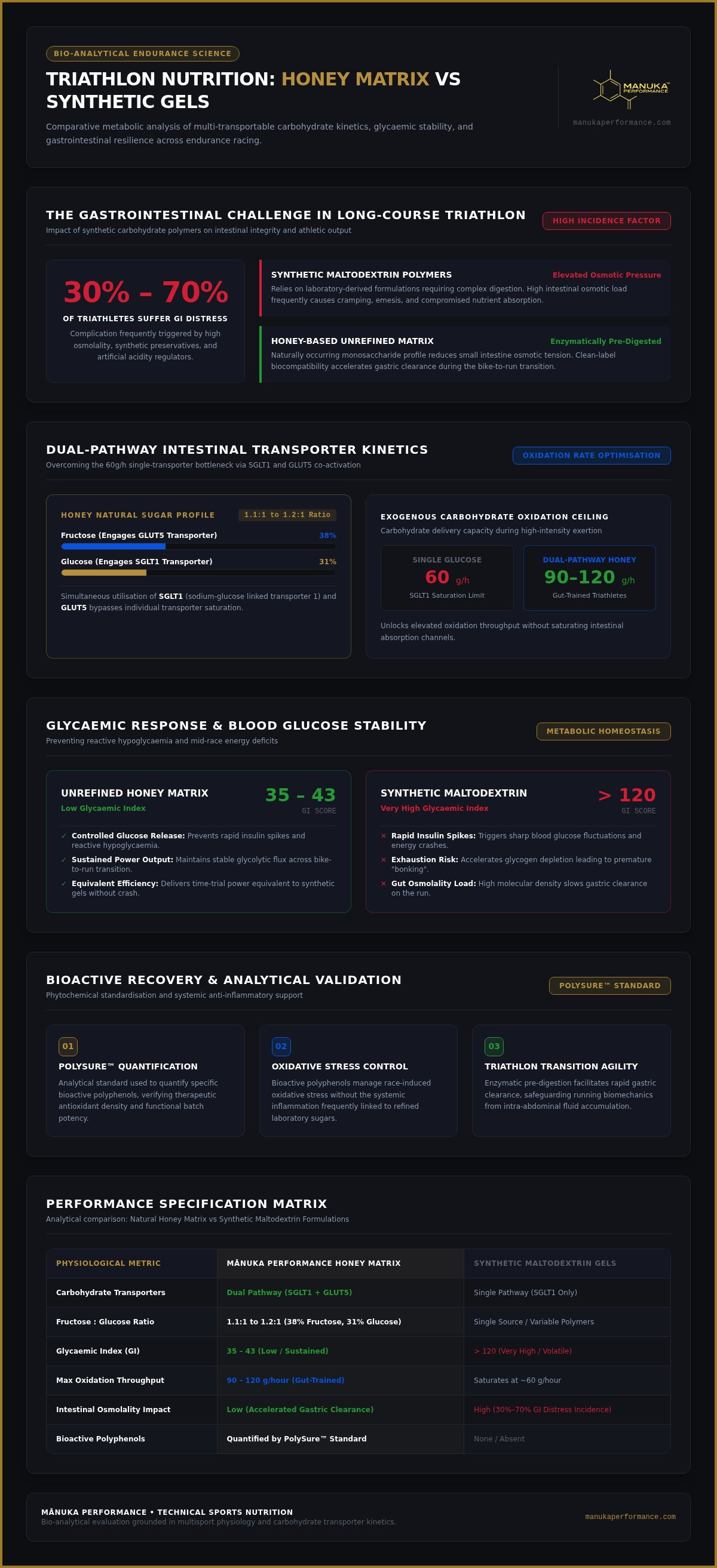
Research indicates that up to 70% of long-distance triathletes suffer from gastrointestinal distress during competition, a physiological complication frequently attributed to the high osmolality and complex digestion requirements of synthetic maltodextrin polymers. Many endurance specialists remain tethered to these laboratory-derived formulas despite chronic gastric instability, primarily due to a perceived lack of rigorous, data-driven alternatives that can match the metabolic demands of high-intensity racing. By shifting the focus toward a sophisticated framework for triathlon nutrition honey, athletes can utilise a naturally occurring 1.1:1 fructose-to-glucose ratio that precisely aligns with dual-pathway intestinal transporters to optimise exogenous carbohydrate oxidation rates. This article provides a comprehensive bio-analytical evaluation of honey-based carbohydrate matrices, demonstrating how they maintain glycogen levels without the systemic inflammation often associated with refined sugars. We will examine the technical role of the PolySure™ analytical standard in quantifying bioactive polyphenols and explore how the enzymatic pre-digestion of honey facilitates superior gastric clearance during the critical transition from the bike to the run.
Key Takeaways
- Understand how the natural 1.1:1 glucose-to-fructose ratio in honey utilises dual-pathway absorption via SGLT1 and GLUT5 transporters to maximise exogenous carbohydrate oxidation during high-intensity exertion.
- Discover how the enzymatic pre-digestion of honey-based matrices facilitates accelerated gastric clearance, thereby mitigating the gastrointestinal distress frequently associated with synthetic maltodextrin polymers.
- Learn to implement a bio-analytically validated strategy for triathlon nutrition honey across various race distances to maintain homeostatic glycogen levels and prevent debilitating energy fluctuations.
- Recognise the critical role of the PolySure™ analytical standard in quantifying the specific bioactive polyphenols necessary for managing oxidative stress and supporting systemic recovery.
- Analyse the comparative performance data demonstrating that unrefined honey-based matrices provide sustained power output and time-trial efficiency equivalent to traditional synthetic energy gels.
The Biochemical Role of Carbohydrates in Triathlon Performance
Triathlon performance is fundamentally limited by the body’s capacity to manage glycolytic flux across three distinct metabolic environments. The swim leg requires a reliance on endogenous liver glycogen, while the bike and run segments necessitate a rigorous exogenous fueling strategy to offset the high rate of carbohydrate oxidation. When glycogen stores are exhausted, the physiological consequence is a catastrophic decline in power output and cognitive function, often termed "bonking." The efficiency of energy conversion during these phases isn't merely a matter of caloric volume. It's determined by the biochemical structure of the fuel. While many athletes rely on conventional energy gels, there's a growing analytical case for triathlon nutrition honey as a superior alternative. Unlike simple sugars, honey exists as a complex functional matrix containing a variety of saccharides and bioactive compounds that influence metabolic rate and gastric clearance.
The Glycaemic Index and Sustained Energy Release
The glycaemic response of a carbohydrate source dictates the stability of an athlete’s energy profile throughout the duration of an event. Honey typically possesses a glycaemic index (GI) between 35 and 43, whereas synthetic maltodextrin often exceeds 120. This lower GI profile is advantageous for triathletes who must avoid the insulin spikes that trigger rapid blood glucose fluctuations. A stable blood glucose level prevents the onset of reactive hypoglycaemia, ensuring that the athlete doesn't experience a debilitating energy deficit mid-race. By utilising a honey-based matrix, triathletes can achieve a more controlled release of energy, which is particularly vital during the cycling leg when the body is preparing for the metabolic transition to the run. Alongside a disciplined fueling strategy, choosing the right apparel for the swim is crucial for overall efficiency; you can explore Direct-to-Consumer Product Sales for performance swimwear from Ocean Motion Wear.
Gastrointestinal Resilience and Ingredient Purity
Gastrointestinal distress is a pervasive issue in long-course triathlon, affecting between 30% and 70% of participants. This instability is often exacerbated by the inclusion of artificial acidity regulators and synthetic preservatives in laboratory-formulated products. These additives can compromise the intestinal barrier, leading to systemic inflammation and reduced nutrient absorption. Clean-label formulations that prioritise ingredient purity are essential for maintaining gut integrity. For athletes focused on avoiding runners stomach issues, honey provides a biocompatible alternative that is naturally easier for the digestive system to process. Its unrefined state reduces the osmotic pressure within the small intestine, allowing for more efficient fluid and carbohydrate uptake without the risk of emesis or cramping.
The Science of the Glucose-Fructose Matrix in Honey
The efficacy of triathlon nutrition honey resides in its unrefined carbohydrate profile, which naturally provides a multi-transportable matrix of monosaccharides. While synthetic formulations often rely on a single-source glucose polymer, honey consists of approximately 38% fructose and 31% glucose, yielding a natural ratio of roughly 1.2:1. This specific molecular arrangement is critical for endurance athletes because the human small intestine employs distinct mechanisms for absorption. Glucose is transported across the intestinal wall via the sodium-glucose linked transporter 1 (SGLT1), while fructose utilises the facilitative GLUT5 transporter. By engaging both pathways simultaneously, triathletes can bypass the saturation limits of a single transporter, which typically occurs at 60 grams of glucose per hour, effectively increasing the total volume of fuel available for oxidation.
Optimising Carbohydrate Oxidation Rates
Pushing exogenous carbohydrate intake beyond the standard 60g/h threshold is essential for maintaining intensity during long-course events. Research published in a systematic review on honey and exercise performance indicates that dual-pathway absorption significantly increases total carbohydrate oxidation rates, sometimes reaching 90 to 120 grams per hour in gut-trained individuals. This increased flux is achieved without the high osmotic load associated with concentrated synthetic gels. Because honey is an enzymatically pre-digested matrix, it exerts less osmotic pressure on the gut lumen, facilitating fluid uptake and reducing the risk of hypertonic-induced nausea. For those seeking to refine their fueling protocols, exploring advanced biotech-driven nutrition can provide the analytical precision required for elite competition.
Metabolic Efficiency and ATP Production
The body's metabolic prioritisation of different sugar molecules allows for a more comprehensive energy strategy. While glucose is rapidly oxidised by working muscles, fructose is primarily metabolised in the liver, where it aids in the replenishment of hepatic glycogen stores. This division of metabolic labour ensures that blood glucose levels remain stable while liver reserves are preserved for late-stage race demands. The presence of maltose and complex oligosaccharides in honey further extends the energy delivery window, providing a staggered release that supports continuous ATP production. The glucose-fructose matrix in honey serves as a strategic performance tool that synchronises intestinal transport kinetics with systemic metabolic requirements.
Honey vs. Synthetic Energy Gels: A Performance Analysis
A rigorous comparative analysis between synthetic energy gels and honey-based matrices reveals a significant disparity in biochemical complexity and functional outcomes. Conventional gels are typically engineered using maltodextrin, a glucose polymer that provides rapid glycaemic flux but lacks the secondary metabolites necessary for holistic metabolic support. In contrast, triathlon nutrition honey offers a high-density nutrient profile that includes essential trace minerals such as potassium and magnesium, which are integral to neuromuscular signalling and fluid balance. The presence of the enzyme invertase in honey facilitates the immediate bioavailability of monosaccharides, which eliminates a biochemical step in the human gut and accelerates gastric clearance compared to synthetic long-chain polymers. A common misconception within the endurance community is that natural unrefined sources are 'too slow' for high-intensity racing. However, the efficacy of multiple transportable carbohydrates during exercise demonstrates that the specific glucose-to-fructose ratio in honey allows for oxidation rates that match or exceed those of synthetic standards. For a deeper technical breakdown, one should consider the evidence regarding do honey energy gels work in real-world competition scenarios.
Phytochemical Composition and Oxidative Stress
Synthetic gels are essentially 'empty' caloric vehicles, providing energy without modulating the physiological stress of ultra-endurance performance. Performance honey contains naturally occurring antioxidants, including phenolic acids and flavonoids, which serve as reactive oxygen species (ROS) scavengers. These compounds assist in managing the systemic load of a triathlon by reducing the oxidative damage to muscle tissues and vascular endothelia. By utilising a quantified standard like PolySure™, athletes can ensure they are receiving a consistent concentration of these bioactive ingredients, rather than relying on the variability of generic raw products. This analytical rigor transforms a simple natural source into a precise biotech solution that supports systemic recovery alongside immediate energy requirements.
Palatability and Flavour Fatigue
The psychological dimension of fueling is often overlooked until the final stages of the run leg, where flavour fatigue can lead to a complete cessation of intake. Artificial sweeteners and synthetic acidity regulators often create a cloying sweetness that becomes unpalatable under high metabolic stress. Honey-based gels provide a complex, natural flavour profile that maintains high compliance levels throughout an event. Integrating triathlon nutrition honey into a race plan allows for a more varied sensory experience, reducing the 'cloying' sensation associated with artificial sweeteners. The smooth, viscous texture of honey is also less likely to cause the throat irritation often reported with highly concentrated synthetic polymers, ensuring that the athlete continues to meet their hourly carbohydrate targets without sensory aversion.
Strategic Triathlon Fueling Protocols Using Honey
Transitioning from biochemical theory to field application requires a structured protocol that accounts for the varying metabolic intensities of different race distances. For athletes preparing for events ranging from Sprint to Ironman, the implementation of triathlon nutrition honey should begin well before the starting gun. A rigorous carbohydrate loading plan for endurance athletes involves utilising honey-based matrices in the 48 hours preceding competition to maximise hepatic and muscular glycogen saturation. During the race, maintaining an optimal electrolyte balance is equally critical. Effective formulations incorporate approximately 2% electrolyte salts to facilitate rapid fluid absorption and maintain neuromuscular function. For those seeking a validated solution, you can explore bioactive energy gels designed for high-performance requirements.
The Bike Leg: Maximising Carbohydrate Intake
The cycling segment represents the primary metabolic window where blood flow to the gut is relatively uncompromised, allowing for higher exogenous oxidation rates. Athletes should target an intake of 80 to 110 grams of carbohydrate per hour during this phase, potentially reaching 120 grams if gut-training protocols have been established. Utilising resealable 45g pouches allows for precise, incremental fueling that can be managed even while in an aerodynamic position. It's often effective to dilute honey-based gels into a bottle of water to create a natural hypotonic solution, which ensures a steady delivery of both glucose and fructose. Determining individual requirements involves assessing sweat rates and metabolic efficiency during training to ensure the fueling volume doesn't exceed the gut's absorption capacity.
The Run Leg: Maintenance and GI Stability
Splanchnic hypoperfusion and the mechanical agitation of running significantly decrease the gastrointestinal system's tolerance for concentrated fuels. To maintain a stable blood sugar profile without inducing nausea, triathletes should step down their hourly intake to between 50 and 80 grams. A "little and often" approach is essential here. Consuming small amounts of a honey-based gel every 15 to 20 minutes reduces the osmotic pull in the small intestine, preserving the integrity of the intestinal barrier. This strategy ensures that the transition from the bike to the run is seamless, preventing the insulin fluctuations that lead to late-stage fatigue. By relying on the naturally balanced saccharide profile of honey, athletes can sustain their pace through the final kilometres while avoiding the gastric distress common with synthetic alternatives.
Mānuka Performance and the PolySure™ Standard
The integration of triathlon nutrition honey into a competitive racing strategy requires more than a reliance on unrefined ingredients. It demands a rigorous analytical framework that can quantify the bioactive potential of the fuel. Mānuka Performance addresses this requirement through the PolySure™ standard, an ISO/IEC 17025 compliant framework designed to detect and measure seven specific, naturally occurring polyphenols. This level of quantification is essential for triathletes who require predictable metabolic outcomes from their nutrition. By utilising High-Performance Liquid Chromatography (HPLC), the PolySure™ standard moves beyond the vague "raw" claims prevalent in the market, establishing a biotech-led benchmark for functional sports nutrition. The New Zealand provenance of the honey is central to this potency, as the unique environmental conditions produce secondary metabolites like methylglyoxal (MGO) and leptosperin, which are absent in standard table honeys.
Leveraging LiquidFuel as a precision tool allows athletes to incorporate triathlon nutrition honey into their regimen with the confidence that every pouch meets stringent anti-doping and quality certifications. Each LiquidFuel 10-Pack provides a measured delivery system of 53% New Zealand Mānuka honey combined with green apple juice and three critical electrolyte salts. This formulation ensures that the carbohydrate matrix is supported by the necessary minerals to maintain fluid balance and neuromuscular function during the most demanding phases of a race. Holding official UMF™ Licence #2031 and being independently batch-tested for World Anti-Doping Agency (WADA) prohibited substances, these gels provide a level of security that is mandatory for professional and serious amateur competitors alike.
Bioactive Ingredients and Biotech Innovation
Shifting from synthetic standards to sports nutrition biotechnology represents a significant move toward systemic precision. Within the PolySure™ framework, the presence of specific phenolic acids and flavonoids, such as phenyllactic acid, gallic acid, and quercetin, is verified above the Limit of Quantification (LOQ). These compounds function as reactive oxygen species (ROS) scavengers, which are critical for modulating the oxidative stress and vascular endothelial damage incurred during long-distance events. This analytical rigor ensures that the athlete is receiving a clinical dose of phytochemicals designed to support physiological resilience, rather than a generic caloric supplement with variable efficacy.
The Future of Performance-Led Nutrition
The endurance market is evolving beyond simple carbohydrate delivery toward a model of comprehensive systemic support. Research-driven biotech solutions now prioritise the modulation of post-exercise inflammation and muscle tissue micro-trauma through the use of functional ingredients that offer measurable results. Mānuka Performance operates at this intersection of nature and advanced technology, providing a product that maintains the integrity of its source while delivering the quantified performance benefits demanded by elite sport. The PolySure™ standard ensures that every LiquidFuel gel contains a quantified concentration of bioactive compounds, providing metabolic consistency across every batch. This commitment to data and molecular verification defines the next generation of endurance fueling.
Advancing Endurance Performance Through Bio-Analytical Precision
The transition from synthetic carbohydrate polymers to a bio-analytically validated honey matrix represents a significant evolution in endurance strategy. By leveraging the natural 1.1:1 glucose-to-fructose ratio, athletes can maximise exogenous oxidation rates while preserving gastrointestinal integrity during high-intensity exertion. The implementation of the PolySure™ standard ensures that every batch provides a quantified concentration of bioactive polyphenols, offering a level of functional support that traditional energy gels simply cannot replicate. Adopting a structured approach to triathlon nutrition honey allows for stable blood glucose profiles and enhanced systemic recovery across all race disciplines. It's clear that moving beyond unrefined claims toward molecular verification is the key to sustained power output and long-term athletic health. This methodology bridges the gap between nature and clinical science, providing a precision tool for those competing at the highest levels. Optimise your fuelling with the LiquidFuel 10-Pack and PolySure™ validated gels. This biotech-driven methodology empowers triathletes to push their physiological limits with absolute confidence in their nutritional foundation.
Frequently Asked Questions
Is honey better than maltodextrin for triathlon racing?
Yes, in terms of metabolic efficiency and gastric tolerance. Honey provides a natural 1.1:1 glucose-to-fructose ratio, engaging dual-transport pathways like SGLT1 and GLUT5. This allows for higher oxidation rates and lower glycaemic variability compared to the high-GI spikes of maltodextrin. The presence of bioactive compounds also supports systemic recovery, making it a more comprehensive performance tool than isolated synthetic polymers, which often lack the phytochemical complexity needed for long-duration events.
How many honey-based gels should I consume during an Ironman?
Consumption depends on individual metabolic rates, but a baseline target is 60 to 90 grams of carbohydrate per hour. For an Ironman-distance event, this typically equates to approximately two LiquidFuel gels per hour on the bike and slightly less during the run. Precise fueling ensures glycogen saturation is maintained throughout the course while mitigating the risk of energy deficits. Athletes should test these volumes during training to ensure their gut is sufficiently trained for the distance.
Does honey cause more stomach issues than synthetic gels?
No, honey generally exhibits superior gastric tolerance because of its lower osmotic pressure and enzymatically pre-digested state. Synthetic gels often contain artificial regulators that can compromise the intestinal barrier. In contrast, the unrefined matrix of honey facilitates rapid gastric clearance. This is particularly beneficial for triathletes who must manage the mechanical agitation of the run leg without experiencing emesis or cramping. It provides a biocompatible fuel source that aligns with human digestive physiology.
Can I use raw honey instead of a dedicated sports gel?
Raw table honey lacks the analytical validation and electrolyte balance required for elite competition. While it contains carbohydrates, it doesn't offer the quantified polyphenol levels or the specific salt concentrations found in LiquidFuel. Dedicated sports gels are formulated for immediate intra-workout delivery. This ensures that the viscosity and nutrient density are optimised for rapid absorption under high metabolic stress, providing a more reliable outcome than unstandardised table products which may vary in composition.
What is the benefit of Mānuka honey specifically for athletes?
Mānuka honey contains unique secondary metabolites, such as methylglyoxal and leptosperin, which provide functional benefits beyond simple energy delivery. These compounds, alongside high concentrations of phenolic acids, serve as reactive oxygen species scavengers. This helps modulate the oxidative stress and systemic inflammation induced by long-distance racing. It supports vascular health and accelerates the recovery phase, making it a sophisticated biotech solution rather than just a natural sweetener for endurance athletes.
How does the PolySure™ standard impact my performance?
The PolySure™ standard ensures metabolic consistency by quantifying seven specific bioactive polyphenols in every batch. This analytical rigor allows triathletes to rely on a predictable concentration of phytochemicals that support physiological resilience. By removing the variability inherent in generic honey products, PolySure™ provides a precision biotech solution. It aligns with the data-driven requirements of professional endurance fueling protocols, ensuring that every gel delivers the same functional performance benefits throughout a competitive season.
When should I take my first honey gel during a triathlon?
Timing should be synchronised with the metabolic demands of the event, typically starting within the first 20 minutes of the bike leg. Because the swim leg is performed without exogenous fuel, immediate carbohydrate replenishment is necessary to stabilise blood glucose levels. Early intake of triathlon nutrition honey prevents the onset of glycogen depletion and ensures a stable energy profile. This proactive approach allows the body to maintain intensity during the critical transition to the run.
Is honey-based nutrition suitable for athletes with sensitive stomachs?
Honey is frequently the preferred choice for athletes prone to gastrointestinal distress. Its clean-label profile avoids the synthetic additives and concentrated maltodextrins that frequently trigger "runner's stomach." The naturally occurring enzymes in honey facilitate easier digestion, allowing for efficient carbohydrate uptake without the bloating or nausea associated with laboratory-derived fuels. This makes triathlon nutrition honey an ideal solution for maintaining performance in sensitive individuals who require high-density energy without the risk of gastric instability.