


For decades, conventional endurance protocols have treated the human digestive tract as little more than an unselective combustion chamber engineered to process refined, synthetic carbohydrates. Phytochemical sports nutrition represents a vital scientific evolution, moving athletic fuelling beyond inert caloric replenishment and into targeted, cellular metabolic support.
If you've experienced the debilitating gastrointestinal distress triggered by hyperosmolar, refined carbohydrate gels, or the compounding systemic inflammation that compromises day-to-day training consistency, you already know that caloric volume alone isn't enough. Endurance athletes have good reason to remain sceptical of generic formulations that promise botanical support without providing analytical compound validation or clear bio-efficacy.
In this guide, you'll discover how quantified phytochemicals and botanical bioactives transform sports nutrition from basic caloric replenishment into targeted cellular performance. We examine the molecular pathways governing polyphenol uptake during prolonged exertion, review the analytical standardisation required to eliminate natural compound variability, and demonstrate how to integrate validated botanical matrices seamlessly into your periodised training programme.
Key Takeaways
- Understand how phytochemical sports nutrition integrates bioactive secondary plant metabolites with functional carbohydrate matrices, moving athletic fuelling beyond inert calories into targeted cellular resilience.
- Examine how whole botanical bioactives act as hormetic triggers to upregulate endogenous antioxidant enzymes via the Nrf2 pathway, avoiding the blunting of training adaptations caused by isolated synthetic mega-doses.
- Identify the gastrointestinal and metabolic advantages of unrefined botanical matrices compared to conventional, stripped maltodextrin formulations.
- Learn evidence-based nutritional protocols to prime baseline cellular defence systems prior to exercise and sustain bioactive compound delivery during prolonged endurance output.
- Recognise the critical role of independent analytical standardisation in validating bioactive polyphenol density and eliminating natural agricultural batch variability.
What Is Phytochemical Sports Nutrition in Modern Athletics?
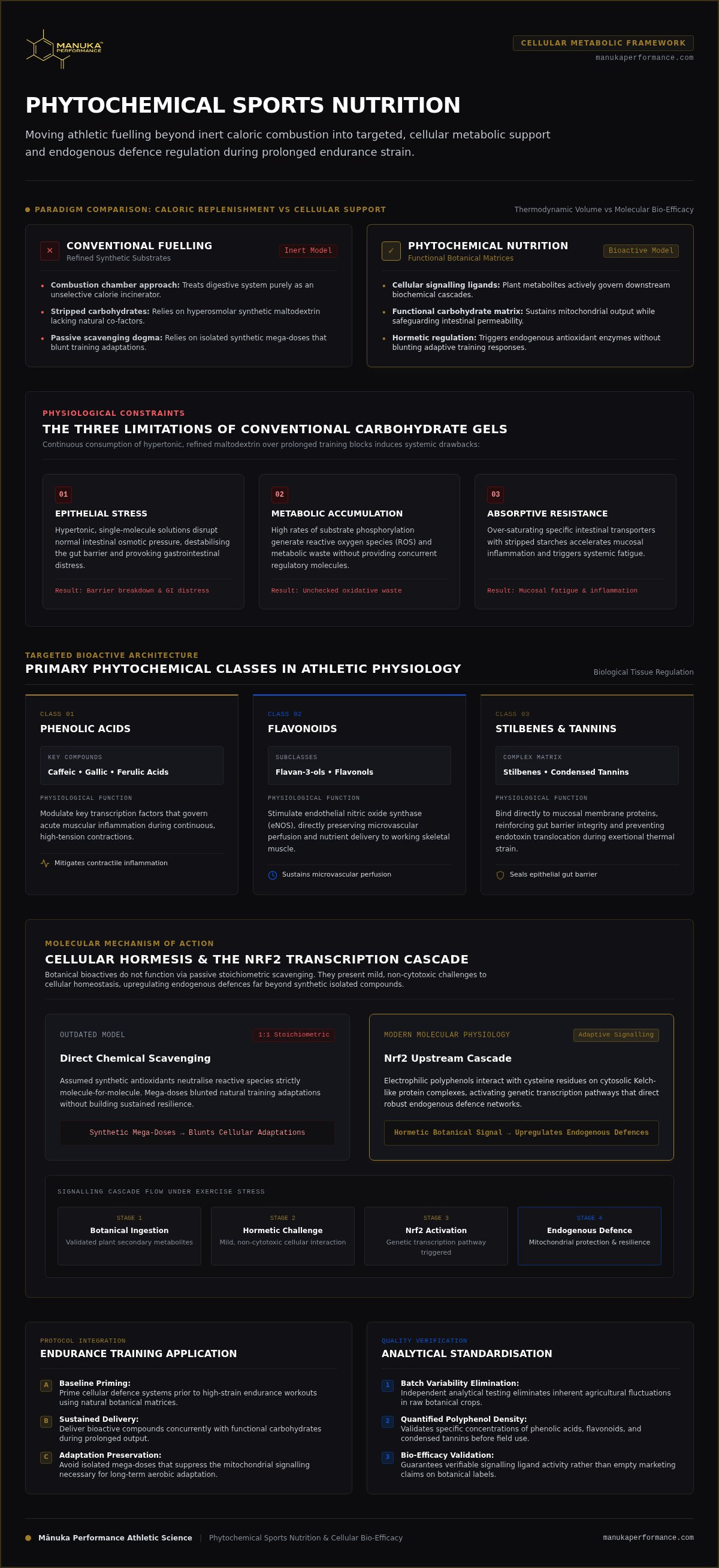
Traditional athletic conditioning frameworks treat intra-workout fuelling purely as a thermodynamic equation. Athletes calculate gross carbohydrate oxidation rates, match them to exogenous caloric intakes, and consume isolated saccharides to avoid systemic glycogen depletion. Phytochemical sports nutrition fundamentally updates this model. Rather than treating intra-workout nutrition as mere caloric replenishment, it integrates active secondary plant metabolites with functional carbohydrate substrates to govern cellular performance under extreme physical stress.
When investigating what are phytochemicals within an athletic framework, we find they aren't inert nutrients or simple antioxidant scavengers. They function as active signalling ligands that modulate biochemical cascades. While traditional endurance matrices rely on stripped, single-dimension carbohydrates like synthetic maltodextrin, botanical formulations provide functional bioactive density. These plant compounds stimulate cellular defence networks, effectively protecting mitochondrial architecture while muscle fibres sustain prolonged glycolytic output.
The Limitations of Inert Macronutrient Fuel
Conventional carbohydrate gels supply isolated, hypertonic sugars devoid of functional co-factors. Continuous consumption of refined maltodextrin over multi-hour training blocks presents severe physiological drawbacks:
- Epithelial stress: Hypertonic, single-molecule solutions alter intestinal osmotic pressure, compromising the gut barrier and provoking gastrointestinal distress.
- Metabolic accumulation: High rates of substrate phosphorylation generate reactive oxygen species and metabolic waste products without providing concurrent regulatory molecules.
- Absorptive resistance: Over-saturating specific intestinal transporters with synthetic starches accelerates mucosal inflammation and systemic fatigue.
Primary Phytochemical Classes in Athletic Physiology
Integrating targeted botanical bioactives creates distinct regulatory responses across stressed biological tissues:
- Phenolic acids: Compounds such as caffeic, gallic, and ferulic acids modulate transcription factors controlling acute muscular inflammation during high-tension contractions.
- Flavonoids: Subclasses including flavan-3-ols and flavonols stimulate endothelial nitric oxide synthase, preserving microvascular perfusion and nutrient delivery to working skeletal muscle.
- Stilbenes and condensed tannins: These complex polyphenols bind to mucosal membrane proteins, reinforcing gut barrier integrity and preventing endotoxin translocation during exertional thermal strain.
This targeted molecular regulation underpins the efficacy of phytochemical sports nutrition. By delivering verified plant bioactives within a supportive carbohydrate matrix, athletes can support cellular integrity during continuous, high-intensity endurance bouts.
Mechanisms of Action: How Botanical Bioactives Regulate Exercise Stress
Early nutritional models assumed that plant antioxidants operated through simple, direct chemical scavenging, neutralising reactive oxygen and nitrogen species on a stoichiometric, one-to-one basis. Modern molecular exercise physiology shows this assumption was incorrect. Secondary plant metabolites function primarily through cellular hormesis. By presenting mild, non-cytotoxic challenges to cellular homeostasis, low concentrations of botanical bioactives activate upstream genetic transcription pathways that direct endogenous defence networks far more effectively than passive antioxidant molecules ever could.
This biological cascade redefines the scope of phytochemical sports nutrition. Instead of merely blunting oxidative by-products, bioactive compounds prime cellular structures against the cumulative metabolic strain of sustained, high-intensity endurance output.
Endogenous Antioxidant Upregulation and the Nrf2 Cascade
Electrophilic polyphenols interact directly with cysteine residues on the cytosolic Kelch-like ECH-associated protein 1 (Keap1). Under resting conditions, Keap1 targets nuclear factor erythroid 2-related factor 2 (Nrf2) for proteasomal degradation. Botanical bioactives modify these critical thiol groups, triggering Keap1 dissociation and allowing Nrf2 to translocate into the cell nucleus.
Once inside the nucleus, Nrf2 binds to the Antioxidant Response Element (ARE) in promoter regions of target genes. This transcriptomic activation dramatically upregulates native protective enzymes:
- Superoxide dismutase (SOD): Catalyses the dismutation of superoxide radicals into molecular oxygen and hydrogen peroxide.
- Glutathione peroxidase (GPx): Reduces organic hydroperoxides and hydrogen peroxide into water, protecting mitochondrial membranes.
- Catalase (CAT): Accelerates the decomposition of high-volume cellular peroxides generated by intense respiratory chain activity.
Vascular Function and Exercise Perfusion
Botanical bioactives play a crucial role in maintaining peripheral perfusion during sustained aerobic workloads. Circulating flavonoid metabolites directly protect vascular endothelial cells from superoxide-mediated degradation of nitric oxide. By preserving endogenous nitric oxide bioavailability and upregulating endothelial nitric oxide synthase (eNOS) transcription, these compounds facilitate coordinated microvascular dilation. Skeletal capillary beds receive continuous, steady oxygenation, mitigating peripheral vascular resistance and lowering cardiovascular strain during protracted racing efforts.
Intestinal Barrier Protection During Heat and Hypoxia
High-intensity locomotion diverts systemic cardiac output away from the splanchnic circulation toward working skeletal muscle and peripheral skin beds. This exercise-induced splanchnic hypoperfusion leads to severe intestinal ischaemia followed by rapid reperfusion upon pace reduction, generating acute mucosal oxidative stress. Enterocyte membranes sustain damage, tight junctions uncouple, and bacterial lipopolysaccharides leak into the systemic bloodstream, provoking acute systemic inflammation.
Dietary polyphenols strengthen these fragile intestinal junctions by promoting the expression of zonula occludens-1 (ZO-1) and occludin proteins. This targeted support forms an essential part of avoiding runners stomach issues under harsh environmental loads. Athletes seeking verified cellular support can explore the bioactive formulations developed by Mānuka Performance, which pair resilient unrefined natural carbohydrate carriers with analytically validated botanical compounds.
Whole Botanical Matrices Versus Isolated Synthetic Compounds
A persistent fallacy in athletic recovery involves the assumption that if low levels of cellular protection are beneficial, isolated mega-doses must be superior. Early sports formulations attempted to counter exertional stress by packing products with synthetic, isolated vitamins. Contemporary clinical investigations show this reductionist strategy misinterprets basic cellular signalling. Whole botanical matrices deliver diverse polyphenols at physiologically coherent levels, operating in distinct biological harmony compared to purified laboratory isolates.
When evaluating advances in sports nutrition biotechnology, the functional difference between these two paradigms becomes obvious. Isolated synthetic compounds bypass endogenous regulatory gates. Natural botanical complexes provide balanced molecular arrays that protect working muscle while preserving the fundamental biochemical adaptations stimulated by hard exercise.
The Molecular Synergism of Carbohydrates and Polyphenols
Natural carbohydrates do far more than supply gross caloric energy. Within unrefined plant complexes, mono- and disaccharide networks serve as natural transport vehicles for bound phenolic compounds. Simultaneous presentation of glucose and fructose accesses distinct intestinal transporters, primarily sodium-glucose linked transporter 1 (SGLT1) and glucose transporter 5 (GLUT5). This multi-pathway transit enhances passive and active absorption of associated phytochemicals across the brush border membrane.
Unrefined carbohydrate substrates also create a protective physicochemical envelope. By buffering botanical bioactives against acidic degradation during gastric transit, the matrix ensures that delicate phenolic glycosides reach the small intestine intact, where cellular absorption occurs.
The Blunting Paradox of Mega-Dose Vitamin Supplements
Synthetic mega-dosing carries well-documented physiological risks for developing athletes:
- Transcriptional suppression: Chronic high-dose synthetic vitamin C and vitamin E quenches the transient reactive oxygen species bursts required to activate peroxisome proliferator-activated receptor gamma coactivator 1-alpha (PGC-1α).
- Arrested mitochondrial biogenesis: Without normal PGC-1α signalling, skeletal muscle cells fail to synthesise new mitochondrial networks, stalling aerobic ceiling gains.
- Blunted vascular remodelling: Total eradication of exercise-induced oxidative signalling impairs systemic angiogenesis and capillarisation around active motor units.
Phytochemical sports nutrition sidesteps this paradox entirely. Whole plant matrices deliver moderate, hormetic compound concentrations that strengthen cellular resilience during hard bouts without switching off adaptive training signals.
Protocol Design: Integrating Phytochemicals into Endurance Training
Translating molecular findings into practical athletic performance demands precise temporal staging. Phytochemical sports nutrition doesn't rely on random botanical consumption; it requires deliberate alignment with your training demands to support vascular tone, protect mucosal integrity, and accelerate post-exertional recovery without blunting adaptive training signals.
Pre-Exertional and Intra-Workout Bioactive Delivery
Baseline nutritional priming begins 30 to 45 minutes prior to scheduled exertion. Ingesting an unrefined botanical carbohydrate complex during this pre-workout window establishes circulating levels of phenolic co-factors before blood flow shifts away from the splanchnic circulation.
During sustained cardiovascular output, maintain a consistent fuelling schedule:
- Target intake: Deliver 30 to 60 grams of botanical carbohydrates per hour, divided into measured doses every 20 to 30 minutes.
- Fluid co-ingestion: Consume approximately 125 to 150 ml of water with each portion to preserve lumen isotonicity and accelerate gastric emptying.
- Periodised integration: Align this peri-workout intake with your wider strategic carbohydrate loading protocols during heavy preparatory microcycles to train gastrointestinal tolerance under load.
Post-Exertional Phase: Balancing Adaptation and Repair
Immediate post-exercise physiology requires targeted restraint. High-intensity sessions trigger necessary reactive species cascades that drive transcriptional adaptations. Saturating tissues with concentrated recovery agents right at the finish line can truncate these native signals.
Instead, delay secondary polyphenol intake until 60 to 90 minutes post-session. Delivering whole-food phytochemical nutrition alongside essential recovery amino acids during this delayed window helps attenuate secondary inflammatory cascades and mitigates delayed-onset muscle soreness, all while letting primary mitochondrial signalling complete undisturbed. For endurance athletes also seeking quality-assured baseline nutrition and daily wellness support, learn more about selecting reputable dietary supplements.
Biomarker Tracking for Tolerance and Adaptation
Athletes should monitor objective and subjective metrics to validate systemic compound tolerance across protracted training blocks:
- Autonomic status: Morning resting heart rate variability (HRV) trends provide direct insight into central nervous system recovery and systemic stress modulation.
- Gastrointestinal response: Track transit time, abdominal bloating, and stool consistency during multi-hour running sessions.
- Structural recovery: Monitor the duration of functional muscle soreness following severe eccentric stress, noting any reduction in multi-day recovery curves.
- Endocrine balance: Monitor systemic fatigue and hormone profiles, as heavy endurance volume can suppress anabolic signalling; for athletes seeking natural recovery support, NaturalTestoMan focuses on aiding the body's endogenous testosterone production without synthetic hormones.
To implement this cellular strategy on race day, integrate verified botanical formulations from Mānuka Performance to secure dual-pathway carbohydrates alongside standardised natural bioactives.
Analytical Standardisation: Validating Bioactive Compounds in Field Fuel
The principal critique levelled against natural sports nutrition targets compound inconsistency. Agricultural inputs naturally fluctuate based on rainfall, soil composition, and seasonal sunlight. Raw plant derivatives without molecular verification cannot guarantee predictable physiological responses in competitive sport. High thermal processing during industrial manufacturing frequently denatures fragile secondary metabolites, turning promising botanical inputs into biologically inert sugar syrups.
Determining whether natural honey-based energy gels deliver genuine cellular utility demands empirical batch analytics. Without chromatographic verification, claims regarding botanical bioactivity remain purely theoretical.
The Problem of Botanical Compositional Variance
Commercial plant extracts and crude apicultural products exhibit massive chemical variance. Uncontrolled batch variation creates distinct vulnerabilities for competitive athletes:
- Thermal denaturing: Standard industrial flash-pasteurisation degrades delicate phenylpropanoids, leaving simple carbohydrate calories stripped of functional co-factors.
- Dosage unpredictability: Secondary metabolite density fluctuates across agricultural harvests, producing unmeasured and variable biological stimulus per serving.
- Substrate dilution: Commercial syrups frequently cut raw botanical bases with cheap high-fructose corn syrups, eliminating the matrix structures that support cellular transport.
The PolySure™ Analytical Quantification Standard
To transition plant-based formulations into reliable athletic protocols, bio-analytical standardisation is essential. Mānuka Performance established the PolySure™ analytical protocol to resolve natural compositional variance.
Using independent high-performance liquid chromatography (HPLC) testing, this testing regime validates the presence and concentration of seven naturally occurring polyphenols within finished product batches. This laboratory validation confirms that bioactive compounds survive packaging intact, providing reliable bioactive density across every racing unit. It merges authentic, unrefined New Zealand honey matrices with pharmaceutical-grade molecular analytical precision.
Selecting Validated Phytochemical Formulations
Athletes seeking genuine physiological resilience must demand empirical compound verification. True phytochemical sports nutrition requires verifiable batch analytics rather than broad marketing claims.
When selecting botanical performance fuel, evaluate the following analytical criteria:
- Chromatographic verification: Confirm that finished batches undergo independent HPLC testing to quantify active phenolic compounds.
- Processing temperature limits: Ensure processing protocols preserve native enzyme structures and avoid destructive high-heat pasteurisation.
- Formulation purity: Select matrices free from synthetic preservatives, artificial colours, and refined industrial starches.
By relying on verified molecular standards, athletes using formulations from Mānuka Performance can integrate unrefined carbohydrate matrices with full confidence in their standardised bioactive density.
Advancing Beyond Caloric Replacement to Cellular Resilience
Endurance performance has evolved beyond the crude ingestion of stripped, synthetic starches. Adopting phytochemical sports nutrition bridges the historical gap between energetic fuelling and cellular defence, delivering hormetic plant bioactives that protect mitochondrial integrity, support microvascular blood flow, and preserve intestinal epithelial barriers during prolonged physical strain.
Rather than relying on unmeasured raw extracts or synthetic mega-doses that blunt muscular adaptations, modern athletic protocols demand exact molecular verification. Clean-label formulations engineered without synthetic maltodextrin utilise an unrefined New Zealand functional honey carbohydrate matrix to provide dual-pathway fuel while safeguarding sensitive compounds through the digestive tract. Through the PolySure™ analytical protocol, which validates seven distinct polyphenols via high-performance liquid chromatography, athletes can eliminate agricultural inconsistency and fuel their bodies with repeatable bio-analytical precision.
Explore Analytically Validated Botanical Sports Fuel and discover how quantified plant metabolites can elevate your cellular conditioning across every training cycle.
Frequently Asked Questions
What is the primary difference between phytochemical sports nutrition and traditional energy gels?
Traditional energy gels rely exclusively on isolated, refined starches like synthetic maltodextrin to deliver rapid caloric energy, whereas phytochemical sports nutrition integrates functional secondary plant metabolites with unrefined carbohydrate matrices. This combination provides both dual-pathway glycolytic fuel and targeted cellular protection. Instead of merely saturating intestinal glucose transporters, bioactive botanical complexes deliver phenolic signalling molecules that actively regulate cellular oxidative stress during sustained exertion.
Can high doses of phytochemicals or antioxidants blunt training adaptations in endurance athletes?
Yes, isolated mega-doses of synthetic antioxidants can blunt critical endurance adaptations by eliminating the physiological reactive oxygen species required for cellular signalling. When athletes consume excessive synthetic vitamins, they suppress PGC-1α transcription, impairing mitochondrial biogenesis and microvascular remodelling. Conversely, whole botanical matrices provide physiologically coherent, lower-concentration polyphenol arrays. These natural complexes stimulate endogenous cellular resilience via hormetic pathways without suppressing the exercise-induced stimuli needed for long-term conditioning gains.
How do plant polyphenols protect the gastrointestinal tract during intense running?
Plant polyphenols preserve intestinal barrier integrity by upregulating the expression of tight junction proteins, specifically zonula occludens-1 and occludin. During prolonged running, splanchnic hypoperfusion restricts blood flow to the digestive tract, inducing mucosal ischaemia and enterocyte hyperpermeability. Dietary bioactives mitigate this ischaemic stress, preventing luminal endotoxins like bacterial lipopolysaccharides from translocating into systemic circulation. This biochemical reinforcement dramatically reduces mucosal inflammation, cramping, and acute exertional gastrointestinal distress.
Which specific phytochemical classes are most beneficial for endurance exercise performance?
Phenolic acids and flavonoids represent the two most functionally impactful phytochemical classes for endurance athletes. Phenolic acids modulate transcription factors controlling acute cellular strain during high-intensity muscle contractions. Flavonoids, including specific flavan-3-ols and flavonols, enhance endogenous nitric oxide bioavailability and activate endothelial nitric oxide synthase. This biological action maintains capillary perfusion across working muscle beds, improving peripheral oxygen distribution while reducing cardiac strain during sustained submaximal cardiovascular efforts.
Is raw table honey sufficient to provide performance-grade phytochemical sports nutrition?
Raw table honey is neither formulated for athletic performance nor analytical consistency, making it unsuitable for rigorous phytochemical sports nutrition protocols. Crude commercial honey varies wildly in sugar ratios, moisture content, and phenolic density depending on floral origin and seasonal harvest conditions. Performance-grade formulations utilise specialised, unrefined functional honey matrices that undergo bio-analytical validation to guarantee exact rheological viscosity, dual-pathway carbohydrate ratios, and measurable, non-denatured polyphenol concentrations across every competitive serving.
How does the PolySure™ analytical standard verify bioactive compound content in sports nutrition?
The PolySure™ analytical standard utilises independent high-performance liquid chromatography testing to quantify seven distinct, naturally occurring polyphenols within finished product matrices. Rather than relying on speculative claims derived from raw agricultural inputs, this rigorous protocol verifies that fragile secondary metabolites have survived packaging and processing without thermal degradation. It provides athletes with verifiable data regarding batch-specific bioactive density, ensuring reliable physiological support and compound consistency in every packet.
What is the ideal timing for consuming phytochemical-rich sports fuel during endurance events?
Athletes should establish baseline systemic bioavailability by ingesting a quantified botanical formulation 30 to 45 minutes prior to exercise. During sustained competition, consume 30 to 60 grams of botanical carbohydrates hourly, divided into 20-to-30-minute intervals alongside adequate water to preserve gut isotonicity. Post-workout bioactive fuel should follow 60 to 90 minutes after finishing, allowing immediate adaptive reactive oxygen cascades to run their course before delivering restorative polyphenols for tissue recovery.