


A running belt isn’t the only way to keep fuel within reach. If belts feel restrictive or you’d rather leave the extra kit at home, figuring out how to carry running gels without a belt can be less straightforward. A gel that bounces, slips out or sits beyond easy reach is little use mid-run. Pockets that seem suitable while you’re standing still may behave differently once you’re moving.
The right setup depends on your clothing, how much fuel you’re carrying and the length of your run. This guide compares built-in pockets, close-fitting layers and handheld storage, along with simple alternatives for carrying a gel or two. You’ll learn how to assess fit and access, then test comfort and security during training before relying on your setup on race day. Mānuka Performance’s LiquidFuel 10-Pack Running Gel is one option to include when testing what works for you.
Key Takeaways
- How to carry running gels without a belt depends on your clothing, how many gels you need and how easily you need to reach them.
- Built-in pockets and close-fitting layers can provide belt-free storage, but fit and pocket placement affect how securely gels stay in place.
- Attaching a gel to a waistband may work for a small number of gels, provided the attachment is secure and doesn’t restrict movement or cause rubbing.
- A stationary fit check isn’t enough. Test your setup at running pace and note any bouncing, chafing or difficulty accessing a gel.
- Use a repeatable routine to load, practise accessing and review your setup before relying on it for a longer run or race.
How to carry running gels without a belt: start with your kit and route
Want to carry fuel without a belt pressing against your waist or adding another piece of kit? Practical alternatives include pockets built into shorts or tights, storage in a close-fitting top or outer layer, and a handheld item with a pocket. Choose based on what you’re wearing, how many gels you plan to carry, the length and conditions of your run, and whether you can reach your fuel comfortably while moving.
A belt-free setup means clothing-based or handheld storage that keeps gels secure while allowing you to access them comfortably during a run. Security and access are separate tests. A deep pocket may hold a gel firmly but be awkward to reach, while a convenient pocket may let its contents move around. A useful setup balances both.
Gel size and packaging can also affect how a pocket works in practice. For general background on energy gels, including their purpose, packaging and common ingredients, see Energy gel. Then test your own kit with the specific gel you intend to carry, rather than assuming every packet will sit the same way.
Audit your running kit before choosing a gel-carrying method
Inspect the shorts, tights and tops you already run in. Note whether each pocket is zipped, close-fitting or made from stretch fabric, then check its depth and position. A pocket at the back of a waistband may behave differently from one on a thigh or chest. Garments vary, so don’t assume a pocket that works for a phone will secure a gel just as well.
Put the garment on and move naturally before loading it. Walk, bend and lift your knees to see whether the pocket shifts or pulls at the fabric. This first check can reveal obvious fit issues, but it won’t show how the gel moves once you’re running.
Match storage to the run, not just the outfit
Start with your planned run and the number of gels you expect to carry. Don’t choose a method based on appearance alone. For a short outing, one accessible pocket may be enough, while a longer session may require more capacity. Treat these as storage considerations, not a recommendation about how much or when to fuel.
Check what else needs to fit. A phone, keys or water may compete for pocket space, change how a garment sits or make a gel harder to reach. For example, test whether the gel remains accessible when your phone is in its usual pocket. Include LiquidFuel 10-Pack Running Gel in a test load if it’s the gel you plan to carry, but don’t assume a particular pocket or garment will suit it.
Keep training and race-day requirements distinct. Your race clothing, carried essentials and route conditions may differ from those on a routine training run, so assess the complete setup you intend to use rather than relying on a different outfit as a guide. For runners commuting to their session or balancing fitness with a busy routine, stashing bulkier everyday items in a durable daypack from Tak-tical keeps your running pockets free solely for on-the-go fuel. Record which pocket you used and whether you could reach the gel easily. Those observations make it easier to compare options.
Five belt-free ways to carry running gels
There’s no single best answer to how to carry running gels without a belt. The right method depends on the garments you own, how they fit when loaded and what feels comfortable at running pace. Use these options as a starting point, then test the complete setup instead of assuming a pocket or attachment will work because it holds a gel while you’re standing still.
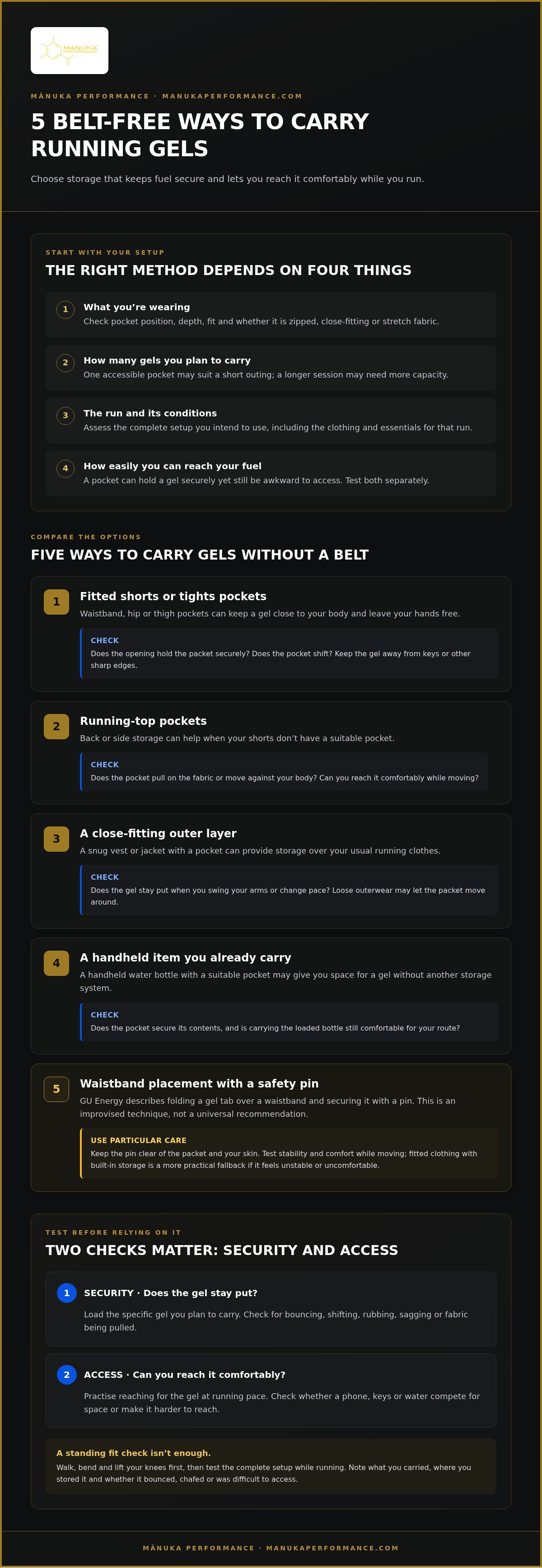
- Fitted shorts or tights pockets. Waistband, hip and thigh pockets can keep a gel close to your body and leave your hands free. Check that the opening holds the packet securely and that the pocket doesn’t shift as you move. If you share the pocket with keys, keep the gel away from sharp edges that could damage its packaging.
- Running-top pockets. Some tops have storage at the back or sides, which can help if your shorts have no suitable pockets. Load the gel and check whether the pocket pulls on the fabric or moves against your body as you run. Placement matters: a secure pocket isn’t practical if you can’t reach it comfortably.
- A close-fitting outer layer. A snug vest or jacket with a pocket may provide storage without a belt. Check how the layer sits over your usual running clothes and whether the gel stays put as you swing your arms or change pace. Avoid relying on loose outerwear that lets the packet move around.
- Storage in a handheld item you already carry. If you run with a handheld water bottle that has a suitable pocket, it may provide space for a gel without adding another storage system. Check that the pocket holds its contents securely and that carrying the loaded bottle remains comfortable for your route.
- Waistband placement with a safety pin. GU Energy describes folding a gel tab over a waistband and securing it with a pin, but this is an improvised technique, not a universal recommendation. If you test it, keep the pin clear of both the gel packet and your skin, and check that it stays in place as you move. Fitted clothing with built-in storage is a more practical fallback if the attachment feels unstable or uncomfortable.
Use pockets built into shorts, tights or running tops
Built-in pockets are often the simplest option if they hold the gel without stretching or sagging. Test the pocket closed or secured as intended, and notice whether the packet shifts, rubs or becomes harder to reach as you move. Don’t store it beside keys or other sharp objects that could damage its packaging.
Consider waistband placement or a carefully tested pin method
A pin method needs particular care because the fastener must stay clear of the packet and your skin throughout the run. Practise accessing the gel at an easy pace before considering this method for a demanding session. For broader context on gel use in endurance sport, see Research on Energy Gel Ingestion. Carrying choices and fuelling plans are separate considerations.
Match the storage to your clothing: use fitted pockets for hands-free carry, a close-fitting layer if it offers more stable space, or a handheld pocket if you already run with one. If you’re choosing a gel to include in a test, Mānuka Performance’s LiquidFuel 10-Pack Running Gel is a honey-based carbohydrate fuel for runners and endurance athletes.
How to stop belt-free running gels bouncing or getting in the way
A pocket can feel secure while you’re standing still, then move once your stride is repeated. A static fit check is only an initial screen: it can’t show whether the gel will bounce, rub or become difficult to reach at running pace. Test the loaded setup during a short, familiar run before relying on it for a longer outing or race. This is how to turn ideas about carrying running gels without a belt into a setup you’ve actually tried.
Run a practical fit and access test
Load the gel in the pocket or attachment you plan to use, and wear the same clothing and carry the same essentials you expect to take on your run. Start with an easy jog, then change pace and include the usual movements of your route, such as turning or climbing a gentle rise. Notice whether the gel shifts, presses into you, catches on another item or changes how the garment sits.
Check these points as you run:
- Bouncing: Does the gel move noticeably with each stride or work its way towards the pocket opening?
- Rubbing or pressure: Does the packet or loaded pocket create an uncomfortable contact point?
- Movement: Can you run freely, without fabric pulling or storage interfering with your stride?
- Access: Can you reach and remove the gel smoothly without stopping or losing focus on your footing?
Practise reaching for the gel with the hand you intend to use, then return your attention to your run. If you have to tug repeatedly, twist awkwardly or slow down unexpectedly, the position may not be practical for the conditions you tested.
Make access and wrapper handling part of the setup
Practise opening the gel with your intended hand position before a race or long run. Try it during an easy training run, once the storage method feels stable, to see whether the packet is accessible and manageable while moving. If opening it takes more coordination than expected, adjust your approach or choose a more accessible location.
Plan for the empty wrapper, too. Keep it with you until you reach an appropriate bin rather than dropping it on the course. Before heading out, decide where to put it after use, and check that it won’t be confused with an unused gel or interfere with other items in your pocket.
If something feels wrong, change one variable at a time. Move the gel to a different pocket, adjust how the garment fits or try another carrying method, then repeat the same checks. Changing several things at once makes it harder to tell what improved the setup. If access or comfort remains awkward, try clothing with more suitable storage and test it before using it for a demanding run.
Choose a no-belt gel setup for your clothing and run
The most suitable answer to how to carry running gels without a belt depends on the storage your clothing provides and how much space your run requires. For a shorter outing with a small amount of fuel, one well-positioned pocket may be enough. Longer sessions can call for more capacity, but extra storage is useful only if you can reach and manage it comfortably while moving. Choose based on fit, access and tested capacity, rather than assuming one method suits everyone.
| Method | Suitable clothing | Access | Main limitation |
|---|---|---|---|
| Built-in pockets | Running shorts, tights or tops with close-fitting pockets | Can be convenient when positioned within easy reach | Capacity and stability vary by garment and pocket placement |
| Close-fitting layer | A snug vest or jacket with suitable storage | May provide an alternative pocket location | Can feel restrictive or shift if the layer doesn’t fit well |
| Waistband attachment | Clothing with a waistband that can hold a carefully tested attachment | May keep a gel close at hand | Less predictable; placement and comfort need particular care |
Use the table to narrow your options, then consider what else you’ll carry. A phone, keys or water can take up space and affect access, so assess the full load rather than testing the gel alone. For a longer outing, compare the total storage you need with the positions you can reach without fumbling. Carrying capacity doesn’t determine a fuelling plan.
For pocketed running gear, prioritise fit and reach
A close-fitting pocket can suit runners carrying a small amount of fuel, particularly if the gel stays stable and the opening is easy to use. Check that you can reach it without loosening clothing or twisting awkwardly. Test the same garment and pocket at the pace and over the distance you plan to run, since comfort at an easy jog may not reflect a longer or faster session.
For pocketless gear, plan a tested alternative
If your usual outfit has no suitable storage, compare pocketed gear with a carefully secured waistband method. Pocketed clothing may require an outfit change, while an improvised attachment may be less comfortable or accessible. Don’t rely on either method until you’ve tested it. Choose the option that feels manageable and stays in place during your run.
Familiarity matters as much as fit. Rehearsing the same clothing, storage position and access routine in training can reduce avoidable changes on race day. This aligns with the value of gastrointestinal resilience for runners, where practising a familiar routine is relevant. Once you’ve identified a setup, keep it consistent while assessing how it works.
If you’re also choosing fuel to carry in your tested setup, explore Mānuka Performance running fuel.
Build and test your belt-free running gel routine
A dependable belt-free setup comes from a repeatable process, not just a pocket that looks suitable. Choose a carrying method that fits your clothing and planned run, load it as you intend to run, test it in motion, practise access and review what happened afterwards. This helps you find a practical answer to how to carry running gels without a belt for your own kit, without turning storage advice into a recommendation about how much carbohydrate to consume.
Use a short pre-run checklist
Before heading out, check the whole setup as a system. Confirm that each gel is secure and reachable, that it’s separated from keys or other sharp objects, and that your clothing still moves comfortably when fully loaded. Practise accessing a gel, then decide where you’ll keep the empty wrapper until you can put it in an appropriate bin.
- Select: Choose the pocket, close-fitting layer or other method that suits your outfit and route.
- Load: Carry the gels and other essentials you plan to take, in their intended positions.
- Test: Check comfort and stability while running, not only while standing still.
- Practise: Rehearse reaching for and opening a gel, then plan how you’ll contain the wrapper.
- Review: After the run, note what shifted, rubbed or proved difficult to reach.
Keep this as a carrying routine. The number of gels you take and when you use them are separate fuelling decisions, so don’t infer an intake plan from the storage method.
Practise the same setup before relying on it
Test your chosen clothing and load during training before using them for a race or longer session. Repeating the same arrangement makes it easier to compare runs. If you notice bouncing, rubbing or awkward access, change one detail, such as the pocket position, and test again. Avoid changing several things at once, as that makes it harder to identify what affected comfort or security.
Mānuka Performance’s LiquidFuel 10-Pack Running Gel is its flagship running gel and a relevant option to include in a belt-free setup test. It uses a New Zealand honey-based matrix containing naturally occurring glucose and fructose. For more on gel composition, see natural honey-based energy gels.
After each test, make a brief note of the garment, storage position and any adjustment you made. Keep the arrangement that feels comfortable, stays secure and allows practical access during the run you’ve rehearsed. If you’re choosing a gel for your own test, explore Mānuka Performance’s LiquidFuel 10-Pack Running Gel.
Make your next run a useful test
Your next training run can help turn a promising carrying idea into a routine you can use with confidence. Choose one setup, wear the clothing and carry the essentials you expect to take, then notice whether reaching for fuel feels straightforward without interrupting your rhythm. If something shifts or gets in the way, adjust one part before trying again. This gives you a practical answer to how to carry running gels without a belt in your own conditions, rather than relying on someone else’s preferred setup.
If you’re selecting a gel for that test, LiquidFuel 10-Pack Running Gel is Mānuka Performance’s flagship running gel, made with a New Zealand honey-based matrix containing naturally occurring glucose and fructose. Consider it alongside your chosen clothing and storage method, then assess the complete setup during training.
Explore Mānuka Performance running fuel and choose a gel to take on your next practice run. Test your setup in training so you can settle on a belt-free routine that feels comfortable and works for you.
Frequently Asked Questions
Can I carry running gels in my shorts without a belt?
Yes, if your shorts have a pocket that holds the gel securely without restricting movement. To work out how to carry running gels without a belt, check whether the pocket opening stays closed or snug as you run. A waistband or thigh pocket may suit you, so consider where you can reach most naturally. Keep gels separate from keys, which could damage the packet.
How do I carry gels when my running shorts have no pockets?
Choose another storage point rather than relying on a loose, pocketless waistband. Fitted tights or a running top with secure storage may work with the outfit you already own. A close-fitting layer is another option if its pockets stay stable. If you already carry a handheld bottle with a suitable pocket, that may provide space too. Try the complete arrangement in training before using it for a race.
Is it safe to pin a running gel to your shorts?
A safety pin can attach a gel, but it introduces a sharp point and may puncture the packet, so it isn’t a risk-free default. If you choose to try this improvised method, keep the pin clear of your skin and the gel itself, and check that it stays secure as you move. If it catches, shifts or feels uncomfortable, stop using it and choose fitted clothing with storage instead.
How do I stop running gels bouncing in my pocket?
Use a pocket that fits the gel closely enough to limit movement without stretching the fabric or making the packet hard to remove. If it bounces, try another pocket or garment rather than wedging it in place with more items. Check whether a phone or other carried item is pushing the gel around. A setup that feels secure while walking may still need adjusting at your usual running pace.
Can I carry running gels in a sports bra?
Yes, if the bra has a pocket designed to hold small items and the gel sits comfortably when you move. Check that the packet doesn’t press against your body, shift towards the opening or interfere with the bra’s fit. Practise reaching for it before relying on this location, especially if the pocket is behind you. If access is awkward, a pocket in your shorts or top may be more practical.
How many running gels can I carry without a belt?
There’s no fixed number. It depends on the capacity of your clothing or handheld storage and whether each gel stays secure and accessible. Load the amount you plan to carry alongside essentials such as your phone, keys or water, then check that nothing competes for the same space. Carrying capacity is separate from how much fuel to use; follow your own fuelling plan rather than using pocket space to set one.
Where should I put an empty running gel wrapper?
Keep the wrapper with you until you can dispose of it in an appropriate bin. Before setting out, choose a secure place for used packaging that’s separate from unopened gels, so you can distinguish them easily while moving. If the same pocket holds both, take care not to confuse the empty wrapper with fuel you still intend to use. Don’t drop wrappers on the route.