


The prevailing assumption that synthetic, maltodextrin-dominant formulations represent the pinnacle of endurance fueling is increasingly challenged by advancements in bio-analytical research. For many high-performance athletes, the pursuit of peak output is frequently undermined by systemic gastrointestinal distress and the volatile insulin responses associated with isolated, engineered polysaccharides. You've likely experienced how honey based sports nutrition is frequently overlooked in favour of these synthetics, yet traditional gels often result in diminishing returns where the immediate ergogenic benefit is negated by late-stage energy crashes.
This reference provides a rigorous analysis of how LiquidFuel, specifically when refined through the PolySure™ analytical standard, offers a physiologically superior alternative to synthetic substrates. We'll examine the unique dual-pathway absorption of the natural glucose-fructose matrix and the role of quantified phytochemicals in modulating oxidative stress. By prioritising precise bio-active validation over generic caloric density, athletes can achieve a more resilient glycaemic response and reliable gut-friendly fueling during high-intensity sessions.
Key Takeaways
- Understand how honey based sports nutrition leverages a dual-pathway carbohydrate matrix to optimise absorption via SGLT1 and GLUT5 transporters.
- Identify the critical role of the PolySure™ standard in validating a precise profile of seven performance-enhancing polyphenols for oxidative stress management.
- Contrast the metabolic efficiency and gastrointestinal stability of functional honey against conventional synthetic carbohydrate formulations used in endurance sports.
- Optimise competition performance by integrating validated honey matrices that provide sustained energy release without the volatility of insulin spikes.
- Recognise the clinical distinction between raw table honey and bio-analytically standardised functional nutrition for elite athletes.
Beyond Simple Sugars: The Emergence of Functional Honey in Elite Sports Nutrition
The evolution of endurance fueling has reached a critical juncture where the reliance on isolated carbohydrate chains is being replaced by sophisticated, bioactive nutrition matrices. Historically, elite athletes viewed caloric intake through a reductive lens, prioritising rapid glucose delivery regardless of the physiological cost. Modern biotechnology now enables a transition toward honey based sports nutrition, where the focus shifts from simple energy provision to the systemic modulation of metabolic stress through quantified phytochemicals. This paradigm shift acknowledges that the biological impact of a fuel source is determined not just by its caloric density, but by the complexity of its molecular structure.
The Limitations of Synthetic Carbohydrate Formulations
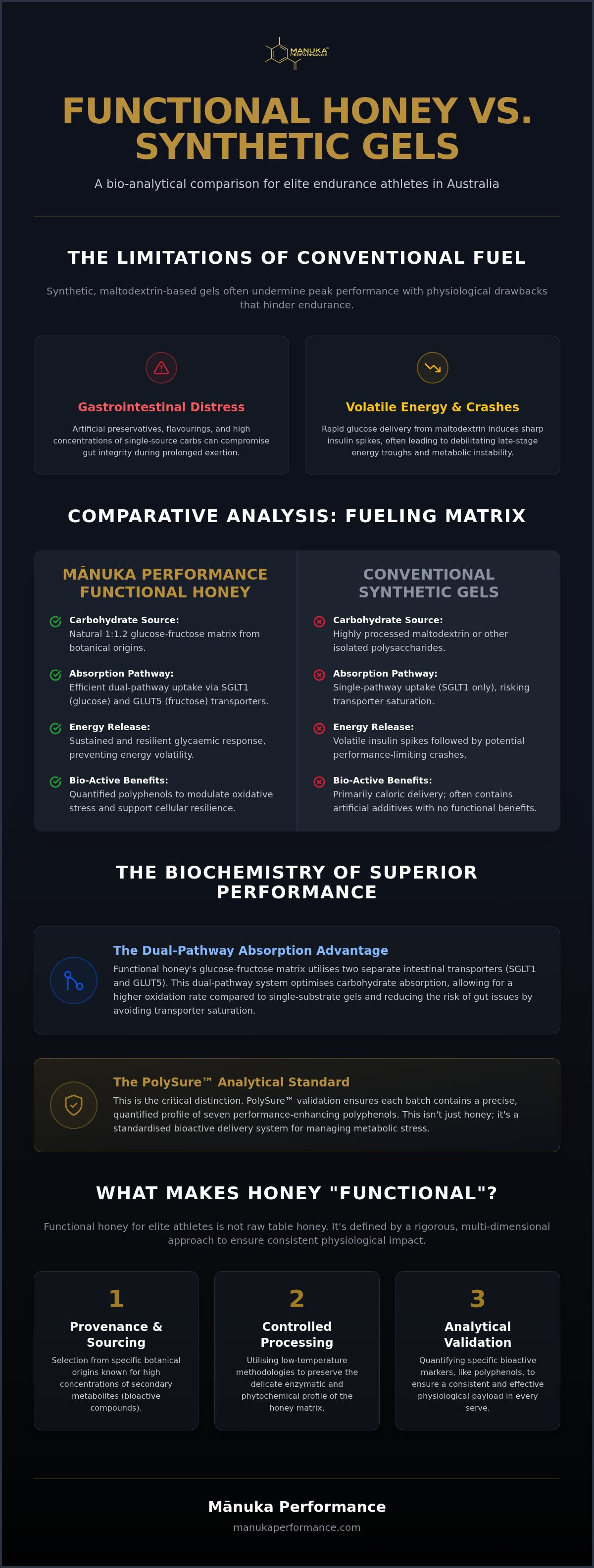
Conventional sports nutrition has long been dominated by maltodextrin, a highly processed polysaccharide designed for rapid gastric emptying. While effective for immediate glucose elevation, these synthetic formulations frequently induce a volatile glycaemic response, characterised by sharp insulin spikes followed by debilitating energy troughs. These metabolic fluctuations are often compounded by artificial preservatives and flavouring agents that can compromise gastrointestinal integrity during prolonged exertion. Consequently, professional circuits are seeing a surge in demand for natural honey-based energy gels NZ, as athletes seek fuel sources that offer metabolic stability without the inflammatory burden of engineered additives.
Defining Functional Honey for High-Intensity Athletic Use
To understand the performance advantages of this shift, one must first consider the fundamental composition of the source material. While a basic understanding of What is Honey? reveals a complex mixture of sugars, enzymes, and trace minerals, the distinction between culinary honey and functional honey is defined by rigorous analytical validation. Functional honey isn't merely a raw agricultural product; it's a standardised bioactive delivery system. The classification of honey as "functional" for athletic applications depends on several key pillars:
- Provenance and Sourcing: Selection from specific botanical origins known for high secondary metabolite concentrations.
- Controlled Processing: Utilising low-temperature methodologies to preserve the delicate enzymatic and phytochemical profile.
- Analytical Validation: Quantifying specific bioactive markers, such as polyphenols, to ensure a consistent physiological payload.
This multi-dimensional approach ensures that the honey matrix provides more than just fuel. It delivers a synergistic blend of antioxidants that support cellular resilience, distinguishing it from the singular, one-dimensional caloric delivery of synthetic gels. For the Australian athlete competing in high-intensity environments, this move toward clean-label, polyphenol-rich nutrition represents a strategic advancement in performance longevity and metabolic health.
The Biochemistry of Performance: Quantifying Polyphenols and the Glucose-Fructose Matrix
Functional honey is defined as a bio-analytical standard of honey containing measured levels of performance-enhancing polyphenols. Unlike generic caloric sources, this specialised matrix operates as a sophisticated delivery system for both energy and bioactive compounds. The physiological utility of honey based sports nutrition is primarily dictated by its molecular composition, which facilitates superior carbohydrate oxidation rates compared to single-substrate synthetic gels. By leveraging the natural synergy between specific saccharides and secondary metabolites, athletes can achieve a more efficient metabolic state during high-intensity exertion.
The Dual-Pathway Absorption Advantage
The efficacy of functional honey in endurance contexts is largely attributed to its 1:1.2 glucose-to-fructose ratio. This specific configuration is critical because human intestinal absorption is limited by the saturation of individual transporter proteins. Glucose relies on the sodium-dependent transporter SGLT1, while fructose utilises the GLUT5 pathway. When an athlete consumes a single-source carbohydrate like maltodextrin, the SGLT1 transporters quickly become saturated, leading to gastrointestinal pooling and reduced energy availability.
High-performance functional honey bypasses this bottleneck by distributing the carbohydrate load across both pathways simultaneously. This dual-pathway mechanism increases total exogenous carbohydrate uptake, allowing for a higher rate of oxidation per hour. For the endurance competitor, this translates to sustained power output and a significant reduction in the risk of gut distress. To explore these benefits further, athletes can review the range of validated solutions available at manukaperformance.com.
Polyphenols: The Bioactive Drivers of Metabolic Recovery
Beyond its role as a primary fuel source, functional honey is distinguished by its quantified payload of seven specific polyphenols. These phytochemicals serve as potent antioxidants that modulate the systemic inflammatory response induced by strenuous exercise. While traditional honey markers focus on antibacterial properties, elite athletes should prioritise sports nutrition biotechnology that validates performance-led bioactives over generic MGO ratings.
The inclusion of these measured polyphenols supports cellular resilience by mitigating the oxidative stress that typically accumulates during prolonged sessions. This biochemical intervention is essential for maintaining systemic integrity and accelerating the transition into a recovery state. By selecting a matrix that provides both rapid energy and protective bioactives, athletes ensure their nutritional strategy addresses both the immediate demands of competition and the long-term requirements of metabolic health.
Comparative Analysis: Natural Honey Matrices versus Synthetic Gels
The metabolic divergence between honey based sports nutrition and traditional maltodextrin gels is rooted in the complexity of their respective carbohydrate structures. While synthetic gels rely on high-glycaemic polysaccharides to force rapid glucose entry, functional honey utilises a tiered release system. This natural matrix provides a more favourable osmotic pressure profile, reducing the likelihood of gastrointestinal distress often caused by the high-concentration solutes found in engineered formulations. The biological response to these different substrates dictates not only immediate performance but also the systemic state of the athlete post-exertion.
Metabolic Efficiency and Glycaemic Control
The glycaemic response to functional honey is notably more stable than that of isolated synthetic sugars. Maltodextrin, with a glycaemic index (GI) often exceeding 100, triggers a rapid insulin surge that can inhibit fat oxidation and lead to secondary hypoglycaemia. In contrast, the fructose component in honey moderates the insulin response, facilitating sustained energy release. Rigorous research into the question of do honey energy gels work indicates that this glycaemic stability allows athletes to maintain higher power outputs without the volatility of sugar crashes. This metabolic efficiency is particularly critical during the final stages of endurance events where glycogen conservation is paramount.
Beyond carbohydrate delivery, the honey matrix contains an array of enzymes and micronutrients that are entirely absent in synthetic gels. These naturally occurring components include:
- Endogenous Enzymes: Diastase and invertase assist in the metabolic processing of saccharides.
- Essential Minerals: Naturally occurring potassium and magnesium support neuromuscular function.
- Phytochemical Resilience: Bioactive compounds that remain shelf-stable in varied climates.
In the demanding Australian climate, the natural shelf-stability and resistance to crystallisation of high-performance honey offer a logistical advantage over synthetic gels that may separate or degrade under extreme thermal stress. This longevity is a hallmark of high-quality raw products; for instance, Balqees Honey explains why the natural properties of honey allow it to remain shelf-stable almost indefinitely.
Elite sports nutrition biotechnology has moved beyond the "calories at any cost" mindset toward a clean-label philosophy. Synthetic gels frequently incorporate artificial thickeners, preservatives, and flavouring agents to mask the chemical profile of their base ingredients. These additives pose systemic risks, potentially inducing low-grade inflammation that hampers recovery. Functional honey provides a whole-food metabolic advantage by delivering energy through a complex phytochemical profile. This transparency in sourcing and composition ensures that athletes aren't just fuelling their performance, but are doing so with a matrix that respects biological integrity. This commitment to quality and purity is shared by health brands like My Wellness, which specialise in high-quality natural health products and supplements designed to complement a clean-label nutritional strategy.
The transition from biochemical theory to field application requires a structured approach to nutrient timing that respects the athlete's physiological constraints. The high bioavailability of honey based sports nutrition allows for a more flexible yet precise fuelling protocol than synthetic alternatives, primarily because the honey matrix is inherently pre-digested by enzymes such as invertase. This reduction in metabolic load is paramount during ultra-endurance and multi-stage events where systemic fatigue can compromise the body's ability to process engineered polysaccharides. By aligning carbohydrate intake with specific metabolic demands, athletes can maintain peak power output while ensuring long-term systemic health.
Avoiding Gastrointestinal Distress
The primary driver of "runner's stomach" is the ingestion of hypertonic solutions that draw water into the bowel, causing significant osmotic imbalance and subsequent distress. Functional honey maintains a more favourable osmotic pressure profile, facilitating rapid gastric emptying and reducing the risk of the pooling effect often associated with high-concentration maltodextrin. Athletes can find comprehensive strategies for avoiding runners stomach issues through natural fuelling protocols that prioritise gut integrity. Training the digestive system to handle high-density carbohydrate loads becomes significantly more manageable when the substrate is a bio-analytically standardised matrix. This approach prevents the inflammatory response often triggered by the artificial thickeners and synthetic preservatives found in conventional gels.
The Intra-Workout Fuelling Protocol
Effective carbohydrate management requires matching intake to the intensity and duration of the effort. For sessions exceeding ninety minutes, a baseline of 30 to 60 grams of carbohydrates per hour is typically recommended, though elite competitors in high-intensity racing may scale this to 90 grams. Co-ingestion with water is critical to maintain the optimal concentration for absorption via the SGLT1 and GLUT5 transporters. In multi-stage events or the demanding Australian climate, the nutrition plan must also account for increased electrolyte requirements and the potential for appetite suppression under thermal stress. A structured plan ensures that the payload of quantified polyphenols and glucose-fructose sugars is delivered consistently to the working muscles. To secure your competition requirements and optimise your endurance protocol at manukaperformance.com, athletes should integrate these validated matrices into their training blocks well before race day.
The gentle nature of the honey matrix is particularly beneficial during the latter stages of a race when the gut becomes increasingly sensitive. Unlike synthetic sugars that can cause sudden acidity or nausea, functional honey provides a soothing effect on the gastric lining. This resilience allows for continued fuelling even when the body is under extreme physiological stress, ensuring that energy levels remain stable until the finish line. Every gram of carbohydrate delivered through this specialised matrix is supported by the naturally occurring enzymes that facilitate immediate cellular utilisation.
Mānuka Performance: Advancing Nutrition through PolySure™ Validation
Mānuka Performance operates at the intersection of high-end biotechnology and functional nutrition. The brand's commitment to honey based sports nutrition is underpinned by a rigorous analytical framework that moves beyond traditional agricultural metrics. By integrating New Zealand's unique floral provenance with sophisticated data science, the firm provides athletes with a level of nutritional precision previously reserved for pharmaceutical applications. This approach ensures that every metabolic outcome is supported by verifiable bioactive concentrations, allowing for a predictable and measurable physiological response during competition.
The PolySure™ Standard Explained
Central to this innovation is the PolySure™ analytical standard. While many competitors rely on the MGO (Methylglyoxal) rating as a marker of quality, this metric primarily measures antibacterial potency, which has limited relevance to the immediate physiological demands of an endurance athlete. Mānuka Performance identifies and quantifies seven specific, naturally occurring polyphenols that are critical for managing oxidative stress and supporting metabolic resilience. This quantification is essential for elite competitors who require absolute predictability in their nutrition protocols. Every production batch undergoes rigorous validation to ensure the bioactive payload remains consistent, providing a reliable ergogenic aid that withstands the scrutiny of professional-grade performance analysis. Moving beyond generic honey to a bioactive ingredient validated by rigorous data science ensures that the athlete's cellular health is supported alongside their energy requirements.
LiquidFuel: The Evolution of the Energy Gel
LiquidFuel represents the practical application of this research-driven philosophy. It isn't merely a natural alternative to synthetic gels; it's a precisely engineered energy solution designed for optimal carbohydrate delivery. By utilising a New Zealand honey-based matrix, LiquidFuel offers a clean-label profile that prioritises phytochemical innovation and molecular purity. The design of this matrix facilitates rapid yet sustained carbohydrate delivery, ensuring that the athlete avoids the metabolic volatility associated with engineered sugars. Athletes who integrate this solution into their training kits are accessing sports nutrition biotechnology that bridges the gap between raw nature and measurable athletic outcomes.
The commitment to quantifying bioactives ensures that the performance benefits are not anecdotal but are based on the measurable efficacy of the ingredients. In a landscape where label transparency is often lacking, Mānuka Performance provides a bio-analytical reference that allows athletes to fuel with confidence. By prioritising the systemic integrity of the honey matrix and the potency of its secondary metabolites, the brand sets a new standard for functional nutrition in the Australian and global markets. This dedication to precision ensures that every gram of fuel contributes to sustained power output and accelerated metabolic recovery.
Advancing Athletic Output through Bio-Analytical Precision
The transition from synthetic carbohydrate substrates to bio-analytically validated matrices represents a significant advancement in endurance physiology. By leveraging the dual-pathway absorption of a natural glucose-fructose matrix, athletes can achieve superior exogenous carbohydrate oxidation without the gastrointestinal instability associated with engineered polysaccharides. The clinical significance of honey based sports nutrition is solidified by the PolySure™ analytical standard, which ensures that seven specific, performance-relevant polyphenols are quantified in every production batch. This scientific rigour distinguishes a research-driven energy solution from generic culinary products, providing elite competitors with the predictable outcomes required for high-stakes competition.
Mānuka Performance remains committed to bridging the gap between New Zealand biotechnology and athletic excellence through our scientifically formulated matrices. Whether you're managing oxidative stress or seeking a more resilient glycaemic response, the integration of clinical-grade sports nutrition provides a clear metabolic advantage. It's time to move beyond the limitations of synthetic sugars and embrace a fuel source validated by rigorous data science. Explore the PolySure™ validated LiquidFuel range for your next session and experience the precision of functional nutrition. Peak performance is within reach when supported by validated science.
Frequently Asked Questions
What makes functional honey different from the honey I buy at the supermarket?
Functional honey is a bio-analytical standard, not a raw culinary product. It's validated by the PolySure™ standard to contain specific levels of seven performance-enhancing polyphenols. Supermarket honey lacks this quantification and often undergoes high-heat processing that degrades bioactive integrity. This clinical-grade fuel is specifically designed for athletic metabolic demands rather than general culinary use, ensuring a consistent payload of secondary metabolites for every session.
Can functional honey prevent gastrointestinal issues during a marathon?
Yes, the 1:1.2 glucose-to-fructose ratio in honey based sports nutrition reduces the risk of gastrointestinal distress. Because it utilises dual-pathway absorption via the SGLT1 and GLUT5 transporters, it prevents the transporter saturation often caused by single-sugar synthetic gels. This maintains osmotic balance in the gut, effectively reducing the likelihood of runner's stomach or bloating during high-intensity endurance events like marathons.
How many grams of carbohydrate are in a honey-based energy gel?
A standard Mānuka Performance energy gel provides approximately 20 to 25 grams of carbohydrates. This is comparable to traditional synthetic gels but delivered via a natural, whole-food matrix that is easier for the body to process. This dosage is designed to align with standard endurance fuelling protocols, where athletes typically aim for 30 to 90 grams of carbohydrate per hour depending on their specific intensity and duration.
Is functional honey suitable for high-intensity interval training (HIIT)?
Functional honey is highly effective for high-intensity interval training due to its rapid yet sustained glucose release. The glucose component provides immediate energy for explosive anaerobic movements, while the fructose moderates the insulin response to prevent energy crashes. Its high bioavailability ensures that the fuel is accessible to working muscles quickly without causing the gastric heaviness often associated with complex synthetic starches or artificial thickeners.
What are the specific polyphenols measured by the PolySure™ standard?
The PolySure™ standard quantifies a specific profile of seven naturally occurring polyphenols found in New Zealand honey. These bioactives are selected for their ability to modulate oxidative stress and support metabolic resilience. The measured compounds include:
- Antioxidant phenolic acids for cellular protection.
- Bioactive flavonoids to support systemic recovery.
- Quantified phytochemicals for consistent performance outcomes.
This rigorous validation ensures every batch meets professional-grade standards for elite athletes.
How does the absorption rate of honey compare to synthetic maltodextrin?
Functional honey offers a more efficient absorption profile than maltodextrin because it avoids the single-transporter bottleneck. Maltodextrin relies solely on the SGLT1 pathway, which saturates at roughly 60 grams per hour. In contrast, honey based sports nutrition utilises both SGLT1 and GLUT5 pathways simultaneously. This allows for higher total carbohydrate oxidation rates and more consistent energy delivery during prolonged athletic exertion without triggering gastrointestinal distress.
Is functional honey better for recovery or intra-workout fuelling?
While primarily designed for intra-workout fuelling, functional honey is also highly effective for post-exercise recovery. During exercise, it provides immediate carbohydrate substrates for peak performance. Post-exercise, the quantified polyphenols help mitigate systemic oxidative stress, while the natural sugars assist in rapid glycogen resynthesis. This dual-purpose utility makes it a versatile component of a professional-grade nutrition strategy that addresses both performance and metabolic health.
Will the fructose in honey cause stomach upset if I have a sensitive gut?
Fructose in a balanced natural matrix is generally better tolerated than isolated synthetic sugars. The specific 1:1.2 ratio found in functional honey is designed to optimise absorption and minimise the amount of unabsorbed sugar remaining in the bowel. For athletes with sensitive guts, this natural configuration reduces osmotic pressure and helps prevent the fermentation and bloating often triggered by engineered high-fructose corn syrups or artificial sweeteners.