


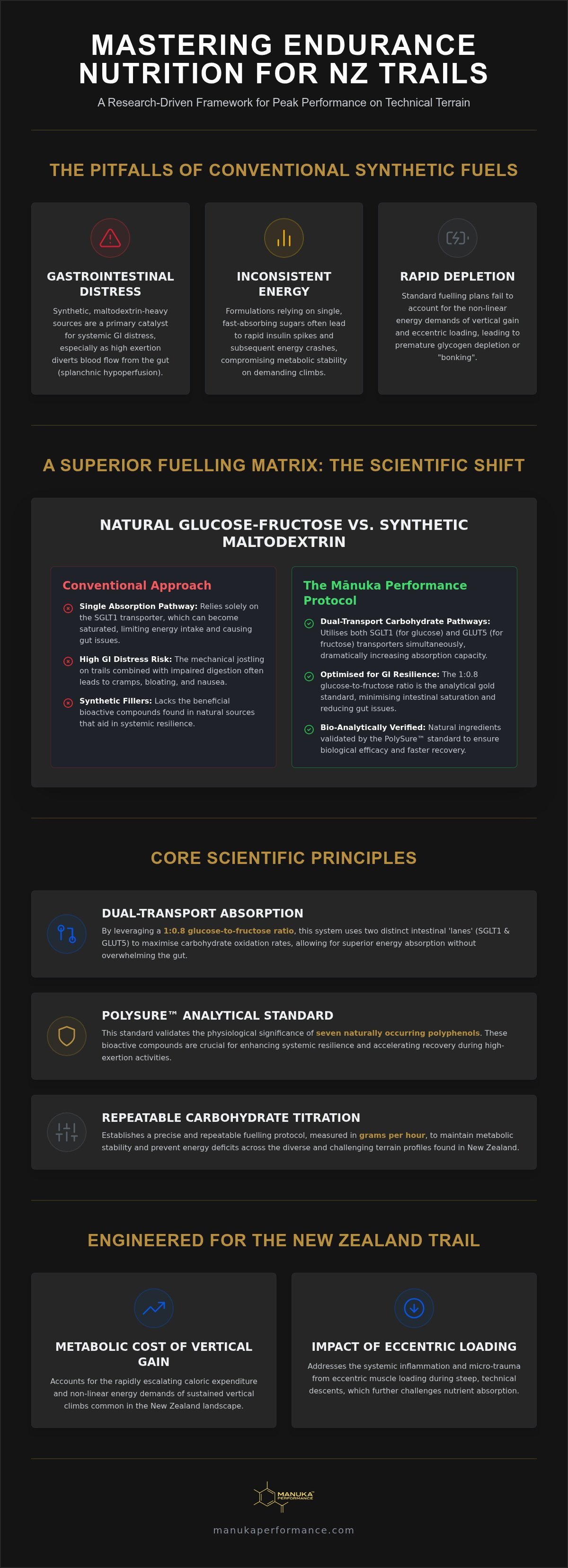
The persistent reliance on synthetic, maltodextrin-heavy carbohydrate sources as the foundational nutrition for trail runners NZ remains a primary catalyst for systemic gastrointestinal distress and inconsistent energy delivery during high-exertion vertical climbs. While traditional sports nutrition often prioritises convenience, it's imperative to recognise that the physiological reality of technical endurance running requires a more sophisticated understanding of bioactive absorption and metabolic efficiency. You likely understand the frustration of a disciplined training block being compromised by recurrent stomach issues or a sudden depletion of glycogen levels on demanding terrain.
This guide provides a comprehensive framework to master the science of endurance nutrition through research-driven protocols that are specifically tailored to the unique environmental and physiological demands of the New Zealand landscape. By integrating the PolySure™ analytical standard and leveraging natural glucose-fructose matrices, you will establish a repeatable nutritional protocol designed to improve gastrointestinal resilience and accelerate recovery. We will examine the transition from synthetic fillers to bio-analytically validated natural ingredients, ensuring your fuelling strategy is as rigorous as your physical preparation.
Key Takeaways
- Analyse the metabolic cost of technical vertical gain and the specific impact of eccentric muscle loading on nutrient absorption during prolonged descents.
- Optimise nutrition for trail runners NZ by transitioning from synthetic maltodextrin to a natural glucose-fructose matrix that leverages dual-transport carbohydrate pathways for superior absorption.
- Identify the physiological significance of seven naturally occurring polyphenols, validated through the PolySure™ analytical standard, for enhancing systemic resilience during high-exertion activities.
- Establish a repeatable carbohydrate titration protocol, measured in grams per hour, to maintain metabolic stability across diverse and challenging New Zealand terrain profiles.
- Utilise bio-analytically verified fuelling solutions to ensure gastrointestinal integrity and faster recovery through clean-label, research-driven protocols that prioritise biological efficacy.
The Physiological Demands of Trail Running in New Zealand
The metabolic requirements of navigating the technical topography of New Zealand are fundamentally distinct from those of traditional road athletics. When athletes engage with the significant vertical oscillation inherent in these environments, the caloric expenditure escalates rapidly beyond standard predictions. Effective nutrition for trail runners NZ requires an analytical approach to these unique stressors, as the body isn't merely moving forward but also constantly working against gravity and stabilising on uneven surfaces.
Environmental variables such as the variable New Zealand climate also play a critical role in systemic homeostasis. Sudden shifts in temperature and humidity influence sweat rates and electrolyte concentration, necessitating a fuelling strategy that adapts to fluid loss and metabolic heat production. These factors operate alongside the foundational principles of sports nutrition to create a highly complex physiological environment where standard intake protocols often prove insufficient. A robust framework for nutrition for trail runners NZ must account for the redirection of blood flow and the mechanical impact of the terrain.
Metabolic Stress and Glycogen Depletion
Quantifying the caloric burn rate on rugged trails reveals a significant discrepancy between flat-surface exertion and technical ascent. Standard marathon fuelling plans frequently fail in these environments because they don't account for the non-linear energy demands of sustained vertical gain. Consistent carbohydrate titration is essential to maintain blood glucose levels and prevent the rapid depletion of glycogen stores. Without precise quantification of these needs, athletes often encounter the "bonk" well before the expected duration of their effort concludes. This metabolic deficit is often exacerbated by the increased intensity required to clear technical obstacles.
Gastrointestinal Resilience on the Trail
Achieving systemic stability involves more than just caloric intake; it requires a focused strategy for avoiding runners stomach issues during periods of high physiological strain. During intense vertical efforts, the body prioritises blood flow to working muscles, leading to splanchnic hypoperfusion, which significantly impairs digestive efficiency. This redirection of resources, combined with the mechanical jostling experienced on technical descents, exacerbates the risk of gastrointestinal distress.
The impact of eccentric muscle loading during steep descents adds another layer of complexity. These forces induce micro-trauma and systemic inflammation, further challenging the gut's ability to process exogenous carbohydrates. There is a clear physiological limit to carbohydrate processing during these endurance efforts. Understanding these thresholds is vital for any athlete seeking to maintain performance while managing the systemic impact of the New Zealand trail environment.
Strategic Carbohydrate Matrices: Beyond Synthetic Formulations
The selection of an exogenous fuel source is a critical determinant of performance outcomes, particularly when evaluating the efficacy of nutrition for trail runners NZ. While conventional sports nutrition has historically relied on synthetic maltodextrin, recent advancements in bio-analytical research suggest that natural carbohydrate matrices offer superior absorption characteristics. This superiority is primarily attributed to the dual-transport system, which utilises distinct intestinal transporters: sodium-glucose co-transporter 1 (SGLT1) for glucose and glucose transporter 5 (GLUT5) for fructose.
By employing a 1:0.8 glucose-to-fructose ratio, athletes can maximise carbohydrate oxidation rates while minimising the risk of intestinal saturation. This specific ratio is considered the analytical gold standard, as it aligns with the physiological capacity of these transporters to process multiple sugar types simultaneously. Unlike synthetic formulations that often lead to rapid insulin spikes and subsequent hypoglycaemic episodes, a natural matrix provides a more modulated glycaemic response. This steady energy release is essential for maintaining metabolic stability during the sustained vertical efforts characteristic of New Zealand trails. A scientific review of endurance nutrition confirms that such multi-transportable carbohydrate strategies significantly enhance exogenous oxidation efficiency compared to single-source glucose formulations.
The Honey Matrix Advantage
The bio-availability of honey-based carbohydrate gels is fundamentally enhanced by the presence of naturally occurring enzymes, such as diastase and glucose oxidase. These enzymes assist in the pre-digestion and systemic absorption of the carbohydrate load, reducing the metabolic burden on the gastrointestinal tract during high-intensity efforts. When conducting a comparative bio-analytical analysis on whether honey energy gels work, it becomes evident that the complex molecular structure of honey facilitates a more efficient delivery of energy to working muscles. This natural complexity ensures that athletes can sustain high power outputs without the digestive compromises associated with isolated synthetic sugars.
Clean Label Standards in Performance Nutrition
For the sophisticated athlete, the presence of synthetic thickeners, artificial preservatives, and gums in trail fuel presents a significant risk to gut integrity. These additives often exacerbate the mechanical distress caused by technical terrain, leading to systemic inflammation and reduced nutrient uptake. Defining a "clean label" standard involves prioritising ingredients with high provenance and minimal processing. Identifying the best Gu energy gel alternative is a priority for those with sensitive stomachs who require a high-performance carbohydrate source without the inclusion of synthetic fillers. By prioritising these bio-analytically validated matrices, runners can achieve a higher degree of metabolic control. To explore these advanced formulations, consider the benefits of natural honey-based sports nutrition for your next endurance event.
Quantifying Performance: The Role of Phytochemicals and Polyphenols
The evolution of sports science has shifted the focus from simple caloric replacement to the sophisticated quantification of secondary metabolites. For those optimising nutrition for trail runners NZ, the inclusion of phytochemicals represents a significant advancement in systemic resilience. These compounds, specifically polyphenols, serve as critical drivers of endurance by modulating the body's response to the extreme physiological stress encountered on technical terrain. Unlike standard carbohydrate products, bio-analytically validated honey matrices provide a complex array of bioactives that support metabolic integrity during prolonged exertion.
PolySure™ and Bioactive Validation
Within the context of performance honey, traditional MGO (methylglyoxal) ratings are often insufficient for assessing athletic efficacy. While MGO serves as a marker for antibacterial activity in raw honey, it doesn't quantify the specific polyphenolic compounds required for functional nutrition. The PolySure™ analytical standard was developed to address this data gap, providing a rigorous framework for the validation of seven naturally occurring polyphenols. This level of analytical science ensures that each batch of performance fuel maintains a consistent bioactive profile, allowing athletes to rely on measurable data rather than anecdotal evidence. By prioritising the quantification of these metabolites, the standard bridges the gap between natural provenance and clinical performance, ensuring that the nutrition for trail runners NZ is grounded in verifiable biotech solutions.
Mitigating Oxidative Damage on the Trail
High-intensity trail running induces significant cellular stress; it leads to a cascade of oxidative damage that can compromise both immediate performance and long-term recovery. The systemic benefits of quantified polyphenols are particularly evident during ultra-endurance efforts where the body's endogenous antioxidant systems are frequently overwhelmed by the demands of vertical oscillation and environmental exposure. These bioactives assist in mitigating the inflammatory response, supporting systemic recovery during multi-day events or high-volume training blocks.
As the field of sports biotechnology continues to mature, the focus is moving beyond simple carbohydrate titration toward a more holistic integration of phytochemical innovation. For the elite athlete, this represents a transition from viewing fuel as mere energy to recognising it as a sophisticated tool for biological optimisation. This analytical approach ensures that the physiological cost of technical terrain is met with a scientifically validated response, allowing for faster recovery through the use of validated bioactive ingredients.
Implementation Protocols: Fueling for NZ Trail Conditions
The transition from theoretical biochemistry to field implementation requires a structured analytical framework. To optimise nutrition for trail runners NZ, athletes must move beyond the "test and learn" approach and adopt a rigorous titration protocol that accounts for terrain-specific metabolic shifts. Establishing a repeatable system ensures that the dual-transport carbohydrate pathways discussed previously are saturated without exceeding the body's current absorption threshold. This systemic stability is the difference between sustained performance and metabolic failure on technical terrain.
Intra-Workout Carbohydrate Titration
Establishing a base-level carbohydrate titration protocol involves calculating specific hourly requirements based on intensity and duration. For most high-exertion efforts, a baseline of 60 to 90 grams of carbohydrates per hour is recommended. However, the "Train the Gut" methodology suggests that this capacity isn't static; through progressive exposure during training, the density of SGLT1 and GLUT5 transporters can be upregulated, potentially allowing for oxidation rates exceeding 90 grams per hour.
Frequency of intake is as critical as total volume. Consuming smaller, more frequent doses (every 15 to 20 minutes) maintains a steady glycaemic profile and reduces the risk of gastrointestinal distress compared to large, bolus ingestions. During significant vertical gain, where intensity and glycogen reliance are at their peak, maintaining this titration is vital. Conversely, on technical descents, the mechanical stress on the gut increases. During these phases, athletes should prioritise smaller volumes to manage the increased gastric jostling. For efforts extending beyond six hours, metabolic efficiency becomes the primary focus, requiring a disciplined adherence to these protocols to prevent systemic depletion.
Electrolyte Management and Hydration Dynamics
Strategic hydration isn't merely about fluid volume; it's about balancing intake with carbohydrate concentration to maintain optimal osmolality. The presence of sodium is essential for the function of the SGLT1 transporter, as glucose absorption is a sodium-dependent process. Without adequate electrolyte concentration, even the most advanced carbohydrate matrix will fail to reach the bloodstream efficiently.
Athletes must distinguish between dehydration and hyponatremia, as both can manifest with similar performance-degrading symptoms. Maintaining a solution osmolality that mirrors blood plasma (approximately 280 to 300 mOsm/kg) facilitates faster gastric emptying and nutrient uptake. If the fuel mix is too concentrated, it draws water into the intestines, leading to the stomach issues common in nutrition for trail runners NZ. By quantifying both carbohydrate and sodium intake, you ensure a synergistic relationship between fuel and fluid. To implement these research-driven protocols with a bio-analytically validated fuel, explore the Mānuka Performance LiquidFuel range for your next endurance block.
Mānuka Performance: Natural Innovation for the Elite Trail Athlete
Mānuka Performance represents the intersection of New Zealand provenance and advanced biotechnological validation, offering a sophisticated alternative to the synthetic paradigms that have historically dominated the industry. For those seeking the highest echelon of nutrition for trail runners NZ, LiquidFuel serves as the definitive bio-analytical response to the diverse physiological challenges presented by technical endurance running. This formulation is underpinned by the proprietary PolySure™ standard, which differentiates the brand through the rigorous quantification of bioactive compounds, ensuring that every batch delivered meets a precise clinical threshold for performance. Unlike generic offerings that rely on hyperbolic claims, this commitment to research-driven biotech solutions provides athletes with the confidence that their fuelling strategy is grounded in measurable systemic efficacy.
The honey-based matrix of LiquidFuel offers distinct advantages for remote trail access, where portability and systemic resilience are paramount. Its molecular structure facilitates rapid gastric emptying, which is essential when navigating the vertical oscillations and unpredictable conditions of the New Zealand landscape. This stability ensures that the athlete can maintain focus on the terrain rather than managing digestive distress.
LiquidFuel: The Performance-Led Honey Matrix
The efficacy of LiquidFuel is derived from its streamlined ingredient profile, which prioritises biological utility over synthetic complexity. By utilising a natural glucose-fructose matrix, the product ensures optimal saturation of dual-transport pathways without the inclusion of maltodextrin, synthetic thickeners, or artificial preservatives. This clean-label simplicity is a deliberate design choice that enhances palatability and gastrointestinal comfort during high-stress efforts when blood flow is redirected away from the digestive system. Athletes can seamlessly integrate LiquidFuel into a strategic carbohydrate loading plan to ensure glycogen stores are fully optimised prior to competition. The portable format is specifically engineered for high-pressure environments, allowing for precise titration even on the most demanding technical segments where coordination and energy stability are critical.
Evidence-Led Recovery Strategies
Post-exertion recovery is fundamentally influenced by the presence of bioactives that manage the systemic inflammatory response and support cellular repair. The seven naturally occurring polyphenols validated by the PolySure™ standard play a vital role in mitigating the oxidative stress induced by eccentric loading and sustained aerobic intensity. A comprehensive performance analysis of natural honey-based energy gels illustrates how these secondary metabolites support long-term training adaptations by protecting cellular integrity against the rigours of the trail. As you refine your 2026 trail nutrition strategy, the transition toward bio-analytically verified matrices becomes a critical component of professional excellence. By aligning your nutrition for trail runners NZ with these clinical standards, you ensure that your physiological potential is supported by the most advanced biotechnological frameworks currently available in the sports nutrition sector.
Advancing Your Performance Framework through Analytical Precision
For athletes who share the rugged NZ trails with their canine companions, ensuring their recovery and nutritional needs are met is just as vital as your own. To support your dog's health and learn about the benefits of natural ingredients like calendula, you can discover Ruff Bar and their range of high-protein, grain-free products for active dogs.
Achieving systemic stability on technical terrain requires a transition from generic supplementation to a protocol grounded in clinical precision. By prioritising natural dual-transport carbohydrate matrices and the systemic benefits of validated phytochemicals, you ensure that your metabolic output remains consistent across the most demanding vertical profiles. Mastering nutrition for trail runners NZ isn't merely about caloric volume; it's about the strategic integration of bio-analytically verified ingredients that support both immediate power output and long-term recovery resilience.
Success in ultra-endurance environments is a direct outcome of rigorous preparation and the application of research-driven biotech solutions. To implement these advanced protocols in your next training block, you can optimise your trail performance with LiquidFuel Running Gels. This formulation, validated by the PolySure™ analytical standard, utilises a high-performance New Zealand honey matrix to provide the metabolic efficiency required by elite endurance athletes. When your fuelling strategy is as disciplined as your physical conditioning, you unlock a new level of professional excellence. It's time to apply these scientific insights to your own trail objectives and experience the measurable difference of validated functional nutrition.
Frequently Asked Questions
Why is honey better than synthetic gels for trail runners?
Honey provides a natural glucose-fructose matrix that utilises dual-transport pathways for more efficient absorption than synthetic maltodextrin. This multi-transportable carbohydrate strategy maximises oxidation rates while reducing the metabolic burden on the gastrointestinal tract. Unlike synthetic gels that often contain thickeners and preservatives, honey-based matrices include naturally occurring enzymes like diastase and glucose oxidase. These enzymes assist in pre-digestion, ensuring a steadier energy release without the insulin spikes associated with isolated synthetic sugars.
How many grams of carbohydrates should I consume per hour while trail running in NZ?
Most high-exertion efforts require a baseline of 60 to 90 grams of carbohydrates per hour to maintain metabolic stability. However, the optimal nutrition for trail runners NZ depends on individual titration and gut training, which can upregulate transporter density for higher oxidation rates. It's essential to consume these amounts in smaller, frequent doses every 15 to 20 minutes. This approach prevents glycogen depletion and ensures the dual-transport carbohydrate system remains saturated without exceeding the body's absorption threshold.
What is the PolySure™ standard and why does it matter for athletes?
The PolySure™ standard is a proprietary analytical framework that validates the presence of seven naturally occurring polyphenols within a finished product. For athletes, this matters because it provides a rigorous measure of bioactive consistency that traditional MGO ratings fail to capture. While MGO focuses on antibacterial activity, PolySure™ quantifies the phytochemicals responsible for managing oxidative stress and systemic resilience. This ensures that every batch of performance fuel meets a precise, research-driven threshold for functional nutrition.
Can honey-based gels help prevent runners stomach issues?
Honey-based gels support gastrointestinal resilience by providing a clean-label carbohydrate source that is free from synthetic fillers, maltodextrin, and artificial thickeners. These additives often exacerbate digestive distress during periods of splanchnic hypoperfusion, where blood flow is redirected away from the gut. The natural enzymes within honey facilitate easier absorption, reducing the mechanical and chemical stress on the intestines. This makes them a superior choice for athletes who frequently experience runners stomach on technical terrain.
How do I fuel for a trail run with significant vertical gain?
Fuelling for significant vertical gain requires a disciplined carbohydrate titration protocol to account for the rapid escalation in caloric expenditure. During high-intensity ascents, glycogen depletion occurs more quickly than on flat terrain, necessitating a consistent intake of 60 to 90 grams per hour. Smaller, frequent volumes are recommended to maintain blood glucose levels while minimising the risk of gastric jostling. This ensures metabolic stability is maintained even as the body works against gravity on technical climbs.
Is Mānuka honey better for performance than standard table honey?
Mānuka honey is superior for performance due to its unique phytochemical profile and the validation provided by the PolySure™ analytical standard. Standard table honey lacks the quantified bioactive content, such as specific polyphenols, required to support systemic resilience and recovery in elite athletes. While raw table honey is a general food product, Mānuka Performance products are engineered as functional nutrition. They utilise a New Zealand honey-based matrix that is specifically tested for consistency and high-performance carbohydrate delivery.
How should I manage my nutrition during an ultra-marathon?
Managing nutrition for trail runners NZ during an ultra-marathon involves balancing carbohydrate titration with strategic hydration to maintain optimal osmolality. You must focus on a repeatable protocol of 60 to 90 grams of carbohydrates per hour while ensuring adequate sodium intake for glucose transport. For efforts exceeding six hours, metabolic efficiency is paramount. Maintaining a solution osmolality that mirrors blood plasma facilitates faster gastric emptying, preventing the systemic depletion and digestive failure common in long-distance endurance events.
What are the benefits of clean-label sports nutrition for endurance?
Clean-label sports nutrition prioritises high-provenance, natural ingredients that eliminate the systemic inflammation often caused by synthetic thickeners and artificial preservatives. For endurance athletes, these standards improve gut integrity and nutrient uptake during prolonged physiological strain. By avoiding isolated synthetic sugars and fillers, clean-label products provide a more modulated glycaemic response and better gastrointestinal resilience. This research-driven approach ensures that the body's resources are focused on performance and recovery rather than processing unnecessary chemical additives.