


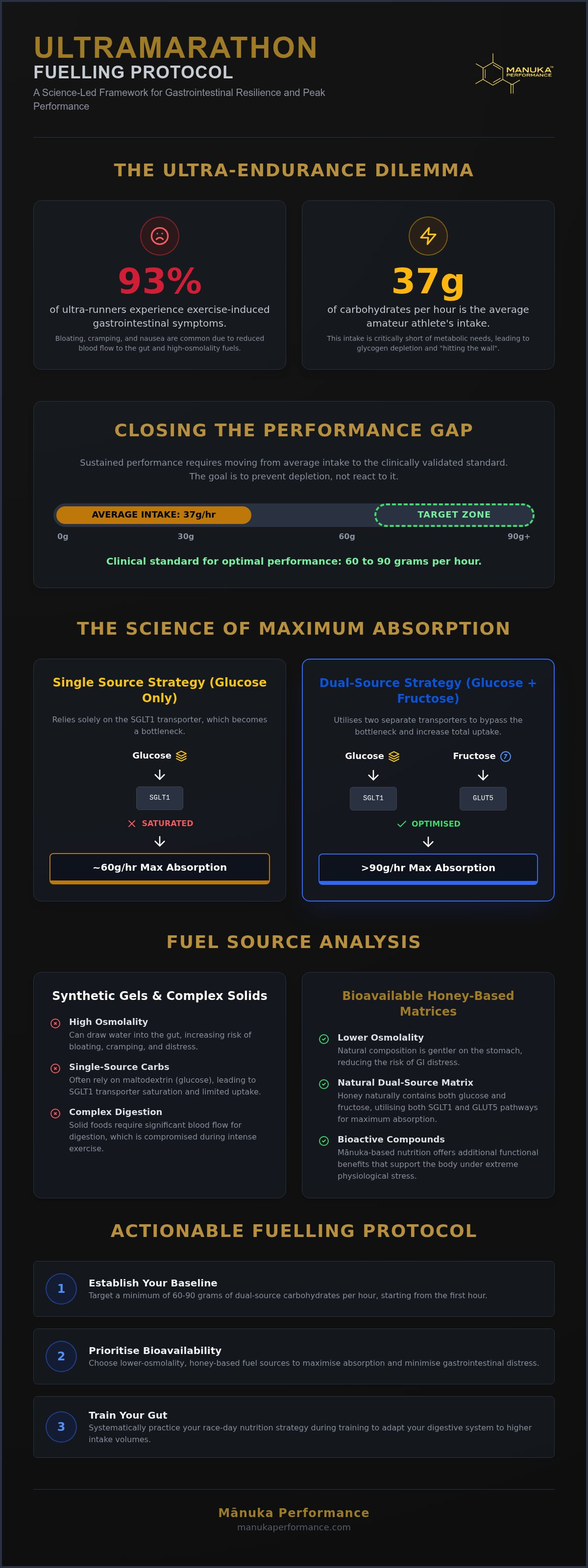
Research confirms that over 93 percent of ultramarathon participants endure exercise-associated gastrointestinal symptoms, yet the average amateur athlete maintains a consumption rate of only 37 grams of carbohydrates per hour, a volume that falls critically short of metabolic requirements. Most endurance runners acknowledge the frustration of "hitting the wall" or managing severe gastric distress, frequently finding themselves caught between the harshness of synthetic gels and the unpredictability of natural sources. You understand that maintaining systemic integrity over a 12 plus hour event requires more than simple caloric intake; it demands a precise biochemical strategy. This guide provides a clinical framework to master your ultramarathon carbohydrate intake per hour, moving beyond speculative fuelling toward a validated, science-led protocol. We'll investigate the biological mechanisms of carbohydrate absorption, the necessity of dual-source energy matrices, and the specific quantification of hourly requirements for both elite and recreational athletes. By applying these rigorous standards to your fuelling strategy, you'll establish a repeatable methodology that ensures gastrointestinal resilience and stable energy levels from the starting line to the final kilometre.
Key Takeaways
- Understand the physiological necessity of a dual-source carbohydrate matrix, utilising both SGLT1 and GLUT5 transporters to maximise absorption and prevent metabolic depletion.
- Establish a precision-based protocol for your ultramarathon carbohydrate intake per hour, targeting the clinical standard of 60 to 90 grams to maintain performance over distances exceeding 50 kilometres.
- Evaluate the metabolic cost of various fuel sources, prioritising bioavailable honey-based matrices over complex solids to enhance gastrointestinal resilience and mitigate the risk of systemic distress.
- Discover how PolySure™ validated bioactives assist in managing the physiological rigours of ultra-endurance events, providing a quantified approach to functional nutrition.
The Physiological Demands of Ultra-Endurance: Why Strategic Fuelling is Essential
The metabolic demands of traversing distances exceeding 50 kilometres necessitate a transition from reliance on endogenous glycogen stores to a sophisticated integration of fat oxidation and exogenous substrate delivery. While the human body possesses significant adipose tissue reserves, the rate of energy liberation from fat is inherently insufficient to maintain the intensities required for competitive performance. Consequently, the central nervous system serves as a biological governor, modulating physical output based on real-time blood glucose concentrations to protect vital organ function. For athletes aiming for specific performance outcomes, relying on subjective hunger cues is a demonstrably failing strategy. Hunger is a lagging physiological indicator that often disappears under the systemic stress of ultra-endurance exertion, leading to a catastrophic energy deficit before the athlete recognises the requirement for intervention. Success in these events is therefore determined by metabolic efficiency, the ability to oxidise fat at higher intensities while preserving limited carbohydrate reserves.
Glycogen Depletion and the Biological Mechanism of the Bonk
Glycogen utilisation rates escalate significantly as intensity moves through aerobic thresholds, with most athletes exhausting their primary stores within two to three hours of sustained effort. When these stores reach critical depletion, the body experiences a systemic failure colloquially known as "the bonk," which is fundamentally a neuro-metabolic protective mechanism. To circumvent this decline, maintaining a precise ultramarathon carbohydrate intake per hour is mandatory to preserve liver glycogen and sustain blood glucose levels. Clinical consensus suggests that without consistent exogenous supplementation, the metabolic shift toward fat oxidation forces a significant reduction in pace, effectively capping the athlete's ceiling of performance. This requirement remains constant regardless of the athlete's perceived energy levels, as the objective is to prevent depletion rather than respond to it after the fact.
The Impact of Exercise-Induced Gastrointestinal Stress
The challenge of maintaining a high ultramarathon carbohydrate intake per hour is complicated by exercise-induced splanchnic hypoperfusion, where blood flow is diverted from the digestive tract to the working musculoskeletal system. This reduction in gastric blood flow, which can reach 80 per cent during peak exertion, severely compromises the gut's ability to process incoming nutrients and maintain epithelial integrity. High-osmolality synthetic gels, which frequently rely on concentrated maltodextrin and artificial additives, can exacerbate this issue by creating an osmotic imbalance that draws water into the intestinal lumen. This process results in the bloating, cramping, and nausea that affect over 93 per cent of ultra-runners. Transitioning to bioavailable, lower-osmolality fuel sources is essential for maintaining gastrointestinal resilience and ensuring that the consumed energy is actually absorbed into the bloodstream for use by the muscles.
Optimising Carbohydrate Absorption: The Science of the Glucose-Fructose Matrix
The rate-limiting factor in ultra-endurance performance is rarely the availability of fuel, but rather the efficiency of intestinal absorption. Traditional single-source carbohydrate strategies rely exclusively on the SGLT1 transporter, which typically reaches saturation at approximately 60 grams per hour. By introducing a dual-transport mechanism, athletes can bypass this biological bottleneck. Fructose utilises the independent GLUT5 transporter, allowing for a higher total oxidation rate without overwhelming the glucose-specific pathways. This synergy is critical for those aiming to increase their ultramarathon carbohydrate intake per hour beyond the standard thresholds to meet the extreme caloric deficits of long-distance racing.
The Dual-Source Advantage in Nutrient Transport
Utilising multiple transportable carbohydrates effectively expands the gut's capacity to process exogenous energy. When glucose and fructose are consumed in a 2:1 ratio, the total exogenous carbohydrate oxidation rate can increase by up to 50 per cent compared to glucose alone. This allows athletes to target an ultramarathon carbohydrate intake per hour of 90 grams or more, providing a sustained fuel supply for the working muscles during the latter stages of an event. The glucose-fructose matrix is a dual-substrate delivery system designed to bypass intestinal transporter saturation by utilising independent absorption pathways. This clinical approach reduces the volume of unabsorbed carbohydrates remaining in the lumen, which is a primary cause of osmotic diarrhoea and systemic discomfort.
Bioavailability and Osmolality of Honey-Based Matrices
While synthetic maltodextrin is often positioned as an industry standard, its molecular complexity requires additional enzymatic breakdown before absorption can occur. In contrast, the natural composition of New Zealand honey provides a sophisticated matrix of simple sugars alongside bioactive polyphenols. The liquid-phase nature of these natural structures facilitates rapid gastric emptying, ensuring that nutrients move efficiently into the small intestine. Research into the bioavailability of honey-based carbohydrate gels suggests that these matrices offer superior intestinal comfort due to their lower osmolality compared to highly concentrated synthetic alternatives. By selecting a fuel source with high bioavailability, you ensure that your fuelling protocol supports performance rather than hindering it through digestive distress. For those seeking a scientifically validated fuelling solution, exploring functional nutrition based on New Zealand honey offers a path toward greater gastrointestinal resilience.
Gastrointestinal Resilience: Navigating Solid Foods vs Bioavailable Gels
Choosing between solid food and liquid-phase nutrition during an ultra-endurance event is a clinical decision that directly impacts systemic energy availability. While "real food" is often promoted for its psychological familiarity, the physiological reality of digestion under stress is complex. Digestion is an energy-intensive process that requires significant parasympathetic activation, which is inherently at odds with the sympathetic dominance required for sustained locomotion. When you consume complex fats or fibrous solids mid-race, you're forcing the body to divert scarce oxygenated blood back to the gut, often resulting in malabsorption or systemic distress. Identifying your individual triggers for runner’s stomach is essential for maintaining a consistent ultramarathon carbohydrate intake per hour without compromising your pace.
The Case for Liquid and Gel-Based Nutrition
Liquid and gel-based protocols offer a distinct advantage by minimising the mechanical and chemical requirements of digestion. Honey-based gels, such as LiquidFuel, provide a pre-emulsified matrix that facilitates rapid gastric emptying and immediate intestinal transit. This efficiency is paramount when navigating technical terrain where the cognitive load is high and the opportunity for structured eating is limited. Building gastrointestinal resilience through consistent training with these bioavailable sources ensures that the gut remains capable of processing nutrients even as systemic fatigue increases. By prioritising liquid-phase nutrition, you maintain a steady-state glucose level, avoiding the erratic peaks and troughs associated with the slower breakdown of solid materials.
When to Incorporate Solid Food
Despite the efficiency of gels, events exceeding 12 hours often introduce the challenge of flavour fatigue and sensory saturation. In these instances, incorporating specific solids can serve a functional purpose beyond mere caloric delivery. The psychological act of chewing can provide a necessary cognitive reset, helping to manage the mental strain of long-duration trail events. However, selections must be strategic; prioritising low-fibre, high-GI solids ensures that the digestive cost remains manageable. You should view solid food as a supplement to your core gel-heavy protocol rather than a replacement. This balanced approach allows you to hit your target ultramarathon carbohydrate intake per hour while managing the sensory demands of the race. It's about finding the intersection between metabolic efficiency and psychological endurance.
Designing Your Ultramarathon Nutrition Protocol: A Step-by-Step Framework
Establishing a clinical protocol requires a shift from reactive eating to proactive substrate management. Your ultramarathon carbohydrate intake per hour should be calibrated against the anticipated metabolic flux and total duration of the event. A baseline of 60 to 90 grams per hour is the current scientific consensus for maintaining performance; however, elite competitors often target 120 grams when utilising a dual-source matrix. This protocol must be supported by a rigorous pre-race phase. Success is predicated on strategic carbohydrate loading to ensure maximum glycogen saturation before the first kilometre. Precision is paramount. You must move beyond generic estimates toward a quantified, phased approach that accounts for the physiological shifts occurring over 100 kilometres or more.
Phase 1: The First 4 Hours of High-Intensity Fuelling
The initial four hours represent the period of highest gastrointestinal resilience. During this phase, you should target the upper limit of your ultramarathon carbohydrate intake per hour to preserve endogenous stores for the later stages. Utilising honey-based gels like LiquidFuel allows for high-density caloric delivery without the osmotic load associated with synthetic maltodextrin. Establishing a consistent hydration rhythm here is critical; water intake must be sufficient to support the transport of these exogenous carbohydrates across the intestinal wall. By maintaining a little and often approach, you avoid the insulin spikes and subsequent hypoglycaemic dips that can occur with large, infrequent boluses of sugar.
Phase 2: Middle Miles and Palate Fatigue Management
As the race progresses into the middle miles, sensory saturation often leads to palate fatigue, which can compromise fuelling consistency. Managing this requires a strategic introduction of flavour variety while strictly adhering to your hourly carbohydrate targets. Monitoring sodium levels becomes increasingly vital during this transition. Sodium is not merely an electrolyte for hydration; it is a functional co-transporter. The SGLT1 transporter is sodium-dependent, meaning that adequate salt intake is required to facilitate the active transport of glucose into the bloodstream. Without sufficient sodium, even the most precise carbohydrate protocol will fail due to malabsorption in the small intestine. To refine your personalised strategy, you can view the clinical specifications of honey-based functional nutrition to see how bioavailable matrices support long-range performance.
Leveraging Bioactive Innovation: The Role of Mānuka-Based Functional Nutrition
The integration of advanced analytical standards into sports nutrition represents a significant departure from traditional, synthetic-based fuelling strategies. While establishing a precise ultramarathon carbohydrate intake per hour is fundamental to performance, the quality of the delivery matrix determines the athlete's systemic resilience over extended durations. PolySure™ serves as the clinical benchmark for this innovation, providing a validated analytical standard that quantifies seven specific naturally occurring polyphenols within the New Zealand honey matrix. This level of precision allows for a sophisticated approach to fuelling that addresses the physiological consequences of ultra-endurance exertion beyond simple glycogen replacement. Mānuka Performance operates at this intersection of biotechnology and natural provenance, ensuring that every gram of carbohydrate is supported by measurable bioactive compounds.
Beyond Simple Sugars: The Power of Polyphenols
The prolonged physical stress of an ultramarathon induces significant oxidative stress and systemic inflammation, factors that frequently lead to performance degradation. Phytochemicals, specifically the polyphenols found in high-grade New Zealand honey, provide a biological mechanism to support the body's internal defences during these periods of extreme load. We've witnessed a profound evolution of sports nutrition biotechnology, moving away from isolated synthetic sugars toward matrices that prioritise metabolic health and intestinal integrity. The analytical validation provided by PolySure™ ensures that these bioactives are present in concentrations sufficient to exert a functional effect, offering a level of rigour previously reserved for pharmaceutical applications. This evidence-based methodology provides athletes with the confidence that their fuelling protocol is optimised for the specific biochemical demands of long-range racing.
LiquidFuel: The Professional Athlete’s Choice
Logistical efficiency is as critical as nutritional density when managing a 100 kilometre event, where the cognitive ability to manage complex fuelling schedules often diminishes. LiquidFuel is engineered to address these operational challenges, offering a clean-label, honey-based matrix that is both highly portable and physiologically superior to maltodextrin alternatives. The 10-pack configuration provides a structured framework for maintaining a consistent ultramarathon carbohydrate intake per hour, allowing for precise titration of energy throughout the race. By selecting a product that prioritises gut health and rapid bioavailability, athletes can mitigate the risk of gastrointestinal failure while maintaining peak power output. You can now optimise your next race with Mānuka Performance LiquidFuel, ensuring your fuelling strategy is grounded in clinical innovation and natural efficacy.
Mastering Systemic Integrity Through Bio-Analytical Precision
Achieving a competitive edge in ultra-endurance racing requires a departure from speculative nutrition toward a quantified, bio-analytical protocol. By mastering your ultramarathon carbohydrate intake per hour through a dual-source glucose-fructose matrix, you bypass the biological limitations of single-transporter saturation and ensure sustained metabolic output. The integration of PolySure™ validated polyphenols further enhances this strategy, providing the systemic resilience needed to manage the oxidative stress of long-range exertion. Mānuka Performance remains at the forefront of New Zealand functional nutrition, bridging the gap between raw natural provenance and rigorous clinical biotech. This research-led approach prioritises gastrointestinal integrity and bioavailability, allowing you to maintain peak performance without the systemic compromises of synthetic alternatives. To implement these scientific standards in your next event, you can secure your LiquidFuel 10-Pack for your next ultra and experience the efficacy of bio-analytical research excellence. Refine your methodology, trust the data, and prepare to redefine your limits on the trail.
Frequently Asked Questions
How many grams of carbohydrates should I eat per hour during an ultramarathon?
Clinical evidence indicates that an optimal ultramarathon carbohydrate intake per hour ranges between 60 and 90 grams for most endurance athletes. Elite competitors often push this threshold to 120 grams by utilising dual-transportable carbohydrate matrices. This volume ensures blood glucose stability and preserves endogenous glycogen. Individual absorption rates vary based on body mass, training status, and gastrointestinal tolerance, necessitating a personalised titration during long-range training sessions to determine your specific metabolic ceiling.
Can I run an ultramarathon on real food alone?
While completing an ultramarathon on solid food is possible, it's often physiologically inefficient due to the high metabolic cost of digestion. Under systemic stress, blood flow is diverted from the gut to working muscles, which significantly impairs the breakdown of complex fibres and fats. This often results in malabsorption and delayed gastric emptying. For sustained performance, a protocol prioritising bioavailable liquid-phase nutrition ensures immediate substrate delivery without the gastrointestinal burden associated with solid materials.
Why do energy gels cause stomach upset during long runs?
Gastrointestinal distress is frequently caused by the high osmolality of synthetic maltodextrin-based gels, which can create an osmotic imbalance in the intestinal lumen. This process draws water into the gut, leading to bloating, cramping, and nausea. Additionally, relying on single-source carbohydrates can saturate the SGLT1 transporter, leaving unabsorbed sugars to ferment. Transitioning to a natural, honey-based matrix with lower osmolality facilitates smoother gastric transit and reduces the likelihood of exercise-associated gastrointestinal symptoms.
Is honey a better energy source than maltodextrin for runners?
Honey provides a naturally occurring glucose-fructose matrix that utilises dual absorption pathways, offering a sophisticated alternative to isolated synthetic maltodextrin. Unlike synthetic sources, New Zealand honey contains bioactive polyphenols, validated by the PolySure™ standard, which support systemic resilience. The lower osmolality of honey-based gels facilitates faster gastric emptying, ensuring that your ultramarathon carbohydrate intake per hour remains consistent without the digestive bottlenecks often associated with highly processed, single-source carbohydrate structures.
How do I prevent palate fatigue during a 100km race?
Preventing palate fatigue requires a strategic rotation of flavour profiles and textures to manage sensory saturation over extended durations. While maintaining your carbohydrate targets is paramount, alternating between sweet, neutral, and slightly salty options can prevent the cognitive aversion to fuelling that often occurs after 12 hours of racing. Incorporating low-fibre, high-GI solid snacks at specific intervals can also provide a psychological reset, provided the primary caloric intake remains focused on bioavailable, liquid-phase nutrition.
What should I eat on the morning of an ultramarathon?
Your pre-race meal should focus on high-glycaemic, low-fibre carbohydrates to ensure maximum glycogen saturation without inducing gastrointestinal distress. Clinical recommendations suggest consuming 1 to 4 grams of carbohydrate per kilogram of body mass approximately three to four hours before the start. Options such as white rice, oats, or white bread with honey are ideal as they're rapidly processed. This meal serves to top up liver glycogen stores that have been depleted during overnight fasting.
Do I need to take electrolytes if I am using honey-based energy gels?
Supplementing with electrolytes remains essential, particularly sodium, which acts as a functional co-transporter for glucose absorption. The SGLT1 transporter is sodium-dependent; therefore, maintaining adequate sodium concentrations in the small intestine is critical for the active transport of carbohydrates into the bloodstream. While honey-based gels provide a superior energy matrix, an integrated electrolyte strategy ensures optimal hydration status and prevents hyponatremia during events where sweat rates and total duration are significantly elevated. Sourcing these essential components from reliable providers such as My Whey can help athletes maintain the rigorous standards required for ultra-endurance success.
Testing your fuelling protocol requires performing gut training during long-duration sessions that mimic race-day intensity and environmental conditions. You should systematically increase your carbohydrate intake over several weeks to adapt the intestinal transporters to higher volumes. Monitoring your subjective gastrointestinal comfort alongside objective performance data allows you to refine your hourly targets. This methodical approach ensures that your race-day strategy is grounded in proven individual tolerance rather than theoretical estimates or generic guidelines.