


Discover how analytical validation of honey polyphenols transforms natural endurance fuelling from a generic carbohydrate into a precision performance tool.
Beyond MGO: Why Polyphenol Validation is the New Standard for Performance Honey
In the world of elite sports nutrition, precision is paramount. Athletes and their support teams scrutinise every component of fuelling and recovery protocols, seeking marginal gains that translate to competitive advantages. While honey has long been recognised as a natural carbohydrate source, its role has been fundamentally redefined by the advent of analytical validation. The term polyphenol validated honey signifies a critical evolution: the transition of honey from a variable agricultural product into a standardised, research-driven bioactive matrix engineered for high-performance applications.
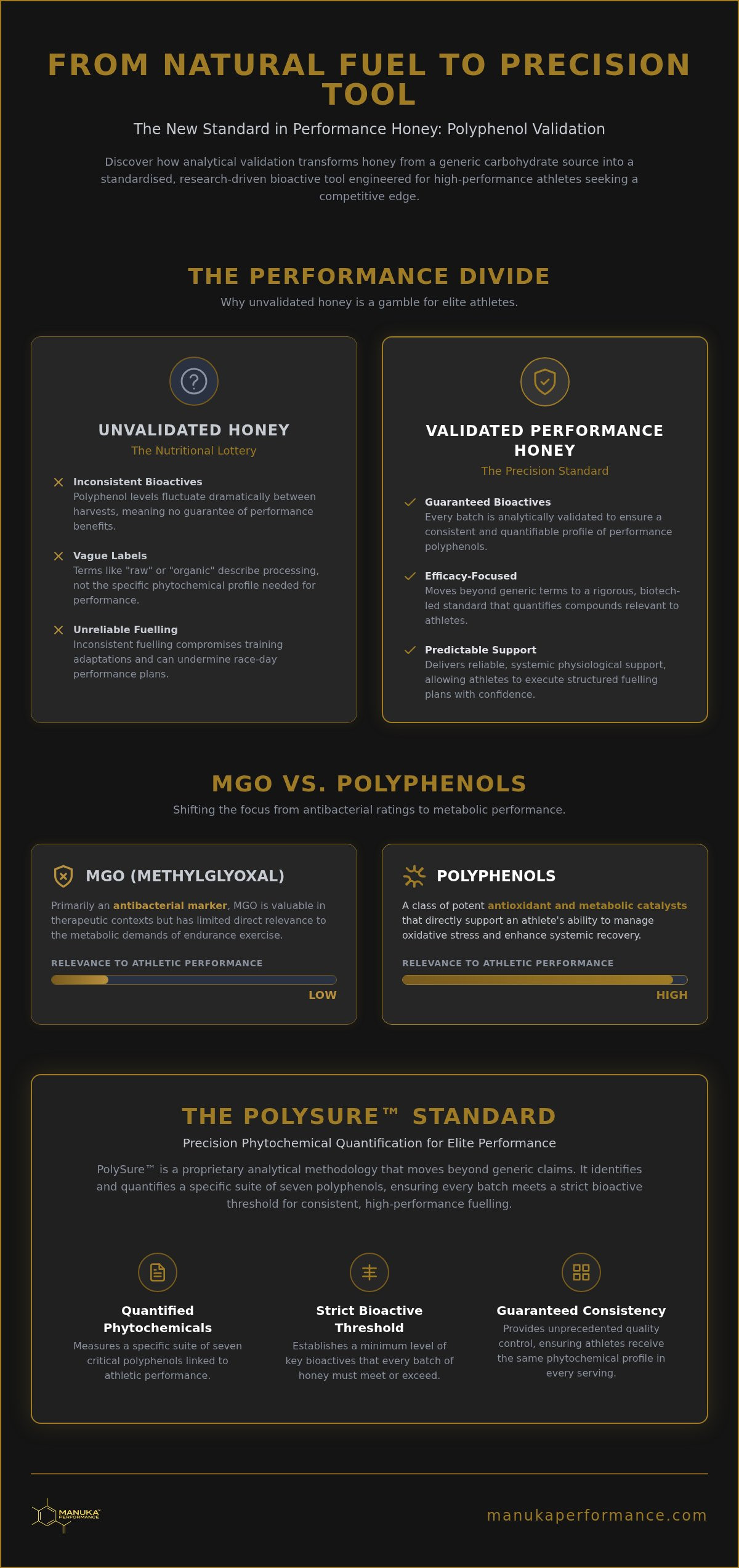
Historically, the conversation around high-performance honey, particularly from New Zealand, has been dominated by the Methylglyoxal (MGO) rating. MGO is a marker primarily associated with non-peroxide antibacterial activity, a valuable attribute in therapeutic contexts but one that holds limited direct relevance to the metabolic demands of an endurance athlete. For performance nutrition, the focus must shift from antimicrobial properties to the compounds that support energy metabolism, manage physiological stress, and contribute to systemic recovery. This is where polyphenols—a diverse class of plant-derived phytochemicals—become the central figures. Validation addresses the inherent variability found in natural ingredients, ensuring that every batch of honey delivers a consistent and quantifiable profile of these performance-oriented bioactives. It moves the standard from traditional food production to the rigorous domain of functional sports biotechnology.
The Problem with Unvalidated Natural Ingredients
The appeal of natural, whole-food ingredients in sports nutrition is undeniable, yet it presents a significant challenge for athletes who depend on consistency. The phytochemical density of honey is influenced by a myriad of environmental factors, including the specific floral source, geographical location, soil composition, and seasonal conditions. Consequently, two batches of honey from the same apiary, let alone different regions, can exhibit vastly different bioactive profiles.
- Variability in phytochemical density: The concentration of key polyphenols can fluctuate dramatically between harvests. This inconsistency means that an athlete using an unvalidated honey product is essentially engaging in a nutritional lottery, with no guarantee of receiving the bioactive compounds that support their performance and recovery goals.
- Insufficiency of "raw" or "organic" labels: While terms like "raw" and "organic" refer to processing methods and agricultural practices, they do not provide any information about the honey's specific phytochemical composition. These labels do not guarantee performance efficacy because they do not involve the quantification of bioactive compounds.
- The risk of inconsistent fuelling: For an elite athlete, inconsistent fuelling can compromise training adaptations and race-day performance. When bioactive compounds are not measured and standardised, the athlete cannot rely on their nutritional strategy to deliver predictable physiological support, undermining the very principle of a structured fuelling plan.
Distinguishing MGO from Performance-Led Polyphenols
Clarifying the distinction between MGO and polyphenols is essential for any serious athlete or sports nutritionist. The market has become accustomed to associating high MGO ratings with premium honey, but this paradigm is insufficient for the specific demands of sports performance. Understanding their different roles allows for more intelligent and targeted nutritional strategies.
- MGO as an antimicrobial marker: Methylglyoxal is a compound recognised for its potent antibacterial properties. While this makes it a focal point for topical applications and general wellness, its function is not directly aligned with the primary needs of an athlete during intense exercise, which are energy delivery and the management of exercise-induced physiological stress.
- Polyphenols as metabolic catalysts: Polyphenols, in contrast, are a broad class of compounds that function as powerful antioxidants and support various metabolic pathways. Their role in sports nutrition is linked to their capacity to help manage oxidative stress, a natural consequence of high-volume endurance exercise. Athletes should therefore prioritise products with a high, validated antioxidant capacity over those with a high antibacterial rating.
- The role of quantified bioactives: Quantified bioactives, specifically validated polyphenols, offer a more sophisticated approach to nutrition. By ensuring a consistent dose of these compounds, clean-label sports nutrition moves beyond simple caloric provision to offer systemic physiological support, addressing the complex biochemical aftermath of intense physical exertion.
The Biochemistry of PolySure™: Quantifying Seven Critical Phytochemicals
To transform honey into a reliable instrument for sports nutrition, a rigorous analytical standard is required. PolySure™ represents this standard—a proprietary methodology developed to move beyond generic antioxidant claims and into the realm of precise phytochemical quantification. It is a system designed to identify and measure a specific suite of seven polyphenols that are intrinsically linked to the bioactivity relevant to athletic performance. This biotech-led approach ensures that the natural potential of honey is not just preserved but also precisely calibrated.
The PolySure™ standard establishes a strict bioactive threshold that every batch of honey must meet before it can be used in performance formulations. This process provides an unprecedented level of transparency and quality control, guaranteeing that athletes receive a consistent phytochemical profile in every single serving. The selection of New Zealand's unique ecosystem as the source for this honey is deliberate; its distinct flora contributes to the production of honey with a naturally high density of the specific polyphenols targeted by the PolySure™ validation process. This synergy between unique provenance and advanced analytical science is what defines the next generation of natural performance fuel.
The PolySure™ Analytical Process
The integrity of any validation system rests on the sophistication of its methodology. The PolySure™ process employs advanced laboratory techniques to create a detailed, quantitative map of the honey's bioactive landscape, ensuring a level of precision that is essential for elite-level nutrition.
- Utilising advanced chromatography: The core of the PolySure™ standard involves High-Performance Liquid Chromatography (HPLC). This powerful analytical technique separates, identifies, and quantifies each component in a mixture. It allows scientists to pinpoint the exact concentration of the seven target polyphenols, creating a unique phytochemical signature for each batch.
- Moving from "presence" to "quantification": Many functional foods claim to contain beneficial compounds, but PolySure™ elevates this by moving from the mere confirmation of "presence" to the precise "quantification" of their concentration. This is the defining difference between a generic natural food and a high-performance nutritional tool.
- The rigour of third-party validation: To ensure complete objectivity and adherence to the highest scientific standards, the analytical process is subject to rigorous oversight. This commitment to third-party validation is a cornerstone of sports biotechnology, providing athletes and nutritionists with the confidence that the product's claims are backed by empirical data.
Why Seven Polyphenols Matter
The decision to validate a profile of seven specific polyphenols, rather than a single marker or a generic "total polyphenol content," is based on a deeper understanding of biochemical synergy. The effectiveness of these compounds is not merely additive; their interactions within the body's complex systems can produce a broader and more robust physiological response.
- The synergistic effect of a broad-spectrum profile: Nature rarely works in isolation. A diverse profile of polyphenols can interact synergistically, meaning their combined effect is greater than the sum of their individual parts. This broad-spectrum approach is designed to provide more comprehensive support for the body's intricate network of metabolic and recovery systems.
- Targeting specific markers that correlate with athletic resilience: The seven polyphenols measured by the PolySure™ standard have been selected based on scientific literature that suggests their relevance to the physiological challenges faced by endurance athletes. These markers are associated with the body's ability to manage oxidative stress and support cellular integrity during and after prolonged physical effort.
- Ensuring the integrity of the honey matrix: The validation process also serves as a quality control measure to ensure the natural honey matrix has not been compromised during formulation. By confirming the presence and concentration of these seven delicate compounds, the standard guarantees the overall integrity and bioactivity of the final product.
Mechanisms of Recovery: How Validated Polyphenols Support Endurance Athletes
Prolonged and intense endurance exercise, such as marathon running or triathlon, places enormous metabolic stress on the body. A key consequence of this stress is the generation of reactive oxygen species (ROS), or free radicals, which can overwhelm the body's natural antioxidant defences. This state, known as exercise-induced oxidative stress, is a significant factor in muscle fatigue, cellular damage, and delayed recovery. A sophisticated fuelling strategy must therefore extend beyond carbohydrate replacement to address this biochemical challenge.
Measured polyphenols, delivered in a consistent dose via polyphenol validated honey, are uniquely positioned to support the body's management of this stress. These compounds can function as secondary scavengers of free radicals, complementing the body's endogenous antioxidant enzymes like superoxide dismutase and glutathione peroxidase. There is a direct relationship between the density of these phytochemicals and the potential for systemic recovery support. By incorporating a quantified intake of bioactives into their fuelling protocol, particularly within the critical post-exercise "recovery window," athletes can provide their bodies with the specific nutritional tools needed to manage the physiological aftermath of high-intensity training and competition.
Mitigating Exercise-Induced Oxidative Stress
Every high-intensity training session or competition takes a physiological toll, particularly at the cellular level. Understanding how to support the body's natural defence mechanisms is crucial for long-term performance and athletic longevity. A key part of this is addressing the biochemical cascade of oxidative stress.
- The physiological toll of high-intensity training: During intense exercise, oxygen consumption can increase 10- to 20-fold. This metabolic acceleration leads to a surge in ROS production, which can damage cell membranes, proteins, and DNA if left unchecked, contributing to the feeling of being unable to maintain pace, often described as "hitting the wall."
- Supporting endogenous antioxidant enzymes: Validated polyphenols do not simply replace the body's own antioxidant systems; they support them. These phytochemicals can help preserve the function of the body's primary enzymatic antioxidants, allowing for a more sustained and effective response to oxidative stress over the duration of an endurance event.
- Addressing inflammatory markers: Intense exercise triggers a natural inflammatory response, which is a necessary part of the adaptation and repair process. The bioactives within validated honey can help support the body's ability to modulate this response, contributing to a more efficient recovery cycle and reducing the prolonged soreness associated with micro-trauma to muscle tissue.
Bioavailability and the Honey Matrix
The efficacy of any nutritional compound is ultimately determined by its bioavailability—the proportion of the substance that enters the circulation and is able to have an active effect. One of the significant advantages of sourcing polyphenols from a natural honey matrix is their enhanced bioavailability compared to isolated, synthetic supplements.
- Enhanced absorption in a natural matrix: Polyphenols delivered in honey are part of a complex food matrix that includes enzymes, organic acids, and other micronutrients. This natural synergy can protect the compounds from degradation in the digestive tract and facilitate their absorption into the bloodstream. For a deeper dive into this topic, explore this clinical performance analysis of honey-based carbohydrate gels.
- The role of dual-source carbohydrates: The natural glucose-fructose matrix of honey not only provides a sustained energy release but also plays a role in nutrient transport. The specific transporters in the gut responsible for absorbing these sugars may also facilitate the uptake of the accompanying polyphenols, ensuring they are delivered efficiently to the body.
- Surviving the digestive process: The unique chemical structure of the honey matrix helps buffer the polyphenols against the harsh acidic environment of the stomach. This protective effect ensures that a greater quantity of these valuable phytochemicals survives the digestive process to reach the small intestine, where they can be absorbed and utilised by the muscles and other tissues.
Analysing the Matrix: Comparing Validated Honey to Synthetic Energy Gels
For decades, the endurance sports market has been dominated by synthetic energy gels, typically formulated with maltodextrin, artificial flavours, and preservatives. While effective at delivering simple carbohydrates, these products often come with significant drawbacks, most notably gastrointestinal (GI) distress. The introduction of polyphenol validated honey as a fuelling source offers a compelling alternative, contrasting a natural, bioactive matrix with a purely synthetic one.
The comparison extends beyond just the carbohydrate source. Validated honey provides a dual-source energy profile of glucose and fructose for efficient absorption, but it also delivers a quantifiable payload of "non-caloric" bioactives—the polyphenols—that synthetic gels lack entirely. This added value represents a paradigm shift in fuelling philosophy: moving from a simple energy replacement model to a holistic approach that simultaneously fuels performance and supports the body's physiological resilience. This makes it a superior choice for athletes seeking both performance and well-being from their nutrition.
Gastrointestinal Resilience and Absorption
One of the most common complaints among endurance athletes is GI distress, often referred to as "runner's stomach." This can range from mild discomfort to race-ending nausea and cramping, and it is frequently linked to the consumption of high-concentration synthetic gels.
- The cause of GI distress with synthetic gels: Many synthetic gels are formulated with long-chain carbohydrates like maltodextrin, which can have a high osmolality. This draws water into the gut, leading to bloating, cramping, and discomfort, especially when the body is already under the stress of intense exercise.
- The osmotic balance of honey: Honey's natural blend of fructose and glucose is gentler on the digestive tract. Its lower osmolality compared to many synthetic alternatives means it is less likely to cause the fluid shifts that trigger GI issues, allowing for smoother and more comfortable fuelling during long events.
- Improving nutrient uptake: The natural, enzyme-rich matrix of honey supports efficient digestion and absorption. This not only applies to its carbohydrates but also to the co-delivered polyphenols, ensuring the athlete receives the full spectrum of benefits from their fuel source. More information on this can be found in this analysis of natural honey-based energy gels.
The Performance Advantage of Clean Label Standards
The "clean label" movement is gaining significant traction in sports nutrition, as athletes become more discerning about the ingredients they consume. This philosophy aligns perfectly with the principles behind polyphenol validated honey, which prioritises purity, transparency, and performance efficacy.
- Eliminating unnecessary additives: Validated honey-based gels are free from the artificial thickeners, preservatives, colours, and flavours that are common in synthetic products. This minimalist approach reduces the chemical load on the body, allowing it to focus its resources on performance and recovery.
- A clinical focus on purity: The commitment to a clean label is not merely a marketing trend; it is a clinical decision. By eliminating extraneous ingredients, the formulation ensures that the active components—the carbohydrates and validated polyphenols—are delivered without interference, translating to better performance outcomes.
- The psychological confidence of validated fuel: Knowing that your fuel is not only effective but also pure and backed by rigorous laboratory validation provides a significant psychological advantage. This confidence allows an athlete to focus completely on their performance, trusting that their nutrition is fully optimised.
Implementing Precision Nutrition: The Mānuka Performance PolySure™ Standard
Mānuka Performance stands at the forefront of the shift towards precision sports nutrition, integrating advanced biotech research directly into its product development. The company operates not as a traditional honey packer but as a phytochemical innovation firm, with the PolySure™ standard serving as the cornerstone of its scientific platform. This commitment ensures that every product is built on a foundation of empirical data and analytical rigour, providing elite athletes with a fuelling solution that is both natural and scientifically calibrated.
The LiquidFuel range serves as a prime case study in the application of this philosophy. It demonstrates how polyphenol validated honey can be formulated into a convenient, effective, and reliable fuelling tool for endurance training and competition. By transitioning to a phytochemical-led nutrition plan, athletes can move beyond generic fuelling and embrace a more sophisticated strategy that supports performance on multiple physiological levels. This approach represents the future of functional nutrition, where the power of nature is unlocked through the precision of science.
LiquidFuel: More Than Just Carbohydrates
The Mānuka Performance LiquidFuel gel is the tangible result of the PolySure™ standard, designed to meet the exacting needs of endurance athletes. Each sachet is a self-contained unit of precision nutrition, delivering more than just a simple dose of sugar.
- The formulation of the LiquidFuel 10-Pack Running Gel: Each 45g sachet is formulated to provide an optimal blend of carbohydrates for rapid and sustained energy, all derived from a New Zealand honey-based matrix. The formulation is clean, simple, and highly functional.
- Ensuring phytochemical consistency: Thanks to the PolySure™ standard, Mānuka Performance can guarantee the bioactive content of every single gel. This consistency is crucial for athletes who need to build a reliable and repeatable nutrition plan for their training and racing.
- Testimonials from athletes: The efficacy of this standardised honey matrix is validated not only in the lab but also in the field. Elite athletes consistently report sustained energy levels, reduced GI distress, and a noticeable difference in their ability to recover from high-intensity efforts when using this clinically formulated fuel.
Choosing Validated Bioactives for Your Next Competition
Making the switch to a bioactive-led fuelling strategy is a decisive step towards optimising your athletic potential. It requires a new way of looking at nutrition labels and integrating products into your training protocol, moving beyond a focus on calories alone to consider the phytochemical value of your fuel.
- How to read a functional nutrition label: When selecting a sports gel, look beyond the carbohydrate count. Seek out products that specify the presence and, ideally, the quantity of bioactive compounds like polyphenols. A commitment to a standard like PolySure™ is a clear indicator of a product's superior quality.
- Integrating PolySure™ products into a protocol: For a marathon or triathlon, plan to consume a validated honey gel at regular intervals (e.g., every 45-60 minutes) to maintain consistent energy levels and provide ongoing bioactive support. It is always recommended to trial any new fuelling strategy in training before implementing it on race day.
- CTA: Explore the PolySure™ validated range at Mānuka Performance
Frequently Asked Questions
- What is the difference between MGO and polyphenol validation in honey?
- MGO (Methylglyoxal) is a compound measured primarily for its antibacterial properties and is relevant for therapeutic or wellness applications. Polyphenol validation, such as the PolySure™ standard, measures specific plant-derived compounds known for their antioxidant capacity and relevance to managing exercise-induced physiological stress, making it the superior metric for athletic performance.
- How does polyphenol validated honey support athletic recovery?
- Intense exercise generates oxidative stress. The quantified polyphenols in validated honey support the body's natural antioxidant defence systems, which helps manage this stress. This contributes to a more efficient recovery process by supporting cellular integrity and modulating the body's response to exercise-induced inflammation.
- Is polyphenol validated honey better for runners with sensitive stomachs?
- Many athletes find honey-based gels gentler on the digestive system than synthetic alternatives. Honey's natural glucose-fructose composition has a lower osmolality, which can reduce the risk of the gastrointestinal distress commonly associated with high-concentration maltodextrin gels.
- Why is New Zealand honey used for PolySure™ validation?
- New Zealand's unique and isolated ecosystem produces flora that results in honey with a naturally high concentration of specific, performance-relevant polyphenols. Mānuka Performance leverages this unique provenance as the foundation for its high-performance, validated products.
- Can I use validated honey gels for marathon fuelling?
- Absolutely. Polyphenol validated honey gels are ideally suited for marathon fuelling. They provide a sustained release of dual-source carbohydrates for energy, while the validated bioactives support the body's systems over the long duration of the event. It is recommended to follow a consistent fuelling schedule, such as one gel every 45-60 minutes.
- How many polyphenols are measured in the PolySure™ standard?
- The PolySure™ analytical standard precisely quantifies a profile of seven specific, naturally occurring polyphenols to ensure a consistent and broad-spectrum bioactive payload in every product.
- Does the validation process affect the taste or texture of the honey?
- No, the validation process is purely analytical. It is a laboratory measurement performed on a sample of the honey and does not involve altering the product itself. The natural taste and smooth texture of the honey are preserved.
- Are there any synthetic additives in polyphenol validated sports gels?
- High-quality, polyphenol validated sports gels, such as those from Mānuka Performance, adhere to clean-label standards. They are formulated without synthetic additives, artificial thickeners, preservatives, or flavours, delivering pure, functional nutrition.
Upgrade your endurance fuel with PolySure™ validated honey
Disclaimer: These statements have not been evaluated by the Food and Drug Administration. This product is not intended to diagnose, treat, cure, or prevent any disease. The information provided in this article is hosted and and intended for the U.S market and may not align with the specific legislation or regulatory frameworks in your region. Please consult with a healthcare professional or sports nutritionist before making any changes to your diet or exercise regimen.