


What does a “natural” label actually tell you about a sports nutrition product? If you’re comparing natural sports nutrition New Zealand options, the ingredient list and product details matter more than broad claims about being clean-label or minimally processed. Look for information about ingredients, origin, composition and intended use.
It’s reasonable to want straightforward ingredients and a fuelling format that suits your training. The challenge is comparing products when labels use broad terms without explaining what they mean. This guide sets out practical criteria for assessing ingredient transparency, provenance, evidence and fit, so you can make a more informed choice without treating “natural” as proof of a particular benefit.
Format and fuelling demands also affect which product may suit your routine. Mānuka Performance’s LiquidFuel 10-Pack Running Gel uses a New Zealand honey-based matrix containing naturally occurring glucose and fructose. Its PolySure™ analytical standard validates seven naturally occurring polyphenols in the finished product. These details describe composition, not a guaranteed athletic outcome. Use them as part of a broader assessment of natural sports nutrition.
Key Takeaways
- Assess natural sports nutrition New Zealand products by their ingredients and evidence, not broad label claims.
- Distinguish where a product is made from where its ingredients come from, and look for clear information about composition.
- Compare formats against your training context, including portability and how you prefer to fuel during endurance activity.
- Use a simple selection process: define your needs, compare formats, review ingredients and evidence, then consider your preferences and tolerance.
- Mānuka Performance connects New Zealand ingredients with analytical measurement. Its composition data should be distinguished from claims about athletic outcomes.
What natural sports nutrition in New Zealand means for athletes
Natural sports nutrition is a category of products positioned around naturally derived ingredients or less-processed formulations. It is not a regulated guarantee that a product suits every athlete or is effective for a particular purpose. For athletes in New Zealand, the label is a starting point, not a substitute for assessing composition, intended use and practical fit.
“Natural” can describe how a product is presented without explaining how its ingredients are sourced, measured or combined. “New Zealand-made” and “New Zealand-sourced” also mean different things: the first describes where a product is made, while the second refers to the origin of one or more ingredients. Neither phrase alone establishes the provenance of every part of a formulation.
What does “natural” tell you about a sports nutrition product?
For food products in New Zealand, “natural” has no specific legal definition, so it isn’t a standardised measure of quality. Under the Fair Trading Act 1986, business claims must be substantiated and not misleading. In practice, assess the ingredient list and product information rather than treating “natural”, “clean” or “premium” as evidence in themselves.
Ingredient descriptions are different from claims about outcomes. A statement about an ingredient’s origin or presence describes composition. A claim that a product improves health or performance makes a different assertion and requires its own evidence. Keeping these categories separate helps you judge what the label establishes.
Why do endurance athletes use sports nutrition?
Fuelling is one part of a broader approach that includes training, everyday eating and individual preferences. The wider field of sports nutrition considers how nutrition relates to physical activity. Specialised products are designed for particular contexts, rather than to replace a varied dietary pattern.
For endurance activity, convenience can matter. A portable format may be practical during exercise, while other foods may fit more easily into a meal. Neither is universally preferable. Consider intended use, composition, ease of carrying and your own preferences when deciding whether a format fits your routine.
Sports nutrition products are also distinct from everyday foods, general wellness supplements and raw table honey. While wellness brands like Coretribe focus on natural health supplements for daily vitality, products formulated specifically for sports use have a defined, immediate training context. A food ingredient’s origin doesn’t, by itself, make the finished sports product equivalent to that ingredient in its unformulated form.
For a closer look at how a honey-based format can be assessed for endurance use, explore this natural honey-based energy gel analysis. It moves from broad category language to the composition and intended use of a specific product.
How to assess ingredients, provenance and measurable evidence
Assess product information by separating three questions: where was it made, where did its ingredients come from, and what has been analytically measured in the finished formulation? Each answer tells you something different. A New Zealand manufacturing statement describes production location; it doesn’t automatically establish the origin of every ingredient or the composition of the final product.
Provenance tells you where an ingredient comes from; analytical validation tells you what a defined method has confirmed in the finished product. Neither replaces the other. Together, they can provide a clearer picture than general descriptors such as “pure”, “premium” or “high quality”, as long as the product information specifies what is being described.
Which ingredient and sourcing details are useful to compare?
Start with the named ingredients and their stated roles. These details help you understand what is in the product and how the formulation is presented for its intended use. Then distinguish the finished product’s manufacturing location from the origin of particular ingredients. A New Zealand company or a made-in-New-Zealand statement doesn’t, by itself, mean every ingredient is locally sourced.
Look for wording that identifies an ingredient and its provenance specifically. Don’t infer origin from a brand’s location or imagery. If the wording is broad, treat it as broad: “New Zealand-made” and “New Zealand-sourced” aren’t interchangeable descriptions.
What does measurable composition add to natural sports nutrition?
An analytical standard can make a composition statement more specific by defining what is validated. This can help when comparing natural sports nutrition New Zealand products, but interpret it within its scope. Evidence about composition isn’t, by itself, evidence of a health effect, faster recovery or improved athletic performance.
Mānuka Performance’s PolySure™ analytical standard validates seven naturally occurring polyphenols in the finished product. That’s a defined compositional point, not a promise about what an athlete will experience. Further context on quantified honey bioactives can help explain how measurement contributes to product analysis without being mistaken for an outcome claim.
When comparing labels or product descriptions, use this evidence check:
- Identify the claim: Is it about manufacturing location, ingredient origin or measured composition?
- Find the detail: Are the ingredients named, and is the measured component clearly specified?
- Keep the conclusion proportionate: Does the information establish origin or composition, or imply an additional outcome?
This approach keeps the evidence useful without asking it to prove more than it does. For an example of a New Zealand company combining natural ingredients with analytical science, explore Mānuka Performance’s sports nutrition work.
How natural sports nutrition options compare for endurance use
Format is a practical choice, not a measure of product quality. A gel, drink or bar may suit different sessions and preferences, but the word “natural” doesn’t establish that any option is right for you. Compare the product’s stated purpose and composition with how you plan to carry and use it.
How do gels differ from drinks, bars and other formats?
Formats differ in how they’re packaged and handled, although details vary by product. A gel is generally a compact, packaged option; a drink is carried as liquid, often in a bottle; and a bar is a solid food format. Chews and other products have their own packaging and handling considerations. These are format-level distinctions, not claims about nutrient content or effects.
Consider the session when narrowing down your preferences. Will you be moving continuously? Can you carry a drink? Do you prefer a solid format? These questions don’t prescribe a fuelling plan. They help identify which product information is most relevant to your circumstances.
| Format | Possible context to consider | Portability considerations | Composition information to look for |
|---|---|---|---|
| Gel | Endurance activity where a packaged format is under consideration | Check pack size and how it’s carried or opened | Named ingredients and any specific composition statements |
| Drink | Sessions where carrying a liquid format is practical | Consider the container needed and how it fits your setup | Ingredient list and any clearly stated composition details |
| Bar | Activity or preparation contexts where a solid format suits your preference | Review the packaging and how it can be carried | Named ingredients and the product’s stated purpose |
| Other packaged formats | Depends on the format and your intended use | Check handling and packaging information for that product | Look for specific details rather than broad promotional wording |
What should athletes compare before choosing a product?
Read the product information as a set of separate clues. The ingredient list describes what’s included, the stated purpose indicates the intended context, and packaging details help you judge practical use. A measurable composition statement is more specific than an adjective such as “clean” or “premium”, but it describes composition, not a guaranteed outcome.
Mānuka Performance’s LiquidFuel 10-Pack Running Gel is its flagship running and endurance product. It uses a New Zealand honey-based matrix containing naturally occurring glucose and fructose. Consider these ingredients alongside the intended context, rather than assuming that a natural positioning alone determines suitability. For more on individual preferences during running, see this guide to avoiding runner’s stomach issues.
Compare the label and packaging with your session and preferences. If you’re considering a honey-based running gel, Mānuka Performance’s endurance nutrition offers a New Zealand example to assess.
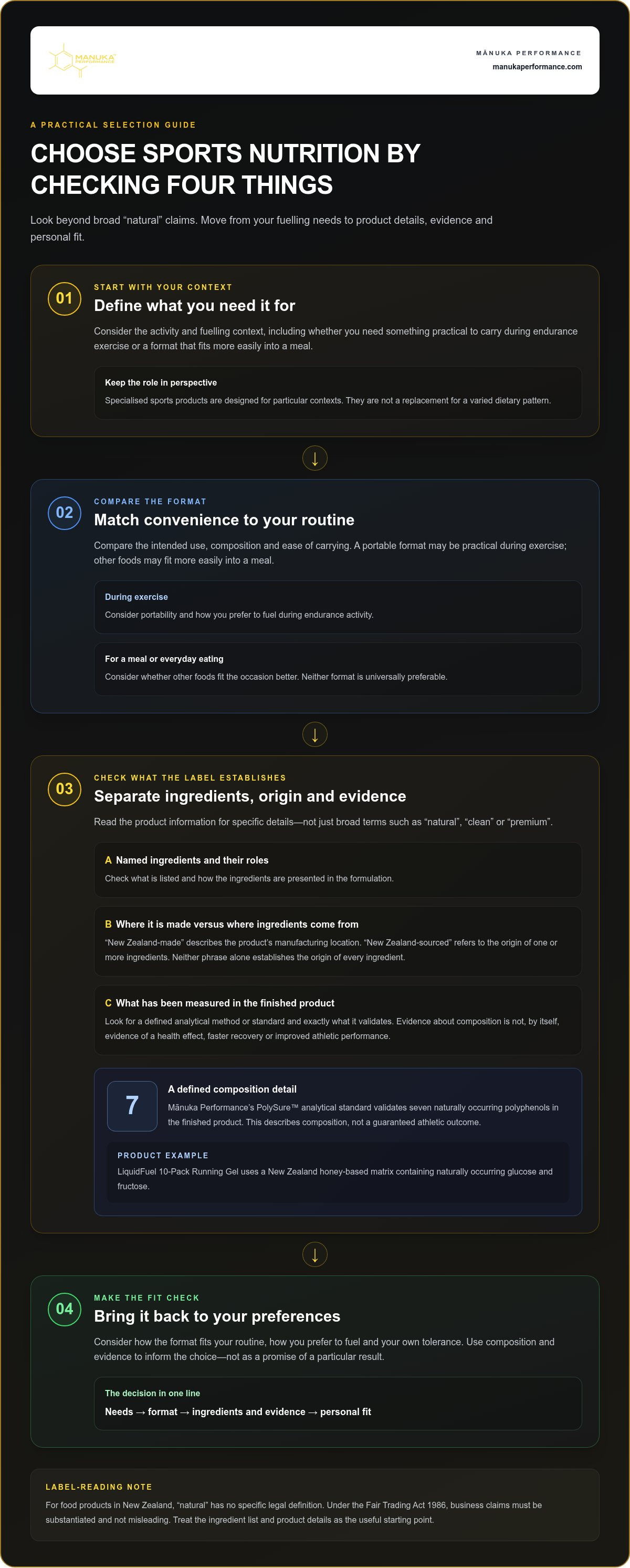
A practical checklist for choosing natural sports nutrition in New Zealand
Start with your training context, then compare formats, ingredients and evidence. This sequence makes natural sports nutrition New Zealand options easier to assess without treating a label claim as a recommendation or assuming one product suits every athlete.
Which questions should you answer before buying?
First, identify the activity and when a convenient nutrition format might fit. Consider the session setting, what you can carry and whether you prefer a gel, drink, bar or another format. Taste, packaging and ease of use matter too: practical fit depends partly on your own preferences.
How can you evaluate claims without overinterpreting them?
Separate descriptive wording from information you can assess. “Natural”, “local” and “clean label” aren’t proof of suitability on their own. A specific analytical measurement describes a defined aspect of composition; it doesn’t establish a health, recovery or performance outcome. Read each statement for what it confirms, rather than what its wording might suggest.
Use this checklist in order:
- Define the context. Identify the activity and when a convenient nutrition format may be useful, without assuming every session requires a specialised product.
- Compare formats. Consider portability, packaging, taste preference and how the format fits your training environment.
- Inspect the ingredients. Read the ingredient list and product information for named ingredients, their stated roles and the product’s intended use.
- Review the evidence. Distinguish ingredient-origin and manufacturing descriptions from measured composition, and distinguish both from claims about outcomes.
- Consider personal fit. Include your preferences and experience with the format, including your own tolerance.
This process grounds your decision in details you can compare. A broad adjective may describe a product’s positioning; a specific, substantiated statement gives you something more precise to assess. For a broader discussion of fuelling context, explore strategic carbohydrate loading for endurance athletes.
If a honey-based gel fits the format you’re considering, explore Mānuka Performance’s LiquidFuel 10-Pack Running Gel, its flagship running and endurance product.
Mānuka Performance: New Zealand natural sports nutrition informed by analysis
Mānuka Performance is a New Zealand functional nutrition company that combines natural ingredients with analytical science. Its products can be assessed through both their stated composition and the information used to describe that composition. When comparing natural sports nutrition New Zealand options, these details help you look beyond a broad category label and understand what a specific product contains and what has been validated.
What makes the LiquidFuel running gel relevant to this category?
LiquidFuel 10-Pack Running Gel is Mānuka Performance’s flagship running and endurance product. Its New Zealand honey-based matrix contains naturally occurring glucose and fructose. These details give you a concrete starting point for assessing a honey-based sports nutrition format in an endurance context.
The value of these details is their specificity, not a claim that the gel is superior to other products or suits every athlete. They identify the matrix and two naturally occurring components without requiring assumptions about quantities, directions for use or comparative effects. This keeps the product description proportionate to the information it provides.
How does PolySure™ connect natural ingredients with analytical science?
PolySure™ is an analytical standard that validates seven naturally occurring polyphenols in the finished product. This gives you a defined compositional point to consider alongside the ingredient description, while keeping it separate from evidence about health or athletic outcomes.
PolySure™ validates seven naturally occurring polyphenols in the finished product. This is a statement about composition, not a guarantee of health or performance outcomes. Analytical validation specifies what has been assessed; it shouldn’t be interpreted as proof of a particular experience during training or competition.
The honey-based matrix and PolySure™ provide two different kinds of product information. The first describes the ingredient base and naturally occurring glucose and fructose; the second concerns validation of polyphenols in the finished formulation. Neither detail establishes an unverified claim about recovery, endurance capacity or other results.
This reflects Mānuka Performance’s wider focus on combining natural ingredients with analytical science, alongside its work in bioactive ingredients and research-driven biotech solutions. For athletes comparing products, the example shows how to assess a specific formulation while keeping composition, intended context and outcome claims separate.
Consider LiquidFuel 10-Pack Running Gel, Mānuka Performance’s flagship running and endurance product, by reviewing its stated ingredients and analytical information as part of your product assessment.
Put a more informed fuelling choice into practice
Connect product information with the demands of your training. Before choosing, identify what you need a format to do practically, then compare its stated composition with the details that matter to you. That makes natural sports nutrition New Zealand a question of evidence and fit, not just a label.
Mānuka Performance applies this approach to its endurance range. Its flagship LiquidFuel 10-Pack Running Gel has a New Zealand honey-based matrix containing naturally occurring glucose and fructose, while PolySure™ validates seven naturally occurring polyphenols in the finished product. These are composition details, not promises of a particular athletic or health outcome.
To compare this New Zealand example with your preferences and training context, explore Mānuka Performance’s natural sports nutrition.
Frequently Asked Questions
Is natural sports nutrition as effective as conventional sports nutrition?
Neither category is inherently more effective. “Natural” describes positioning or ingredients, not a universal measure of effectiveness. Compare the specific product’s composition and intended use with your training context. A product designed for endurance fuelling may serve a different purpose from one intended for another setting. Product information isn’t a performance guarantee; a qualified sports dietitian can provide personalised guidance based on your circumstances.
Can natural sports nutrition provide carbohydrates for endurance exercise?
Some products are formulated as carbohydrate sources, but their amounts and composition vary. Check the nutrition information for the specific product rather than estimating from words such as “natural” or “honey-based”. Mānuka Performance describes its LiquidFuel running gel as using a honey-based matrix containing naturally occurring glucose and fructose. That identifies components, but it isn’t a fuelling prescription. Assess the product information in light of your own needs.
What is the difference between New Zealand-made and New Zealand-sourced sports nutrition?
“New Zealand-made” describes where a product is manufactured, while “New Zealand-sourced” refers to where an ingredient originates. A product made in New Zealand may contain ingredients from different places. Read product-specific information to understand whether a claim applies to the finished product or a named ingredient. Don’t infer that every ingredient is locally sourced from a brand’s New Zealand identity or manufacturing location.
Are natural sports nutrition products automatically free from additives?
No. The word “natural” doesn’t provide a complete ingredient specification or establish that a product contains no additives. Read the ingredient list and product description, paying attention to named ingredients rather than relying on broad category language. If you’re avoiding a particular ingredient, check the product-specific information for it. A general clean-label or natural positioning isn’t a substitute for that detail.
How should I trial a sports nutrition product before an event?
Assess an unfamiliar product during training rather than first using it on event day. Follow the manufacturer’s product information and note the format, session context, your preferences and how well it fits your routine. This is a practical way to learn about your own experience, not an individual nutrition prescription. If you have persistent concerns or specific dietary needs, seek guidance from a qualified health professional.
What does PolySure™ measure in Mānuka Performance products?
PolySure™ is Mānuka Performance’s analytical standard for validating seven naturally occurring polyphenols in the finished product. It provides a defined compositional measurement that can be distinguished from a broad ingredient description. The validation describes what is assessed; it doesn’t establish a health benefit, recovery effect or guaranteed athletic outcome. This distinction helps you interpret analytical information without assigning it a meaning beyond the measurement itself.