


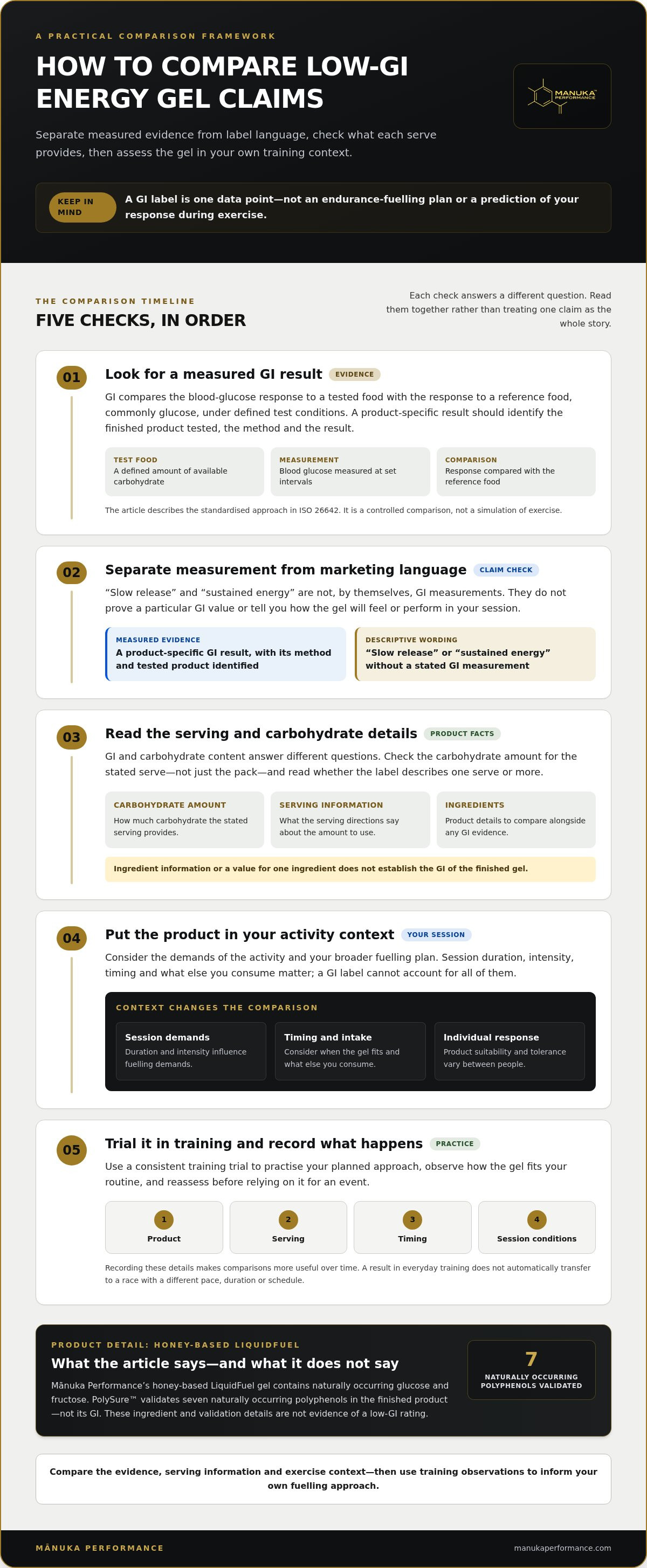
A low-GI label is one data point, not an endurance-fuelling plan. When comparing low GI energy gels, it helps to separate what the claim measures from what you need to know for a session. Glycaemic index (GI) describes the blood-glucose response to a tested food under defined conditions. “Slow release”, by contrast, may be marketing language rather than a measured GI result. Neither phrase tells you how much carbohydrate a gel provides or whether it suits your routine.
Look at any GI claim alongside the carbohydrate amount, serving information and ingredients. Those details help you assess the product, but they don’t predict your personal response or guarantee a particular performance outcome. This article explains what GI measures, where its limits lie and how to compare product information without treating a label claim as a fuelling plan.
Mānuka Performance’s honey-based LiquidFuel gel contains naturally occurring glucose and fructose. PolySure™ validates seven naturally occurring polyphenols in the finished product, not its GI. Use the framework below to compare claims, then trial a suitable fuelling approach in training before relying on it for an event.
Key Takeaways
- Understand what GI measures and why it can’t predict a gel’s effect on your endurance performance.
- Compare low-GI energy gels by separating measured evidence from phrases such as “slow release” or “sustained energy”.
- Check carbohydrate content and serving information alongside any GI claim to assess how a gel could fit your fuelling routine.
- Use a consistent training trial to practise with a gel, record your observations and reassess before race day.
- Consider honey-based gels as carbohydrate-fuelling options, but don’t treat ingredient information as evidence of a low-GI rating.
What does low GI mean on an energy gel?
Glycaemic index (GI) compares the blood-glucose response after consuming a food with a specified amount of available carbohydrate against the response to a standard reference food, usually glucose. It describes a response measured under test conditions. It doesn’t establish how a gel will affect an athlete during a run or ride.
A measured GI result compares blood-glucose responses to a tested food and a standard reference. “Slow release” and “sustained energy” are not, by themselves, GI measurements. These phrases may describe a brand’s positioning, but they aren’t proof of a particular GI value or a predictable fuelling effect.
Energy gels are portable carbohydrate sources for endurance activity, but ingredients and formulations vary. The Energy gel Wikipedia article provides general background on their use and composition. It doesn’t validate an individual product claim. Evidence needs to relate to the food or finished gel being described.
How is the glycaemic index measured?
Under the standardised approach described in ISO 26642, participants consume a test food that provides a defined amount of available carbohydrate, and researchers measure blood glucose at set intervals. They compare the response with that to the same amount of carbohydrate from a reference food, commonly glucose. This controlled comparison makes results interpretable, but it isn’t a simulation of exercise.
Results depend on the specific food tested and the method used. A value for an ingredient can’t automatically be applied to a gel containing that ingredient, because the complete formulation and serving may differ. For a gel, look for product-specific evidence that identifies the product tested, the method and the result. Without that information, don’t infer a GI value from the ingredient list or a marketing phrase.
What does a low-GI claim tell an endurance athlete?
A substantiated low-GI claim tells you something limited about the tested food’s relative blood-glucose response under the stated test conditions. It doesn’t guarantee steadier energy, improved performance or a particular response during exercise. Exercise context, timing, carbohydrate intake and individual response are separate considerations. GI is only one part of assessing an in-exercise carbohydrate source.
When comparing low GI energy gels, keep three kinds of information distinct: a measured GI result, the gel’s stated carbohydrate and serving information, and descriptive wording such as “slow release”. Each can inform a decision, but each answers a different question. Interpret a product claim according to the evidence it describes, not as a prediction of how the gel will feel or perform in your session.
How GI, carbohydrate and exercise fuelling fit together
A GI result describes one measured characteristic of a food. It doesn’t tell you the complete carbohydrate contribution of a gel or whether its serving suits a particular session. For a practical comparison, read any GI evidence alongside the carbohydrate amount per serve, serving directions and ingredients. These details show what the product provides; your training plan determines how and when it may fit.
GI alone can’t establish whether a gel suits an athlete. Suitability depends on the product’s carbohydrate information and the demands of the activity.
Why GI is not a complete measure of fuelling suitability
A GI figure and a carbohydrate declaration answer different questions. GI compares blood-glucose responses under test conditions; the label’s carbohydrate information tells you how much carbohydrate a stated serving provides. Neither figure accounts for your session length, pace, schedule or overall fuelling plan. The Australian Institute of Sport’s sports-nutrition guidance treats fuelling as activity-specific, rather than a decision based on one product characteristic.
- Check the carbohydrate amount for the stated serving, not just the pack.
- Read the serving directions and note whether the label describes one serve or more.
- Consider the ingredients and other product information relevant to your routine.
- Keep a GI result separate from descriptive claims about release or energy.
These details support a more complete assessment, but they don’t predict your personal response. For example, two gels could state the same carbohydrate amount but have different ingredient lists or claims. Compare those details in the context of your own fuelling plan.
Why exercise context changes the comparison
You may assess a gel for a short, easy training session differently from one you’re considering for a long run or race. Duration and intensity influence the fuelling demands of an activity. Timing and what else you consume matter too, and a single GI label can’t account for these variables.
Training gives you an opportunity to practise a planned approach and observe how a product fits your routine. A race may involve a different pace, duration and schedule, so a choice that works in everyday training may not automatically transfer. Individual preferences and tolerance vary. Record the product, serving, timing and session conditions to make comparisons more useful over time.
The Australian Institute of Sport advises matching carbohydrate strategies to the sport and exercise demands. Avoid applying one intake target to every athlete or event: a suitable plan depends on the activity and the individual. Use serving information as one input, then assess how the gel fits your broader fuelling schedule rather than choosing it on a low-GI claim alone.
When assessing low GI energy gels, ask what evidence supports the claim and how the product’s stated carbohydrate information fits the session. Mānuka Performance’s honey-based sports energy gels are one product category to assess by their stated ingredients and fuelling information. Ingredient origin alone isn’t evidence of a GI result.
How to compare low-GI energy gel claims
A useful comparison separates what a label says from what its evidence demonstrates. Record the exact wording: “low GI” is a different type of claim from “slow release” or “sustained energy”. Then compare supporting information with practical product details, including carbohydrate per serving, serving directions and format. This helps you identify what is measured, what is descriptive and what hasn’t been specified.
What evidence supports a low-GI gel claim?
For a low-GI claim, look for testing of the finished gel, not just an ingredient used to make it. Useful information identifies the product tested, the testing method and the reported result. Evidence about one carbohydrate or ingredient may provide context, but it doesn’t establish the GI of a complete gel with a different formulation or serving.
Be precise when information is missing. If a label says “slow release” but provides no GI result or test details, record the wording as a brand claim and the evidence as “not stated”. That doesn’t prove the claim is false; it means the available information doesn’t show a measured GI result. Don’t infer one from the ingredients, product name or an unrelated certification.
Which product details deserve comparison?
Use the same fields for each gel. The table below separates claim language and evidence from the details that help you judge practical fit. Fill it in using the packaging or product information. Leave a field blank or mark it “not stated” when the information isn’t provided.
| Compare | What to record | How to interpret it |
|---|---|---|
| Exact claim | “Low GI”, “slow release”, “sustained energy” or other wording | Preserve the label’s precise language; these terms aren’t interchangeable. |
| GI evidence | Finished product tested, method identified, result reported | Distinguish a product-specific measurement from ingredient information or general wording. |
| Carbohydrate | Amount per stated serving and any disclosed carbohydrate sources | Compare like serving units and note what the product actually declares. |
| Serving and format | Serving directions, packaging format and stated intended use | Consider how the instructions and format fit the activity you’re planning. |
For example, you can assess a gel that lists carbohydrate sources but gives no GI test details by reviewing its stated composition and serving information. Don’t assign it a measured GI result on that basis. Equally, a reported GI result doesn’t mean the product will suit every athlete or session.
Mānuka Performance’s LiquidFuel 10-Pack Running Gel uses a New Zealand honey-based matrix containing naturally occurring glucose and fructose. PolySure™ validates seven naturally occurring polyphenols in the finished product. That is a distinct analytical measure, not evidence of a GI rating. The example shows why evidence needs to match the specific claim it supports.
When comparing low GI energy gels, don’t rank products by GI unless comparable, substantiated, product-specific data are available. No single label term establishes fuelling suitability or predicts an individual response. Use your comparison to identify what the label supports, then assess the remaining product details against your activity and fuelling plan.
How to test an energy gel in training
A planned training trial can help you assess how a gel fits your routine before relying on it during an event. It won’t verify a low-GI claim or predict the same response every time, but a consistent record can make your observations more useful. Avoid introducing an unfamiliar gel on race day, when the pace, distance and conditions may leave little room to adjust.
A practical training-trial process
Choose a familiar session that suits your current training, and follow the product’s stated serving directions. Where practical, repeat the same approach so you can compare observations without changing several factors at once.
- Review the label. Note the stated serving, carbohydrate information, ingredients and directions. Record the exact product claim separately, so a phrase such as “sustained energy” isn’t confused with a measured GI result.
- Select a suitable session. Pick a training run or ride that gives you a relevant opportunity to practise your planned fuelling routine. Don’t make your first trial a key workout or event. Choose a session where you can pay attention to timing and how the product fits.
- Follow the directions. Use the serving and timing you intend to assess, following the product’s instructions. Keep other parts of your routine as consistent as practical, including the activity and any other food or drink.
- Record the context. Write down the product, serving, timing, activity, duration and conditions. Add a brief note on taste, ease of use and perceived tolerance during and after the session.
- Review and reassess. Look across repeated trials before drawing a practical conclusion. If you test a different timing or serving approach, change one variable at a time where possible, and record the change clearly.
How to interpret your own observations
Your notes describe your experience in a particular session. They aren’t a measurement of blood-glucose response, proof of a gel’s GI or evidence that it changed performance. Perceived tolerance is useful personal context, but it’s different from a laboratory assessment. Intensity, duration and other session conditions can also affect how comparable two trials are, so don’t treat one observation as a universal result.
For related digestive context, Mānuka Performance’s scientific guide to runners’ stomach issues discusses factors relevant to runners’ experiences. If you have specific dietary or medical needs, seek individual advice from an appropriately qualified health professional or sports dietitian before changing your fuelling approach.
Use this process to assess how a product fits your training, not to confirm claims about low GI energy gels. If you’re considering a honey-based carbohydrate option for a structured training trial, explore Mānuka Performance’s running gel and assess its product information against your plan.
Where honey-based gels fit in a low-GI comparison
You can assess a honey-based gel as a carbohydrate-fuelling option without assuming its honey matrix makes it low GI. Ingredient origin and GI are different kinds of information: a honey-based formulation tells you something about the product’s composition, while a GI value requires evidence specific to the tested product and method.
Mānuka Performance’s LiquidFuel 10-Pack Running Gel uses a New Zealand honey-based matrix containing naturally occurring glucose and fructose. This describes its carbohydrate source, not a GI result. “Honey-based” can’t tell you how the finished gel was tested or what blood-glucose response it produced.
What analytical transparency can and cannot establish
PolySure™ validates seven naturally occurring polyphenols in the finished product. This is a defined analytical measure of those compounds. It isn’t a GI test, evidence of a particular glycaemic response or proof of an athletic outcome. Each form of analysis answers a different question, so a finding about polyphenols shouldn’t support a separate claim about blood glucose or performance.
When reviewing product information, identify what was measured, which product or compounds the measurement concerns, and what the result can reasonably establish. For broader context on the formulation and its development, read the natural honey-based energy gel performance analysis.
A considered next step for comparing gels
Bring your comparison back to four practical questions: what exactly does the product claim, what evidence supports that wording, what carbohydrate and serving information is disclosed, and how does the stated use fit your activity? Keeping these points separate helps you compare products fairly, even when labels use different language or provide different levels of detail.
On that basis, LiquidFuel can be considered as a honey-based carbohydrate product without describing it as low GI or assigning it a GI value. Its glucose and fructose content, stated serving information and your intended use are the relevant product details to assess. PolySure™ provides specific information about validated polyphenols, but it doesn’t change the evidence needed to substantiate a GI claim.
For another perspective on how honey-based gels can be examined, see the comparative analysis of honey energy gels. If this product category suits your fuelling plan, explore Mānuka Performance and review the product information as part of your comparison.
Make your next fuelling choice a measured one
Make your next step a practical comparison, not a search for a label that promises certainty. Note the claim, supporting evidence, carbohydrate information and intended use. Then trial a suitable option in training and record how it fits your routine. This gives you a considered basis for deciding whether a product belongs in your fuelling plan, without treating a low-GI claim as a prediction of your personal response.
Mānuka Performance’s LiquidFuel 10-Pack Running Gel is a honey-based carbohydrate option, with a New Zealand honey matrix containing naturally occurring glucose and fructose. PolySure™ validates seven naturally occurring polyphenols in the finished product. This distinct measure doesn’t establish a GI rating or exercise outcome. Together, these details clarify what the product is and what its analytical information describes.
Explore the product information and decide whether LiquidFuel suits a training trial. Explore Mānuka Performance’s honey-based energy gels, then make your next fuelling choice with clarity and confidence.
Frequently Asked Questions
Is a low-GI energy gel automatically better for endurance exercise?
No. A low-GI label doesn’t establish that a gel is the best match for your event, schedule or fuelling preferences. For example, its serving size may not fit the amount you intend to consume during a session. Compare the supporting evidence and label information with your planned activity, then practise your approach in training. “Low GI” alone can’t predict how you’ll respond or perform.
Can an energy gel be called low GI without a published test result?
A label phrase alone can’t demonstrate a measured GI value. Look for evidence specific to the finished gel, including the testing method and product assessed. A test of one ingredient or a general description of the formulation doesn’t establish the result for the complete product. If a result isn’t presented, treat the claim as unverified from the information available rather than estimating a value from the ingredient list.
Are honey-based energy gels low GI?
Not automatically. Honey’s carbohydrate profile can vary, and the presence of honey doesn’t establish the glycaemic response of a finished gel. Check whether the product itself has relevant testing evidence, and assess its carbohydrate information separately. Knowing that a gel uses honey tells you about an ingredient source, not how the complete formulation performed in a GI test. Don’t use “honey-based” as a substitute for product-specific evidence.
Can I use a low-GI gel during a marathon?
Possibly, but the GI claim alone can’t determine whether a gel fits your marathon plan. Consider its stated carbohydrate content and directions alongside your intended timing and the products you’ve already practised using. A race is a poor setting for discovering that an unfamiliar product doesn’t suit your routine. Trial your planned approach in training first, and seek advice from a suitably qualified sports nutrition professional if you need individual fuelling guidance.
Should I take water with an energy gel?
Follow the instructions for the specific gel rather than assuming every formulation is used in the same way. Check the package directions before training, and plan how you’ll carry or access water if those instructions call for it. Don’t change the stated directions because a product carries a low-GI claim. If the label leaves a practical question unresolved, seek qualified advice instead of making assumptions during a race or long session.
Does a low-GI claim mean a gel provides energy for longer?
Not necessarily. A low-GI statement and wording such as “slow release” describe different things, and neither phrase alone proves how long a particular gel will feel useful during exercise. Check whether the wording is supported by product-specific evidence, then consider the full serving and carbohydrate information. To assess practical fit, record when you use the gel and how it fits your planned fuelling routine during training.