


Honey’s clearest role for endurance athletes is as a source of carbohydrate. The evidence on honey for endurance athletes benefits is most useful when this fuelling role is separated from broader claims about recovery, immunity or other effects, which require evidence of their own.
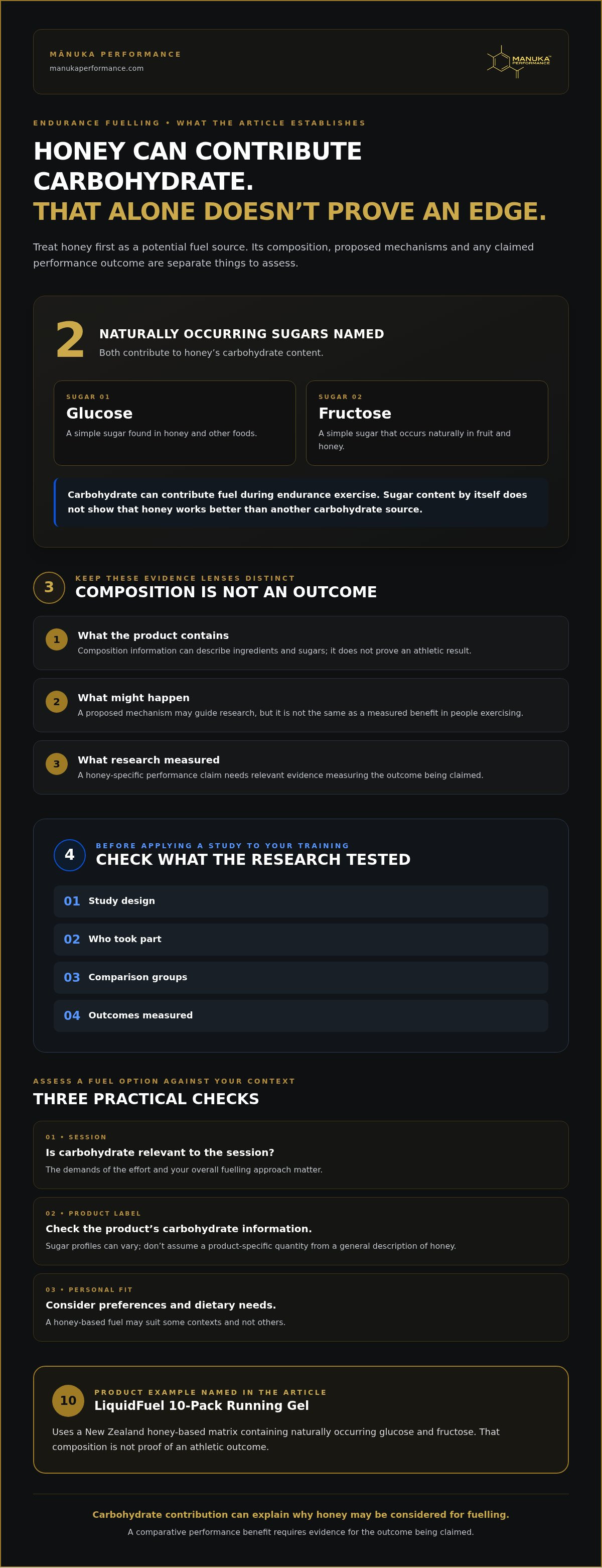
Athletes often want fuel that is practical, suits their preferences and fits the demands of training. Honey contains naturally occurring glucose and fructose, so honey-based products can contribute carbohydrate during exercise. That fact alone doesn’t show that honey produces better results than other carbohydrate sources.
This article explains how honey may fit into endurance fuelling, what research can and can’t establish about honey-specific effects, and what to consider when assessing a product. It also distinguishes composition information, such as the validation of naturally occurring polyphenols, from evidence of a performance outcome. Use these points to assess whether a honey-based fuel suits your training and to compare products using their carbohydrate information without overstating the benefits.
Key Takeaways
- Assess honey first as a carbohydrate source. Its sugars alone don’t establish a unique performance effect.
- When weighing honey for endurance athletes benefits, distinguish human exercise findings from proposed mechanisms and broader nutrition research.
- Match a fuel option to your session, the product-label information and your preferences or dietary needs.
- Before applying a study’s findings to your training, check what it measured and who took part.
- LiquidFuel 10-Pack Running Gel uses a New Zealand honey-based matrix containing naturally occurring glucose and fructose. Its composition isn’t proof of an athletic outcome.
Honey for endurance athletes: what benefits are realistic?
Honey contains naturally occurring sugars, so it can provide carbohydrate during endurance exercise. That makes it a potential fuel source, not proof of a unique performance effect. When assessing honey for endurance athletes benefits, distinguish the product’s composition from claims about what it does for an athlete. The latter require evidence from relevant studies.
In brief: honey may contribute carbohydrate to an endurance fuelling plan, but its sugar content alone doesn’t establish a honey-specific effect on performance or health.
This is a measured starting point, not a dismissal of honey as a fuel option. Its relevance depends on the session and an athlete’s individual needs and preferences. It shouldn’t be presented as a guaranteed result or a medical intervention.
What does honey contribute during endurance exercise?
Honey provides dietary carbohydrate through its naturally occurring sugars. During prolonged exercise, carbohydrate can be one source of fuel, but the amount an athlete needs and the form that suits them depend on the session and their overall fuelling approach. The Honey: Composition and History overview offers general context on honey’s composition, not evidence of a sports performance effect.
For an athlete considering fuel for a longer effort, honey’s carbohydrate content may be relevant. How its sugars are processed is a separate question, covered in the next section.
Which advertised benefits need more careful wording?
Claims about endurance, recovery, inflammation or immunity go beyond saying that honey provides carbohydrate. Each describes a distinct outcome and needs appropriate evidence in athletes. A study showing that a food contains certain compounds, for example, doesn’t by itself demonstrate that consuming it changes a training or health outcome.
The same caution applies to proposed mechanisms. An explanation of how a substance might act can help guide research, but it isn’t equivalent to a measured benefit in people exercising. Study design, participants, comparison groups and outcomes all affect how much a finding can support a claim.
Natural origin and Mānuka identity also don’t establish superior sports performance on their own. They may describe a product’s source or composition, but a performance comparison requires direct evidence for the outcome being claimed. Keeping these categories separate helps prevent a descriptive feature from becoming an implied promise.
Start with a specific question: is carbohydrate relevant to the session? Then consider the fuel’s composition and whether it suits your preferences and dietary needs. Honey-based fuel may suit some contexts and not others. This distinction provides a sound basis for considering sugar composition and research without assuming that every proposed benefit has been demonstrated.
How honey’s glucose and fructose relate to endurance fuel
Glucose and fructose are naturally occurring sugars in honey, including the New Zealand honey-based matrix used in Mānuka Performance’s LiquidFuel 10-Pack Running Gel. Both are forms of dietary carbohydrate that can contribute fuel during endurance exercise. This helps explain why honey may be considered as one fuelling option, but it doesn’t establish that honey works better than other carbohydrate sources.
Glucose, fructose and the carbohydrate contribution
Glucose is a simple sugar found in foods and used by the body. Fructose is another simple sugar that occurs naturally in fruit and honey. Their presence means honey contains carbohydrate, but the proportions can vary with floral source and other factors. A single sugar profile shouldn’t be treated as universal across all honey or honey-based products.
During prolonged exercise, carbohydrate can contribute to the energy available for muscular work. This general role applies to carbohydrate from different foods and products, not just honey. When comparing sports fuels, check the current product label for its carbohydrate information rather than estimating an amount from a general description of honey. Don’t assume a product-specific quantity without checking that label.
Carbohydrate fuel is not the same as a proven honey advantage
Recognising carbohydrate as a potential exercise fuel is different from demonstrating a comparative advantage for one source. To establish that honey offers a distinct benefit, research would need to compare it with an appropriate alternative under relevant exercise conditions and assess a clearly defined outcome. The Scientific Review of Honey in Exercise provides research context, but a review doesn’t mean every proposed effect has been established for every athlete or product.
Carbohydrate content can explain why honey may contribute to fuelling, but it can’t establish a comparative performance benefit by itself. Natural origin describes where an ingredient comes from; it doesn’t prove a superior exercise outcome. These are separate questions. Performance claims need evidence that measures performance, rather than relying on ingredient composition or a proposed mechanism.
When deciding whether to trial a fuel, compare its labelled carbohydrate contribution with the demands of the session, your preferences and your dietary needs. This article doesn’t set an hourly intake target. Appropriate fuelling strategies depend on the individual and exercise context, and detailed guidance belongs in a dedicated sports nutrition resource.
That distinction is central to evaluating honey for endurance athletes benefits: carbohydrate contribution is a relevant starting point, while any additional honey-specific effect requires evidence of its own. Athletes interested in this format can explore honey-based running gel as one option to assess against their fuelling needs.
What does research say about honey benefits for endurance athletes?
Interpret research according to what was actually tested. Evidence that carbohydrate can contribute fuel during endurance exercise supports a general nutrient role; it doesn’t automatically establish that honey improves performance, recovery or another outcome. To assess claims about honey for endurance athletes benefits, look for direct human evidence and a clear match between the study and the claim.
A useful study summary identifies who participated, what they consumed, what the comparison group received, how long the intervention lasted and which outcomes researchers measured. A trial of honey alone asks a different question from one testing a mixed drink or an isolated compound. Without these details, it’s difficult to know whether a result applies to endurance athletes or to a honey-based fuel product.
How to judge studies on honey and exercise
Prioritise human studies involving relevant exercise and outcomes, such as a defined endurance performance measure. Check whether the comparison isolates honey’s contribution or compares two products with different ingredients. Sample size and study duration matter too. A small or short trial may be informative, but its findings shouldn’t be treated as definitive or assumed to apply across athletes and training contexts.
Broader nutrition research can explain why carbohydrate is considered in exercise fuelling. Laboratory or mechanistic research can suggest questions for future studies. Neither type alone proves that honey produces a distinct effect during training or competition.
Performance, recovery and antioxidant claims: separate the outcomes
Performance, recovery and antioxidant measures are separate research questions. A study measuring a blood marker, for instance, hasn’t necessarily shown a change in race performance, muscle soreness or recovery. Results from one population or exercise protocol also can’t automatically be generalised to endurance athletes. Interpret each result according to its measured outcome, not the broader claim attached to it.
| Evidence type | What it can support | What it can’t establish by itself |
|---|---|---|
| Carbohydrate’s general role | Carbohydrate can contribute fuel during endurance exercise. | That honey is superior to another carbohydrate source. |
| Human exercise trial | An outcome measured for the tested participants, intervention and conditions. | A universal benefit beyond the study’s design or population. |
| Laboratory marker or proposed mechanism | A compositional finding or a possible biological explanation. | A meaningful performance, recovery or health benefit in athletes. |
Interpret evidence claim by claim: carbohydrate’s fuelling role is distinct from uncertain honey-specific effects, and preliminary or indirect findings can’t support guaranteed outcomes. This is especially relevant to antioxidant messaging. Measuring compounds or changes in a laboratory marker may characterise a product or guide research, but it doesn’t demonstrate an athletic benefit without appropriate human outcome data.
For a balanced assessment, separate what is established about carbohydrate from what an individual honey study actually measured. Don’t turn a plausible mechanism, a composition result or a preliminary finding into a promise that honey will improve endurance, recovery, inflammation or immunity.
How endurance athletes can assess honey as a fuel option
Assess honey-based fuel in context rather than treating it as a universal solution. What suits one runner may not suit another. Consider the session, the product’s label, its format and your preferences or dietary needs. The steps below offer a practical way to evaluate a product without assuming a particular performance outcome.
A simple framework for evaluating honey-based fuel
- Define the session. Consider its duration, intensity and practical demands. A short, easy session may call for different fuelling considerations from a long training run or race, so don’t apply one intake target to every effort.
- Read the product label. Use the nutrition and ingredient information for the specific product instead of estimating its carbohydrate contribution from general facts about honey. Review the serving information and how it fits with the rest of your planned fuelling.
- Assess format and preference. Consider how you’ll carry and consume the product during activity, and whether its ingredients suit your dietary preferences. Format matters in practice, but convenience doesn’t establish a performance advantage. This natural honey-based energy gel analysis offers further context on the product format.
- Practise in training. If a product is unfamiliar, trial it during training rather than first using it on event day. Note how it fits your routine and whether you’re comfortable using it under conditions similar to your intended event.
These steps aren’t a prescribed fuelling plan. Individual needs and tolerances vary. People managing a health condition, dietary restriction or persistent exercise-related gut symptoms may benefit from advice from a qualified health professional. For broader context, see this guide to runner’s stomach and gastrointestinal considerations.
Where honey fits within a wider nutrition plan
Honey is one possible carbohydrate source, not a complete endurance nutrition strategy. Your overall approach may involve planning for the demands of the event and your individual requirements. A single gel or ingredient can’t account for every part of that plan. Race preparation is separate from choosing an exercise fuel, and this resource on strategic carbohydrate loading addresses that distinction.
To explore a New Zealand honey-based option, review LiquidFuel 10-Pack Running Gel against your session and preferences. Its honey-based matrix contains naturally occurring glucose and fructose. That describes the product’s composition, not a guaranteed athletic outcome.
Mānuka Performance’s honey-based option for endurance athletes
For athletes considering honey as one possible carbohydrate source, Mānuka Performance’s flagship running gel is LiquidFuel 10-Pack Running Gel. It offers a concrete example of how a honey-based fuel can be described without treating ingredient identity as evidence of a particular athletic result. The product uses a New Zealand honey-based matrix containing naturally occurring glucose and fructose.
This distinction matters when interpreting claims about honey for endurance athletes benefits. Ingredients and analytical characterisation help describe what a product contains. Evidence of a performance effect requires research that measures the relevant outcome. These forms of information answer different questions.
What the honey-based matrix and PolySure™ describe
The honey-based matrix describes the product’s carbohydrate-source approach. Glucose and fructose occur naturally in the matrix, but their presence doesn’t establish that this gel is more effective than another fuel option. Use product composition as one part of your assessment, alongside the nutrition information and your fuelling needs.
PolySure™ validates seven naturally occurring polyphenols in the finished product. This analytical validation characterises composition; it isn’t proof that the polyphenols improve endurance, recovery or health. Keeping these points separate makes it possible to understand the composition information without implying an outcome that the validation itself doesn’t measure.
Explore a research-led honey-based running gel
LiquidFuel combines a New Zealand honey-based matrix with analytical characterisation of selected naturally occurring polyphenols. These details provide a defined basis for understanding the product. Whether it suits you depends on your session, preferences and wider fuelling approach. They shouldn’t be read as a promise of improved performance or a substitute for individual evaluation.
In practical terms, this product is one honey-based option to consider alongside other sources of carbohydrate. Reviewing its composition can help you decide whether it aligns with your criteria. The product’s origin and validated constituents don’t establish an outcome beyond what the evidence supports.
To review the product in more detail, explore LiquidFuel as one option for your endurance fuelling considerations.
Make your next fuelling choice evidence-led
Turn general claims into criteria you can apply consistently: what the product contains, how that information is validated, and whether it fits your training needs. This keeps the question of honey for endurance athletes benefits grounded in composition and relevant evidence, rather than assumptions about natural ingredients.
LiquidFuel combines a New Zealand honey-based matrix containing naturally occurring glucose and fructose with PolySure™, which validates seven naturally occurring polyphenols in the finished product. These details characterise the product; they don’t promise a particular athletic outcome. Consider them alongside your fuelling priorities as you decide what to trial and assess.
Explore Mānuka Performance’s LiquidFuel running gel and review how it aligns with your approach to endurance fuelling. Assess it against your needs and experience as you plan for training.
Frequently Asked Questions
Is honey a good source of energy for endurance athletes?
Honey provides carbohydrate, which can contribute to fuelling during endurance exercise. Whether it suits you depends on factors such as the session, the rest of your nutrition plan and personal preference. A runner might consider a honey-based fuel for a long training session, for example, but that doesn’t mean it will suit every runner. Carbohydrate’s general fuelling role also doesn’t prove that honey uniquely improves performance.
Does honey improve endurance performance?
Carbohydrate can play a role in endurance fuelling, but that doesn’t demonstrate that honey improves performance compared with other carbohydrate sources. Assess claims about honey for endurance athletes benefits against directly relevant human studies, including what participants consumed and which performance outcomes were measured. Evidence from a proposed mechanism or a different exercise context can’t establish a guaranteed result in endurance training or competition.
Can honey help replenish muscle glycogen after exercise?
Carbohydrate intake is relevant to restoring muscle glycogen after exercise, but the overall recovery diet and circumstances affect the process. Honey can contribute dietary carbohydrate, yet that fact doesn’t show that it is uniquely effective for glycogen restoration. Consider your broader food and fluid intake after a session rather than treating one ingredient as a complete recovery strategy. Glycogen physiology also doesn’t establish other recovery or health effects for a specific honey product.
Is Mānuka honey better than other honey for endurance athletes?
A Mānuka label alone doesn’t establish superior exercise performance. Honey identity, measured composition and demonstrated athletic outcomes are distinct kinds of information, and one can’t substitute for another. To support a claim about a particular product, research would need to test that product or a suitably comparable formulation and measure a relevant outcome. Provenance or bioactive content, by itself, doesn’t show that athletes will perform better.
Does honey contain glucose and fructose?
Yes. Honey contains naturally occurring sugars, including glucose and fructose, although their proportions can vary. These sugars are carbohydrate constituents, not evidence of a particular effect during exercise. When assessing a packaged sports fuel, use the current nutrition information for that specific product rather than assuming its composition from general facts about honey. This is useful when comparing serving information across formats or planning what to carry for a session.
Can endurance athletes use honey-based fuel during training?
Honey-based fuel may be considered as one carbohydrate option during training, but its suitability depends on the session, product format, dietary needs and individual tolerance. If you’re trialling an unfamiliar product, test it during training rather than first using it in an event, and note how it fits your routine. There’s no universal intake recommendation here. For personal dietary concerns or persistent symptoms, seek guidance from a qualified health professional.
Are honey’s antioxidant properties proven to improve athletic recovery?
Antioxidant measurements or proposed mechanisms don’t, on their own, prove improved recovery in athletes. A change in a laboratory marker may describe a biological response, but it doesn’t necessarily indicate a practical difference in recovery. Assess human research by its design, participants and measured outcomes, including whether it tested recovery directly. Without relevant evidence, antioxidant content shouldn’t be presented as proof that honey or a specific product improves athletic recovery.