


What if taking another gel isn’t the best first response when race-day fuelling goes off plan? Troubleshooting race day nutrition issues starts with separating what you notice from what you assume: fatigue, nausea or a sudden change in pace can have several possible contributors, including food, fluid, effort and race conditions.
It’s understandable to worry that changing fuel mid-race could make discomfort worse, particularly when it’s hard to distinguish an energy slump from gut discomfort. One symptom can’t confirm the cause, so a measured response is more useful than changing several things at once.
This guide offers a practical way to review what happened, choose a cautious next step during or after an event, and record useful details for training. It also explains how to assess a fuel, including a honey-based option, before relying on it in a future race. The aim is a clearer process, not a one-size-fits-all prescription.
Key Takeaways
- For troubleshooting race day nutrition issues, first identify whether the main concern is gut discomfort, difficulty taking fuel, an energy slump or fluid concerns.
- Review recent fuelling, effort and race conditions together. One symptom alone can’t establish the cause.
- Assess what’s happening and choose a measured response rather than making several changes at once.
- Record what you ate and drank, how you felt and what was happening during the race to guide future training trials.
- When trialling a fuel in training, review its ingredient information and practical use without treating any product as a guaranteed fix.
Troubleshooting race day nutrition issues: identify the problem before reacting
An unexpected race-day problem can have several possible contributors, so a symptom alone rarely tells you whether food, fluid, effort or conditions played a part. Start by noting what you felt, when it began and what had changed beforehand, rather than immediately blaming a particular fuel. This gives you a more useful basis for deciding what to review.
Race-day nutrition troubleshooting means looking at symptoms, timing and recent decisions together. That fits within broader sports nutrition principles, which include food intake, hydration and timing, while recognising that a race brings changing physical and environmental demands.
Which race-day nutrition issue are you experiencing?
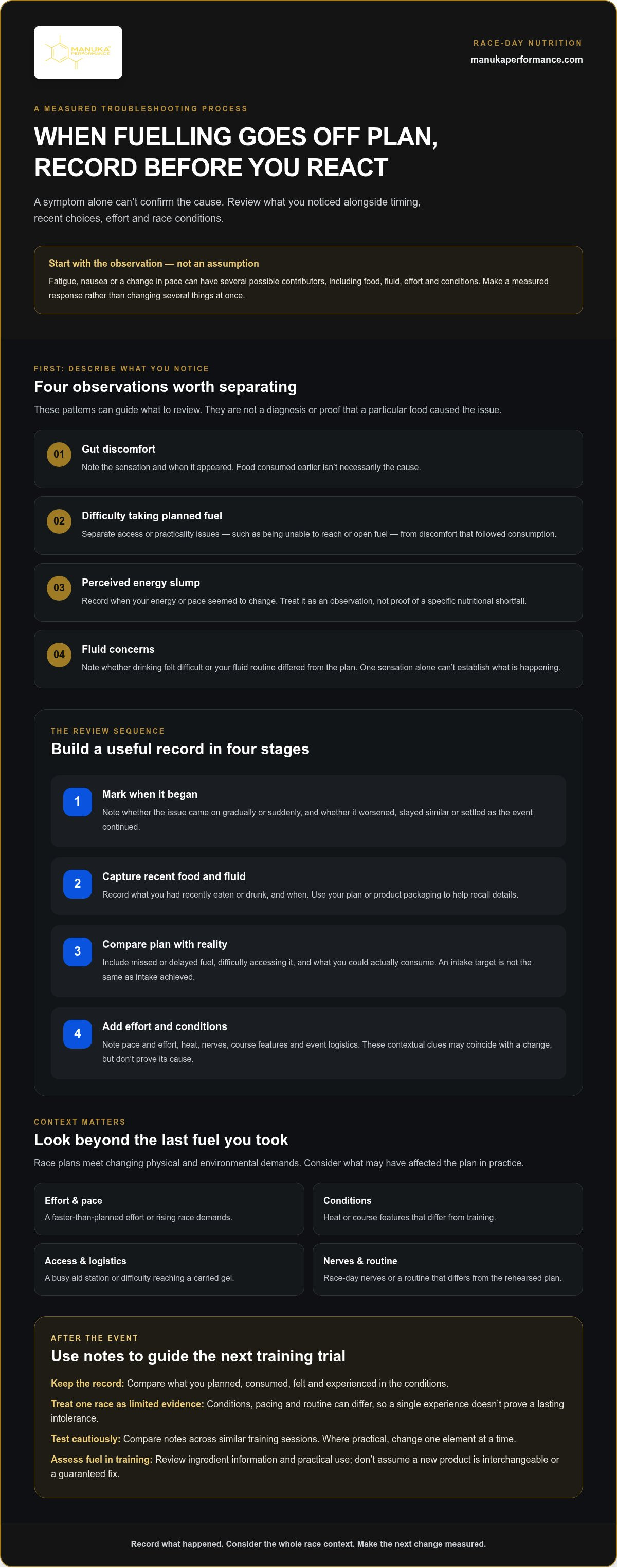
Describe what you notice in plain terms before trying to explain why it happened. The pattern can point to useful details to review, but it isn’t a diagnosis or proof that a particular food caused the issue.
- Gut discomfort: Note the sensation and when it appeared. A food consumed earlier isn’t necessarily the cause.
- Difficulty taking planned fuel: Was the problem access or practicality, such as being unable to reach or open what you planned, or did discomfort follow consumption? These are different observations to record.
- Perceived energy slump: Record when your energy or pace seemed to change. Treat it as an observation, not proof of a specific nutritional shortfall.
- Fluid concerns: Note whether drinking felt difficult or your fluid routine differed from the plan. One sensation alone can’t establish what is happening.
Include the surrounding context in your notes. A faster-than-planned effort, heat, nerves, course features or event logistics may coincide with a change in how you feel or your ability to take fuel. These factors don’t prove a cause, but considering them helps avoid treating food as the only possible explanation.
What to record before changing your plan
Make a brief record as soon as practical, while the details are fresh. Compare what happened with your rehearsed approach; don’t try to reach a definitive conclusion during a demanding event.
- When the issue began, and whether it came on gradually or suddenly.
- What you had recently eaten or drunk, and when. Use your plan or product packaging to help recall details.
- Any departure from your rehearsed plan, including missed or delayed fuel or difficulty accessing it.
- Your effort, pace and conditions, and whether the issue worsened, stayed similar or settled as the event continued.
After the race, keep these notes with your training observations. One event is limited evidence: conditions, pacing and routine can differ from one race to another, so a single experience doesn’t prove a lasting intolerance. Compare notes across similar training sessions before deciding what to test. Where practical, change one element at a time so it’s easier to tell what differed.
Why race-day fuelling problems happen: understand the interacting factors
A fuelling plan plays out in a moving, demanding environment, not a controlled test. What you intend to eat or drink may differ from what you can manage once pace, course demands, weather, nerves and event logistics come into play. Because these factors can overlap, troubleshooting race day nutrition issues means reviewing more than the last food consumed.
Carbohydrate descriptions can help you compare ingredient information, but they can’t guarantee a particular response. Glucose and fructose are different types of carbohydrate. For example, the honey-based matrix in Mānuka Performance’s LiquidFuel 10-Pack Running Gel contains naturally occurring glucose and fructose. This describes the ingredients, not how an individual athlete will respond during competition.
How effort and event conditions can complicate fuelling
A plan that feels manageable in a steady training session may be harder to follow when race effort rises or conditions change. Heat, a faster pace, nerves, a crowded aid station or difficulty accessing a carried gel may affect how practical the plan feels. These are contextual clues, not definitive explanations for an individual’s symptoms, and they can’t diagnose a cause.
Separate what was written in the plan from what happened in practice. You might intend to take fuel at a particular point, then miss the opportunity while negotiating a busy section of the course. Or you may follow the plan but find that race conditions feel different from training. Record those details: an intake target is not the same as intake actually achieved, and neither one explains a symptom on its own.
Why practice matters more than a last-minute product change
Rehearsing foods, fluids and timing during training lets you assess whether each choice is practical at the effort and in the conditions you expect. Record what you used, what you could consume and how the session unfolded. A race-day experience alone can’t establish a food intolerance, because the event may differ from training in several ways at once.
Products can differ in ingredients and composition, so don’t assume a new option is interchangeable or will produce a particular response. Review the product information, then trial one planned option at a time in training instead of using it for the first time on race day. For a deeper explanation of how training and digestive experience relate, read this guide to gastrointestinal resilience and runner’s stomach issues.
A useful review compares four things: what you planned, what you consumed, the effort and conditions, and when the issue appeared. If you’re assessing a honey-based running gel, consider its ingredient information alongside your training notes. Mānuka Performance’s honey-based sports nutrition is one option to evaluate in that process. The aim is to learn about your routine, not to treat a product as a guaranteed fix.
Is your race-day gel the cause? Compare the likely issue before changing fuel
A gel is one variable to review, not an automatic explanation or solution. One race can’t establish that a particular gel caused a symptom: the product, amount or timing may have changed alongside pace, fluid intake, conditions or other parts of your routine. Use the pattern below to identify what information to examine next, not to diagnose the cause.
| Issue observed | Details to review | Cautious next step | What not to assume |
|---|---|---|---|
| Difficulty consuming fuel | Was the gel accessible and practical to take? Did its packaging, timing or use differ from what you practised? | Review the logistics and rehearse the planned approach during training. | That the gel’s ingredients caused a problem when it may not have been consumed. |
| Gut discomfort | What had you consumed, and when? Also review effort, conditions, fluid intake and any other changes. | Record the sequence and compare it with training before changing one variable in a future session. | That the last food consumed was necessarily the cause, or that one race proves intolerance. |
| Perceived energy change | Did your intake or timing differ from plan? Consider how pace, course demands and conditions changed. | Compare the race record with a similar training session and note differences. | That a change in energy confirms a particular shortfall or that changing gels will resolve it. |
When a gel may be one variable to review
Compare the product used on race day with the option you practised. Check whether the ingredients, amount or timing differed, and whether you could take it as planned. Then consider what else changed, including effort, weather, fluid intake or event logistics. A gel can coincide with a symptom without causing it. Assess honey-based fuel by the same standard rather than assuming it will be easier to tolerate or relieve discomfort.
How to compare options without overinterpreting one race
Review ingredient information and practical use, then test a new option in training rather than at a key event. Keep other parts of the session as consistent as practical, so your notes are more useful when comparing experiences. For broader context, explore natural honey-based energy gels and this comparative analysis of honey energy gels, which considers product comparison without treating a race-day symptom as a verdict.
For a practical assessment, include a honey-based option such as Mānuka Performance’s LiquidFuel 10-Pack Running Gel in a training trial. Compare its ingredient information and use with your own recorded experience. This is an evaluation, not a promise of a particular response. Explore Mānuka Performance as you consider which option to assess in training.
What to do when race-day nutrition is not going to plan
If your fuelling routine becomes difficult, focus on assessing what’s happening rather than trying to fix everything at once. Respond safely to the situation, then use the experience to improve your preparation later. General guidance can’t determine the right intake for every athlete, so don’t compensate with unplanned quantities of carbohydrate, fluid or electrolytes.
- Pause and check your immediate safety. Ease off if needed and follow event safety instructions. Don’t force food or drink if you feel unwell or taking it feels unsafe.
- Describe the pattern. Note whether the main issue is difficulty accessing fuel, discomfort, a perceived energy change or concern about fluids. Don’t decide on the cause from one symptom.
- Review what just changed. Consider recent intake and timing alongside pace, conditions and practical factors, such as whether you could reach your planned fuel.
- Choose one cautious adjustment, if appropriate. If it’s safe and practical, avoid adding several foods or supplements or consuming a large amount of fluid to compensate.
Routine adjustments are different from safety concerns. If symptoms are severe, unusual or worsening, stop and seek appropriate medical help rather than continuing to experiment with fuelling. An article can support reflection, but it can’t assess your condition during an event.
A measured in-event response
Use the event’s safety guidance and pay attention to how you feel before deciding whether to continue. If the issue is mainly practical, such as being unable to access planned fuel, note that rather than trying to replace it with several unfamiliar options. If you’re unwell, don’t force intake. Make a cautious adjustment only if it’s safe to do so, and treat severe or worsening symptoms as a reason to stop and seek help.
Use training to investigate the next time
After the event, turn your observations into a question you can test in training. Choose one variable to change, such as the product or timing, while keeping other parts of the session as consistent as practical. Record the product, timing, effort, conditions and symptoms, including whether they changed as the session progressed. This makes comparisons more useful than changing several parts of the plan at once.
One race is limited evidence, not a reliable basis for a lasting conclusion about tolerance. If symptoms persist or concern you, discuss them with a qualified health professional rather than relying on repeated self-experimentation. Product information can inform a training trial, but it can’t predict an individual response. If you’re reviewing fuel for a future session, explore honey-based sports nutrition gels as one option to assess during training.
Build a more reliable race-day nutrition plan with evidence-led product choices
A difficult race can still provide useful information if you separate what you observed from what you can reasonably conclude. Review which parts of your plan were practical, what differed from expectation and what remains uncertain. Then use training to test one adjustment at a time, rather than treating a product change as a guaranteed fix. This makes troubleshooting race day nutrition issues a repeatable process of observation and refinement.
A repeatable review before your next event
After the event, compare your plan with what actually happened. Note which foods and fluids you used, whether you could follow the intended routine, and how effort and conditions affected the session. If several factors changed together, keep your conclusions tentative. A race record is useful evidence, but it may not isolate a single cause.
Use that review to define a practical training trial. Choose one element to assess, such as a product, timing or how you carry and access fuel, while keeping other factors as consistent as possible. Rehearse the intended approach in training before relying on it in competition. This lets you assess practical use and your own experience under exercise conditions without assuming one session predicts every race.
If you have recurring difficulties, individual dietary needs or uncertainty about an appropriate fuelling approach, seek guidance from a qualified sports dietitian. They can consider your circumstances in context; general article advice can’t provide an individual nutrition prescription.
Assessing a honey-based running gel in training
For an ingredient-led assessment, Mānuka Performance’s LiquidFuel 10-Pack Running Gel is a honey-based running gel with a New Zealand honey-based matrix containing naturally occurring glucose and fructose. Review the ingredient information and consider how you plan to use it in a training session, then record your observations. This supports an individual evaluation; it doesn’t promise comfort, performance or a particular response.
PolySure™ validates seven naturally occurring polyphenols in the finished product. This is information about product composition and validation, not evidence that the gel will resolve a race-day issue. Keep the distinction clear when comparing options: ingredient details can inform a decision, while your training experience helps you assess whether a product fits your routine.
Before your next event, keep the plan simple enough to practise and document. Record what you intend to use, what you actually manage, and any relevant differences in effort or conditions. Revisit the plan after training and change one variable at a time when further testing is appropriate. The resulting evidence is more useful than a last-minute switch made in response to one difficult race.
To assess this option in your own training, explore Mānuka Performance’s honey-based running gel.
Carry one clear question into your next training block
Choose one uncertainty from your race notes and turn it into a question you can examine in training. Decide in advance what you’ll keep consistent and what you’re changing, then record what happens without expecting a single session to settle every question. This gives troubleshooting race day nutrition issues a practical direction: not a search for a perfect product, but a clearer understanding of what you can carry, consume and repeat under relevant conditions.
Use those observations to shape your next race plan, leaving room to adapt if the course, effort or weather differs. If you’re considering a honey-based option as part of that process, explore Mānuka Performance’s honey-based running gel and assess it during training before race day.
Methodical refinement takes time, but each well-recorded session can inform your next decision. Keep the process measured, use the evidence you gather and approach your next start line with a plan you’ve had the chance to practise.
Frequently Asked Questions
What should I do if my stomach feels unsettled during a race?
If your stomach feels unsettled, prioritise your immediate safety and don’t force food or drink. Consider whether you can continue comfortably and safely, and follow event instructions if you need assistance. After the event, note when the feeling began and what was happening around that time, including your effort and the conditions. This record can guide a later review, but it can’t identify a cause by itself.
Can an energy gel cause stomach problems during a race?
A gel could be one factor, but timing alone doesn’t show that it caused your discomfort. Check whether the product, amount or timing differed from what you’ve used in training, and whether other parts of your routine changed at the same time. Compare ingredient information and your observations across training sessions rather than judging a product from one race. Persistent or concerning symptoms warrant advice from a qualified health professional.
Why do I feel an energy slump during a race?
An energy slump can have several possible contributors, so the sensation alone can’t confirm that you need more fuel. Review the preceding part of the race: did your pace change, did you miss a planned opportunity to eat, or were the course and conditions more demanding than expected? Note what happened before and after the slump. Avoid compensating with an unplanned large intake based only on that feeling.
Should I change my nutrition plan during a race?
Change your plan cautiously, and only when doing so feels safe and practical. If you missed a planned opportunity, don’t automatically make up for it by taking several foods or supplements or consuming a large amount of fluid at once. Follow event guidance, pay attention to how you’re feeling and prioritise safety over sticking rigidly to a schedule. If symptoms are severe or worsening, stop and seek appropriate help.
How can I test race-day nutrition before an event?
Use training sessions to practise the products and routine you intend to use, including carrying and accessing fuel while moving. Trial one change at a time, and choose a session that lets you observe how the plan works without making a key race your first test. Record what you used, when you used it, your effort and the conditions. A qualified sports dietitian can help tailor advice to individual needs.
When should I stop racing because of nutrition-related symptoms?
Stop if symptoms are severe, unusual, worsening or make it unsafe to continue, and alert event medical staff or seek appropriate medical help. Don’t push through just to complete the course or try to manage serious symptoms by adding food or fluid. If symptoms persist or recur across events, discuss them with a qualified health professional before making further changes to your race-day plan.