


The right plan for energy gels for half marathon racing isn’t a fixed number of sachets. It depends on your expected time on course, overall fuelling and what you’ve practised tolerating. Gels may suit a longer or harder effort, but timing, texture and fluid instructions all affect how practical they are to use while running. Choosing a packet is only one part of the plan.
This guide explains how duration and effort can shape your approach, how to compare carbohydrate content and other product details, and how gels fit alongside fluids and pre-race fuelling. It also covers how to rehearse timing and quantity in training, then adjust your plan based on what you can comfortably sustain. Honey-based gels, including Mānuka Performance’s LiquidFuel, are one option to compare by their label and your own experience. Measured product composition should not be confused with evidence of a particular race outcome.
Key Takeaways
- Decide whether energy gels for half marathon racing fit your expected duration, effort, pre-race meal and experience.
- Understand how carbohydrate, stored glycogen and circulating glucose relate to fuelling, without assuming every runner needs the same intake.
- Compare gels using the same serving basis, and consider carbohydrate content, ingredients, pack format and label directions.
- Build confidence with a structured training trial: read the label, test the gel during a comparable run, record your intake and refine your plan.
- Consider LiquidFuel 10-Pack Running Gel as a honey-based option. Its New Zealand honey matrix contains naturally occurring glucose and fructose.
Are energy gels right for your half marathon race plan?
An energy gel is a portable source of carbohydrate taken during exercise. It can be a compact, convenient way to include carbohydrate while running, but carrying one doesn’t mean you need to use it. Whether energy gels for half marathon racing suit your plan depends on how long and hard you expect to run, what you’ve eaten beforehand and what you’ve practised tolerating.
Carbohydrate fuelling provides a source of fuel during exercise. It doesn’t guarantee reduced fatigue, a faster finish or any other specific race outcome. The body uses carbohydrate through metabolic processes involving stored glycogen and glucose in the blood. For a broad overview of these processes, see Carbohydrate Metabolism.
When might a half-marathon runner consider a gel?
Start with your expected time on course, rather than adopting a schedule simply because it’s common in race advice. A runner anticipating a shorter, comfortable effort may plan differently from someone expecting a longer or more intense race. Your pre-race meal and any other carbohydrate you consume also contribute to the overall plan.
A gel may be useful when it has a clear role, such as providing a portable source of carbohydrate during a sustained effort. Decide when and why you might use it instead of taking one automatically at the start line or copying another runner’s routine. Intake guidance depends on duration, effort and personal tolerance, so treat general recommendations as a starting point rather than a personal prescription.
- Consider your expected time and intensity, not distance alone.
- Account for your pre-race meal and any other planned fuelling.
- Base your approach on experience with the food or product during training.
Some runners may not need a gel for their race plan. Those who do may use different timing and quantities. There isn’t one formula for every half-marathon runner.
What an energy gel can and cannot do
A gel provides carbohydrate in a portable format that can be easier to carry and access than other foods while running. Its usefulness depends on whether its format, ingredients and directions fit your plan, and whether you can consume it comfortably during exercise. A product’s composition tells you what it contains, not what result you’ll get in a race.
Honey-based gels are one option to consider when comparing carbohydrate sources. Mānuka Performance’s honey-based gel performance analysis discusses this product category and its composition. Use that information to compare options, then assess a gel against your planned intake and training experience. A gel can contribute to a fuelling strategy, but it can’t replace an individual plan or guarantee how a race will feel.
How carbohydrate fuelling works during a half marathon
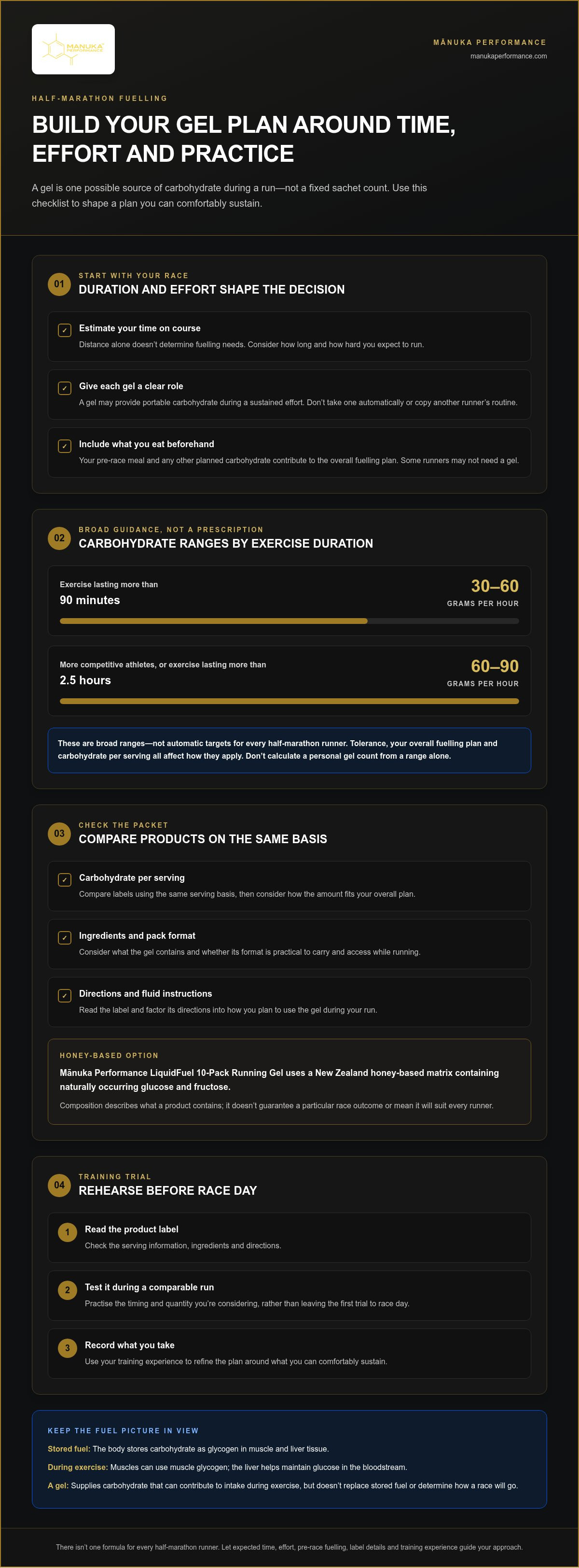
Carbohydrate is an important fuel for working muscles, particularly as exercise intensity rises. The body stores carbohydrate as glycogen in muscle and liver tissue. During exercise, muscles can use muscle glycogen, while the liver helps maintain glucose in the bloodstream. Circulating glucose is the sugar carried in the blood and available to tissues. A gel supplies carbohydrate that can contribute to intake during exercise, but it doesn’t replace stored fuel or determine how a race will go.
Evidence-based intake ranges are a starting point, not a universal prescription. Expected duration and effort matter, and a practical plan should be individualised and rehearsed. The USADA Sports Nutrition Guide provides broader athlete nutrition guidance. Apply fuelling information in the context of your event and circumstances.
How duration and effort shape carbohydrate needs
Distance alone doesn’t tell you how long you’ll be running. Two people covering the same half-marathon course may have different time on course, intensity and fuelling considerations. As duration increases, carbohydrate intake during the event may become more relevant, while a shorter effort may place different demands on your plan. Your pre-race meal and the intensity you can sustain also inform the decision.
For exercise lasting more than 90 minutes, commonly used sports-nutrition guidance gives a range of 30-60 grams of carbohydrate per hour. For more competitive athletes, or those exercising for more than 2.5 hours, guidance may extend to 60-90 grams per hour. These are broad ranges, not automatic targets for every half-marathon runner. Individual tolerance, your overall fuelling plan and the carbohydrate per serving in a product all affect how the guidance applies. Don’t calculate a personal gel count from a range alone.
Use your expected time on course as one planning input, then consider whether taking carbohydrate during the race fits your needs and past experience. A faster anticipated finish doesn’t automatically call for a particular gel schedule, and a longer duration doesn’t determine which product or amount you’ll tolerate.
Why glucose and fructose appear in endurance-fuelling discussions
Glucose and fructose are distinct carbohydrates, and both occur naturally in some food-based ingredients. Their presence on a product label describes its composition. It doesn’t, by itself, prove that a particular formula will improve performance or suit every runner. Gels also differ in ingredients, carbohydrate quantities and directions, so compare current labels using the same serving basis.
Mānuka Performance’s LiquidFuel 10-Pack Running Gel uses a New Zealand honey-based matrix containing naturally occurring glucose and fructose. This tells you what the product is made from, not that it provides a guaranteed athletic advantage. If honey-based gels are relevant to your comparison, explore Mānuka Performance’s honey-based sports gels alongside your race-plan requirements.
How to compare energy gels for a half marathon
Start with the details you can check and use: carbohydrate per serving, ingredients, pack format and label directions. These help you assess whether a gel fits your planned intake and how practical it will be to carry. Claims about easy digestion, absorption or race results are different. Don’t treat them as outcomes guaranteed by an ingredient list.
Which label details matter when choosing a running gel?
Read the current label instead of relying on an old review or a serving figure quoted elsewhere. Check how much carbohydrate the stated serving provides, scan the ingredients for components you wish to avoid or test, and follow the directions for use. If caffeine matters to your plan, check whether it’s listed and how much the label states. Don’t assume all gels contain it.
| Compare | What to check |
|---|---|
| Carbohydrate | Grams per stated serving, using the same serving basis across products. |
| Ingredients | The listed carbohydrate sources and any other ingredients relevant to your preferences. |
| Pack format | How the packaging fits your running kit and whether you can access it easily. |
| Directions | Serving instructions and any guidance about consuming the gel with fluid. |
Serving sizes can differ, so compare like with like. Use the label’s stated serving and don’t mistake a multi-serve container’s total contents for one serving. If the carbohydrate figure is unclear, don’t estimate it from the product name or pack size. The label is the right source for product-specific quantities and directions.
How to assess format, taste and personal tolerance
Practicality matters at race pace. Consider whether the pack is easy to carry, open and consume while moving, and whether its texture and flavour are acceptable to you. These are personal observations, not reliable predictions of another runner’s experience. Test a candidate during training rather than using it for the first time on race day, and note what you consumed and how it felt.
Keep composition separate from performance evidence. A product may identify particular carbohydrate sources or other measurable ingredients, but that alone doesn’t prove improved absorption, easier tolerance or a faster finish. For broader context on formulation and comparative analysis, see this honey gel comparative analysis.
If gut comfort is a concern, change one factor at a time during training, such as the gel or the timing, so you can better interpret your experience. The scientific guide to runners’ stomach issues offers further context, but it can’t predict how an individual product will suit you.
Use the comparison to shortlist energy gels for half marathon fuelling. Then let label details and repeatable training experience guide your choice, rather than unsupported promises.
How to practise an energy-gel plan before half-marathon race day
A fuelling plan is more useful when tested under conditions that resemble the event. Use training to check whether a gel fits your intended intake, whether its packaging is manageable, when it’s practical to take and how it fits into your run. Don’t trial an unfamiliar gel for the first time on race day.
Build a race plan around your expected time on course
Estimate your likely finish time from realistic training pace and conditions, rather than an aspirational target. Then consider whether taking carbohydrate during the race fits your overall plan, including your pre-race meal. Compare any proposed intake with current guidance and the product’s stated carbohydrate per serving. Without those details and your individual context, an exact gel count would be guesswork.
Rehearse, record and refine your approach
Work through these steps in order. Adjust the plan only after you have useful observations from training:
- Review the current label. Note carbohydrate per serving and the directions for use. Follow any stated fluid instructions. Don’t assume every gel has the same requirements.
- Choose a suitable training trial. Pick a run reasonably comparable in duration and effort to the race, and use the product at the point you’re considering for event day. Avoid testing it during an unusually easy session if your race effort will be substantially different.
- Record your intake. Write down what you ate beforehand, what you consumed during the run, when you took it and any relevant observations, including how easy the pack was to access while moving.
- Refine one element at a time. If the timing, format or experience didn’t suit, adjust a single factor in a later suitable session. Keeping other factors consistent can make it easier to interpret what changed.
- Rehearse the settled approach. Repeat the plan in a comparable run and practise carrying and accessing the gel as you intend to on race day. Follow the label directions rather than making assumptions about fluids or serving size.
Rehearsal checklist: test the product, timing, carrying and label directions in comparable training so fewer fuelling decisions are untested on race day.
Keep your record brief and factual. It doesn’t need to prove that a product is right or wrong after one attempt. Patterns across repeated trials are more informative than a single run, especially when effort, food beforehand or conditions vary. If you experience persistent or concerning symptoms, stop treating the issue as a product-selection problem and seek advice from an appropriately qualified health professional.
For runners assessing energy gels for half marathon training, Mānuka Performance’s honey-based sports gels are one option to consider within a rehearsed, individual plan. Explore Mānuka Performance’s honey-based gels as you compare products and plan your training trial.
Choosing a half-marathon gel: where Mānuka Performance fits
Once you’ve built a fuelling plan around your expected time on course and practised it in training, product choice becomes a question of fit rather than promises. Mānuka Performance’s flagship running-gel product is LiquidFuel 10-Pack Running Gel. It uses a New Zealand honey-based matrix containing naturally occurring glucose and fructose, making it one honey-based option to assess as part of your race strategy.
What the LiquidFuel gel information tells runners
The product’s composition gives you useful context, but it doesn’t determine how much carbohydrate you should take, when to take it or whether the gel suits you. Those decisions depend on your plan and experience. Before using any gel, check its current label for serving information and directions, then compare the stated carbohydrate per serving with your planned intake. Don’t infer a serving quantity, fluid requirement or other product detail from the product name or ingredients alone.
Consider the practical questions you’ve been testing in training: can you carry and access the pack comfortably, do the flavour and texture work for you, and can you take it at your intended point in the run? Your repeated experience helps you assess preference and practical use. Product composition alone can’t establish personal tolerance or a race outcome.
How PolySure™ provides analytical product information
PolySure™ validates seven naturally occurring polyphenols in the finished product. This is analytical information about measured composition, not clinical evidence that the product or its polyphenols improve half-marathon performance, prevent fatigue or provide a health benefit. That distinction lets you consider documented product characteristics without treating them as proof of an athletic result.
When comparing energy gels for half marathon fuelling, keep three questions separate: what the product contains, what its current label instructs, and how it fits the plan you’ve tested. Composition details can inform your comparison, while expected duration, planned carbohydrate intake and training observations guide whether and how you use the gel. An ingredient description can’t substitute for that individual assessment.
For a practical final check, make sure your rehearsed plan accounts for your anticipated time on course, the carbohydrate quantity on the product’s current label and any relevant directions. If one of those details is unclear, don’t guess. Make the comparison using information you can verify. A measured, product-specific approach is more useful than broad claims about speed, absorption or stomach comfort.
If LiquidFuel’s honey-based composition aligns with the criteria you’ve established, explore Mānuka Performance running gels as you consider the product within your rehearsed race plan.
Make your fuelling plan your own
Turn your training observations into a simple race-day decision: what you’ll carry, when you expect to use it and how it fits your overall intake. Keep the plan realistic and grounded in what you’ve rehearsed, rather than adding a new product or schedule because race day feels different. If your needs or training experience change, review the plan before the event.
For runners comparing energy gels for half marathon fuelling, product information can help make the choice more transparent. LiquidFuel 10-Pack Running Gel’s New Zealand honey-based matrix contains naturally occurring glucose and fructose, while PolySure™ validates seven naturally occurring polyphenols in the finished product. These are composition details, not guarantees of a particular result. Assess them alongside the label, your preferences and your tested approach.
If the product’s composition aligns with your criteria, explore Mānuka Performance running gels as you refine your race plan. Then take that plan back into training and build towards the start line with confidence in the choices you’ve practised.
Frequently Asked Questions
Do I need energy gels for a half marathon?
No. Energy gels for half marathon racing aren’t necessary for every runner. Your expected time, effort, pre-race eating and experience all shape whether taking carbohydrate during the event makes sense. For example, a runner expecting a shorter, controlled effort may plan differently from someone anticipating a longer time on course. Base the decision on your own race plan rather than assuming a gel is compulsory because others carry one.
When should I take an energy gel during a half marathon?
A common starting point is to consider the first gel around 30-45 minutes into the race, with any further intake planned at suitable intervals, rather than taking one automatically at the start. This is a general timing suggestion, not a rule for every runner or product. Base your schedule on your intended carbohydrate intake, label directions and training experience. Don’t try a new timing strategy for the first time during the event.
How many energy gels should I take for a half marathon?
There isn’t one correct gel count for every half marathon. Start with your individual carbohydrate plan: estimate the total intake you’re aiming for during the race, then compare it with the carbohydrate per serving on the gel’s current label. Account for anything else you plan to consume and how long you expect to run. This calculation helps organise a plan, but it doesn’t establish a suitable target or override your tolerance.
Can energy gels upset your stomach while running?
Yes, some runners experience stomach discomfort with a gel, although individual responses differ and a symptom can have more than one contributing factor. A new product, unfamiliar texture or unpractised timing can make it harder to know what suits you. Test one change at a time in training and record what you used and when. If symptoms are persistent or concerning, seek advice from an appropriately qualified health professional.
Should I take an energy gel with water?
Follow the directions on the specific gel’s current label, as fluid instructions can differ between products. If the label advises taking it with water, plan access to water at that point in your run and practise the routine in training. Don’t assume every gel needs the same amount of fluid or that extra water is always required. Keep your broader hydration approach separate from product directions.
Can I use energy gels for a half marathon without practising first?
You can, but it’s a gamble: race day gives you little opportunity to learn whether the flavour, texture, packaging or timing suits you. A training trial also lets you practise opening and carrying the pack while moving, rather than discovering a practical issue mid-race. Test the product during a suitable run and follow the label directions. If you haven’t rehearsed a gel plan, avoid making several unfamiliar fuelling changes at once.
Are honey-based energy gels suitable for a half marathon?
They may suit a half-marathon plan if their labelled carbohydrate content, ingredients and directions fit your needs and you’ve tested the product in training. “Honey-based” describes an ingredient source, not a guarantee of easier digestion or a particular race result. Compare the current label with your planned intake and consider how the product works for you in practice. Choose based on composition and experience, not a performance promise.