


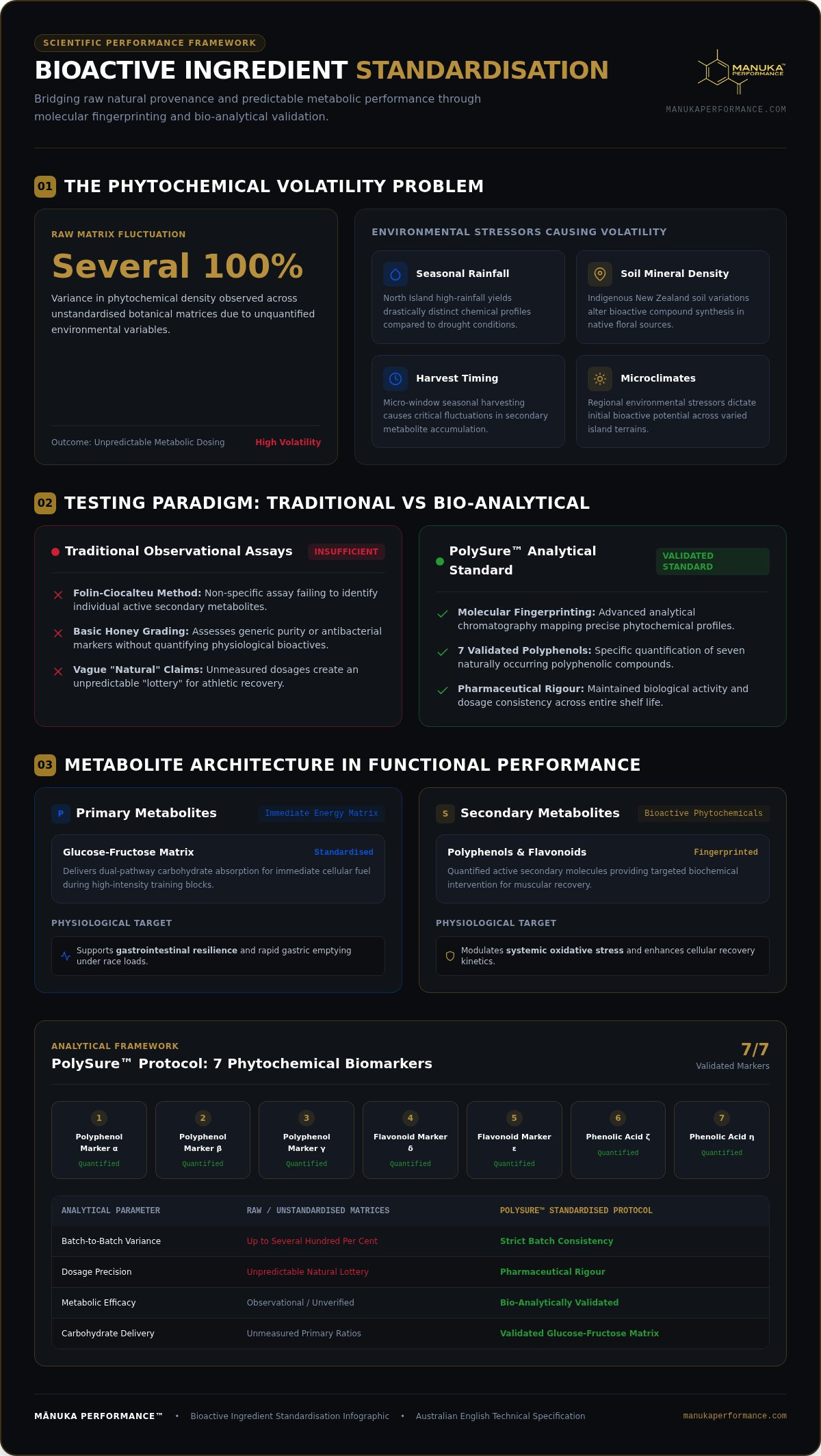
The traditional reliance on non-specific assays such as the Folin-Ciocalteu method is no longer sufficient for validating the metabolic efficacy of functional nutrition. While many products claim natural superiority, the reality remains that raw botanical matrices can vary in phytochemical density by several hundred per cent depending on environmental factors like seasonal rainfall and soil composition. This lack of bioactive ingredient standardisation often leads to inconsistent performance results and deep-seated scepticism among elite athletes who require absolute precision. You likely recognise that a simple honey grading system or a vague natural label doesn't guarantee the physiological resilience needed for high-intensity training.
This article details the rigorous scientific protocols required to validate phytochemical density and ensure metabolic efficacy in performance-led nutrition. You'll discover how the PolySure™ analytical standard provides a bio-analytical framework to identify high-performance phytochemical markers beyond basic antibacterial ratings. We will explore the transition from single-marker proxies to comprehensive molecular fingerprinting, providing the technical insights required to optimise recovery through quantified bioactives and a validated glucose-fructose matrix.
Key Takeaways
- Understand why bioactive ingredient standardisation is the essential bridge between raw natural provenance and predictable metabolic performance in elite sports nutrition.
- Identify the environmental variables, such as soil composition and harvest timing, that cause significant volatility in phytochemical density within unstandardised products.
- Explore the PolySure™ analytical framework, a biotech-led protocol that validates seven specific, naturally occurring polyphenols to ensure batch-to-batch consistency.
- Learn how a standardised glucose-fructose matrix supports gastrointestinal resilience and aids in the management of systemic oxidative stress during intense training blocks.
- Gain insights into developing a bio-analytical race-day protocol that prioritises quantified phytochemicals over synthetic alternatives for superior recovery outcomes.
The Fundamentals of Bioactive Ingredient Standardisation
Bioactive ingredient standardisation represents the critical transition from observational naturalism to precise biochemical validation within the functional nutrition sector. While the term "natural" remains a common marketing descriptor, it offers no insight into the actual density of the active compounds responsible for physiological change. In contrast, bioactive ingredient standardisation is the rigorous process of quantifying specific phytochemical markers to ensure that every batch delivered to an athlete contains a precise, efficacious concentration of active molecules. This shift is driven by a growing demand for bio-analytical validation, where the focus moves from simple caloric intake to the systemic impact of secondary metabolites.
The distinction between a raw natural ingredient and a standardised one is profound. A raw ingredient is subject to the volatility of its environment; factors such as soil composition, climate, and harvest timing dictate the initial bioactive potential. Provenance plays a critical role here, as specific geographical regions, such as the indigenous forests of New Zealand, provide unique environmental stressors that enhance the production of these compounds. However, without standardisation, these natural advantages remain unquantified and unreliable for elite performance applications.
The Clinical Necessity of Precise Quantification
Standardisation effectively eliminates the "lottery" associated with natural ingredient efficacy. When an athlete consumes an unstandardised product, the metabolic response is unpredictable because the dosage of active constituents is unknown. By establishing a rigorous bio-analytical framework, manufacturers can provide a baseline for metabolic response through measured dosages. This approach integrates pharmaceutical rigor into the functional nutrition landscape, moving away from anecdotal evidence toward data-driven performance outcomes. Much like the stringent quality control protocols employed by analytical research suppliers such as Onyx Biolabs, establishing verified chemical benchmarks ensures that the biological activity of the product is maintained throughout its shelf life, providing the consistency required for professional training regimes.
Categorising Bioactive Compounds in Performance Nutrition
To understand the complexity of natural matrices, one must distinguish between primary metabolites, such as the glucose and fructose used for immediate energy, and secondary metabolites, which include polyphenols and flavonoids. These secondary metabolites are responsible for modulating oxidative stress and supporting recovery. Advanced analytical techniques allow researchers to map the unique phytochemical profiles of these matrices, identifying specific chemical fingerprints that correlate with athletic performance. Bioactive standardisation is the rigorous quantification of secondary metabolites to ensure predictable physiological outcomes. By focusing on these fingerprints, the industry can move beyond crude extracts toward highly targeted, functional formulations.
Overcoming Phytochemical Variability in Natural Matrices
Phytochemical volatility is an inherent characteristic of unstandardised natural products, where the concentration of secondary metabolites can fluctuate by several hundred per cent between production cycles. These variations are driven by complex environmental interactions, including soil mineral density, local microclimates, and the precise timing of the harvest. New Zealand honey provides a distinct case study in this volatility. A batch harvested from the North Island during a high-rainfall season may exhibit a vastly different chemical profile than honey sourced from the same floral variety in the South Island under drought conditions. Without a framework for bioactive ingredient standardisation, these natural discrepancies render raw ingredients unreliable for athletes who require precision-led nutrition to support their metabolic demands.
Traditional grading systems have historically failed to address this complexity. While many systems focus on purity or provenance, they do not account for the specific density of the bioactives that dictate physiological resilience. This lack of quantification creates a performance gap, where the intended biological effect is lost due to the inherent instability of the raw material.
The Limitations of Single-Marker Grading
Many industry standards rely on a single marker, such as Methylglyoxal (MGO) in mānuka honey, which primarily serves as a proxy for non-peroxide antibacterial activity. While MGO is a useful indicator for topical or antimicrobial applications, it provides an incomplete efficacy profile for systemic performance. Relying solely on high-MGO honey ignores the entourage effect, where a diverse matrix of polyphenols and flavonoids works synergistically to modulate oxidative stress. This narrow focus is increasingly at odds with modern FDA botanical quality control standards, which are moving toward multi-marker quantification to ensure batch-to-batch consistency and predictable metabolic outcomes. Athletes who rely on single-marker products risk missing the broader phytochemical spectrum necessary for recovery.
Analytical Challenges in Complex Biological Systems
Quantifying bioactives within a dense carbohydrate matrix presents significant technical hurdles. Researchers utilise High-Performance Liquid Chromatography (HPLC) to isolate and identify specific phenolic compounds, yet maintaining the integrity of these molecules during processing is difficult. Thermal exposure or improper filtration can easily degrade sensitive bioactives, stripping the product of its functional value. Current sports nutrition biotechnology is evolving to solve these issues through advanced extraction and stabilisation methods that preserve delicate chemical structures. By overcoming these analytical barriers, it's possible to transition from inconsistent raw materials to standardised, high-performance formulations. To ensure your performance regime is backed by these rigorous standards, it's essential to utilise a validated biotech-led platform that prioritises molecular precision.
The PolySure™ Protocol: A New Standard for Polyphenol Quantification
The PolySure™ protocol serves as a sophisticated analytical architecture designed to address the inherent variability of phytochemical density in raw botanical matrices. This proprietary framework functions as the bridge between New Zealand’s indigenous flora and the predictable biological outcomes required by elite athletes. By implementing this specific protocol, bioactive ingredient standardisation moves beyond theoretical quality control into the realm of quantifiable metabolic assurance. Every batch of raw material undergoes rigorous laboratory scrutiny to ensure that the finished product maintains a precise concentration of secondary metabolites, regardless of seasonal or geographical fluctuations in the source honey.
This multi-dimensional validation process ensures that the functional integrity of the matrix is preserved. Batch-specific testing is not merely a safety precaution; it's a fundamental requirement for ensuring that every LiquidFuel gel delivers a standardised dose of bioactives. This level of precision allows for a more nuanced understanding of how these compounds interact with human physiology during intense physical exertion, providing a level of reliability that unstandardised natural products cannot offer.
Quantifying the Seven Pillars of PolySure™
The core of the PolySure™ framework lies in the identification and quantification of seven specific, naturally occurring polyphenols, including key phenolic acids and flavonoids. These markers were selected based on their consistent presence in New Zealand honey and their established functional relevance to systemic resilience. The testing protocol utilises Liquid Chromatography–High Resolution Mass Spectrometry (LC-HRMS) to achieve a level of molecular resolution that traditional methods cannot match. This rigorous approach tracks the bioactives from the raw New Zealand honey through to the final formulation, ensuring that the compounds remain stable within the liquid carbohydrate matrix. This stability is vital, as it ensures the bioactives are ready for intestinal absorption alongside the glucose and fructose components.
PolySure™ vs. Traditional Grading: A Comparative Analysis
Traditional honey grading systems, such as MGO and UMF, were developed primarily to measure methylglyoxal concentrations and antibacterial potency. While these metrics are valuable for topical applications, they offer limited insight into the systemic antioxidant modulation required for athletic recovery. PolySure™ transcends these single-marker systems by providing a comprehensive profile of the polyphenols that dictate physiological performance. This shift from antimicrobial metrics to bioactive quantification is essential for a detailed performance analysis of NZ innovation. Standardisation based on polyphenol content provides athletes with a reliable metric for managing oxidative stress and supporting long-term recovery, a level of detail that traditional grading simply doesn't provide.
Physiological Implications of Standardised Bioactive Intake
The transition from analytical validation to physiological application is where the true value of bioactive ingredient standardisation becomes apparent. When secondary metabolites are delivered at precise, quantified concentrations, they function as targeted modulators of systemic oxidative stress rather than incidental components of a natural matrix. For the endurance athlete, this precision is vital for attenuating the excessive inflammatory cytokines triggered during high-intensity training blocks. By down-regulating pathways like NF-κB and up-regulating Nrf2, standardised polyphenols support a more controlled biological response to physical exertion, ensuring that the body’s internal environment remains conducive to sustained performance.
Beyond inflammation, these quantified bioactives influence mitochondrial efficiency and overall metabolic throughput. Mitochondria are highly susceptible to oxidative damage during prolonged aerobic activity, which can lead to a decline in cellular energy production. Standardised phytochemicals provide the necessary antioxidant protection to maintain mitochondrial membrane integrity, thereby supporting efficient ATP synthesis. This bio-analytical approach bridges the gap between simple nutrient intake and cellular-level recovery, transforming nutrition into a precise tool for biological optimisation. For athletes looking to enhance their recovery with high-quality European nutraceuticals, such as collageen shots kopen from Labo Mariva, the same principles of scientific validation and molecular precision apply.
Gastrointestinal distress remains a significant barrier to performance, often caused by the saturation of intestinal transporters when using synthetic formulations. A standardised honey matrix offers a distinct bio-analytical advantage by utilising a natural glucose-fructose ratio of approximately 1:1.2. This specific configuration facilitates concurrent absorption through two separate pathways: the SGLT1 transporter for glucose and the GLUT5 transporter for fructose. This dual-transport mechanism allows for higher carbohydrate oxidation rates, often reaching 90 grams per hour, without the gastric pressure associated with synthetic maltodextrin. For those seeking to eliminate digestive volatility, this scientific guide to avoiding runner's stomach provides deeper insights into maintaining GI integrity through precise nutrition.
Optimising the Recovery Window with Measured Bioactives
The efficacy of a recovery protocol depends heavily on the consistency of the bioactive dosage. In unstandardised products, the polyphenol density varies so significantly that the post-exercise inflammatory response becomes unpredictable, hindering the athlete's ability to plan subsequent training sessions. By utilising ingredients validated through the PolySure™ framework, athletes ensure that the phytochemical markers responsible for tissue repair and systemic homeostasis are present in every serving. Standardised bioactive intake allows athletes to replicate successful nutritional outcomes with empirical certainty. This level of reliability is essential for maintaining progress across an entire season. To integrate this level of precision into your own training regime, you can explore our range of bio-analytically validated sports nutrition.
Integrating Standardised Bioactives into Advanced Performance Regimes
Developing a sophisticated race-day protocol requires a shift in perspective from simple caloric counting to a bio-analytical approach where bioactive ingredient standardisation ensures the delivery of protective phytochemicals alongside primary fuel sources. Elite athletes are increasingly moving away from synthetic formulations because these products often lack the secondary metabolites required to manage the systemic load of high-intensity competition. By utilising standardised natural alternatives, competitors gain a dual advantage: high-density energy delivery through a validated glucose-fructose matrix and quantified bioactive support to maintain physiological homeostasis. Identifying products that meet the PolySure™ standard of validation allows athletes to eliminate the variables of natural volatility and focus on precise performance outcomes.
The transition toward standardised natural nutrition is not merely a preference for clean-label ingredients; it's a strategic decision based on the predictable biological efficacy of quantified compounds. As the industry moves beyond simple carbohydrate fuelling, the focus is sharpening on how these bioactives can be leveraged to sustain metabolic throughput under extreme stress. This integration marks the next phase of performance nutrition, where the provenance of the material is matched by the rigour of its laboratory validation.
Strategic Fuelling with PolySure™ Validated Gels
The implementation of LiquidFuel within a strategic carbohydrate loading plan allows for the precise accumulation of glycogen stores while simultaneously priming the biological environment with polyphenols. Timing bioactive intake for maximum physiological impact involves consuming these validated gels at regular intervals during endurance events to maintain a steady-state concentration of protective compounds in the plasma. The advantage of using New Zealand-sourced, research-driven nutrition lies in its ability to provide a clean-label solution that doesn't compromise on intestinal absorption or systemic resilience. This methodical approach ensures that the athlete's nutritional strategy is as rigorous as their physical training.
The Future of Sports Biotechnology
The phytochemical revolution is moving toward a future where bioactive ingredient standardisation facilitates personalised nutrition protocols based on specific athlete biometrics and recovery profiles. Rather than a generic approach to fuelling, advanced analytical frameworks will allow for the tailoring of phytochemical density to address individual inflammatory markers and oxidative stress levels. Mānuka Performance remains at the forefront of this evolution, continuously refining the PolySure™ standard to encompass a broader spectrum of functional molecules that support long-term athletic health. You can learn more about our research and biotech solutions to understand how our ongoing laboratory work is redefining the boundaries of human performance through molecular precision.
Advancing Performance Through Bio-Analytical Precision
The evolution of functional nutrition depends on the transition from anecdotal naturalism to rigorous bio-analytical validation. Through bioactive ingredient standardisation, the inherent volatility of raw botanical matrices is replaced by a precise, measurable framework that guarantees batch-to-batch consistency for every athlete. This methodology, underpinned by extensive New Zealand phytochemical research and the PolySure™ analytical validation protocol, ensures that you're no longer gambling on the efficacy of your clean label performance nutrition.
By prioritising quantified secondary metabolites alongside a natural glucose-fructose matrix, you're modulating systemic resilience with empirical certainty rather than relying on unverified claims. It's time to move past synthetic approximations and embrace a biotech-led approach that respects both the complexity of nature and the clinical demands of elite performance. Explore the PolySure™ Validated LiquidFuel Range to integrate this level of scientific precision into your next training block. You've trained with discipline; your nutrition should reflect that same commitment to excellence.
Frequently Asked Questions
What exactly is bioactive ingredient standardisation?
Bioactive ingredient standardisation is the rigorous bio-analytical process of quantifying specific secondary metabolites, such as polyphenols, to ensure every production batch contains a precise concentration of active compounds. Unlike generic natural labels, this framework eliminates the phytochemical volatility caused by environmental factors like soil composition and climate. It provides a reliable baseline for metabolic response, allowing athletes to utilise functional nutrition with the same dosage precision found in clinical or pharmaceutical applications.
How does the PolySure™ standard differ from UMF or MGO honey grading?
The PolySure™ standard evaluates a broader spectrum of systemic bioactives, specifically seven naturally occurring polyphenols, whereas UMF and MGO focus exclusively on methylglyoxal for antibacterial potency. While antimicrobial ratings are valuable for topical use, they don't reflect the phytochemical density required for managing oxidative stress during endurance events. PolySure™ provides a multi-dimensional validation of the matrix’s functional capacity, offering a more relevant metric for physiological resilience and athletic recovery.
Why should athletes care about standardised polyphenols?
Athletes require standardised polyphenols to ensure their recovery protocols are supported by consistent, efficacious doses of antioxidants. Unstandardised products often contain fluctuating levels of secondary metabolites, leading to unpredictable physiological outcomes. By utilising quantified bioactives, competitors can effectively down-regulate exercise-induced inflammatory cytokines and support mitochondrial integrity. This level of precision allows for the replication of successful nutritional strategies across an entire training block or competitive season.
Are standardised natural bioactives more effective than synthetic alternatives?
Standardised natural bioactives offer a distinct advantage through the entourage effect, where a complex matrix of co-occurring compounds enhances biological activity beyond what isolated synthetic molecules can achieve. Additionally, delivering these bioactives within a natural glucose-fructose matrix facilitates superior gastrointestinal resilience. Synthetic formulations often lack the phytochemical diversity necessary to modulate systemic stress, making standardised natural alternatives a more comprehensive solution for high-performance fuelling and long-term recovery.
Does the standardisation process affect the taste or texture of energy gels?
The standardisation process is an analytical framework involving rigorous laboratory testing and doesn't negatively alter the organoleptic properties of the energy gels. Because the PolySure™ protocol focuses on validating naturally occurring compounds within the honey matrix, the resulting LiquidFuel gels maintain their smooth texture and natural flavour profile. The process ensures that the functional density is preserved without requiring the addition of synthetic thickeners or artificial flavouring agents often found in lower-tier products.
How can I verify if a product uses standardised bioactive ingredients?
Verification is achieved by identifying the PolySure™ validation seal on packaging and reviewing batch-specific Certificates of Analysis. Reputable functional nutrition brands provide transparency regarding their analytical protocols and the specific concentrations of phytochemicals present in their formulations. If a product only lists generic honey or lacks a quantified polyphenol profile, it hasn't undergone the rigorous bio-analytical testing required to meet the high standards of performance-led bioactive ingredient standardisation.
What are the specific polyphenols measured in the PolySure™ protocol?
The PolySure™ protocol identifies and quantifies seven specific, naturally occurring polyphenols that are consistently present in New Zealand honey-based matrices. These include a selection of phenolic acids and flavonoids chosen for their established roles in modulating systemic homeostasis and managing oxidative stress. By tracking these specific chemical fingerprints using High-Performance Liquid Chromatography, Mānuka Performance ensures that every gel provides a standardised phytochemical dose to support the metabolic demands of elite endurance training.
Is bioactive standardisation necessary for amateur athletes?
Bioactive standardisation is highly beneficial for amateur athletes, as gastrointestinal resilience and efficient recovery are universal requirements for physical progress. While elite competitors often lead the adoption of biotech-driven nutrition, any individual engaged in regular training benefits from the GI-friendly glucose-fructose matrix and the consistent antioxidant support provided by quantified polyphenols. Using validated products eliminates the guesswork from nutrition, allowing athletes at all levels to focus on their performance goals with confidence.