


What if the gel you blame is only part of the problem? If you’ve had stomach cramps soon after fuelling, it’s understandable to ask why do energy gels cause stomach cramps, especially when discomfort disrupts a run or race and leaves you unsure whether to change your gel, pace or hydration.
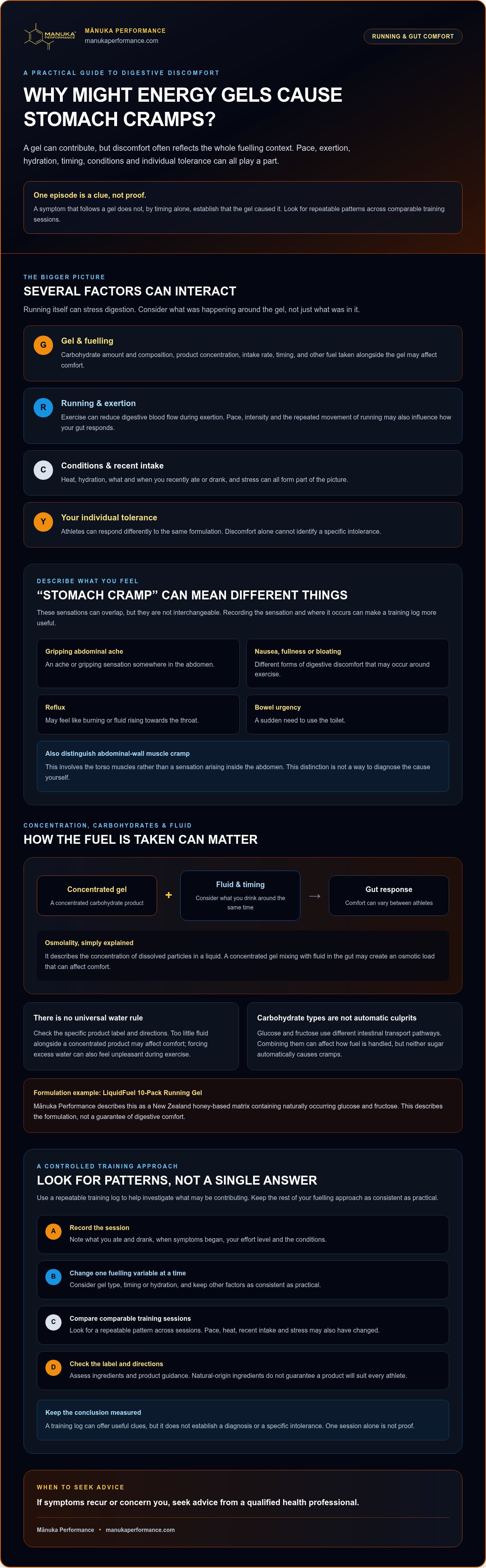
Gels can contribute, but symptoms often reflect the whole fuelling context. Running places stress on digestion, and exercise intensity, hydration, carbohydrate amount and timing, and individual tolerance can all influence how your gut responds. A concentrated gel may also need enough fluid alongside it.
This guide explains possible reasons for cramping and sets out a controlled way to track your fuelling and test adjustments during training. You’ll learn how to look for patterns across gel type, timing, pace and hydration, and when persistent or concerning symptoms call for advice from a qualified health professional.
Key Takeaways
- Learn why do energy gels cause stomach cramps, and how to distinguish cramping from nausea, bloating, reflux or bowel urgency.
- Understand how carbohydrate amount, composition and timing may affect digestive tolerance differently from one athlete to another.
- Consider factors beyond the gel, including pace, heat, hydration, pre-run food and stress, before drawing conclusions.
- Use a repeatable training approach to review symptoms and adjust one fuelling variable at a time.
- Assess gel labels and directions carefully. Natural-origin ingredients don’t guarantee a product will suit every athlete.
Why might an energy gel cause stomach cramps during a run?
Exercise-related abdominal discomfort can have several interacting causes; there isn’t one universal gel trigger. If you’re asking why do energy gels cause stomach cramps, start by identifying what “cramp” means and what else was happening when the symptoms began.
Energy gels are concentrated carbohydrate products designed to provide fuel during exercise. Some formulations also contain ingredients such as caffeine. Their composition is only part of the picture: running itself can stress digestion through reduced digestive blood flow during exertion and the repeated movement of the body.
What does “stomach cramp” mean during exercise?
Athletes may use “stomach cramp” for different sensations, from a gripping ache anywhere in the abdomen to nausea, fullness or bloating. Reflux may feel like burning or fluid rising towards the throat, while bowel urgency is a sudden need to use the toilet. These symptoms can overlap, but they aren’t interchangeable. Describing the sensation and its location can help you track episodes more accurately.
Digestive discomfort also differs from a muscle cramp in the abdominal wall, which involves the torso muscles rather than a sensation arising inside the abdomen. This distinction isn’t a way to diagnose the cause yourself. Seek advice from a qualified health professional if symptoms recur or concern you.
Why can symptoms appear after taking a gel?
A symptom that follows a gel may suggest a pattern, but timing alone doesn’t prove the gel caused it. The same point in a run may also involve a faster pace, warmer conditions, accumulated stress, recent food or fluid intake, or several factors together. A gel’s carbohydrate amount and ingredients may matter, but athletes can respond differently to the same formulation.
Exercise-related gut symptoms are multifactorial. They may reflect the combined effects of exertion, pace, heat, hydration, recent intake, stress and individual digestive tolerance, rather than one food or product. A repeatable pattern across comparable training sessions can offer more useful clues than one episode, without establishing a diagnosis or specific intolerance.
Use a training log to record what you ate and drank, when symptoms began, your effort level and the conditions. That context can help you investigate the pattern methodically in the sections that follow.
How gel concentration, carbohydrates, and timing can affect the gut
The carbohydrate dose in a gel, its ingredients and the rate at which you consume it can all influence digestive comfort. A serving taken alongside other fuel may feel different from the same serving taken alone, and responses vary between athletes. There isn’t one answer to why do energy gels cause stomach cramps based on a single carbohydrate or formulation.
Osmolality is the concentration of dissolved particles in a liquid. A more concentrated mixture has more particles relative to its water content. A concentrated gel entering the gut may create an osmotic load as it mixes with fluid, potentially affecting comfort. How energy gels affect the gut explains this process and why product concentration, fluid and individual response matter.
Can glucose and fructose affect digestive comfort?
Glucose and fructose are absorbed through different intestinal transport pathways, so combining carbohydrate types can affect how fuel is handled. That doesn’t mean either sugar automatically causes cramps. Formulation, serving size, intake rate and personal tolerance all contribute, and discomfort alone can’t identify a specific intolerance.
For example, Mānuka Performance’s LiquidFuel 10-Pack Running Gel uses a New Zealand honey-based matrix containing naturally occurring glucose and fructose. That describes the formulation, not a guarantee of digestive comfort. If you’re considering a honey-based gel, check its label and directions, then trial it individually in training.
Does taking a gel without water cause cramps?
There isn’t a universal water rule for every gel. Directions differ by product, so check the specific label rather than assuming a gel must always be taken with a fixed volume of fluid. Too little fluid alongside a concentrated product may affect comfort, while forcing excess water can also feel unpleasant during exercise.
Consider the gel’s concentration, when you take it and what you’re drinking around that time. In training, change one factor at a time and keep the rest of your fuelling approach as consistent as practical. That makes it easier to observe whether the pattern changes. Don’t treat one session as proof: pace, conditions and prior intake can also affect symptoms.
For a closer look at the ingredients and directions of honey-based sports energy gels, review the product information and assess whether a particular option is appropriate to test during training. Ingredient origin alone can’t predict how your gut will respond.
Are energy gels always the cause, or could something else explain cramps?
A cramp that starts after a gel can make the product seem like the obvious cause, but sequence alone doesn’t establish that it was the sole trigger. Gel dose and timing may interact with effort, conditions, hydration, pre-run food and stress. If you’re considering why do energy gels cause stomach cramps, compare the whole session rather than judging the gel in isolation.
How can pace, heat, and pre-run food contribute?
Race pace may be harder to sustain than a training pace, while warm conditions can add to the demands of exercise. Either may coincide with changes in digestive comfort, though neither proves what caused a particular episode. Record meal timing, other foods and drinks, and stress alongside gel use. Don’t try to push through significant or worsening pain.
Compare the factors around an episode:
- Gel dose: Note the serving amount, timing and any other carbohydrate consumed.
- Pace: Record your effort and whether symptoms began during a harder stretch.
- Heat: Note the conditions, including whether the session felt unusually warm.
- Hydration: Record what and when you drank, without assuming more fluid is always better.
- Pre-run food: Log what you ate or drank and how long before exercise.
- Stress: Consider race pressure, nerves, poor sleep or other unusual demands.
Could a gel ingredient or intolerance be involved?
An ingredient or formulation could contribute to symptoms, particularly if you already know you don’t tolerate a particular ingredient. Check the label and record the product used, but don’t infer an allergy, intolerance or medical condition from cramps alone. Recurring symptoms or a suspected ingredient reaction are reasons to seek guidance from a qualified clinician or sports dietitian.
Use your notes to look for repeatable patterns across sessions, not to prove a cause from one run. If symptoms are persistent, severe, worsening or unusual for you, seek assessment from a qualified health professional. Severe pain or symptoms accompanied by faintness, blood or repeated vomiting warrant prompt medical attention. Stop exercising if pain is significant rather than trying to fuel through it.
How to troubleshoot energy-gel cramps before your next event
A methodical approach can help you identify patterns without assuming the gel is the only cause. If you’re still asking why do energy gels cause stomach cramps, use your next training sessions to review what happened and test one manageable change at a time, rather than altering your entire fuelling plan at once.
What should you change first when a gel causes discomfort?
Start with the product directions and the conditions of the session. Compare how you used the gel with its current label, then consider whether pace, weather, hydration or other food and drink differed from your usual routine. Avoid testing during a race or pushing through significant pain.
- Review the episode: Note what the discomfort felt like, where it occurred and when it began relative to taking the gel.
- Check the label: Record the product and serving details as stated on the current packaging, then compare your use with its directions.
- Establish a repeatable context: Choose a training session where effort, route and conditions are as consistent as practical.
- Adjust one variable: For example, test a different timing or serving amount while keeping other parts of your routine steady. Seek guidance from a qualified health professional or sports dietitian if you’re unsure what adjustment is appropriate.
- Review the result: Look for a pattern across sessions rather than treating one comfortable or uncomfortable run as conclusive.
How can a training log reveal a pattern?
Record the product name and serving details from the current label, when you consumed it, your effort level and the environmental conditions. Add fluid intake, pre-run food and other drinks, then describe the symptom and when it began. These details make it easier to compare similar sessions and notice whether discomfort recurs under similar circumstances.
Testing fuel during training is more informative than trying it for the first time on race day. You can observe your response in a familiar, repeatable setting and adjust without race-day pressure. As you review your approach, consider your overall intra-workout carbohydrate fuelling rather than looking at a gel in isolation.
To assess a honey-based sports energy gel as one option in your own training, review the gel product information and check its current label and directions before testing it.
Choosing and testing an energy gel without assuming it prevents cramps
A suitable gel is one that fits your fuelling plan and that you’ve assessed in training, not one whose ingredient positioning promises a particular digestive outcome. Natural-origin ingredients don’t guarantee symptom-free use or suitability for every athlete. The question of why do energy gels cause stomach cramps has an individual answer, so choose based on transparent product information and your own response under comparable conditions.
What should runners check on an energy-gel label?
Compare products using the same practical criteria, and check the current packaging rather than relying on old online descriptions. Review:
- Ingredients: Check the full ingredient list, particularly for anything you already know you don’t tolerate.
- Carbohydrate information: Note the amount stated per serving and how it fits your overall fuelling plan.
- Serving details and directions: Confirm the stated serving and any instructions about use or fluid.
- Portability: Consider whether the packaging is practical to carry, open and use during your activity.
- Personal tolerance: Trial the gel in training and record your response. Don’t treat ingredient origin or marketing language as a predictor.
Neither “natural” nor “synthetic” establishes how an individual will respond. Product features and ingredient information also shouldn’t be treated as evidence that a gel prevents cramps.
How should you assess a honey-based running gel?
Mānuka Performance’s LiquidFuel 10-Pack Running Gel is one option athletes can evaluate individually. The product information describes a New Zealand honey-based matrix containing naturally occurring glucose and fructose. That composition is not evidence that it prevents cramps or improves digestion, and it doesn’t establish how any particular athlete will tolerate it.
Before comparing products, check the current label for serving information, carbohydrate details, ingredients and recommended use. Verify those specifications against the packaging before using them in a fuelling plan. If you’re considering a honey-based gel, assess its label against the same criteria as other options, then trial it in training rather than for the first time at an event.
When comparing honey-based energy gels and their role in your fuelling plan, keep the same principle in mind: ingredient transparency helps you understand what a product contains, while careful individual testing can help you assess your own tolerance. LiquidFuel is one candidate to evaluate, without assuming a particular digestive result.
Build confidence in your fuelling plan through training
Energy-gel cramps don’t necessarily point to one product or ingredient. The timing of symptoms is a clue, not proof: effort, heat, hydration, other intake and individual tolerance may also contribute. To understand why do energy gels cause stomach cramps, review the whole session and use a training log to test one fuelling adjustment at a time.
Choose gels by checking their current labels, carbohydrate information and directions, then assess your own response in training rather than relying on claims about natural ingredients or digestive comfort. If symptoms are persistent, severe or unusual, seek advice from a qualified health professional.
Mānuka Performance’s LiquidFuel 10-Pack Running Gel is a honey-based option for endurance athletes to assess individually. Its New Zealand honey-based matrix contains naturally occurring glucose and fructose. PolySure™ validates seven naturally occurring polyphenols in the finished product; this validation isn’t evidence of cramp prevention or improved digestion.
Explore Mānuka Performance’s honey-based sports nutrition and review product information as part of your own careful fuelling assessment. With a structured approach, you can build a clearer picture of what suits you and approach your next event with greater confidence.
Frequently Asked Questions
Why do energy gels cause stomach cramps?
Energy gels may coincide with cramps if their carbohydrate dose, concentration or timing doesn’t suit an athlete, but the gel may not be the only factor. Pace, heat, stress, other foods and fluid intake can also affect comfort during exercise. A gel taken shortly before symptoms isn’t proof of causation. Record what you consumed, when symptoms began and the session conditions. Seek professional advice if symptoms recur, worsen or feel unusual.
Can energy gels cause stomach cramps even when I drink water?
Yes. Drinking water doesn’t guarantee that a gel will be comfortable, because the serving, ingredients, intake rate, exercise intensity and individual tolerance may also contribute. Follow the directions for the specific product rather than forcing extra fluid. If symptoms repeatedly follow one gel, record the pattern and discuss it with a sports dietitian or another qualified health professional, particularly before making substantial changes to your fuelling plan.
Should I take water with an energy gel?
Check the instructions for the specific gel, as directions can differ between products. Don’t assume every gel requires the same amount of water or follow one universal rule. Both inadequate and excessive fluid intake may be unhelpful during exercise, so avoid forcing extra water. Practise your intended fuelling approach in training, where you can assess how it suits you. For longer events or ongoing symptoms, seek individual advice from a qualified professional.
Can fructose in energy gels cause stomach cramps?
Fructose may be one contributing factor for some athletes, but it isn’t a universal explanation for cramps. The amount and formulation, other carbohydrates, intake rate, exercise conditions and personal tolerance may all influence digestive comfort. One episode can’t establish a fructose intolerance. Record the product, timing and circumstances, then look for a recurring pattern. If symptoms persist or concern you, discuss them with a qualified health professional rather than self-diagnosing.
How can I stop energy gels causing stomach cramps?
You can’t guarantee that a particular change will prevent cramps, but a structured test can help identify patterns. Review the product directions and record what you consumed, when symptoms began, your effort level and the conditions. During training, change one factor at a time, such as timing, rather than introducing several new products or fuelling strategies together. If cramps are severe or keep recurring, seek advice from a qualified health professional.
Are natural energy gels easier to digest than other gels?
Not necessarily. “Natural” describes ingredient origin or product positioning; it doesn’t guarantee digestive comfort or suitability for every athlete. Ingredients, serving size, timing, exercise conditions and personal tolerance can all influence how a gel feels during a session. Compare current product labels and directions, and trial unfamiliar options in training rather than on race day. Treat claims about digestive comfort cautiously unless reliable evidence supports the specific claim.
When should I seek help for cramps after taking an energy gel?
Seek professional advice if cramps keep recurring, are severe, or occur with other symptoms that concern you. Don’t assume every episode is caused by nutrition, and don’t try to diagnose an allergy or medical condition from cramps alone. A GP or appropriately qualified health professional can assess the broader pattern and advise whether further evaluation is needed. Keep notes on the product, intake, exercise conditions and symptoms to support that discussion.