


The fuel with the simplest ingredient list isn’t automatically the better choice for your next long run. In a Tailwind vs natural endurance fuel comparison, focus on how each option delivers carbohydrates, what its label quantifies and whether its format fits your training.
Drink mixes and gels can provide carbohydrates in different ways, while terms such as “natural” don’t tell you on their own how a product fits your fuelling plan or feels during exercise. Compare the ingredients and labelled quantities rather than assuming one carbohydrate source is universally superior.
This guide compares Tailwind drink mix with natural fuel options by composition, delivery format and training needs. It covers practical trade-offs and ways to test a fuelling approach before race day. Tolerability varies from person to person, so practise with a product in training rather than introducing it during competition.
For a New Zealand honey-based example, Mānuka Performance’s LiquidFuel 10-Pack Running Gel contains naturally occurring glucose and fructose. The comparison that follows focuses on useful product details, not on treating “natural” or “synthetic” as a verdict.
Key Takeaways
- In a Tailwind vs natural endurance fuel comparison, assess carbohydrate sources and labelled quantities rather than treating “natural” as a measure of suitability.
- Compare delivery format as well as the fuel itself. Account for fluid access, carrying needs and how each option fits your planned intake.
- Match your choice to the session’s duration, intensity and practical conditions. Consider your overall fuelling approach, not just one label claim.
- Trial one format at a time in a familiar training session and record how it goes. Use your observations to make considered adjustments before race day.
- LiquidFuel 10-Pack Running Gel is one example of a honey-based gel format, with naturally occurring glucose and fructose.
Tailwind vs natural endurance fuel: what is actually being compared?
For a useful Tailwind vs natural endurance fuel comparison, keep the categories distinct. Tailwind refers here to the brand’s endurance drink mix, prepared in a bottle and consumed as a drink. “Natural endurance fuel” describes products made with ingredients sourced from foods or other natural materials, not one standard recipe or delivery method. Natural options can include gels, drinks and other portable foods, so the details depend on the specific product.
Both drink mixes and gels can contribute carbohydrates during exercise, but they deliver them differently. A drink mix is consumed with the fluid used to prepare it. A gel is a concentrated serving carried separately and used alongside an athlete’s hydration plan. Neither format, nor the word “natural”, tells you which option is more suitable, tolerable or effective for you. Those judgements depend on the product’s composition and your individual response.
Start with information you can check on the label: carbohydrate quantity per serving, named carbohydrate sources, serving size and any other ingredients relevant to your preferences. For Tailwind, use the current product packaging for exact figures, as formulations and labels can change. Check the same details for a natural option rather than assuming its ingredient source makes it the right match.
Why product format matters during endurance exercise
A drink mix needs to be measured or carried, mixed with fluid and managed in a bottle during the session. A gel is a concentrated, portable serving used separately from your hydration plan. The Energy gel overview describes this format and its use in endurance sports. In practice, format affects preparation, carrying capacity and how easily you can organise intake while moving.
What “natural” can and cannot tell an athlete
Ingredient-source language describes a formulation, not a guaranteed outcome. A honey-based carbohydrate matrix, for example, identifies honey as an ingredient source. It doesn’t by itself establish product quality, suitability, tolerability or comparative performance. To assess those things, review the full ingredient list and nutrition panel, then try the product in training. Natural ingredients can still be processed and formulated, so the label provides more useful detail than a broad category claim.
Mānuka Performance’s LiquidFuel 10-Pack Running Gel is a gel-format option made with a New Zealand honey-based matrix containing naturally occurring glucose and fructose. This describes its carbohydrate sources, not a claim that it outperforms a drink mix or suits every athlete. The sections that follow compare products by label details, delivery logistics and fit with a fuelling approach you’ve practised.
Compare Tailwind and natural endurance fuel by carbohydrates and delivery
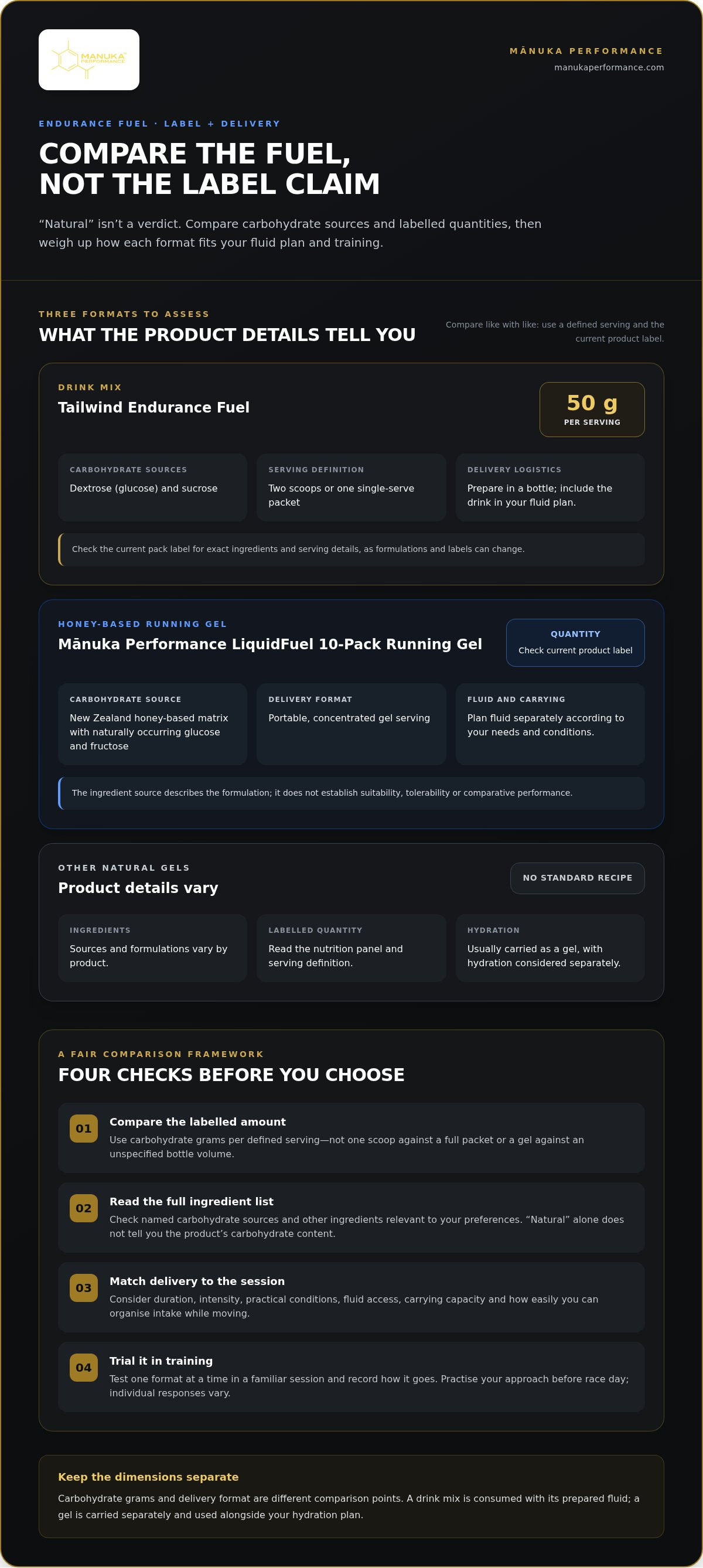
A fair comparison separates what a product provides from how you consume it. Carbohydrate grams and delivery format are separate comparison dimensions. A drink mix provides carbohydrates in a bottle of fluid, while a gel provides a portable, concentrated serving to manage alongside your hydration plan.
| Option | Format | Carbohydrate source | Labelled quantity | Fluid and carrying considerations |
|---|---|---|---|---|
| Tailwind Endurance Fuel | Drink mix, prepared in a bottle | Label lists dextrose (glucose) and sucrose | 50 g per serving, defined as two scoops or one single-serve packet; check the current pack label | Requires a bottle and preparation; account for the drink as part of your fluid plan |
| Mānuka Performance LiquidFuel 10-Pack Running Gel | Honey-based running gel | New Zealand honey-based matrix with naturally occurring glucose and fructose | Use the current product label to compare the carbohydrate amount per serving | Portable gel format; plan fluid separately according to your needs and conditions |
| Other natural gels | Varies by product | Varies by ingredients and formulation | Read the individual nutrition panel and serving definition | Usually carried as a gel, with hydration considered separately |
How to read carbohydrate sources and quantities
Glucose and fructose are carbohydrate names, not evidence that a product is superior overall. Tailwind Endurance Fuel’s listed sources include dextrose, which is glucose, and sucrose, which is composed of glucose and fructose. Formulas can change, so confirm the ingredients and serving details on current packaging. Compare grams per defined serving, rather than comparing one scoop with a full packet or one gel with an unspecified bottle volume. Include maltodextrin in a comparison only if it appears on the specific product label you’re assessing.
Natural gels aren’t one standard formulation. LiquidFuel’s honey-based matrix is one example, while other products may use different ingredients and serving sizes. Check the full ingredient list and nutrition panel rather than inferring carbohydrate content from the words “honey” or “natural”.
Drink mix versus gel: practical delivery differences
A mix needs to be measured and prepared in a bottle; a gel is ready to carry and use without mixing. On a run or ride, carrying capacity, refill access and ease of handling a bottle or packet can shape what fits your routine. Fluid access matters too: a gel doesn’t replace a hydration plan, while a prepared drink contributes fluid as you consume it. Neither format is universally more convenient.
For more context on the formulation and development of honey-based gels, explore this honey energy gel performance analysis. Mānuka Performance’s honey-based running gel is one option to assess using the same label and delivery criteria.
Which endurance fuel fits your session? A fair comparison framework
Choosing between Tailwind and a natural gel makes more sense when you start with the session, not a single label claim. Consider how long and intensely you’ll exercise, whether you can carry and access fluid, and what intake pattern you’ve practised. A bottle-based approach may suit one route, while a portable gel may fit another. Neither format is automatically better.
The best format is the one you can practise consistently and tolerate during the demands of your session. Consider the whole fuelling plan, including any other drinks or products you’ll use, rather than judging a product by its carbohydrate source alone. Carbohydrate needs vary with the athlete and exercise demands, so don’t treat a single target as universal. For individual guidance, use current evidence-based sports nutrition advice and consult a qualified sports dietitian if needed.
- Duration and intensity: Consider the session’s demands and how your fuelling approach will fit across its length.
- Fluid access: Account for what you can carry, refill or reach during the activity.
- Rehearsed intake: Choose an approach you’ve tested in training, not a new format on race day.
When a drink mix may suit the session
A prepared bottle can be practical if you can carry it and drink from it during the session. With this format, carbohydrate and fluid arrive together as you drink, but that doesn’t guarantee better fuelling or hydration. Include any additional water, sports drink or gels in your plan, so you can assess your total intake rather than the bottle in isolation. Bottle access and refill points can also affect the practical fit.
When a natural gel may suit the session
A portioned gel may fit an activity where a compact, ready-to-carry format works with your routine and bottle access is limited or intermittent. Mānuka Performance’s LiquidFuel 10-Pack Running Gel is a specific honey-based example, with naturally occurring glucose and fructose. Its formulation isn’t representative of every natural gel. Plan fluid separately and practise using the gel in the conditions you expect. A comparative analysis of honey energy gels offers further context on evaluating this category.
For your next suitable training session, decide in advance what you’ll carry, when you expect to take it and how you’ll manage fluids. Afterwards, consider whether the plan was practical and comfortable in light of the session’s demands. If a honey-based gel is one format you’re considering, explore honey-based running fuel as part of your comparison.
How to test Tailwind or natural fuel in training before race day
A repeatable trial makes the Tailwind vs natural endurance fuel comparison more useful than relying on a single impression. Choose a familiar training session and keep conditions as consistent as practical. This helps you assess the product and delivery format without changing several parts of your fuelling plan at once. The aim is to gather observations, not to prove one option suits every athlete or event.
- 1. Choose a familiar session. Select a run or ride with a route, duration and effort level you know. Avoid making your first trial during a key event or unusually demanding workout.
- 2. Select one format. Test either the drink mix or the gel, following its current label directions. Keep your usual approach to other food and fluids as consistent as possible.
- 3. Record what you use. Note the product, serving amount, timing and fluid consumed. Include any other fuel so you can interpret the full intake, not just one product.
- 4. Log the conditions and experience. Record effort, weather and route conditions, along with perceived tolerance and any practical issues.
- 5. Review before adjusting. Consider whether the format was easy to prepare, carry and use. Repeat the trial or change one variable in a later session.
Record a useful training comparison
Write down the product label details, amount used, fluid intake and when you took each serving. Include practical observations: could you open the gel while moving? Was mixing the drink straightforward? Did the bottle fit your carrying set-up? Note how the session felt, but don’t treat one outcome as proof of a universal product effect. Repeating the trial in a comparable session can help distinguish a consistent pattern from an isolated experience.
Gastrointestinal comfort is one observation to track, alongside energy, thirst and ease of use. It can be influenced by factors beyond the product, including effort, conditions and the rest of your intake. This scientific guide to runner’s stomach issues provides further context, but it isn’t a substitute for individual assessment.
Adjust the approach cautiously
Make changes in training, not for the first time on race day. If you’re changing serving amounts or moving towards a higher-carbohydrate approach, adjust gradually and observe how the plan fits your sessions. Avoid increasing several products at once. For complex dietary needs or a detailed event fuelling plan, seek guidance from a qualified sports dietitian. Your notes can make that discussion more specific.
To trial a honey-based gel format, explore Mānuka Performance’s running gel and assess it using the same measured training approach.
Where Mānuka Performance fits: a measured natural gel option
In a Tailwind vs natural endurance fuel comparison, Mānuka Performance’s LiquidFuel 10-Pack Running Gel is a natural, gel-format option to assess alongside a drink mix. Its New Zealand honey-based matrix contains naturally occurring glucose and fructose. That describes the formulation’s carbohydrate sources; it doesn’t establish superior absorption, improved performance or suitability for every athlete.
Consider how the product fits your own fuelling approach. Review the current nutrition panel and serving information, how you’ll carry and use the gel, your access to fluid and your observations during training. Ingredient source is one part of the assessment, not a substitute for evaluating the whole product and trying it in a relevant session.
What the confirmed honey-based matrix means
The honey-based matrix identifies New Zealand honey as the product’s carbohydrate source, with naturally occurring glucose and fructose. This doesn’t indicate a race outcome, recovery experience or health result. Keep formulation facts separate from outcome claims, and use the label and your training notes to judge whether a gel format fits your routine.
A gel may suit an athlete who prefers a portable, portioned format, provided its use fits their fluid plan and is practised beforehand. Another athlete may find a prepared drink more practical. Neither conclusion follows from the word “honey”. It depends on comparing delivery logistics and personal experience in context.
Explore a natural gel with analytical validation
PolySure™ is an analytical standard used to validate seven naturally occurring polyphenols in the finished product. It provides information about product composition. It isn’t a performance guarantee, and the presence of validated polyphenols doesn’t establish a health outcome. Keeping these distinctions clear lets ingredient provenance and analytical validation inform your comparison without overstating what either can demonstrate.
For further detail on evaluating honey-based gels, read this honey-based energy gel performance analysis. It can add context as you review formulation and evidence, while your label comparison and training trials remain central to deciding whether the format works for your plan.
Once you’ve compared labels and considered how each format fits your sessions, explore the product range as part of your fuelling research.
Put your fuelling choice to the test
Your next step is practical: choose the approach that best fits your session and test it under familiar training conditions. Record what you use, how you manage fluids and whether the format works for you. Then use those observations to refine your plan instead of making a last-minute switch based on a label or ingredient category.
This is the value of approaching Tailwind vs natural endurance fuel as a personal comparison, not a contest with a universal winner. If a honey-based gel is part of your evaluation, Mānuka Performance’s LiquidFuel 10-Pack Running Gel uses a New Zealand honey-based matrix, while PolySure™ validates seven naturally occurring polyphenols in the finished product. These are formulation and validation details to consider alongside your training experience, not promises of an outcome.
Explore Mānuka Performance’s honey-based running gel as you compare options. Practising before competition and reviewing what works for you can help you build a considered fuelling strategy.
Frequently Asked Questions
Can Tailwind and a natural energy gel be used in the same fuelling plan?
Yes, a plan can include both a drink mix and a gel, provided you consider their combined contribution to carbohydrate and fluid intake. For example, if you carry a prepared bottle and a gel for a longer session, record when and how much of each you use. Check current labels and practise the combination in training. If you have specific nutrition needs, a qualified sports dietitian can help tailor your plan.
Is natural endurance fuel always better than a sports drink?
No. “Natural” describes ingredient sourcing, not whether a product is better for a particular athlete or session. Compare the ingredients, labelled carbohydrate quantity and format, then consider whether the product fits your routine and training experience. Ingredient origin alone can’t guarantee performance, recovery or health outcomes. In a Tailwind vs natural endurance fuel comparison, assess specific products using current label information and relevant evidence rather than relying on category terms.
How much carbohydrate should I take during an endurance event?
There isn’t one amount that suits every athlete or event. Your needs can depend on event duration and intensity, training history, what else you consume and how you tolerate your fuelling approach. Use current evidence and discuss a personalised plan with a qualified sports dietitian, particularly if your needs are complex. Practise your planned intake during training, where you can assess its fit, rather than experimenting with a new strategy during competition.
What happens if I find a fuel difficult to tolerate?
Don’t assume a product will suit you just because its label looks appropriate. Pause the trial if you feel unwell, and note the product, amount, timing, fluid intake and session conditions. Review those details across training sessions rather than drawing a firm conclusion from one experience. If symptoms persist, or you need help adapting your fuelling approach, speak with a qualified sports dietitian or an appropriate health professional.
Can I compare Tailwind and gels by carbohydrate grams alone?
No. Carbohydrate grams are useful, but the serving definition matters: a figure may refer to a scoop, a full prepared serving or an individual gel. Also consider the listed carbohydrate sources, preparation, fluid requirements and how you’ll carry the product. Check current packaging before comparing figures, as product formulations and serving information can change. A like-for-like comparison makes it easier to understand what each option contributes to your overall plan.
Should I test a new endurance fuel before race day?
Yes. Training gives you an opportunity to practise with a new product before relying on it in competition. Start with a familiar session, use the product as directed and note how it fits your fuelling and hydration routine. Keep other variables as steady as practical so you can interpret your observations. If you’re changing your carbohydrate intake, adjust cautiously and seek individual advice where needed rather than making a sudden race-day change.
What is PolySure™ in Mānuka Performance’s natural endurance fuel?
PolySure™ is Mānuka Performance’s analytical standard for validating seven naturally occurring polyphenols in the finished product. It describes a method of validating product composition; it doesn’t by itself demonstrate a particular performance, recovery or health outcome. When assessing a fuel, consider this information alongside its ingredient list, nutrition details, serving format and your own training experience. That keeps analytical validation distinct from claims about how an individual athlete will respond.