


For running, the best carbohydrate choice depends on the session and when you eat. Simple sugars can provide readily available fuel during a run, while complex-carbohydrate foods can work well in everyday meals and recovery. Understanding simple vs complex carbs for running starts with timing: digestion and exercise demands affect which source is practical.
Carbohydrates differ in structure and in how they fit around exercise. Simple carbohydrates contain one or two sugar molecules; complex carbohydrates occur in foods such as oats, whole grains, beans, lentils and vegetables.
This guide explains how these differences relate to digestion, pre-run meals and post-run glycogen replenishment. It also covers why combining glucose and fructose can matter during endurance exercise, helping you match carbohydrate choices to your run instead of assuming one type is always better.
Key Takeaways
- Match carbohydrate type to when you’re eating and the demands of your run, rather than treating one option as best in every situation.
- Use everyday meals and post-run food to support glycogen replenishment, with recovery needs shaped by your next training session.
- Consider digestion and fibre when planning pre-run fuel, particularly if certain foods leave your stomach uncomfortable.
- For longer endurance efforts, learn how glucose and fructose can work together to inform your fuelling strategy.
What’s the difference between complex and simple carbohydrates?
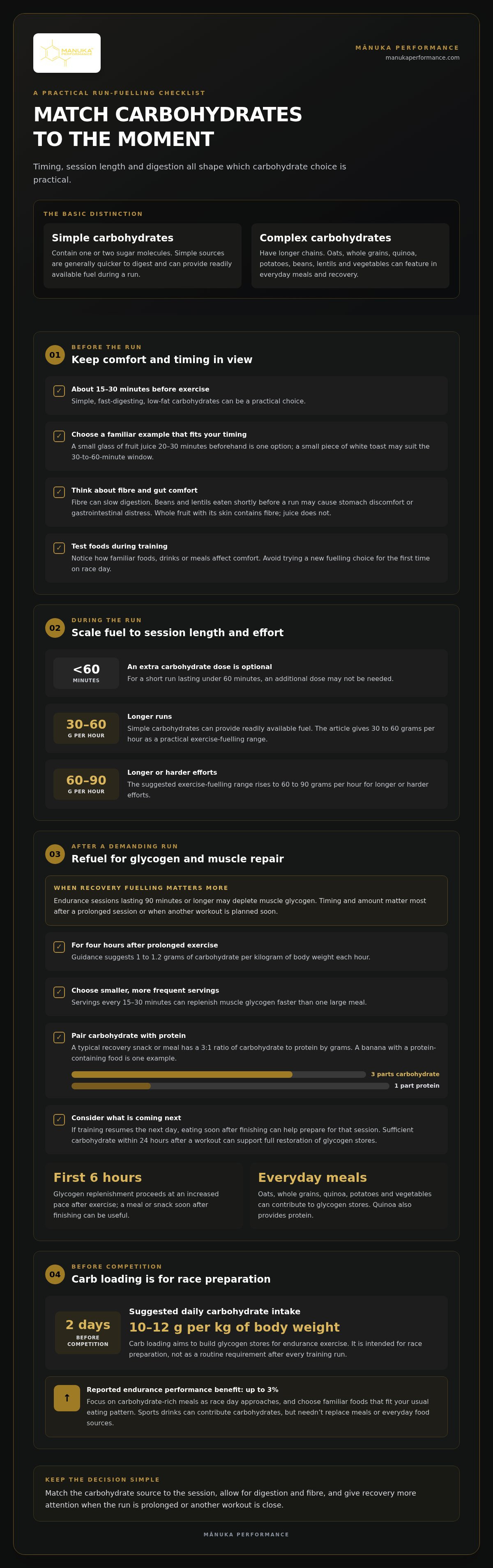
Simple carbohydrates contain one or two sugar molecules; complex carbohydrates have longer chains. For running, the useful choice depends on the food’s form, when you eat it and the session ahead.
Carbohydrate digestion
Digestion breaks carbohydrates into sugars, including glucose, which the body can use for energy. Simple sources are generally quicker to digest, while fibre in foods such as oats, beans and lentils can slow digestion. This matters before a run: beans and lentils eaten shortly beforehand may cause stomach discomfort or gastrointestinal distress.
Whole fruit with its skin contains sugar and fibre, unlike juice without fibre. For a short run lasting under 60 minutes, an extra carbohydrate dose is optional. During longer runs, simple carbohydrates can provide readily available fuel. A practical exercise-fuelling range is 30 to 60 grams per hour, rising to 60 to 90 grams per hour for longer or harder efforts. The simple vs complex carbs for running distinction helps explain why fuel choice changes with duration.
Complex carbs for glycogen and recovery
Complex carbohydrates contribute to glycogen stores, which fuel exercise and are replenished during recovery. Oats, whole grains, quinoa, potatoes and vegetables can all feature in everyday meals. Quinoa also provides protein, showing that carbohydrate foods can contribute other nutrients as well as energy.
After a run, include carbohydrate-rich foods in a meal or snack, and pair them with protein to support muscle repair. The balance of carbohydrates, protein and fat can vary with training demands and race preparation. Complex-carbohydrate foods can anchor everyday meals, while simpler fuel may be more practical during a long run. The simple vs complex carbs for running comparison is most useful when it considers both the session and recovery.
Post-run recovery and glycogen replenishment
After a demanding run, carbohydrates help restore glycogen, the stored fuel used by working muscles. Timing and amount matter most after a prolonged session or when another workout is planned soon.
Restoring glycogen after a run
Glycogen replenishment is the process of replacing carbohydrate stored in muscle after exercise. Endurance sessions lasting 90 minutes or longer may deplete muscle glycogen, making post-run food relevant to recovery. For four hours after prolonged exercise, guidance suggests 1 to 1.2 grams of carbohydrate per kilogram of body weight each hour. Smaller servings every 15 to 30 minutes can replenish muscle glycogen faster than one large meal.
After a run, pair carbohydrate with protein to support muscle repair. A typical recovery snack or meal has a 3:1 ratio of carbohydrate to protein by grams. A banana with a protein-containing food, or quinoa as part of a meal, offers a practical example. If training resumes the next day, eating soon after finishing can help prepare for that session.
Glycogen stores and carb loading
Carb loading increases carbohydrate intake before competition to build glycogen stores for endurance exercise. During the two days before competition, the suggested intake is 10 to 12 grams of carbohydrate per kilogram of body weight each day. This approach is intended for race preparation, rather than a routine requirement after every training run.
Carbohydrate loading can improve endurance performance by up to 3%. Focus on carbohydrate-rich meals as race day approaches, while choosing familiar foods that fit your usual eating pattern. Sports drinks can also contribute carbohydrates, but they needn’t replace meals or everyday food sources.
Recovery needs depend on run duration, intensity and the time until your next session. Sufficient carbohydrate within 24 hours after a workout can support full restoration of glycogen stores. During the first six hours after exercise, replenishment proceeds at an increased pace, so a meal or snack soon after finishing can be useful. Use the demands of your training week to guide how much attention recovery fuelling needs.
Digestibility and gastrointestinal discomfort
Fuel that sits comfortably can make a run easier to manage. Consider fibre, food form and timing when choosing pre-run carbohydrates, since all can affect digestion.
Glycaemic index and digestion speed
The glycaemic index ranks carbohydrate foods by their effect on blood sugar, but it does not measure digestion speed alone. Processing, fibre and the foods eaten alongside carbohydrates can affect the response. For example, a drink without fibre may be absorbed differently from whole fruit, even if both contain simple sugars. The index can inform choices, but it cannot predict how every runner will feel during exercise.
Fibre and digestion
Fibre in plant foods can slow digestion and affect gut comfort. Whole fruit with its skin contains fibre as well as simple sugars, while fruit juice lacks that fibre and may digest more quickly. Whole-grain foods can suit everyday meals, but beans and lentils eaten just before a run may cause stomach discomfort or gastrointestinal distress.
Timing helps match food texture and composition to the session. About 15 to 30 minutes before exercise, simple, fast-digesting, low-fat carbohydrates can be a practical choice. A small glass of fruit juice 20 to 30 minutes beforehand is one example; a small piece of white toast may suit the 30-to-60-minute window.
Test familiar foods during training, not for the first time on race day. Notice whether fibre-rich choices, drinks or a meal containing protein affect comfort, then adjust the timing or portion. Carbohydrate loading before competition is a separate fuelling strategy; it doesn’t mean a high-fibre meal immediately before running is suitable. Keep pre-run choices simple and familiar, especially when a hard session is planned.
Combining glucose and fructose
Glucose and fructose are simple sugars, but combining them can affect how much carbohydrate endurance runners can use during exercise. Consider duration, hourly intake and gut tolerance together rather than treating all carbohydrate sources as interchangeable.
During longer efforts, glucose and fructose use different absorption pathways in the intestine. Combining them can help increase carbohydrate absorption and delivery compared with relying on glucose alone. This can matter when the fuelling target is high, because the gut’s capacity to absorb carbohydrate may become a limiting factor. A mixed-carbohydrate drink or gel is one way to take in both sugars during a run.
For exercise lasting 2.5 hours or longer, the guidance gives a range of 60-90 grams of carbohydrate per hour, with up to 120 grams per hour for trained guts. For exercise lasting 3 hours or more, it recommends 90 grams of simple carbohydrate per hour. These targets differ by effort duration and training adaptation, so they aren’t a starting point for every runner.
Build tolerance during training before relying on a high intake in a race. Start with an amount you can manage, then increase gradually as your gut adapts. The stated approach for gut training is to begin at 30-40 grams of carbohydrate per hour during shorter sessions, then increase by about 10 grams every few weeks. Practise with the same format you expect to use, such as a drink or gel, and note how eating affects comfort.
Potatoes, sweet potatoes and vegetables contain carbohydrates that can contribute to meals and glycogen replenishment, but they serve a different practical role from portable fuel during prolonged running. A mixed glucose-and-fructose product may suit sustained endurance efforts where higher hourly intake is relevant. To explore a portable option, view honey-based sports energy gels and consider how they fit your training fuelling strategy.
Mānuka Performance: Natural, clean label honey based sports energy gels
Mānuka Performance offers natural, clean label honey based sports energy gels for runners seeking a convenient carbohydrate fuel option during training or endurance events. The flagship LiquidFuel 10-Pack Running Gel uses a New Zealand honey-based matrix, making it a practical format to consider when portable fuel suits your running plan.
Choose gels to complement your broader approach: complex carbohydrate foods can form part of everyday meals and recovery, while portable carbohydrate fuel may be useful during longer runs. Mānuka Performance products are differentiated by PolySure™, an analytical standard validating seven naturally occurring polyphenols in the finished product.
Explore Mānuka Performance’s running fuel and sports nutrition products online.
Refine your fuelling approach with each training block
Use your next training block to refine your fuelling choices in practice. Simple vs complex carbs for running is not a fixed rule; it is a way to consider timing, digestion and the demands of your sessions. Notice which foods feel comfortable, which formats are easy to use on the move, and how your choices fit around training and recovery. Change one part of your routine at a time so you can tell what works for you.
If you’re exploring portable carbohydrate options for training, Mānuka Performance offers natural, clean label honey based sports energy gels, alongside CPG Sports Nutrition Products and PolySure™ Bioactive Ingredients. Contact Mānuka Performance to learn more about its sports nutrition offering.
With a considered approach and regular practice, you can build a fuelling routine suited to the way you run. Each session offers a chance to learn what works for you.
Frequently Asked Questions
What are Carbohydrates?
Carbohydrates are nutrients that supply energy. Digestible carbohydrates are broken down into glucose for the body to use; some is used during activity, while some is stored as glycogen in muscles and the liver. Fruit, bread, oats and potatoes all provide carbohydrates, but their fibre and other nutrients differ, so they can play different roles in a runner’s eating pattern.
What About an Hour or More Before - or During Long Efforts?
If you have an hour or more before a run, choose familiar food that provides energy without feeling heavy. As the start approaches, lower-fat, easier-to-digest choices may feel more comfortable. During a long effort, portable carbohydrates such as gels, chews or sports drinks can be easier to consume than solid food. Match the format to your gut tolerance and practise it in training.
What are simple and complex carbohydrates, and how do they differ?
Simple carbohydrates contain one or two sugar molecules, while complex carbohydrates have longer molecular chains. Glucose and fructose are simple sugars; oats, beans and lentils provide complex carbohydrates. The food source matters too: whole fruit contains fibre alongside sugars, whereas juice has little or no fibre. Processing and the foods eaten with carbohydrates can also influence digestion.
Which carbohydrates are best before a run, and when should you eat them?
When you have time to eat well before running, choose a meal built around familiar complex-carbohydrate foods. Rice or pasta can form part of a pre-run meal eaten two to three hours beforehand. Closer to the start, a small, low-fat snack with simple carbohydrates may be easier to tolerate. Test your preferred foods and timing during training, not for the first time on race day.
How many grams of carbohydrates should runners eat before running?
A practical pre-run target is 1-4 grams of carbohydrate per kilogram of body weight, eaten 1-4 hours beforehand. The specific amounts increase with the time available: 1 gram per kilogram one hour before, 2 grams two hours before, 3 grams three hours before, or 4 grams four hours before. For example, calculate the amount from your body weight, then choose foods you tolerate comfortably.
What carbohydrates are best during a run, and when do runners need them?
On longer runs, readily consumed simple carbohydrates in gels, chews or sports drinks can provide fuel without a full meal. A small carbohydrate intake is optional during exercise lasting under an hour; fuelling becomes more relevant during longer efforts, particularly as intensity and duration increase. Practise your chosen format and intake in training so your race-day plan reflects what your stomach tolerates.