


The traditional reliance on the nebulous "natural" label in sports nutrition has reached its functional limit, as elite endurance outcomes in 2026 now depend entirely on the rigorous analytical quantification of bioactive compounds rather than the mere presence of botanical ingredients. You've likely recognised that inconsistent results from standard supplements often stem from a fundamental lack of phytochemical standardisation, leaving athletes to navigate a sea of complex biochemical claims and the persistent risk of gut distress caused by synthetic additives. Precise quantification is now the primary differentiator for elite results. This analysis demonstrates how the precise identification of polyphenols for athletic performance, specifically those derived from New Zealand honey matrices and validated through the PolySure™ standard, provides a sophisticated framework for systemic recovery and endurance optimisation. By moving beyond the generic application of antioxidants, we'll examine the specific mechanisms of phytochemical action and the necessity of High-Performance Liquid Chromatography in verifying the provenance and purity of every bioactive fraction. The following sections provide a methodical overview of current biotechnological research, offering a clear pathway to integrate evidence-backed recovery protocols that prioritise physiological integrity and measurable performance gains.
Key Takeaways
- Understand the transition from traditional macronutrient loading to a sophisticated model of systemic physiological optimisation using plant-derived secondary metabolites.
- Learn how the targeted application of polyphenols for athletic performance modulates oxidative stress through hormetic responses, thereby enhancing mitochondrial efficiency.
- Discover why analytical quantification via the PolySure™ standard is essential to overcome the inherent biochemical variability found in generic natural supplements.
- Identify how a honey-based glucose-fructose matrix facilitates superior absorption of phytochemicals when integrated into both acute and chronic training protocols.
- Explore the role of New Zealand provenance in the development of high-density bioactive formulations that represent the 2026 frontier of sports biotechnology.
The Evolution of Sports Nutrition: From Macronutrient Loading to Phytochemical Precision
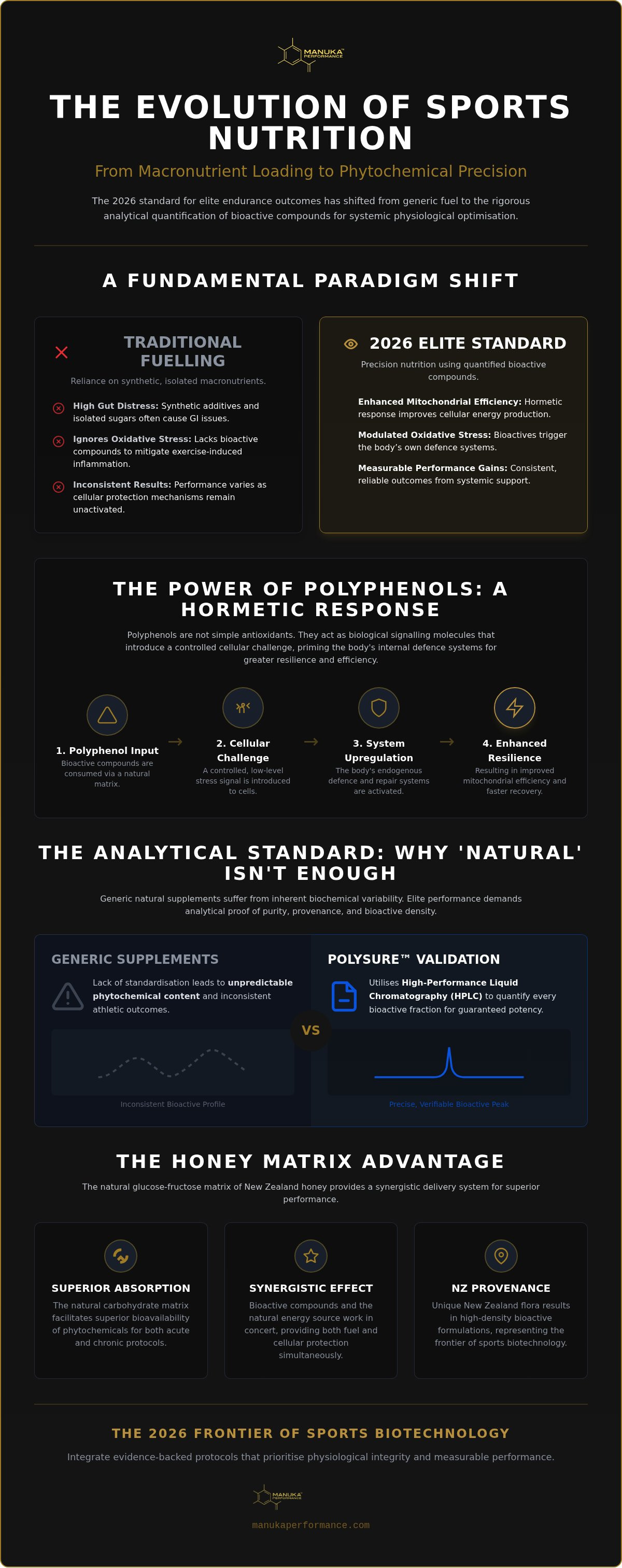
The 2026 sports nutrition landscape has undergone a fundamental paradigm shift, moving beyond the rudimentary focus on glycogen replenishment toward a sophisticated model of systemic physiological optimisation. While the historical emphasis remained fixed on macronutrient ratios and simple energy availability, contemporary elite protocols now prioritise the role of secondary metabolites. We've reached a point where traditional "clean label" standards are merely the baseline requirement for professional entry. The true differentiator in the current era is the analytical quantification of bioactives, specifically how we utilise polyphenols for athletic performance to manage the complex biological demands of high-output endurance and rapid recovery.
The Limitations of Traditional Carbohydrate Fueling
Conventional sports nutrition has long relied on synthetic glucose-fructose ratios designed for rapid absorption, yet these isolated formulations often neglect the broader biological context of the athlete. While they provide the necessary substrate for ATP production, they don't address the systemic cost of oxidative stress incurred during sustained high-intensity efforts. Macronutrients alone are insufficient for mitigating the exercise-induced inflammation that compromises long-term resilience. The absence of a natural bioactive matrix in synthetic gels means that while the fuel is present, the cellular protection mechanisms remain unactivated. This gap often results in inconsistent performance outcomes and the gut distress frequently reported by athletes using chemically isolated energy sources.
Phytochemicals as Performance Modulators
The emergence of phytochemical analysis has provided a sophisticated tool for enhancing athletic resilience through the targeted use of plant-based bioactives. To understand the depth of this shift, it's necessary to define the specific compounds involved: What are polyphenols? These secondary metabolites, which are found in high concentrations within specific New Zealand honey varieties, function as more than simple antioxidants. They act as precise performance modulators that trigger the body's internal defence systems without blunting the essential training adaptations required for elite progression.
Unlike generic antioxidant supplements that can be counterproductive, the specific polyphenols for athletic performance found in validated honey-based matrices support a balanced physiological state. The synergy between a natural carbohydrate matrix and measured phenolic acids is critical. It ensures that bioactive compounds are delivered in a bioavailable form, allowing for both acute performance support and chronic systemic health. This transition toward measured, bioactive-rich nutrition matrices represents the new frontier of sports biotechnology, where the focus is on the integrity of the provenance and the measurable efficacy of the phytochemical profile.
Mechanisms of Action: How Polyphenols Modulate Exercise-Induced Oxidative Stress
Polyphenols are structurally diverse plant compounds that serve as biological signalling molecules in human metabolism. Within the context of high-intensity physical exertion, the application of polyphenols for athletic performance operates through a sophisticated hormetic mechanism rather than simple antioxidant scavenging. By introducing a controlled cellular challenge, these phytochemicals trigger the upregulation of endogenous defence systems, effectively priming the biological environment for subsequent stressors. This process is essential for reducing the cumulative recovery debt often experienced during multi-day competition phases. Scientific evidence demonstrates that specific phenolic acids directly influence mitochondrial efficiency by modulating the electron transport chain, which directly correlates with improved aerobic capacity and sustained power output under peak physiological load.
The Nrf2 Signalling Pathway and Endogenous Recovery
The efficacy of specific phytochemicals lies in their ability to activate the Nuclear factor erythroid 2-related factor 2 (Nrf2) pathway, which serves as the primary regulator of the cellular antioxidant response when utilising polyphenols for athletic performance. Unlike synthetic antioxidants that may blunt essential training adaptations, polyphenols modulate the response to exercise-induced oxidative stress by stimulating the transcription of phase II detoxifying enzymes and cytoprotective proteins. This distinction is critical for elite athletes, as it allows for the maintenance of physiological resilience without interfering with the mitochondrial biogenesis required for performance progression. During intensive training blocks or multi-day endurance events, this targeted modulation ensures that the inflammatory response remains within a functional range, facilitating faster systemic restoration and cellular repair. Many professional protocols don't rely on generic supplementation for this reason, as the precision of the stimulus is paramount.
Vascular Function and Oxygen Delivery
Beyond cellular protection, certain flavonoids play a pivotal role in maintaining vascular endothelial health and optimising oxygen transport through the promotion of nitric oxide bioavailability. These compounds induce endothelial nitric oxide synthase (eNOS) activity, which leads to vasodilation and significantly enhances peripheral blood flow to the working musculature during peak aerobic exertion. This improved haemodynamic profile is essential for maintaining nutrient delivery and metabolic waste clearance while under significant metabolic load. By integrating validated phytochemical matrices into their protocols, athletes can achieve a more efficient oxygen delivery system, which remains a key component of the 2026 performance frontier. Utilising a scientifically validated bioactive matrix ensures that these physiological mechanisms are supported by precise, quantifiable concentrations of the necessary phenolic fractions, rather than relying on the variable profiles found in unstandardised natural products.
The Analytical Standard: Why Phytochemical Quantification Outperforms Generic Natural Sourcing
The inherent lack of biochemical uniformity in raw botanical sources presents a significant challenge for elite athletes who require predictable physiological outcomes. The "Natural Variability Problem" is particularly evident in apiculture; two jars of honey, even those harvested from the same region, are never biochemically identical due to fluctuations in soil composition, local climate, and floral source density. In 2026, the mere qualification of a product as "natural" or "rich in antioxidants" is no longer sufficient for professional applications. High-performance protocols demand the analytical quantification of polyphenols for athletic performance to ensure that every dosage delivers a precise concentration of bioactive fractions. Biotechnology now bridges the gap between raw provenance and measured outcomes, transforming honey from a functional food into a standardised performance matrix.
The PolySure™ Framework for Bioactive Validation
The PolySure™ standard addresses the inconsistency of raw materials by validating seven naturally occurring polyphenols within the honey matrix. This framework utilises High-Performance Liquid Chromatography (HPLC) to provide compound-specific quantification, which is the precise method recognised for professional athletic standards. This level of rigour ensures that the phytochemical profile remains stable throughout the product's shelf life, preventing the degradation of delicate secondary metabolites. For a deeper technical overview of these protocols, refer to the Analytical Standards for Honey in Sports Nutrition: A Scientific Framework. By adhering to such rigorous testing, we eliminate the guesswork associated with unstandardised supplements, allowing for the integration of polyphenols for athletic performance into highly controlled training environments.
Benchmarking Phytochemical Density
While many competitors suggest that dietary fruit intake provides sufficient bioactive support, this approach ignores the massive variability in phytochemical density caused by post-harvest processing and storage. Honey-based matrices offer a distinct advantage in terms of bioavailability and compound preservation. The natural glucose-fructose structure of honey acts as a protective medium, sequestering delicate phenolic compounds and maintaining their integrity more effectively than isolated fruit extracts. This preservation is critical for athletes who require standardised dosages to elicit a predictable hormetic response. Elite performance relies on the ability to replicate physiological results across multiple training blocks, a feat that is only possible when the density of the bioactive matrix is verified through clinical-grade analytical standards rather than generic sourcing claims.
Strategic Integration of Polyphenol-Rich Matrices into Endurance Training Protocols
Designing a successful endurance protocol requires more than simple caloric replenishment. It demands a structured integration of polyphenols for athletic performance that accounts for both acute metabolic support and chronic physiological adaptation. The natural glucose-fructose matrix found in New Zealand honey serves as an ideal delivery vehicle, as it enhances the bioavailability of phenolic compounds through synergistic transport mechanisms. This dual-fuel approach ensures that athletes receive rapid-acting energy while simultaneously introducing bioactives that support cellular resilience during the most demanding phases of a race or training session. Standardised protocols don't just provide fuel; they offer a sophisticated mechanism for biological protection that is essential for maintaining high training volumes.
Pre-Workout Priming and Intra-Workout Resilience
Intra-workout resilience is achieved by maintaining a steady state of quantified phytochemicals within the systemic circulation. By utilising honey-based energy gels, athletes can effectively mitigate real-time oxidative damage without the risk of the gastrointestinal distress that frequently complicates high-intensity efforts. This is particularly relevant for triathletes and ultra-endurance competitors where nutrient delivery must be both efficient and non-irritating. For a detailed technical breakdown of these matrices, explore the Natural Honey-Based Energy Gels: A Performance Analysis of NZ Innovation. This strategic timing ensures that the body’s internal defence systems are primed prior to the onset of peak metabolic stress, allowing for sustained power output without the systemic cost typically associated with prolonged exertion.
Post-Exercise Recovery and Systemic Repair
The immediate post-exercise window offers a unique opportunity for phytochemicals to facilitate systemic repair and reduce the severity of delayed onset muscle soreness (DOMS). While some historical perspectives suggested that antioxidants might interfere with training adaptations, modern research indicates that the complex phenolic profile of honey-based bioactives modulates rather than suppresses the inflammatory response. This allows for necessary cellular signalling to occur while preventing excessive tissue damage that can lead to chronic overreach. It's essential to recognise that the long-term adherence to a phytochemical-rich nutrition plan supports vascular endothelial health and immune robustness, which are critical for athletes competing at an elite level. By integrating polyphenols for athletic performance into the recovery phase, athletes can ensure a faster return to baseline and better consistency across consecutive training blocks. To implement these protocols into your own training, you can explore our range of bioactive energy solutions.
PolySure™ and the Future of Bioactive Validation in Sports Biotechnology
Mānuka Performance is spearheading the evolution of sports nutrition by transitioning away from traditional functional food models toward rigorous biotechnological innovation. The efficacy of polyphenols for athletic performance is no longer a matter of anecdotal evidence; it's a measurable outcome of analytical quantification that meets the highest standards of clinical research. By applying pharmaceutical-grade rigour to natural matrices, we've established a new frontier where the biological potential of secondary metabolites is fully realised. This shift is essential for elite athletes who require absolute certainty regarding the provenance and potency of their nutritional protocols. PolySure™ serves as the primary mechanism for this validation, ensuring that the intersection of nature and technology provides a consistent, high-density bioactive profile that supports systemic optimisation.
The Science of New Zealand Performance Honey
The unique phytochemical profile of New Zealand’s native flora is a direct result of the country’s distinct evolutionary history and environmental conditions. These factors contribute to a higher concentration of phenolic acids and flavonoids than are typically found in other global honey sources. Mānuka Performance utilises research-driven biotechnology to isolate and harness these bioactives, ensuring they remain stable and bioavailable within our performance matrices. For a comprehensive analysis of how these compounds are validated, see our technical guide on Quantified Honey Bioactives: The Analytical Standard for Functional Performance. As we look toward the future, the integration of personalised bioactive dosing and real-time systemic monitoring will further refine how we apply polyphenols for athletic performance, allowing for nutrition that is as precisely calibrated as a training programme.
Conclusion: Elevating Performance Through Analytical Rigour
The era of relying on generic "natural" claims has passed, replaced by a sophisticated requirement for validated, quantified nutrition that can withstand the scrutiny of professional athletic standards. We've demonstrated that the analytical quantification of polyphenols is the critical differentiator for endurance recovery and systemic resilience. By prioritising phytochemical density and provenance, athletes can move beyond the limitations of synthetic isolates and unstandardised raw materials. The transition toward this level of analytical rigour is not merely a trend; it's a fundamental requirement for the modern athlete who demands measurable outcomes and physiological integrity. Choosing a standard like PolySure™ ensures that your nutritional strategy is built upon a foundation of integrity, precision, and the relentless pursuit of professional excellence.
Advancing Elite Performance Through Phytochemical Precision
The transition from rudimentary macronutrient loading to the strategic application of polyphenols for athletic performance marks a definitive advancement in sports biotechnology. We've established that the analytical quantification of bioactives, rather than the mere presence of botanical ingredients, is the critical factor in managing systemic recovery and oxidative stress. By utilising honey-based matrices validated through the PolySure™ standard, athletes can secure the predictable physiological outcomes necessary for elite competition. This level of precision eliminates the variability inherent in unstandardised natural products, allowing for highly calibrated training adaptations and sustained resilience.
As a New Zealand biotech research leader, Mānuka Performance remains dedicated to the development of clinical-grade phytochemical standards that bridge the gap between nature and pharmaceutical-level rigour. It's time to move beyond variable supplements and adopt a framework rooted in analytical validation and measurable efficacy. We invite you to explore the PolySure™ range and the science of LiquidFuel to integrate these innovations into your own endurance protocols. Achieving your professional peak requires a commitment to scientific integrity and the relentless pursuit of excellence.
Frequently Asked Questions
Do polyphenols actually improve running performance?
Clinical evidence suggests that specific phenolic acids enhance running performance by improving mitochondrial efficiency and peripheral blood flow. By utilising polyphenols for athletic performance, athletes can maintain a higher power output under significant metabolic load. This improvement is attributed to the modulation of oxidative stress rather than direct scavenging, which allows the body to sustain aerobic capacity over prolonged endurance events without the premature onset of physiological fatigue.
How much polyphenol content should an athlete consume daily?
Optimal dosage depends on training volume and the specific bioactive profile of the supplement used. While generic dietary guidelines suggest broad intake, elite athletes require a quantified approach to ensure a consistent hormetic response. Rather than focusing on total weight, it's essential to prioritise standardised concentrations of validated compounds. This ensures that the physiological stimulus is sufficient to trigger endogenous defence systems without exceeding the threshold of metabolic efficiency during intensive training blocks.
Can I get enough polyphenols from a normal diet?
While a diet rich in colourful flora contains these compounds, the inherent variability in soil quality and post-harvest processing makes it difficult to achieve consistent levels. For high-performance requirements, relying on unstandardised dietary sources introduces too much uncertainty. Analytical quantification provides a level of precision that raw foods cannot match. This allows for the integration of polyphenols for athletic performance into a professional protocol where every bioactive fraction is accounted for and verified.
What is the difference between raw honey and performance-led honey gels?
Raw honey is a variable functional food, whereas performance-led gels are biotechnological solutions optimised for nutrient delivery. While raw honey contains bioactives, the concentrations of specific polyphenols fluctuate significantly between batches. Performance gels utilise a standardised New Zealand honey-based matrix to ensure a consistent glucose-fructose ratio and a verified phytochemical density. This provides the gastrointestinal comfort and predictable energy release required during high-intensity competition, which raw honey cannot guarantee due to its natural variability.
Will taking polyphenols during training blunt my fitness adaptations?
Research indicates that naturally derived polyphenols modulate the inflammatory response rather than suppressing it entirely. Unlike high-dose synthetic antioxidants like Vitamin C or E, which can interfere with mitochondrial biogenesis, these phytochemicals support the body's adaptive mechanisms. By triggering the Nrf2 signalling pathway, they enhance the endogenous recovery response. This ensures that the athlete gains the benefits of training stress while mitigating the excessive tissue damage that leads to chronic overreaching and performance stagnation.
How does the PolySure™ standard differ from other honey certifications?
The PolySure™ standard is an analytical framework that specifically validates seven naturally occurring polyphenols using High-Performance Liquid Chromatography. Most honey certifications focus on purity, sugar content, or regional provenance, but they rarely quantify the bioactive compounds responsible for performance gains. PolySure™ provides a clinical-grade verification of phytochemical density. This ensures that every batch meets a precise biochemical profile, providing the consistency that professional athletes and research institutions require for systemic optimisation.
Are there any side effects to high polyphenol intake for athletes?
Polyphenols derived from natural food matrices like honey are generally well-tolerated and don't typically cause the gastrointestinal distress associated with concentrated synthetic extracts. Some athletes might experience minor digestive sensitivity if consuming extremely high doses of isolated phenolic compounds without a proper delivery matrix. Utilising a standardised honey-based gel ensures that the bioactives are delivered in a bioavailable form that aligns with human metabolic pathways, significantly reducing the risk of adverse reactions during peak exertion.
How do polyphenols help with muscle recovery after a marathon?
Polyphenols facilitate muscle recovery by reducing the cumulative recovery debt through the upregulation of phase II detoxifying enzymes. Following a marathon, the body experiences significant exercise-induced oxidative stress and systemic inflammation. Targeted phytochemical intervention helps manage these processes by promoting cellular repair and vascular endothelial health. This leads to a reduction in delayed onset muscle soreness (DOMS) and a faster return to baseline physiological function, allowing the athlete to resume training with greater consistency and reduced injury risk.