


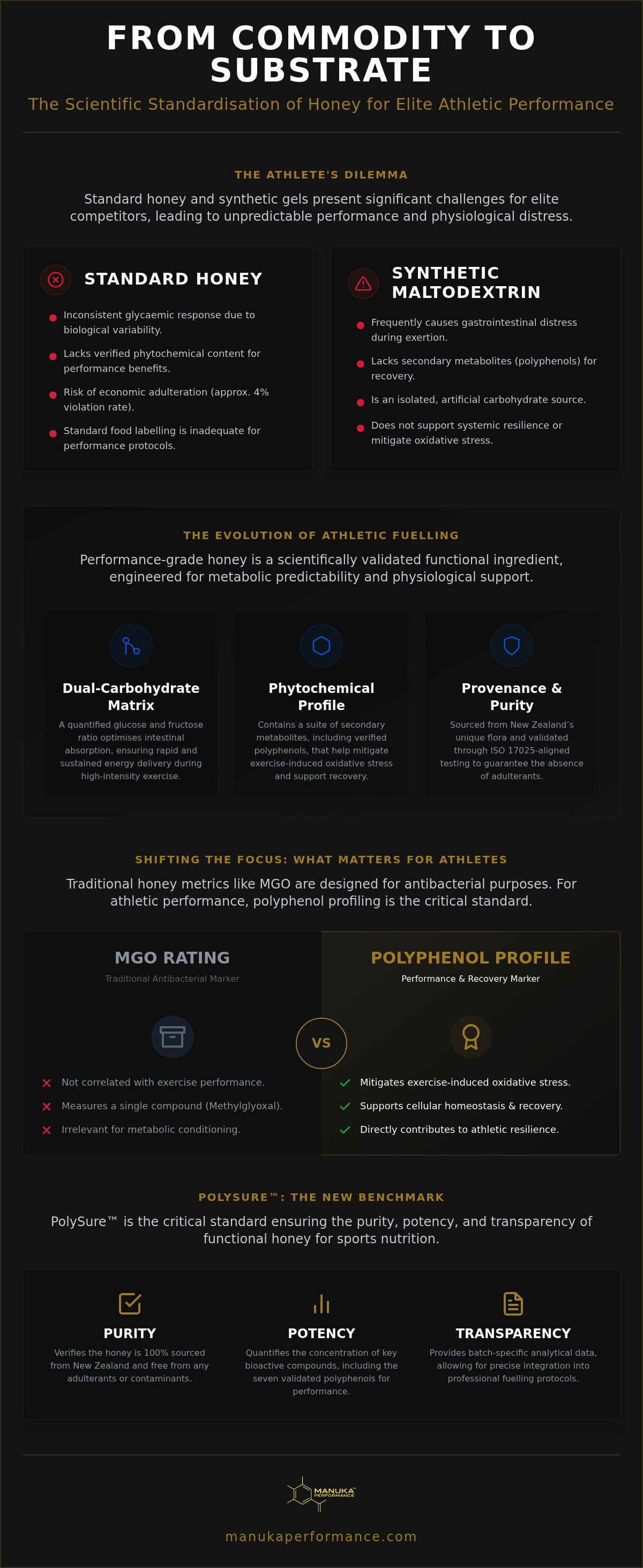
The transition from a raw agricultural commodity to a validated biochemical substrate represents the critical frontier in modern athletic supplementation. While many athletes have historically utilised unrefined honey for its carbohydrate density, the inherent biological variability of non-standardised batches often results in inconsistent glycaemic responses and performance fluctuations. You likely recognise that the lack of transparency in traditional labelling, coupled with the gastrointestinal distress frequently caused by synthetic maltodextrin formulations, necessitates a more rigorous approach to honey analysis for sports nutrition.
This article establishes a scientific framework for the biochemical standardisation of honey, demonstrating how the quantification of specific phytochemical markers, such as the seven polyphenols validated by the PolySure™ standard, ensures metabolic predictability for elite competitors. We'll examine the role of these bioactive compounds in mitigating exercise-induced oxidative stress and provide a technical justification for adopting natural, clean-label fuelling strategies. By the conclusion, you'll understand the rigorous analytical protocols required to transform New Zealand honey into a precision-engineered functional ingredient that meets the demands of high-performance metabolic conditioning.
Key Takeaways
- Distinguish between generic table honey and performance-grade substrates by identifying the specific biochemical markers required for metabolic consistency.
- Understand how precise honey analysis for sports nutrition validates a dual-carbohydrate matrix of glucose and fructose to optimise intestinal absorption during high-intensity exertion.
- Learn to prioritise polyphenol profiling over traditional MGO ratings to target exercise-induced oxidative stress rather than simple antibacterial activity.
- Discover how to integrate quantified analytical data into a professional fuelling protocol for accurate carbohydrate pacing and effective glycogen loading.
- Recognise the PolySure™ benchmark as a critical tool for ensuring the purity, potency, and transparency of honey-based functional ingredients sourced from New Zealand.
Beyond the Pantry: Why Generic Honey Analysis Fails the Elite Athlete
The concept of "performance-grade honey" is fundamentally distinct from the culinary product found in domestic pantries. While Honey is globally recognised as a carbohydrate source, elite athletic application requires a transition from a raw material to a validated functional substrate. This shift necessitates rigorous honey analysis for sports nutrition to quantify bioactive markers that influence metabolic efficiency, moving beyond the simplistic view of honey as a mere sweetener. For the professional competitor, a sweetener is a commodity; a functional matrix is a strategic asset. This matrix represents a systemic evolution where the honey serves not only as a fuel source but as a delivery vehicle for phytochemicals that modulate the body's response to the physiological demands of training.
The Limitations of Standard Food Labelling
Standard nutritional panels are designed for general dietary compliance rather than the precise requirements of high-intensity physiological stress. These labels typically list total carbohydrates and sugars, yet they fail to account for the significant glycaemic variability inherent in non-standardised batches. Without specific quantification of the glucose-to-fructose ratio and the presence of secondary metabolites, athletes cannot predict the rate of gastric emptying or the stability of blood glucose levels during competition. The absence of verified phytochemical content in mass-market products creates a risk of inconsistent performance outcomes that professional programmes don't tolerate.
Provenance and Purity as Performance Markers
In a global market where economic adulteration remains a persistent challenge, provenance testing is a non-negotiable component of professional fuelling. Recent data from the FDA suggests a violation rate of approximately 4% for honey adulteration, highlighting the necessity of advanced analytical methods to confirm purity. For the elite athlete, New Zealand’s unique flora provides a specific phytochemical profile that is high in potent bioactives, yet these benefits remain theoretical unless backed by empirical data. Advanced honey analysis for sports nutrition ensures that "natural" ingredients are transformed into "verifiable" assets through ISO 17025-aligned testing. By validating the absence of adulterants and confirming the concentration of naturally occurring polyphenols, practitioners can move from anecdotal usage to a data-driven functional matrix that supports systemic performance and recovery.
The Biochemistry of Performance: Quantifying Bioactive Compounds
The efficacy of honey as a performance substrate is predicated on its complex biochemical architecture rather than its caloric density alone. A sophisticated honey analysis for sports nutrition prioritises the quantification of enzymatic activity, such as glucose oxidase, which contributes to the preservation of the matrix's integrity and supports its role as a functional fuel. Unlike isolated carbohydrate syrups, natural honey contains a suite of bioactive compounds that must be profiled to ensure batch-to-batch consistency in a professional training environment. This phytochemical profiling allows for the identification of specific molecular structures that interact with human metabolic pathways, ensuring that the substrate performs reliably under varying thermal and physiological conditions.
Secondary Metabolites and Athletic Resilience
Polyphenols represent a critical category of secondary metabolites that function as markers for physiological resilience and systemic recovery. These compounds modulate the inflammatory response by neutralising reactive oxygen species generated during high-intensity aerobic and anaerobic exertion. A Systematic Review on Honey Supplementation indicates that the presence of these antioxidants can support cellular homeostasis and potentially mitigate the markers of muscle damage under sustained metabolic stress. In the context of honey-based gels, bioavailability refers to the rate and extent to which the specific phytochemical constituents are absorbed into the systemic circulation and become available at the site of physiological action. By utilising PolySure™ technology to validate seven specific polyphenols, researchers can ensure that each serving delivers a standardised dose of these protective compounds, allowing for a more clinical approach to recovery.
The Glucose-Fructose Ratio and Gastric Emptying
Optimising carbohydrate oxidation requires a precise dual-pathway approach where glucose and fructose are delivered in a specific ratio to prevent intestinal transporter saturation. Laboratory analysis ensures that the matrix maintains a ratio approaching 1:0.8, which is the current gold standard for maximising exogenous carbohydrate absorption while minimising gastrointestinal distress. This quantification is essential for preventing "runners stomach," a condition often exacerbated by the osmotic pressure of unverified sugar blends or synthetic maltodextrin gels. The application of these quantified sugar profiles provides several physiological advantages:
- Enhanced exogenous carbohydrate oxidation rates by utilising both SGLT1 and GLUT5 transporters.
- Reduced risk of osmotic imbalance within the small intestine.
- Consistent delivery of energy without the spikes and crashes associated with unstandardised sweeteners.
While generic honey may fluctuate significantly in its fructose-to-glucose balance due to seasonal floral variations or processing temperatures, laboratory-verified ratios provide the metabolic predictability required for elite competition. Professionals seeking this level of precision often transition to honey based energy gels NZ to guarantee their fuelling metrics are based on empirical data rather than botanical chance.
Comparing Analytical Standards: MGO vs. Polyphenol Profiling
Within the established market for New Zealand honey, the Methylglyoxal (MGO) rating has long served as the primary indicator of product value. However, MGO is essentially an antibacterial marker, and its relevance to metabolic efficiency or athletic endurance is negligible. While medical-grade honey prioritises antimicrobial potency for topical applications or internal wellness, elite sports requirements demand a different set of metrics. This necessitates a shift in honey analysis for sports nutrition toward polyphenol profiling, which targets the specific physiological demands of high-intensity exertion rather than clinical infection control. Transitioning from "medical honey" to "functional performance honey" requires a departure from traditional grading systems in favour of standards that reflect bioactive efficacy during exercise.
Why MGO is a Misleading Metric for Athletes
The biological role of MGO is primarily sequestered to its interaction with bacterial proteins, a function that doesn't translate into improved VO2 max, glycogen sparing, or lactate clearance. High MGO concentrations don't correlate with athletic efficacy; in fact, a singular focus on this compound often results in the omission of the broader phytochemical spectrum essential for recovery. Athletes who select honey based solely on MGO ratings risk utilising a substrate that lacks the antioxidant capacity required to manage the oxidative stress of sustained endurance events. Relying on an antibacterial marker for a metabolic task is a fundamental misalignment of nutritional strategy that can lead to inconsistent results on race day.
The PolySure™ Advantage: Seven Validated Markers
To address the limitations of traditional grading, the PolySure™ analytical standard has been established as the definitive benchmark for functional sports nutrition. This protocol moves beyond single-marker analysis by validating seven distinct, naturally occurring polyphenols within the honey matrix. Measuring a multi-marker profile ensures a more robust functional outcome, as these specific phytochemicals work synergistically to support systemic resilience and mitigate exercise-induced inflammation. Crucially, this analysis is performed on the finished product rather than just the raw material, providing several key assurances for the athlete:
- Potency Retention: Verification that the heat-sensitive bioactives remain intact after the gel formulation process.
- Synergistic Efficacy: Ensuring the presence of a full spectrum of polyphenols rather than an isolated compound.
- Batch Consistency: Providing a data-backed guarantee that every sachet delivers the same level of functional support.
By quantifying bioactives in the final delivery format, the PolySure™ standard provides the transparency required for professional fuelling protocols. This level of rigorous validation ensures that the honey functions as a precision-engineered tool, allowing athletes to focus on performance with the confidence that their substrate is biologically optimised for the task at hand.
Implementing Analysed Honey into a Professional Fuelling Protocol
Integrating a quantified honey substrate into a professional training programme requires a shift from intuitive fuelling to data-driven administration. While generic honey exhibits a broad glycaemic index range from 32 to 87, honey analysis for sports nutrition allows practitioners to identify the specific metabolic profile of a batch, ensuring that the rate of glucose entry into the bloodstream is predictable. This precision is vital for pre-race glycogen loading, where the objective is to saturate muscle stores without causing intestinal distress or metabolic instability. By applying rigorous honey analysis for sports nutrition, athletes can transition from simple calorie consumption to a sophisticated protocol that addresses both acute energy requirements and long-term systemic resilience.
Pre-Workout: Establishing a Glycaemic Base
Establishing a stable glycaemic base begins approximately 30 to 45 minutes before the commencement of high-intensity exertion. Utilising a honey-based gel during this window leverages its natural fructose-glucose composition to provide a sustained release of energy, effectively avoiding the insulin spikes and subsequent hypoglycaemic crashes often associated with isolated dextrose or sucrose. For early-morning sessions, where liver glycogen stores are depleted, a standardised honey matrix provides an immediate yet controlled elevation of blood glucose, supporting cognitive focus and early-stage power output without the risk of gastrointestinal heaviness.
Intra-Workout: Sustaining High-Intensity Output
Maintaining high-intensity output necessitates a carbohydrate delivery rate of 60 to 90 grams per hour, a "sweet spot" that is only achievable when the intestinal transporters aren't overwhelmed. The natural matrix of analysed honey facilitates this through its inherent ratio of glucose and fructose, which utilises independent transport pathways (SGLT1 and GLUT5) to maximise oxidation rates. Because this matrix contains naturally occurring minerals and organic acids, it reduces the systemic reliance on external electrolytes by supporting better fluid balance. This purity is essential for preventing the "gut shut-down" that often occurs when synthetic additives or unverified sugar blends are consumed under physiological stress. Managing gastrointestinal resilience through pure, analysed ingredients ensures the body remains receptive to fuel even in the final stages of an endurance event.
Post-exercise recovery protocols also benefit from the seven validated polyphenols identified through PolySure™ analysis. These compounds assist in managing systemic inflammation and oxidative stress, facilitating a faster return to physiological homeostasis. To implement these scientific findings into your own regime, you can explore the range of PolySure™ validated products from Mānuka Performance.
PolySure™: The New Benchmark for Functional Sports Nutrition
Mānuka Performance operates at the direct nexus of biotechnology and professional athletic supplementation. By formalising the honey based energy gels NZ innovation, the brand has successfully redefined the parameters of natural fuelling through a clinical lens. Every batch undergoes a rigorous validation process that bridges the gap between raw botanical sources and standardised functional substrates. This systemic approach ensures that the final product isn't merely a natural sweetener but a precision-engineered delivery system for bioactive compounds. The commitment to this level of technical superiority allows elite competitors to rely on a substrate that maintains its integrity under the most demanding physiological conditions.
The Future of Phytochemical Innovation
Current research in the field of honey analysis for sports nutrition is increasingly focused on the specific molecular interactions of secondary metabolites with the human endocrine system. Mānuka Performance is committed to maintaining absolute transparency through the PolySure™ standard, which validates the presence of seven specific polyphenols critical for physiological resilience. This analytical rigour isn't simply a quality control measure; it's the only methodology capable of ensuring elite-level results within an industry where unstandardised products are the norm. Every production cycle is aligned with ISO 17025 testing protocols to confirm that the heat-sensitive bioactives remain potent and available for systemic absorption. As the understanding of phytochemical applications deepens, the brand continues to pioneer new research into how these compounds can further optimise the body's response to sustained metabolic stress.
Elevate Your Performance with Data-Backed Nutrition
Embracing a fuelling strategy rooted in clinical data allows athletes to move beyond the ambiguity of "natural" marketing and adopt a framework of validated performance. The transition to clean-label, analysed fuelling solutions represents a sophisticated shift in how professionals approach their metabolic requirements. Utilising research-driven biotech products offers a level of prestige and reliability that generic alternatives can't match. It's time to demand the same level of quantification from your nutrition that you demand from your training metrics. Adopting this standard ensures your fuelling protocol is built on a foundation of integrity and precision. Explore the PolySure™ range and scientific research to integrate the gold standard of honey analysis for sports nutrition into your professional training programme.
Advancing Athletic Potential Through Biochemical Precision
The transition from unrefined natural products to precision-engineered substrates represents the defining shift in contemporary athletic supplementation. By prioritising rigorous honey analysis for sports nutrition, practitioners move beyond the metabolic uncertainty of generic sweeteners to embrace a framework of clinical predictability. This framework has detailed why traditional metrics like MGO are insufficient for performance, highlighting instead the necessity of quantifying seven specific polyphenols to ensure systemic resilience and glycaemic stability. Mānuka Performance continues to lead as phytochemical innovation leaders, utilising New Zealand biotech excellence to transform botanical sources into validated functional tools. Adopting the PolySure™ analytical standard ensures that your fuelling protocol is grounded in empirical data rather than botanical variability, allowing for a more sophisticated approach to endurance and recovery. It's time to align your nutritional intake with the same level of scientific rigour you apply to your physical conditioning.
Discover the Science of PolySure™ Validated Nutrition
Frequently Asked Questions
What is the difference between standard honey analysis and sports-specific analysis?
Standard analysis focuses on food safety, moisture content, and basic sugar percentages for general consumption. Sports-specific analysis, such as that utilised in PolySure™ protocols, quantifies bioactive markers like specific polyphenols and the exact glucose-to-fructose ratio required for metabolic predictability. This advanced honey analysis for sports nutrition ensures that the substrate meets the physiological demands of high-intensity exertion rather than merely fulfilling general dietary requirements for table honey.
Why are polyphenols important for endurance athletes and runners?
Polyphenols function as secondary metabolites that assist in mitigating exercise-induced oxidative stress and systemic inflammation. During sustained endurance events, the body generates reactive oxygen species that can lead to cellular damage and delayed recovery. By providing a standardised dose of validated polyphenols, athletes can support their body's natural resilience. These compounds are critical for maintaining homeostasis during the metabolic strain associated with long-distance running or competitive cycling.
Does a higher MGO rating mean the honey is better for sports performance?
No, a high MGO rating does not correlate with improved athletic performance or metabolic efficiency. MGO is primarily an antibacterial marker used for therapeutic or topical applications. For sports nutrition, the presence of specific polyphenols and a quantified carbohydrate matrix is far more relevant. Selecting honey based solely on MGO ignores the phytochemical spectrum necessary for managing the physiological stress encountered during training and competition.
How does the glucose-fructose ratio in honey compare to synthetic gels?
Natural honey contains a dual-carbohydrate matrix of glucose and fructose, which typically aligns with the 1:0.8 ratio recommended for optimal oxidation. Many synthetic gels rely on maltodextrin, which can cause significant gastrointestinal distress due to its osmotic pressure. Analysed honey provides a more complex, naturally occurring sugar profile that utilises multiple intestinal transporters, facilitating higher carbohydrate absorption rates without the systemic instability often triggered by unverified synthetic formulations.
Is honey analysis necessary to avoid gastrointestinal issues during a race?
Rigorous analysis is essential to ensure the metabolic predictability required to avoid gastrointestinal distress. Unstandardised honey can exhibit significant glycaemic variability and fluctuating sugar ratios, which may lead to osmotic imbalances and "runners stomach." By utilising honey analysis for sports nutrition, practitioners can confirm that the substrate maintains a consistent biochemical profile, ensuring that gastric emptying occurs at a predictable rate even under high-intensity physiological stress.
What specific polyphenols are measured in the PolySure™ standard?
The PolySure™ standard validates seven naturally occurring polyphenols within the honey matrix to ensure a robust functional profile. These markers include specific phytochemicals identified through biotech research for their ability to support systemic resilience. Measuring these seven distinct compounds allows for a multi-marker validation process, ensuring that every batch delivers a consistent bioactive dose. This level of quantification is what transforms raw New Zealand honey into a validated functional substrate for elite athletes.
Can I use raw honey instead of analysed honey-based energy gels?
While raw honey contains carbohydrates, its inherent biological variability makes it unsuitable for precision fuelling protocols. Raw batches can fluctuate in sugar ratios, mineral content, and phytochemical potency, leading to inconsistent energy delivery. Analysed honey-based gels provide a standardised functional matrix that has been validated for purity and potency. Professional athletes require this data-backed consistency to calculate precise carbohydrate intake and ensure reliable performance outcomes during competition.
How does New Zealand honey provenance affect its analytical profile?
New Zealand’s unique floral landscape produces honey with a highly distinct phytochemical signature that is often superior in bioactive potency. The isolation of the country's native flora results in the presence of specific secondary metabolites that aren't found in other geographic regions. Analytical profiling confirms this provenance, ensuring the absence of environmental contaminants and validating the high concentration of polyphenols. This unique biological heritage provides the foundation for creating high-performance functional substrates.