


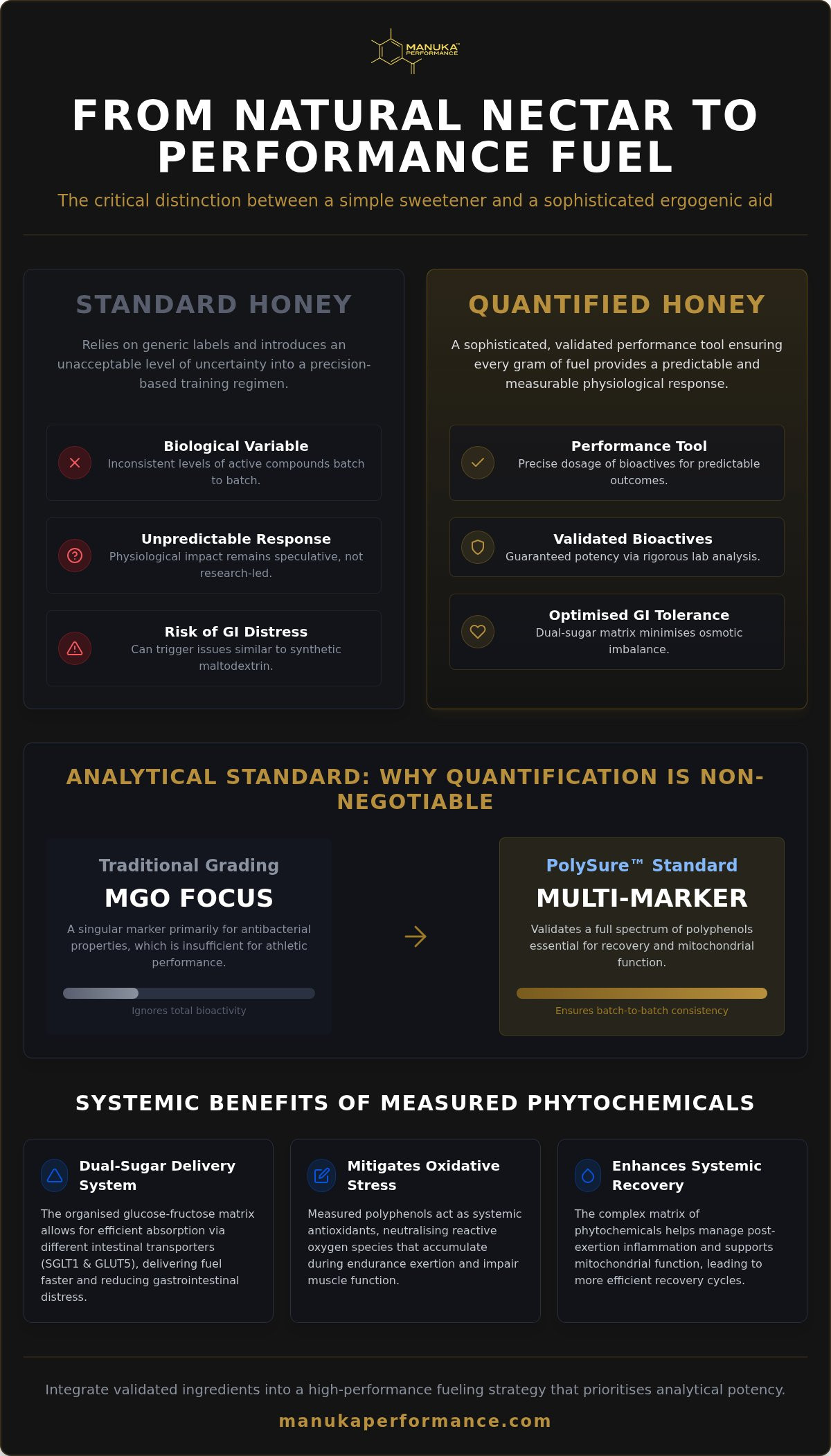
For the elite athlete or research-focused practitioner, the presence of quantified honey bioactives represents the critical distinction between a simple sweetener and a sophisticated ergogenic aid. You likely recognise that while natural honey offers a cleaner alternative to the gastrointestinal distress often triggered by synthetic maltodextrin, the inherent variability of raw nectar introduces an unacceptable level of uncertainty into a precision-based training regimen. Without rigorous laboratory validation, even the most premium honey remains a biological variable rather than a reliable performance tool.
This analysis explores the clinical significance of measured phytochemicals, demonstrating how the PolySure™ analytical standard transforms a variable natural substance into a precise, performance-led fuel. We will examine the biochemical validation of seven specific polyphenols and the methodology required to optimise systemic recovery through measured antioxidant profiles. By shifting from a reliance on vague natural labels to a framework of analytical quantification, you can ensure that every gram of fuel provides a predictable and measurable physiological response during endurance training.
Key Takeaways
- Distinguish between standard natural honey and the clinical precision of quantified honey bioactives within a functional nutrition framework.
- Understand the biochemical role of the glucose-fructose matrix in delivering specific polyphenols that mitigate oxidative stress during endurance exertion.
- Recognise why High-Performance Liquid Chromatography and the PolySure™ standard are non-negotiable for ensuring batch-to-batch consistency and ingredient validation.
- Identify the systemic benefits of measured phytochemicals in managing post-exertion inflammation and enhancing mitochondrial function.
- Learn to integrate validated ingredients into a high-performance fueling strategy that prioritises analytical potency over generic honey grading.
Defining Quantified Honey Bioactives in Functional Nutrition
Bioactives are defined as extranutritional constituents that occur in minute quantities within food matrices, yet exert significant influence on biological processes. While many natural substances are inherently bioactive by nature, the transition to functional nutrition requires these compounds to be "quantified for performance." This distinction is paramount for the high-performance athlete. To understand the foundational composition of this substance, one might ask What is Honey? at its most basic level; however, for elite training, we must look beyond simple carbohydrates to the specific quantified honey bioactives that dictate physiological outcomes. The phytochemical matrix found in New Zealand honey is unique, offering a complex array of compounds that require rigorous analytical validation to ensure consistency.
Athletes require precision in bioactive dosage to ensure predictable physiological responses. When you're operating at your metabolic limit, the difference between a variable natural product and a standardised performance tool is the difference between success and gastrointestinal failure. Relying on unmeasured natural nectar introduces an unacceptable variable into a controlled training protocol.
The Role of Phytochemicals in Performance-Led Ingredients
Phytochemicals represent the internal defence mechanisms of plants, evolved over millennia to mitigate environmental stressors and oxidative damage. In the context of New Zealand honey, these compounds form a complex matrix that elevates the substance from a caloric sweetener to a sophisticated functional delivery system. The efficacy of these compounds is strictly dependent on their bioavailability, which refers to the proportion of the substance that enters the circulation and is able to have an active effect. Without precise measurement, the metabolic impact of these phytochemicals remains speculative. By validating these markers, we move from anecdotal benefits to research-led outcomes.
Why Basic Honey Grading Fails the Modern Athlete
Traditional honey grading has historically relied on Methylglyoxal (MGO) as a singular proxy for quality. For the modern athlete, this narrow focus is insufficient. MGO primarily reflects antibacterial properties rather than the broad-spectrum antioxidant and anti-inflammatory capacity required for exertion recovery. Relying on a single marker ignores the total bioactivity of the substance. A multi-marker analytical approach is essential to validate the presence of specific polyphenols, ensuring that the dosage remains consistent across every training cycle. Quantified honey bioactives provide a level of transparency that simple MGO ratings cannot match, allowing for a more nuanced understanding of how these ingredients interact with human biology during high-intensity sessions.
The Biochemistry of Performance: Beyond Carbohydrates and MGO
Honey is often mischaracterised as a simple carbohydrate source. In reality, it functions as a highly organised glucose-fructose matrix that serves as a sophisticated carrier for quantified honey bioactives. This dual-sugar delivery system allows for simultaneous absorption through different intestinal transporters, specifically SGLT1 and GLUT5, which reduces the risk of the osmotic imbalances that lead to gastrointestinal distress. By utilising this natural matrix, the body can access fuel more efficiently than it can through isolated synthetic sugars.
The clinical significance of this matrix extends well beyond calorie delivery. During prolonged endurance events, the body undergoes significant oxidative stress, resulting in the accumulation of reactive oxygen species that can impair muscle function. Measured polyphenols within the honey matrix act as systemic antioxidants, neutralising these species and supporting cellular integrity. This metabolic efficiency ensures that the athlete isn't merely replenishing glycogen but is also protecting the underlying biological machinery responsible for energy production. The synergistic effect of multiple phenolic acids provides a more robust physiological response than any isolated compound could ever achieve.
Polyphenols: The Secondary Metabolites of Endurance
Specific classes of polyphenols, including various flavonoids and phenolic acids, are central to the efficacy of performance-led honey. These compounds assist the body to metabolise fuel more effectively by modulating the enzyme activity involved in carbohydrate breakdown and energy release. Extensive research into phenolic compounds and health benefits suggests that these secondary metabolites also support gastrointestinal resilience, a factor that is often the undoing of endurance athletes during high-intensity sessions. By maintaining gut barrier integrity under heat stress, these bioactives ensure that performance remains consistent throughout the duration of an event.
The Limitations of Methylglyoxal (MGO) in a Sports Context
Methylglyoxal, commonly known as MGO, is a 1,2-dicarbonyl compound primarily responsible for the non-peroxide antibacterial activity in certain honeys. While MGO is a critical marker for clinical wound care or general wellness, its relevance to acute athletic performance is largely indirect. Relying solely on MGO fails to account for the broader phytochemical profile necessary for systemic health and exercise recovery. A truly functional fuel must be validated across a wider spectrum of markers to ensure it meets the rigorous demands of high-intensity training. To experience the precision of a multi-marker approach, you may consider integrating validated bioactive solutions that prioritise comprehensive quantification over singular, unrelated metrics.
Analytical Methodology: Why Quantification is Non-Negotiable
Precision in sports nutrition requires more than a simple list of ingredients; it demands a rigorous analytical framework. High-Performance Liquid Chromatography (HPLC) serves as the definitive methodology for ingredient validation, allowing researchers to separate, identify, and measure each individual compound within a complex honey matrix. This level of scrutiny is essential because the mere "presence of" a compound doesn't guarantee a physiological effect. For a substance to function as a performance-led fuel, it must contain quantified honey bioactives at specific, repeatable concentrations. Without this data, an athlete is essentially guessing at their metabolic support.
Analytical rigour must extend beyond the raw material to the finished product. It's insufficient to test nectar at the point of harvest, as subsequent processing, thermal exposure, and storage conditions can significantly degrade delicate phytochemicals. By testing the final formulation, we ensure that the bioactive integrity remains intact at the moment of consumption. This methodology moves honey from the category of a variable agricultural product into the realm of a standardised biotech solution, providing the clinical certainty required for professional training protocols.
The PolySure™ Standard: A Biotech Approach to Honey
The PolySure™ analytical standard represents a significant advancement in the validation of functional ingredients. This protocol involves the precise measurement of seven specific naturally occurring polyphenols, creating a "fingerprint" of functional efficacy that unstandardised natural products can't replicate. While raw honey varies wildly in potency based on soil quality, climate, and floral source, the PolySure™ standard ensures that every batch meets a strict threshold of bioactivity. This level of consistency is what allows an athlete to rely on quantified honey bioactives for predictable recovery and performance outcomes, effectively eliminating the biological variance inherent in raw nature.
Ensuring Clean Label Integrity through Data
In the Australian and New Zealand markets, the "clean label" movement has evolved beyond the removal of synthetic additives to a demand for total transparency and provenance. Analytical science plays a pivotal role in this evolution by preventing adulteration and confirming the authentic origin of the material. For professional athletes, who face stringent anti-doping regulations and high metabolic demands, the need for lab-validated nutrition profiles is absolute. Quantification provides the empirical evidence that a product is both pure and effective. By demanding data-backed labels, the modern athlete ensures their fuel is as disciplined and precise as their training regime.
Systemic Benefits of Measured Phytochemicals in Training
The integration of quantified honey bioactives into a training protocol provides a systematic approach to managing the physiological stressors inherent in high-intensity endurance exercise. While the previous section detailed the analytical methodology required to validate these compounds, the systemic application focuses on their ability to modulate inflammation markers and optimise mitochondrial function. Specific polyphenols within the honey matrix interact with cellular pathways to enhance energy production at the mitochondrial level, ensuring that the biological machinery remains efficient under sustained load. This biochemical support extends to the gut-brain axis, where the presence of measured phytochemicals assists in maintaining cognitive focus and systemic equilibrium during the late stages of exertion. These benefits are central to a sophisticated natural honey-based energy gel strategy, where the objective is to provide both immediate fuel and long-term physiological protection.
Mitigating Oxidative Stress and Promoting Recovery
During intense physical activity, the body generates reactive oxygen species that can lead to muscle damage and prolonged recovery times. Honey polyphenols serve as potent neutralising agents, directly scavenging these free radicals and supporting the body's endogenous antioxidant systems. Unlike synthetic antioxidant supplementation, which can sometimes blunt the adaptive response to exercise, the natural bioactive profile of honey provides a balanced approach to recovery. Timing is critical; consuming these bioactives within the immediate post-exertion window allows for the rapid attenuation of oxidative markers. By utilising quantified honey bioactives, athletes can ensure they're receiving a therapeutic dosage of phytochemicals necessary to facilitate cellular repair without interfering with natural training adaptations.
Gastrointestinal Resilience for Endurance Athletes
The phenomenon of "runners stomach" is often a consequence of intestinal permeability and osmotic imbalances caused by concentrated synthetic sugars like maltodextrin. Quantified ingredients within a natural honey matrix support gastrointestinal resilience by promoting a stable environment for the gut microbiome, even under the thermal stress of endurance training. The complex structure of honey facilitates more efficient nutrient absorption, reducing the likelihood of the distress that often compromises performance in long-distance events. This natural matrix allows the athlete to maintain high caloric intake without the systemic inflammation often associated with processed alternatives. To implement these research-led findings into your own training, you can explore our range of bioactive energy solutions designed for clinical precision.
Integrating PolySure™ Validated Ingredients into Protocols
Developing a fueling protocol based on measured bioactive potency requires a departure from traditional "calories-per-hour" thinking. Elite coaches are increasingly shifting toward phytochemical-rich endurance fuels because they offer a level of systemic protection that simple sugars lack. When you integrate quantified honey bioactives into a regimen, you're not just managing glycogen; you're optimising the biological environment for sustained performance. This approach allows for synergistic effects when combined with other functional ingredients, such as electrolytes or specific amino acids, creating a comprehensive metabolic support system that addresses both fuel delivery and oxidative protection. The future of sports biotechnology lies in this personalised precision, where nutrition is tailored to individual quantified markers and real-time physiological feedback, ensuring that every milligram of fuel serves a specific biological purpose.
Strategic Fueling with LiquidFuel and PolySure™
Utilising LiquidFuel within a marathon or triathlon context involves a deliberate transition from synthetic, maltodextrin-based gels to a bioactive honey matrix. The primary benefit of this shift is the elimination of the "performance plateau" often caused by gastrointestinal distress or erratic glucose spikes. By knowing exactly what is in your energy gel packet through the PolySure™ standard, you can calculate your intake of specific polyphenols to match the metabolic intensity of your event. For example, during a long-distance triathlon, the steady delivery of quantified honey bioactives assists in maintaining gut integrity and cognitive focus, ensuring that the final stages of the race are not compromised by metabolic instability or systemic fatigue. This precision allows athletes to move beyond the trial-and-error of natural products toward a reliable, data-backed fueling strategy.
The Mānuka Performance Commitment to Biotech Innovation
Mānuka Performance operates as a specialist at the intersection of New Zealand’s natural provenance and advanced biotechnology. The commitment to the PolySure™ analytical standard is not merely a quality control measure; it's a mechanism for ensuring consumer trust through rigorous data validation and academic rigour. As the industry moves toward more clinical depth, the brand remains a leader in New Zealand functional nutrition by prioritising the measurable efficacy of its developments over typical retail enthusiasm. This persona of integrity and precision is deeply concerned with the provenance of materials and the validation of systemic innovation. Athletes are invited to explore the research-led product range, including the LiquidFuel 10-Pack Running Gel, where every offering is backed by the certainty of analytical quantification and a pursuit of professional excellence in the field of human performance.
Advancing Human Performance through Analytical Precision
The transition from variable agricultural products to research-led biotech solutions represents a fundamental evolution in endurance nutrition. By moving beyond singular metrics like MGO and prioritising the validation of seven specific polyphenols, athletes can finally eliminate the biological variance that often compromises high-intensity performance. The integration of quantified honey bioactives ensures that every training session is supported by a stable, predictable, and clinically relevant dose of phytochemicals. This level of analytical rigour provides the transparency required for elite protocols where gastrointestinal resilience and mitochondrial efficiency are non-negotiable.
As New Zealand Biotech Innovation continues to redefine the intersection of nature and science, the demand for clinically validated polyphenol profiles will only increase. Adopting the PolySure™ Analytical Standard allows you to transition from anecdotal natural benefits to a framework of rigorous validation. We invite you to Explore the PolySure™ Validated Range at Mānuka Performance and implement the definitive standard for functional excellence. Your commitment to discipline in training deserves a corresponding precision in your functional fuel.
Frequently Asked Questions
What exactly are quantified honey bioactives?
Quantified honey bioactives are extranutritional constituents, primarily polyphenols and phenolic acids, that have been analytically measured to ensure a specific concentration within a food matrix. Unlike general natural compounds, these bioactives are validated for their physiological impact on biological processes. In a functional nutrition context, this quantification allows athletes to move beyond the uncertainty of raw nectar. By establishing a standardised dosage, these compounds provide a predictable ergogenic response that supports systemic health during high-intensity training cycles.
How does PolySure™ differ from the UMF or MGO rating systems?
The PolySure™ standard differs from UMF or MGO systems by prioritising a broad spectrum of seven specific polyphenols rather than focusing on a singular antibacterial marker. While MGO (Methylglyoxal) is a relevant indicator for wound care or general wellness, it doesn't reflect the antioxidant or anti-inflammatory capacity required for athletic recovery. PolySure™ provides a comprehensive fingerprint of functional efficacy, ensuring batch-to-batch consistency for performance-led applications that standard grading systems typically overlook.
Are these bioactives present in regular supermarket honey?
Regular supermarket honey frequently lacks validated levels of these compounds due to ultra-filtration processes that remove pollen and degrade delicate phytochemicals. Research from 2026 indicates that over 75% of honey in some grocery sectors is filtered to the point where origin and bioactive content cannot be verified. Additionally, supermarket products aren't subject to the rigorous analytical testing required to confirm the presence of quantified honey bioactives, making them unreliable for precision-based sports nutrition protocols.
Can quantified bioactives improve my marathon recovery time?
Quantified bioactives assist in reducing marathon recovery time by neutralising reactive oxygen species and modulating systemic inflammation markers post-exertion. By providing a measured dose of specific polyphenols, these compounds help protect cellular integrity and support mitochondrial function during the critical recovery window. This analytical precision ensures that the athlete receives a therapeutic concentration of antioxidants, facilitating a more rapid return to training compared to the variable results seen with unstandardised natural sweeteners or synthetic alternatives.
Why is HPLC testing important for sports nutrition?
High-Performance Liquid Chromatography (HPLC) is essential for sports nutrition because it allows for the precise separation and identification of individual compounds within a complex biological matrix. This methodology ensures that the active ingredients are not only present but are also available at the concentrations required for a physiological effect. For professional athletes, this level of validation provides the empirical evidence necessary to trust that their fuel is free from adulterants and meets strict performance-led standards.
How do these bioactives help with sensitive stomachs during running?
These bioactives support gastrointestinal resilience by maintaining gut barrier integrity and promoting a stable microbiome environment during the heat stress of running. The natural honey matrix utilises dual-sugar transporters, which reduces the osmotic imbalances that typically lead to "runners stomach" or distress caused by synthetic maltodextrin. By including quantified honey bioactives, the fuel acts as a functional delivery system that protects the digestive tract while providing a steady and efficient release of energy.
Is the polyphenol content affected by the heating process of honey?
Excessive thermal exposure significantly degrades the delicate polyphenol profiles found in raw honey, rendering them less effective for functional use. Standard commercial honey often undergoes high-heat pasteurisation for clarity and shelf-life, which compromises the integrity of its secondary metabolites. To maintain the efficacy of these compounds, cold-processing and rigorous batch testing are required. This ensures that the analytical profile of the finished product reflects the original bioactive potency intended for systemic performance and recovery support.
How can I tell if an energy gel uses quantified bioactives?
To identify if an energy gel utilises quantified bioactives, look for specific analytical standards such as PolySure™ or detailed lab-validated polyphenol counts on the packaging. Standard labels that only list "honey" or "MGO" don't provide the necessary data regarding phytochemical concentration. Professional products will transparently display their multi-marker profiles, confirming that the ingredients have undergone HPLC testing to ensure batch consistency and the clinical potency required for elite endurance training protocols.