


The traditional practice of consuming a generic carbohydrate packet moments before the starting gun often fails to account for the intricate physiological transition required to shift from resting glycogen preservation to active glycolytic flux. You've likely experienced the frustration of inconsistent energy levels or the sudden onset of gastrointestinal distress caused by synthetic maltodextrin during the critical opening kilometres of an endurance event. This clinical inquiry establishes a rigorous framework for determining exactly when to take energy gel before a race to ensure maximum glycogen saturation and systemic metabolic efficiency.
We'll examine the biochemical interaction between your pre-race breakfast and subsequent gel intake, alongside strategies to enhance gastrointestinal resilience through the use of natural bioactive matrices validated by the PolySure™ analytical standard. By synchronising your carbohydrate intake with the body's internal metabolic clock, you can develop a repeatable nutrition strategy that eliminates gastric heaviness and facilitates a seamless transition to peak race intensity. This guide synthesises contemporary research on carbohydrate loading with practical protocols designed for the modern elite competitor seeking physiological optimisation and metabolic precision.
Key Takeaways
- Establish a precise metabolic bridge by identifying exactly when to take energy gel before a race to ensure peak glucose availability during the initial phase of exertion.
- Synchronise your pre-race nutrition with the T-minus 3-hour breakfast protocol to optimise gastric emptying and avoid the metabolic interference of high-fibre inputs.
- Tailor your carbohydrate ingestion to specific event distances, from anaerobic 5km efforts to the multi-phase fueling requirements of a half marathon.
- Utilise natural honey-based matrices and PolySure™ validated polyphenols to enhance systemic resilience and bypass the gastrointestinal limitations of synthetic alternatives.
The Biological Imperative: Why Pre-Race Carbohydrate Loading Matters
The initiation of high intensity exercise triggers a rapid shift in substrate utilisation, moving the body from a state of resting homeostasis to one of accelerated glycolytic flux. While many athletes focus on mid-competition fueling, the physiological foundation for performance is established during the pre-race window. The phenomenon colloquially known as the "bonk" is rarely a sudden event; rather, it represents the final stage of a cumulative depletion process that frequently begins before the starting gun fires. Establishing a baseline of metabolic readiness requires more than a passive reliance on previous evening meals. It demands a deliberate strategy to saturate blood glucose levels, which serves to delay central nervous system fatigue and preserve intramuscular stores.
Central nervous system fatigue acts as a primary regulator of athletic output. When blood glucose concentrations fluctuate, the brain perceives a threat to metabolic stability and proactively increases the rating of perceived exertion to force a reduction in intensity. By determining precisely when to take energy gel before a race, an athlete can effectively bridge the gap between their last solid meal and the onset of competition. This early carbohydrate ingestion facilitates a mechanism known as glycogen sparing, where the body utilises exogenous glucose for the high-intensity start, thereby reserving finite muscle glycogen for the critical final kilometres of the event.
Glycogen Homeostasis and Athletic Performance
The average endurance athlete possesses a physiological limit for intramuscular glycogen, typically capped at approximately 400 to 600 grams depending on muscle mass and previous carbohydrate loading protocols. Once these stores are compromised, the body initiates gluconeogenesis, a metabolically expensive process of synthesising glucose from non-carbohydrate sources. Pre-race fueling prevents the premature activation of these pathways. Maintaining stable blood sugar through a strategic gel dose also enhances cognitive focus, allowing for sharper tactical decision-making and better pacing during the chaotic early stages of a race.
The Limitations of Synthetic Maltodextrin Formulations
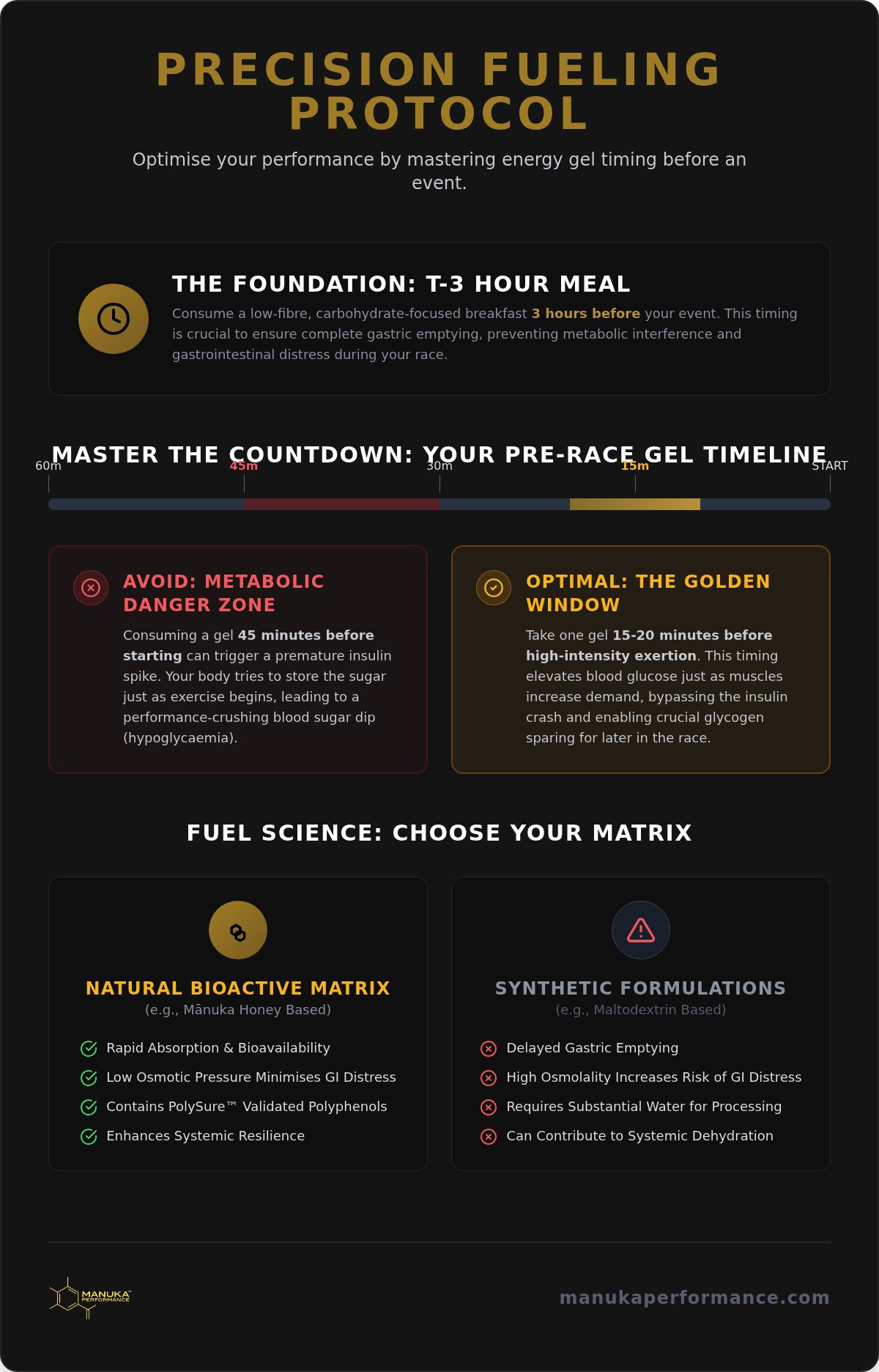
Many traditional sports nutrition products rely on synthetic maltodextrin, which can present significant physiological challenges. These formulations often exhibit high osmolality, a characteristic that correlates with significant gastric emptying delays and subsequent gastrointestinal distress. Because complex synthetic sugars require substantial water for processing, they can inadvertently contribute to systemic dehydration. LiquidFuel offers a superior alternative by utilising a natural glucose-fructose matrix derived from New Zealand honey. This bioavailable structure ensures rapid absorption without the osmotic pressure associated with synthetic alternatives, providing a cleaner metabolic transition as you prepare for the starting line.
Strategic Timing: When to Take Energy Gel Before a Race
The precision of carbohydrate timing is critical to maintaining metabolic stability during the transition from rest to high-intensity effort. When considering when to take energy gel before a race, the objective is to elevate blood glucose levels at the exact moment the sympathetic nervous system suppresses insulin secretion. This suppression typically occurs at the onset of exercise, meaning that a gel consumed too early can trigger a counter-productive hormonal response. Timing the intake to the final 15 minutes of your pre-race preparation ensures that the glucose enters the bloodstream as the muscles increase their metabolic demand, bypassing the risk of an insulin-induced crash.
The "golden window" for pre-race gel consumption is between 15 and 20 minutes before high-intensity exertion.
Integrating this "warm-up dose" into your final physical activation protocol ensures that the glucose is available in the bloodstream just as the muscles begin to increase their uptake. Conversely, consuming a gel in the 45-minute window before the start, often referred to as the metabolic "no-mans-land", frequently results in a blood sugar dip. This occurs because the body has sufficient time to release insulin to manage the sugar spike, but the subsequent exercise-induced glucose clearance hasn't yet begun to inhibit that insulin response. For a more comprehensive overview of these mechanisms, consult this scientific guide to energy gels for athletes.
Avoiding Reactive Hypoglycaemia
Consuming high-glycaemic index sugars between 30 and 60 minutes before a race without immediate follow-up activity presents a significant risk of reactive hypoglycaemia. In this state, the body’s insulin response can inadvertently lower blood sugar levels just as the race begins, leading to early-onset lethargy and diminished power output. To maintain a steady metabolic state during long corral wait times, athletes should delay their final gel until they are within the 20-minute threshold of the starting gun. This ensures the surge in glucose coincides with the physiological shift into race mode, providing a stable energy platform for the opening kilometres.
The Bioavailability of Honey-Based Matrices
The efficacy of a pre-race gel is largely determined by its absorption kinetics and its ability to pass through the intestinal wall without causing distress. High-performance honey naturally provides a balanced ratio of glucose and fructose, a configuration that facilitates the use of multiple transportable carbohydrates. While glucose utilises the SGLT1 transporter, fructose is absorbed via the GLUT5 pathway, effectively reducing the load on any single intestinal transporter. This dual-pathway approach ensures that LiquidFuel provides a more efficient energy delivery system than single-source synthetic gels. You can explore a deeper analysis of absorption rates in our study on natural honey-based energy gels NZ.
The Morning Event Nutrition Framework: Breakfast and Beyond
Achieving metabolic readiness for a morning event requires a structured integration of solid and liquid substrates. While the final gel dose provides immediate glucose, its efficacy depends on the preceding state of the gastrointestinal tract and the clearance of earlier meals. A T-minus 3-hour protocol for breakfast is recommended to facilitate optimal gastric emptying, ensuring that solid matter has cleared the stomach before the physical intensity of competition begins. This window allows for the initial insulin response to stabilise, preventing the hormonal interference that can occur when solid food and high-intensity exertion overlap. Fluid intake during this period should balance electrolyte concentrations with carbohydrate saturation. Excessive plain water can dilute plasma sodium, whereas insufficient fluid may hinder the transport kinetics of the subsequent gel dose.
If your morning race breakfast was delayed or insufficient, you must adjust your strategy for when to take energy gel before a race to compensate for the lower baseline of liver glycogen. In such scenarios, moving the gel intake to the earlier end of the 20-minute window or considering a slightly larger carbohydrate bolus can help bridge the deficit. This flexibility ensures that the central nervous system remains supported despite the sub-optimal start to the day.
Constructing Your Pre-Race Breakfast Guide
Athletes should prioritise simple starches such as white sourdough, porridge oats, or bananas, while strictly avoiding high-fat or high-fibre alternatives that prolong digestion. Current clinical recommendations suggest consuming 1 to 4 grams of carbohydrate per kilogram of body mass in the 1 to 4 hours before exercise to maximise liver and muscle glycogen stores. It's critical to maintain dietary consistency; introducing novel foods on race morning compromises gastrointestinal resilience and increases the risk of distress. A predictable, low-residue meal provides the necessary substrate without the burden of heavy digestive processing.
Bridging the Gap: From Breakfast to the Starting Line
The transition from a solid breakfast to race fuel requires a strategic "top-up" approach rather than treating a gel as a primary meal replacement. LiquidFuel provides a sophisticated energy release through its honey-based matrix, which contains naturally occurring phytochemicals validated by the PolySure™ standard. Unlike refined table sugar, these bioactive components support systemic resilience as you monitor for early signs of "runners stomach" during the shift to high-intensity exertion. Using a gel as this metabolic bridge ensures that blood glucose remains elevated as you move from the assembly area to the starting line, maintaining a seamless thread of energy from your morning meal to the race itself.
Distance-Specific Protocols for Morning Competition
Metabolic demands are not uniform across all racing distances. Determining exactly when to take energy gel before a race requires an understanding of how the specific duration of the event interacts with your body's glycogen stores. In shorter, high-intensity events, the gel acts as a cognitive and metabolic primer. In longer endurance disciplines, the pre-race dose is the first step in a multi-hour fuelling sequence designed to prevent the depletion of muscle glycogen. Environmental variables, such as elevated temperature or humidity, accelerate the rate of glycogenolysis, necessitating a more aggressive approach to pre-race carbohydrate saturation.
The High-Intensity 5km/10km Protocol
Many general guides suggest that events under 60 minutes don't require exogenous fuel. However, clinical observation indicates that elevated blood glucose levels during the first kilometre can enhance anaerobic power output and mental clarity. A single LiquidFuel gel consumed 15 minutes before the start provides a critical metabolic buffer for maximum VO2 efforts. The natural honey-based matrix is significantly less likely to cause gastric heaviness compared to synthetic maltodextrin; this is vital when breathing rates are at their peak. If using caffeinated variants, the pre-race window offers a distinct psychological advantage by lowering the perception of effort during the most intense phases of the race.
The Marathon Fuelling Roadmap
For the marathon distance, the pre-race protocol must integrate into a broader cumulative roadmap. When determining when to take energy gel before a race of this length, one must account for the 90 to 120 grams per hour carbohydrate requirement suggested by research from January 2026. This sequence begins at T-minus 3 hours with the breakfast protocol discussed previously and continues with the first gel dose 15 to 20 minutes before the start. For the Half Marathon, this pre-race dose acts in synergy with a mid-point gel at the 10km mark, maintaining blood glucose levels as muscle glycogen begins to decline. Systematic "gut-training" during training blocks is essential to improve tolerance for these higher intake volumes. Ensuring you've used your race-day nutrition during long runs will validate your gastrointestinal resilience before you reach the starting line. To secure your supply for your next training block, you can purchase the LiquidFuel 10-Pack Running Gel to begin your gut-training protocol.
Mānuka Performance: Bio-Analytical Innovation in Endurance Fuel
The efficacy of a pre-race nutrition strategy is fundamentally dependent on the biochemical integrity of the fuel source. While determining when to take energy gel before a race is a critical tactical decision, the physiological success of that choice hinges on the bioavailability of the carbohydrate matrix. Mānuka Performance operates at the intersection of biotechnology and functional nutrition, moving beyond the industry reliance on synthetic polymers and thickeners. LiquidFuel is engineered using a New Zealand honey-based matrix that provides a natural glucose-fructose ratio, ensuring rapid systemic absorption without the osmotic burden often associated with laboratory-synthesised maltodextrin.
This clean-label approach significantly reduces the risk of gastrointestinal distress, as the body is primed to recognise and process natural food structures more efficiently than synthetic analogues. By prioritising the provenance of our materials and the measurable efficacy of our developments, we provide a performance-led nutrition solution that supports the athlete's metabolic transition from rest to peak intensity. This systemic innovation ensures that your pre-race dose acts as a precise metabolic bridge, providing stable glucose availability as you approach the starting line.
PolySure™: Validating Natural Efficacy
Standardisation is the cornerstone of clinical efficacy. To ensure that every batch of LiquidFuel meets the rigorous demands of elite competition, we utilise the PolySure™ analytical standard. This proprietary process quantifies the phytochemical profile of our gels, validating the presence of seven naturally occurring polyphenols. For the endurance athlete, these bioactive compounds contribute to systemic resilience and metabolic efficiency during high-intensity exertion. By applying biotech research to natural sources, Mānuka Performance provides a level of quantification and purity that transcends conventional sports nutrition, offering a predictable fuel source that aligns with the body's natural digestive pathways.
The LiquidFuel Advantage for Australian Athletes
The transition from synthetic formulations to a clean-label alternative is particularly beneficial for athletes who have previously struggled with the chemical aftertaste and gastric heaviness of traditional gels. LiquidFuel maintains the natural palatability of its honey base, facilitating easier ingestion during the high-intensity minutes before a race begins. For Australian athletes preparing for intensive seasonal training blocks, the LiquidFuel 10-Pack Running Gel offers a convenient solution for executing a structured gut-training protocol. Integrating this scientifically validated fuel into your regimen allows you to refine the timing of when to take energy gel before a race, ensuring your metabolic state is perfectly calibrated for the starting gun. To secure your supply of research-backed endurance fuel, you can order LiquidFuel directly from our laboratory to begin your protocol.
Calibrating Your Final Metabolic Preparation
Achieving peak performance requires a shift from anecdotal fuelling methods to a protocol grounded in biochemical precision. By understanding exactly when to take energy gel before a race, you can ensure that exogenous glucose availability coincides with the suppression of insulin at the onset of high-intensity effort. This strategy, when integrated with a structured T-minus 3-hour breakfast and a bioavailable New Zealand honey matrix, eliminates the risk of reactive hypoglycaemia and gastrointestinal instability. The analytical rigour of the PolySure™ standard ensures that every dose of LiquidFuel provides the quantified phytochemical support necessary for systemic resilience during competition. Transitioning to a clean-label, research-driven nutrition source allows you to focus entirely on tactical execution rather than metabolic maintenance.
Optimise your race day nutrition with the LiquidFuel 10-Pack and enter your next event with the confidence of a scientifically validated fuel strategy. We look forward to seeing your performance reach its full physiological potential.
Frequently Asked Questions
Is it better to take an energy gel before or during a race?
Both applications are essential for a comprehensive fuelling strategy. The pre-race dose acts as a metabolic primer to saturate blood glucose; meanwhile, intra-race ingestion maintains those levels as glycogen stores deplete. Strategic timing for when to take energy gel before a race ensures you enter the event with maximal availability. Mid-race intake prevents the central nervous system from triggering early fatigue; therefore, a dual-phase approach is recommended for optimal performance.
Can I take an energy gel on an empty stomach before a morning race?
While physiologically possible, it's not the optimal protocol for endurance performance. Relying solely on a gel without a preceding breakfast may lead to insufficient liver glycogen stores. A structured T-minus 3-hour meal provides a baseline of substrate; this allows the pre-race gel to serve as a supplementary glucose spike rather than a primary energy source. This method also helps mitigate gastrointestinal sensitivity and prevents the onset of early-race lethargy.
How much water should I drink with a pre-race energy gel?
Consuming approximately 150 to 200 millilitres of water with a gel is recommended to facilitate rapid gastric emptying and prevent osmotic distress. Synthetic gels with high osmolality often require significant fluid for processing; however, LiquidFuel’s honey-based matrix is naturally bioavailable. Proper hydration ensures the glucose-fructose ratio is efficiently transported across the intestinal wall, providing the necessary energy without causing systemic dehydration or the sensation of gastric heaviness during high-intensity starts.
What happens if I take an energy gel too early before the start?
Ingesting a gel too far in advance, specifically in the 30 to 60-minute window, can trigger reactive hypoglycaemia. During this period, the body responds to the sugar spike by releasing insulin; this may lower blood glucose levels just as the race commences. This metabolic "no-mans-land" results in early-onset lethargy and diminished power. Delaying intake until the 15 to 20-minute threshold aligns the glucose surge with exercise-induced insulin suppression for stable energy.
Can I use honey as a natural alternative to energy gels?
Raw table honey lacks the analytical standardisation required for elite performance; however, a honey-based matrix like LiquidFuel is specifically engineered for endurance. Unlike standard honey, this formulation is validated by the PolySure™ standard for its polyphenol content and phytochemical profile. This ensures a consistent glucose-fructose ratio that optimises absorption through dual-transport pathways. It provides a superior clinical alternative to both raw honey and synthetic maltodextrin gels for serious competitors.
Will taking a gel 15 minutes before a race cause an insulin crash?
No, because the onset of high-intensity physical activity suppresses the secretion of insulin. When you determine when to take energy gel before a race, the 15-minute window is considered the "golden window" because the sympathetic nervous system is already preparing for exertion. This ensures the glucose is utilised by the working muscles for glycolytic flux rather than being sequestered by insulin; this maintains metabolic stability and mental focus throughout the race start.
How many energy gels should I take for a half marathon?
A typical half marathon protocol involves one gel taken 15 to 20 minutes before the start, followed by subsequent doses every 45 minutes of exertion. Current research from 2026 suggests that endurance athletes benefit from 60 to 90 grams of carbohydrate per hour. For a two-hour finisher, this equates to a pre-race dose plus two to three gels during the event. This frequency maintains glycogen sparing and prevents the cognitive fatigue associated with depletion.
Should I use caffeinated energy gels for my pre-race dose?
Caffeinated variants can provide a significant ergogenic advantage when used in the pre-race window. Caffeine lowers the rating of perceived exertion and enhances central nervous system drive; this is particularly beneficial for high-intensity starts in 5km or 10km events. It's essential to validate your systemic tolerance during training blocks to ensure the caffeine doesn't exacerbate gastrointestinal sensitivity or elevate your heart rate beyond the desired physiological thresholds for your specific event.