


The most natural-looking option isn’t automatically the most dependable fuel for an ultra. Choosing natural fuel for ultra running means looking beyond ingredient appeal to the carbohydrate it provides, how easily you can carry and consume it, and whether you tolerate it over time.
If you’re unsure which foods will work across hours on the trail, that’s understandable. Natural options vary in format and carbohydrate content, and a fuel that seems appealing at home may be difficult to eat while running. The practical test is whether it suits your needs and can be used consistently.
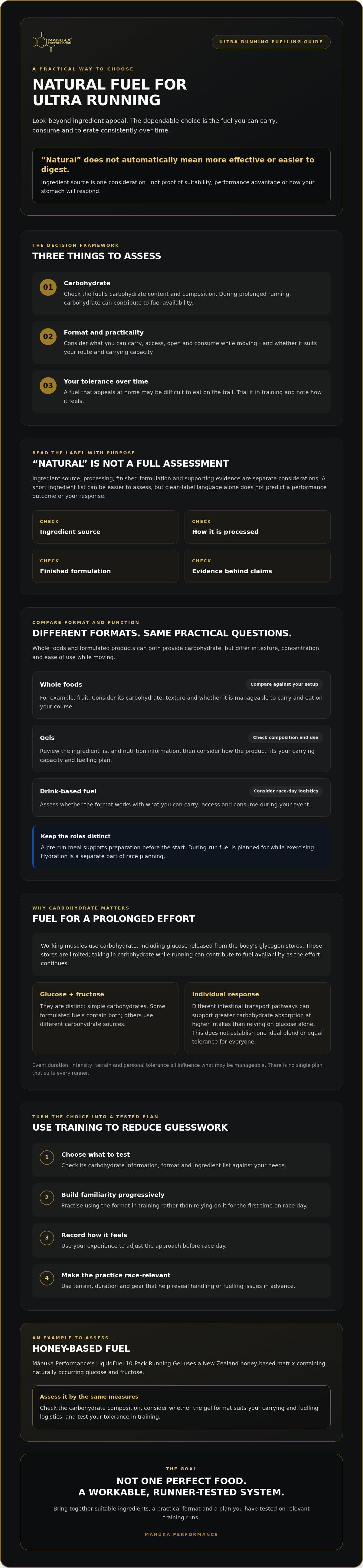
This guide explains why carbohydrate matters during prolonged running and how to compare natural fuel formats against race-day demands, including portability, tolerance and fuelling logistics. You’ll also learn how to test a plan in training, so your choices are based on experience rather than guesswork. The goal isn’t to find one perfect food, but to build a workable system in which ingredients, format and a runner-tested plan fit together.
Key Takeaways
- Assess natural fuel for ultra running by its carbohydrate content, format and practicality, not ingredient appeal alone.
- Compare whole foods, gels and drink-based fuel against your carrying setup and what you can manage on the trail.
- Build familiarity with a fuelling format progressively in training. Record how it feels and adjust your approach before race day.
- Practise with race-relevant terrain, duration and gear to identify handling or fuelling issues in advance.
- Honey-based gels are one option to assess. Mānuka Performance’s LiquidFuel 10-Pack Running Gel uses a New Zealand honey-based matrix containing naturally occurring glucose and fructose.
What counts as natural fuel for ultra running?
“Natural” describes an ingredient’s source or formulation. It doesn’t establish that a fuel is more effective, easier to digest or suitable for every runner. Natural fuel for ultra running is carbohydrate-containing food or a formulated product made with ingredients from natural sources, selected for its composition and practicality rather than an assumed performance advantage. Options might include whole foods such as fruit or a purpose-made fuel using ingredients such as honey. The useful question is how a particular option works for you during prolonged exercise.
An ultramarathon is generally longer than a marathon, although event formats and terrain vary. For an effort lasting many hours, plan not just what to eat before setting off, but how you’ll take in fuel repeatedly as the event progresses. Consider where you’ll carry it, when you can access it and whether you can manage it while moving.
What does natural mean in sports fuelling?
The word “natural” isn’t, on its own, a standardised guarantee of a product’s composition or suitability. Assess four separate things: where the ingredients come from, how they’ve been processed, how the finished fuel is formulated, and what evidence supports any claims made about it. A short ingredient list can make a product easier to assess, but clean-label language alone doesn’t prove a performance outcome or predict how your stomach will respond.
Whole foods and formulated products can both provide carbohydrate, but they differ in texture, concentration and ease of use while moving. Ingredient appeal is one consideration, not a substitute for checking the information that matters to your fuelling plan. Look at the nutrition information and ingredient list, then consider whether the product’s format fits your route and carrying capacity.
Why does fuelling matter over ultra distances?
During prolonged running, carbohydrate is an important fuel source. The body stores some carbohydrate as glycogen, which can be used during exercise. Taking in carbohydrate during a long event can contribute to fuel availability. How much and what form may be manageable depends on the event’s duration and intensity, as well as individual tolerance. There’s no single plan that suits every runner.
Keep the categories clear. A pre-run meal supports preparation before the start; during-run fuel is what you plan to consume while exercising. Hydration is a separate part of race planning, and everyday food choices contribute to your overall diet rather than automatically serving as practical race fuel. Start by considering what you can carry, open and consume consistently on your course. Test those choices in training before relying on them in an event.
How carbohydrate-based natural fuel supports prolonged running
During a long run, working muscles use carbohydrate, including glucose released from the body’s glycogen stores. Those stores are limited, and taking in carbohydrate while running can contribute to fuel availability as the effort continues. Carbohydrate helps supply energy during prolonged exercise, but its effects depend on the demands of the event and the individual runner. No ingredient can guarantee a particular result.
The practical aim is a fuelling approach you can tolerate and repeat, rather than relying on a label to predict your response. Event duration, effort, terrain and personal tolerance all influence what may be manageable. For broader guidance on planning food around distance running, see Fueling strategies for distance runners from Mayo Clinic Health System.
What roles do glucose and fructose play?
Glucose and fructose are distinct simple carbohydrates. Some formulated fuels contain both, while others rely on different carbohydrate sources. “Natural” doesn’t describe one standard recipe. In the intestine, glucose and fructose use different transport pathways, so consuming them together can support greater carbohydrate absorption at higher intakes than relying on glucose alone. That doesn’t establish one ideal blend or mean every runner will tolerate a combination equally well.
For runners, the useful takeaway is to check a product’s actual carbohydrate composition, then trial it at a level and pace that reflect their training plan. Composition tells you what a fuel contains, but it can’t establish how an individual will feel or respond during an ultra.
What can research tell runners about natural ingredients?
Evidence about carbohydrate delivery addresses a different question from analysis of other compounds in a food or finished product. Identifying naturally occurring compounds confirms their presence; it doesn’t, by itself, demonstrate an acute fuelling effect or a change in race performance. Keep those evidence categories separate when assessing claims about natural fuel for ultra running.
For a focused discussion of the product category, read this analysis of honey-based energy gels. Mānuka Performance’s LiquidFuel 10-Pack Running Gel uses a New Zealand honey-based matrix containing naturally occurring glucose and fructose. That composition helps explain what the product contains, but it isn’t proof of a specific athletic outcome. See Mānuka Performance’s honey-based sports nutrition for product information.
Natural fuel options for ultra running: compare format and function
The right format is one you can carry, access and consume reliably over the course you’re running. Whole foods, gels and drink-based fuel each solve practical problems differently, with trade-offs in weight, preparation, packaging and ease of intake. To compare natural fuel for ultra running, match each format to your route and carrying setup rather than assuming one option will suit every runner.
| Format | Potential advantages | Limitations to consider | Useful situation to trial |
|---|---|---|---|
| Whole foods | Can offer familiar textures and a choice of food types. | May take more space, need more handling or be harder to chew while moving. Packaging and storage requirements vary. | Practise with the foods and containers you can realistically carry on a training route. |
| Formulated gels | Compact and designed for portable, measured servings. | Packaging creates waste, and texture, ingredients and carbohydrate content differ between products. | Test opening and consuming the gel while running, including with the kit you plan to use. |
| Drink-based fuel | Can combine fluid intake with a source of carbohydrate. | Requires water and a suitable bottle or reservoir. Mixing and carrying enough supply may add logistical demands. | Trial preparation, carrying capacity and access to water on a route similar to your event. |
When might whole foods be practical?
Whole foods may suit a runner who values familiar options and has a practical way to pack and access them. Check whether they’ll stay intact, fit your pockets or pack, and be manageable to eat on the move. Chewing and appetite can also feel different as an effort continues, so an option that works early in a run may not remain appealing later. Trial your choices rather than treating any food as universally suitable.
How do gels and drinks differ in use?
Gels are generally compact, while drink-based fuel requires a container and preparation. That difference affects how much you can carry, how often you need to refill, and how you manage empty packaging. Products vary, so check the current ingredient list and nutrition label rather than inferring composition from a format or “natural” description. For a deeper comparison of the honey-gel category, read whether honey energy gels work.
Before settling on a format, trial it with the terrain, pace and carrying arrangement you expect to use. A mixed approach may be practical for some runners, but test it as a complete plan so you can assess how the formats work together.
How to test a natural ultra-running fuelling plan in training
A fuelling plan becomes useful when you know how it works for you, not just what its label says. Practise with the foods or products you’re considering before race day, using conditions that resemble your event as closely as practical. This can uncover issues with taste, handling, timing or stomach tolerance while there’s still time to adjust.
How should runners practise fuel intake?
- Choose one format to assess. Check its ingredients and nutrition information. Then consider how you’ll carry and access it on your planned route.
- Trial it during a suitable training run. Start with a manageable session and use the product as directed on its label. Don’t introduce an unfamiliar fuel or strategy for the first time in a race.
- Record what happened. Note the format, timing, run duration, terrain and conditions, along with perceived tolerance, appetite and any difficulty opening, carrying or consuming it.
- Adjust gradually. Change one element at a time, such as the format or timing, so you can better interpret your response. Repeat the trial before deciding whether the change is workable.
- Practise the complete setup. As your preparation progresses, include race-relevant duration, terrain, clothing, pack or belt, and access to any supplies you expect to use.
Keep the record simple. Consistent notes across training runs can help distinguish a one-off issue from a pattern, and show whether a product that seemed manageable early in a run remains practical later. Individual responses vary, so no format or plan can guarantee a symptom-free experience.
How can runners account for gastrointestinal tolerance?
Build familiarity progressively rather than forcing a fuelling strategy that feels difficult to tolerate. Consider the combined demands of running and consuming fuel, and make adjustments cautiously. Changing several products or timings at once makes it harder to identify what contributed to a response. Plan fuelling and hydration together, including how you’ll carry fluids and access water, but individual fluid needs vary, so avoid relying on an unsupported fixed target.
For further guidance on gut tolerance, read this scientific guide to runner’s stomach issues. Persistent or severe symptoms warrant advice from a qualified health professional.
Use your training notes to refine a natural fuel for ultra running strategy that fits your event logistics and personal experience. Explore Mānuka Performance’s honey-based running gel as one option to assess in training, after checking its product information and whether it suits your plan.
Where honey-based fuel fits into a natural ultra-running strategy
A honey-based gel is one possible way to carry carbohydrate during an ultra, not a required choice or a universally suitable one. Its place in a natural fuel for ultra running plan depends on practical details: how easily you can carry and consume it, whether you like the taste, and how it feels during training. Honey origin or “natural” positioning alone can’t predict individual suitability.
What should runners assess in a honey-based gel?
Before trying a gel, check the current product label for its declared carbohydrate quantity, ingredient list and directions. Consider the packaging too: can you carry it securely, open it while moving and manage the empty wrapper? Then trial it in training, noting taste and tolerance under conditions that resemble your event. These checks help you assess the product as a whole rather than relying on one ingredient or label description.
Product information can change, so use the current label rather than assuming details based on the product category or an earlier description. A measured composition can help you understand what a gel contains, but it doesn’t establish how your body will respond or prove a particular race outcome.
How does Mānuka Performance describe its approach?
Mānuka Performance’s LiquidFuel 10-Pack Running Gel uses a New Zealand honey-based matrix containing naturally occurring glucose and fructose. This identifies carbohydrate sources present in its matrix. It shouldn’t be taken as a promise of a specific fuelling effect or as evidence that the product will suit every runner.
PolySure™ is an analytical standard used to validate seven naturally occurring polyphenols in the finished product. That validation concerns the presence of those compounds. It isn’t evidence that they improve acute fuelling, recovery or race performance.
To assess whether this format belongs in your own plan, review the current label and trial it in training before relying on it during an event. Explore Mānuka Performance’s running fuel and consider how the product details fit your fuelling preferences and race logistics.
Build a fuelling plan you can trust on the trail
The best natural fuel for ultra running isn’t defined by an ingredient label alone. Match the format to your event, consider how practical it is to carry and consume, then use training runs to learn what you tolerate and can repeat. Small, deliberate adjustments give you a more considered plan than trying something new on race day.
PolySure™ validates seven naturally occurring polyphenols in the finished product. This identifies compounds present, not a proven fuelling or performance outcome. Check current product details and decide whether the format suits your plan.
Explore Mānuka Performance’s running fuel as one option to assess. With a plan practised in training, you can approach your next ultra with greater clarity and confidence.
Frequently Asked Questions
What is the best natural fuel for ultra running?
There’s no single best option for every runner. Compare formats by how much carbohydrate they provide, how easy they are to carry and consume, and whether you’ve tolerated them during training. Whole foods, gels and drink-based fuels each have practical trade-offs, and an appealing ingredient list can’t predict your personal response. Choose an option that suits your event logistics, check its current nutrition information, then test it on training runs before race day.
How much carbohydrate should I take during an ultra?
Your carbohydrate needs depend on factors such as event duration, intensity and individual tolerance, so a universal target may not suit your race or circumstances. Consult current sports nutrition guidance and consider speaking with a qualified sports dietitian to develop an appropriate plan. Check the carbohydrate quantity declared on each fuel’s current label, then practise your planned intake during training. Avoid making a large change or attempting an unfamiliar intake strategy for the first time on race day.
Can you use honey as fuel during an ultra?
Yes, a honey-based product can be one possible carbohydrate format during an ultra, provided it suits your plan and you tolerate it. Honey-based formulations vary, so check the current label for declared carbohydrate quantity, ingredients and directions rather than assuming all products have the same composition. Trial the product during training, including its taste, packaging and ease of use while running. Honey’s origin or naturalness alone can’t establish that it will suit you.
Are natural energy gels better than synthetic gels for ultra running?
There isn’t a universal winner. “Natural” describes ingredient source or formulation, but doesn’t by itself tell you how much carbohydrate a gel contains, how practical it is to use or how you’ll tolerate it. Compare current labels and consider packaging, taste, directions and training experience. Evidence about carbohydrate content or delivery is also distinct from evidence about other ingredients. Choose based on the product’s composition and your tested response, not a natural-versus-synthetic label alone.
What should I eat during an ultra if gels do not suit me?
Whole foods and drink-based fuels are alternatives to gels, and some runners may prefer to use more than one format. Assess whether your choices are easy to carry, access and consume on your planned route, and check product labels for carbohydrate information where relevant. Food texture and appetite can affect practicality over a long effort. Trial your options in training, since neither a familiar food nor a particular format is guaranteed to suit everyone during an ultra.
How do I avoid stomach problems when fuelling during an ultra?
You can’t guarantee that a fuelling plan will prevent stomach problems, but practising it in training can help you assess tolerance before race day. Introduce one change at a time, record what you consume and how you feel, then adjust gradually. Include conditions that resemble your event, such as terrain and carrying setup. Individual responses vary. If symptoms are persistent or severe, or you have ongoing concerns, seek advice from a qualified health professional.
Should I use a new natural fuel on race day?
No. Avoid making race day your first trial of an unfamiliar fuel or fuelling strategy. Test it during training so you can assess taste, packaging, timing, ease of consumption and personal tolerance while running. Practise with race-relevant terrain and the equipment you expect to carry, then make any adjustments gradually. Read the current product label before use, and allow enough training opportunities to decide whether the format fits your plan.