


The bottle in your hand may contribute to your fluid intake without providing the carbohydrate you need, while a gel can deliver fuel without replacing fluid. Choosing liquid carbohydrate fuel for runners is therefore not simply a choice between a drink and a gel. Plan carbohydrate delivery and hydration as related but separate parts of your run.
Drinks, powders and gels provide different amounts of carbohydrate and come with different practical demands. Fluid and electrolyte needs add another consideration, and a format that works comfortably in training may not suit every runner or event.
This guide compares common fuel formats and explains how to build a repeatable routine around your run and hydration needs. You’ll learn how to assess carbohydrate intake separately from fluid intake, and how a honey-based gel such as Mānuka Performance LiquidFuel could fit into a strategy you practise during training.
Key Takeaways
- Understand how liquid carbohydrate fuel for runners differs from water and electrolyte products, so you can plan fuel and hydration separately.
- Compare ready-to-drink beverages, drink mixes, gels and water by carbohydrate delivery, fluid contribution and practicality on the move.
- Learn how glucose and fructose are used during exercise, and why a carbohydrate blend that suits one runner may not suit another.
- Build a repeatable fuelling routine by checking product directions, practising in training, recording your experience and adjusting gradually.
- Assess Mānuka Performance LiquidFuel as a honey-based gel containing naturally occurring glucose and fructose, and consider how it fits your established plan.
What Is Liquid Carbohydrate Fuel for Runners?
Liquid carbohydrate fuel for runners is a drinkable or swallowable source of carbohydrate used during exercise. The term can include ready-to-drink beverages, powders mixed with water, gels and other soft or fluid formats. Textures vary: some gels are thick, while others are more fluid. The word “liquid” doesn’t mean every gel provides meaningful hydration or can be taken without water.
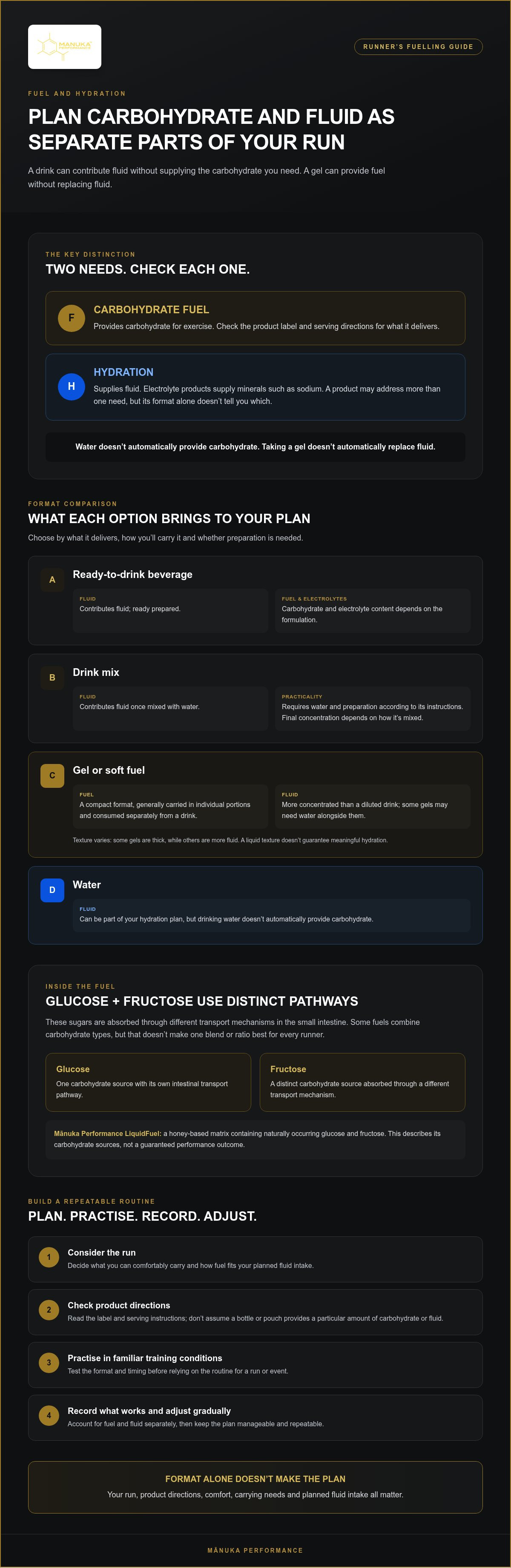
Carbohydrate fuel delivers carbohydrate for exercise; hydration supplies fluid, while electrolyte products supply minerals such as sodium. A product may address more than one of these needs, but its format alone doesn’t tell you which ones it covers. A carbohydrate-containing drink can contribute both fuel and fluid, whereas a gel is primarily a compact fuel format. For a general overview of the different purposes a sports drink can serve, see the classification of sports drinks.
How do runners use liquid carbohydrate fuel?
During sustained exercise, runners can use carbohydrate fuel as one way to take in carbohydrate while running. A format that fits in a pocket or bottle and is straightforward to consume can be practical, particularly when stopping to handle food isn’t convenient. Choose by considering the run, what you can comfortably carry and how the fuel fits your planned fluid intake.
Planning ahead makes the routine easier to practise. Waiting until you feel low on energy to decide whether to fuel can leave you without a clear approach. Instead, consider the session and product directions before you start, then test the timing and format in familiar training conditions. Keep the plan manageable and note what works for you.
Is a gel the same as a sports drink?
No. A ready-to-drink beverage comes prepared and contributes fluid; its carbohydrate and electrolyte content depends on the formulation. A powder also contributes fluid once mixed, but requires water and preparation according to its instructions. Gels are generally carried as individual portions and consumed separately from a drink. Their texture and concentration vary, and some may need water alongside them.
Check the product label and serving directions rather than assuming a pouch, gel or bottle delivers a particular amount of carbohydrate or fluid. Then account for those details in your hydration plan: taking a gel doesn’t automatically replace fluid, and drinking water doesn’t automatically provide carbohydrate. Practising the combination during training helps you establish a routine that is practical for your runs.
How Liquid Carbohydrate Fuel Is Digested and Used During a Run
Once consumed, carbohydrate is digested into simpler sugars that can be absorbed through the small intestine and used by the body during exercise. Glucose and fructose are two distinct sugars found in many sports-fuelling formulations. Their relevance lies not only in the energy they provide, but also in how the intestine absorbs them.
Carbohydrate composition can matter during exercise because glucose and fructose use different intestinal transport pathways, allowing the gut to absorb them through more than one route. This helps explain why some fuels combine carbohydrate types, but it doesn’t make one blend or ratio the best choice for every runner. Individual tolerance, the demands of the run and the rest of the fuelling plan all matter.
What do glucose and fructose contribute to a fuel blend?
Glucose and fructose are absorbed using distinct transport mechanisms in the small intestine. In a formulation containing both, their absorption does not rely on precisely the same pathway. The practical takeaway is that carbohydrate sources can be complementary, not that every runner needs a particular ratio or will respond identically to a blend.
Mānuka Performance’s LiquidFuel honey-based matrix contains naturally occurring glucose and fructose. This describes its carbohydrate sources, not a guaranteed performance outcome. Runners can assess how the product fits their routine by practising with it during training.
Why do concentration and fluid intake matter?
A gel or concentrated fuel and a diluted drink deliver carbohydrate in different amounts of fluid. A drink mix is prepared in water, so the final concentration depends on how it is mixed. A gel is a more concentrated format and may be taken separately from fluid. Follow the product’s serving directions and account for fluid independently in your hydration plan rather than assuming a fuel format meets both needs.
Osmolality describes the concentration of dissolved particles in a liquid. It can help explain why two products with the same volume may differ in composition, but it doesn’t by itself predict how comfortable a product will feel or how an individual will absorb it. A liquid format doesn’t guarantee smooth digestion or prevent gastrointestinal symptoms.
For broader context on sports drinks and their intended role during strenuous exercise, see the discussion from the Harvard T.H. Chan School of Public Health. Runners considering a honey-based option can explore honey-based running gels as one format to practise within an established fuelling and hydration plan.
Liquid Fuelling Compared: Sports Drinks, Mixes, and Gels
The most useful format depends on how you want to carry fuel and fluid during a particular run. Compare what each option delivers, how you’ll transport it and whether preparation is needed. No single format is best for every runner. The Gatorade Sports Science Institute (GSSI) provides further sports nutrition and hydration resources, but your carbohydrate and fluid plans still need to account for the product you choose.
| Format | Carbohydrate delivery | Fluid contribution | Carrying and preparation |
|---|---|---|---|
| Ready-to-drink beverage | Carbohydrate is already incorporated; the amount varies by product. | Provides fluid as well as any carbohydrate and electrolytes listed on the label. | Convenient when carrying a bottle is practical; no mixing required. |
| Drink mix | Delivers carbohydrate once mixed, with the final concentration depending on the product and water volume. | Contributes the water used to prepare it. | Powder can be carried and mixed before or during a run; follow the stated mixing directions. |
| Gel | Provides carbohydrate in a compact serving; composition and texture vary. | Usually contributes less fluid than a drink. Some gels are intended to be taken with water. | Easy to carry in a pocket or belt; check directions for whether additional water is recommended. |
| Water | Provides no carbohydrate. | Provides fluid. | Simple to carry in a bottle or access along a route; does not need preparation. |
When might a drink or drink mix suit a runner?
A ready-to-drink beverage can suit a route where carrying a bottle is manageable, while a mix may help combine fluid and carbohydrate in one bottle. Neither removes the need to plan the two separately. First consider the carbohydrate your session calls for, then think about the fluid you expect to need. The amount of water used changes a mix’s concentration, so follow the product’s directions rather than guessing.
When might a gel be the more practical format?
A gel can be easier to carry than a bottle when you want a compact fuel option, although texture and instructions vary between products. Check whether it should be taken with water, and include that fluid in your hydration plan rather than assuming the pouch replaces it. For ingredient-focused context, read this analysis of honey-based energy gels. Practise your chosen combination in training before relying on it during an event.
In practice, liquid carbohydrate fuel for runners works best when the format suits the run, the way you’ll carry supplies and the product’s directions. Match carbohydrate delivery to your fuelling plan, and manage fluid intake as a separate consideration.
How to Practise a Liquid Fuelling Routine in Training
A repeatable fuelling routine is built through observation, not guesswork. Testing a familiar product during training lets you assess its timing and practicality under conditions you can manage, rather than introducing an unfamiliar format on race day. Race-day fuelling should be practised beforehand.
- Choose the context. Pick a training session that reflects the kind of run you’re preparing for, including its duration, effort and likely conditions.
- Check the directions. Read the product label for serving guidance and whether the fuel should be taken with water. Keep hydration planning separate from your carbohydrate plan.
- Practise the routine. Use the product as directed and note when you take it and what fluid you drink alongside it.
- Record your observations. Briefly note perceived tolerance, how easy the fuel is to carry and consume, fluid intake, pace and conditions.
- Adjust gradually. Change one variable at a time, such as timing or format, so it’s easier to see what changed. Repeat the trial before settling on a routine.
Your notes are personal observations, not clinical evidence or proof that a product will suit every run. Over time, they can help you decide whether a format fits your needs and whether the routine is practical to repeat.
How should runners test a fuel format before an event?
Start with a manageable session rather than making race day your first trial. Follow the serving directions, note when you consume the fuel and record what fluid accompanies it. If you want to compare formats or timing, test them separately where practical. Changing one factor at a time makes the results easier to interpret. Keep the record simple and include conditions such as effort and weather, which can affect how a run feels.
What if a runner experiences stomach discomfort?
Discomfort can have more than one contributing factor, so avoid treating a single run as a diagnosis. Review your pace, intake timing, product concentration and fluid alongside your notes, and consider guidance from a qualified health professional if symptoms are persistent, severe or concerning. No format can guarantee freedom from gastrointestinal symptoms. For further background, read this scientific guide to runners’ stomach issues.
Use training to assess whether liquid carbohydrate fuel for runners fits your routine, including how it sits alongside your hydration plan. To explore a honey-based option for your practice sessions, view the honey-based running gels.
How Mānuka Performance LiquidFuel Fits into a Runner’s Fuel Plan
Mānuka Performance LiquidFuel 10-Pack Running Gel is a honey-based carbohydrate-fuel option designed for runners and endurance athletes. Its New Zealand honey-based matrix contains naturally occurring glucose and fructose, two carbohydrate types used in sports-fuelling formulations. This describes the product’s ingredient composition; it doesn’t establish how much carbohydrate an individual should consume or predict how a particular runner will respond.
LiquidFuel is a gel, so assess it as one part of a wider approach rather than as a substitute for drinking. The amount and timing of carbohydrate a runner needs depend on the session and their personal tolerance, while fluid intake remains a separate consideration. Product directions and training practice can help you judge whether this format suits your routine.
What distinguishes the LiquidFuel honey-based matrix?
The matrix uses New Zealand honey as its carbohydrate source, with naturally occurring glucose and fructose. The product also uses PolySure™, an analytical standard that validates seven naturally occurring polyphenols in the finished product. This describes composition and analytical validation, not evidence that natural ingredients guarantee comfort, absorption or performance for every athlete. For further context on the format, read this comparative analysis of honey energy gels.
How can runners assess whether a gel fits their approach?
Consider the event duration, how you prefer to carry fuel and how a gel fits into your separate fluid plan. Check the product directions, then practise using it in training before an event. Note the timing, your perceived tolerance and any fluid taken alongside it. These observations can help you decide whether the format is practical for you, but they don’t guarantee the same experience in different conditions or on race day.
When comparing liquid carbohydrate fuel for runners, ask how a specific product fits your overall plan, rather than whether one format is universally superior. Individual carbohydrate and hydration needs vary, so use the gel in a way that aligns with its directions and your practised approach. Explore Mānuka Performance for LiquidFuel product information.
Build a Fuelling Routine You Can Trust
The central principle is straightforward: plan carbohydrate delivery and fluid intake as related but separate parts of your run. Drinks, mixes and gels involve different practical trade-offs, so the right format depends on your route, carrying preferences, session and individual tolerance. Practise your chosen routine in training, follow product directions and adjust it based on your observations before race day.
Mānuka Performance LiquidFuel offers a honey-based option for runners and endurance athletes. Its New Zealand honey-based matrix contains naturally occurring glucose and fructose, and its PolySure™ analytical standard validates seven naturally occurring polyphenols in the finished product. These details describe its ingredients and analytical validation; they don’t replace an individual fuelling or hydration plan.
If you’re considering a honey-based gel as part of your approach, explore LiquidFuel running gel and assess how it fits your practised routine. Explore LiquidFuel and choose a format to practise as part of your next training run.
Frequently Asked Questions
Are energy gels considered liquid carbohydrate fuel?
Yes, gels are commonly grouped with liquid or semi-liquid carbohydrate fuels because they can usually be consumed without chewing. Their texture and concentration vary, however, and a gel isn’t necessarily equivalent to a sports drink. Some are intended to be taken with water. Follow the specific product directions, practise your fuelling routine during training and plan fluid intake separately rather than treating a gel as a replacement for hydration.
Can runners use carbohydrate drinks and gels together?
Yes, some runners combine formats, but doing so changes the total carbohydrate supplied and may affect how much fluid they take in. Consider the contribution of each serving, follow the product directions and test the combination during training before using it at an event. Using both isn’t necessary or suitable for every runner or session. For event-specific targets, refer to current sports nutrition guidance or seek advice from a qualified practitioner.
How much carbohydrate should a runner take during a run?
There isn’t one amount that suits every runner. Appropriate intake depends on factors such as session duration, intensity, training history and individual tolerance. Use current sports nutrition guidance as a starting point, and verify that any figures you rely on remain up to date. Practise your planned intake during training rather than first testing it at an event. A sports dietitian can help tailor recommendations to your training and circumstances.
Should runners drink water with a carbohydrate gel?
It depends on the gel’s formulation and serving directions. Some products are intended to be taken with water, while drink mixes are prepared using the dilution instructions on the label. Read the product information and plan hydration separately from carbohydrate intake, so a gel isn’t mistaken for a fluid replacement. Practise the same approach during training, ideally in conditions similar to your event, rather than trying an unfamiliar product and fluid combination on race day.
Is honey-based carbohydrate fuel suitable for every runner?
No single fuel format suits every runner, and individual responses can differ. A honey-based gel may be one option to assess alongside drinks or other formats, but its ingredient source alone doesn’t establish personal tolerance or a performance benefit. Mānuka Performance LiquidFuel uses a New Zealand honey-based matrix containing naturally occurring glucose and fructose. Review product information, follow directions and practise during training; seek qualified advice if health concerns or dietary needs affect your choices.
When should runners practise using liquid carbohydrate fuel?
Practise during training before relying on a product or routine in an event. Start with a suitable session, follow serving directions and record when you take the fuel, what fluid accompanies it, the conditions and your personal response. Testing one change at a time can make your observations easier to interpret. Avoid introducing an unfamiliar product or combination for the first time on race day, when there’s less opportunity to assess how it suits you.