


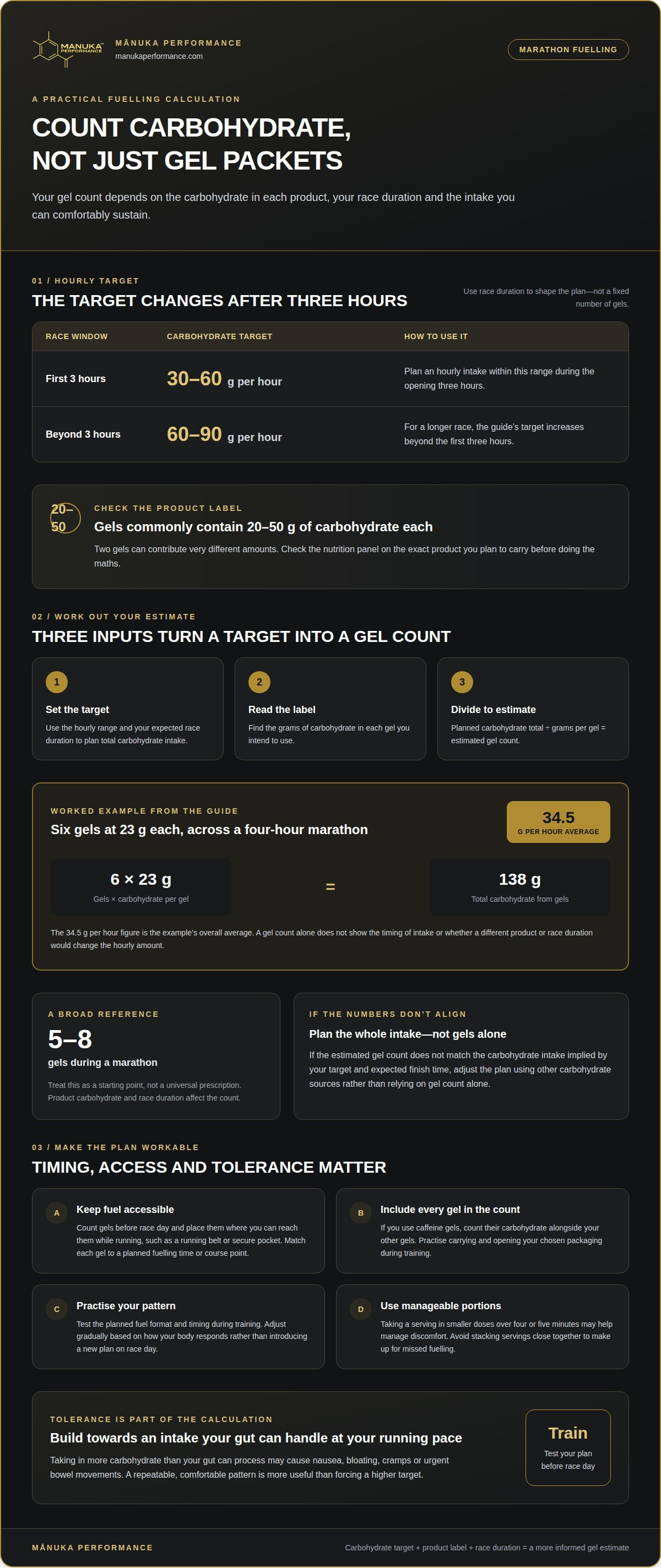
A marathon gel plan is a carbohydrate calculation, not a fixed gel count. The practical answer to how many carbs per hour for marathon runners is 30-60 g per hour during the first three hours, increasing to 60-90 g per hour beyond that for a longer race. As gels commonly contain 20-50 g of carbohydrate each, the number you need depends on the product and your hourly target.
It’s understandable to want a simple answer to how many carbs per hour for marathon runners, especially when race-day fuelling can feel like one more detail to manage. But a gel count that ignores carbohydrate content, race duration and what your stomach tolerates may not meet your needs.
This guide explains how to estimate gels from your target intake, plan when to take them and adjust your approach if fuelling causes discomfort. Practising before race day helps you build a strategy around what you can sustain, rather than choosing a number in isolation.
Key Takeaways
- Estimate gels from the carbohydrate in each one and your race duration, then check the total against your hourly fuelling target.
- Begin fuelling early and space later intake consistently; taking smaller portions over four or five minutes may help manage stomach discomfort.
- Practise your race-day plan during training, adjusting the timing and format to what feels comfortable while running.
- Understand how carbohydrate supports marathon fuelling, then choose an approach you can sustain across the distance.
1. How many gels do you need for a marathon?
Start with your carbohydrate target and the amount in each gel, rather than choosing a fixed race-day count. Gels commonly contain 20-50 g of carbohydrate, so two products can contribute very different amounts. Check the nutrition panel on the exact gel you plan to carry, then divide your planned total carbohydrate intake by its grams per gel. This gives an estimate, which you can compare with your hourly target and race duration.
For example, six gels containing 23 g each provide 138 g of carbohydrate. Across a four-hour marathon, that averages 34.5 g per hour. This example shows why a gel count alone can mislead: the same six gels would deliver a different hourly amount if each contained more or less carbohydrate, or if your race took longer. Use the label and expected duration in your own calculation.
As a broad reference, runners are often advised to take 5-8 gels during a marathon. Treat that as a starting point, not a universal prescription. The hourly target is 30-60 g during the first three hours, then 60-90 g per hour beyond the first three hours for longer races. Work out the intake those targets imply for your expected finish time, then calculate how many gels supply it. If the number does not align, adjust the plan using other carbohydrate sources rather than relying on gel count alone.
Plan access as carefully as quantity. Count your gels before race day and place them where you can reach them while running, such as in a running belt or secure pocket. Match each gel to a planned fuelling time or course point, and keep the sequence easy to remember. If you include caffeine gels, count their carbohydrate alongside that of your other gels. Practise carrying and opening your chosen packaging during training so handling it doesn’t disrupt your running rhythm.
Gels commonly contain 20-50 g of carbohydrate. No carbohydrate amount for sports drinks is provided.
2. Managing stomach discomfort
Stomach discomfort during a marathon can disrupt concentration and make a fuelling plan difficult to follow. Nausea, bloating, cramps or bowel urgency may occur when carbohydrate intake exceeds what your gut can handle at your running pace. Large, closely spaced servings can be harder to manage than smaller portions taken steadily. Aim for a repeatable intake pattern that feels manageable during effort.
Practise your intended carbohydrate plan during training runs instead of introducing it on race day. Use the same fuel format and timing you plan to use in the marathon, then adjust gradually based on how your body responds. Keep a simple record of the product, amount, timing and any symptoms. This can help you identify whether a particular serving size or pattern causes problems.
Portioning fuel can make intake easier to manage. Consume a serving in smaller doses over four or five minutes while running, rather than taking it all at once. Avoid stacking servings close together to make up for missed fuelling, as a sudden increase can be difficult to tolerate. A steady schedule makes it easier to assess your response.
If discomfort begins, don’t force another serving immediately. Ease your pace if needed, allow symptoms to settle, and resume fuelling in smaller portions when you feel comfortable. Consider whether the issue followed a larger dose, a change in product or a faster intake rate. Repeating the same test during training can help you distinguish a one-off response from a pattern worth adjusting.
Taking in more carbohydrate than your gut can process at that pace may cause nausea, bloating, cramps or urgent bowel movements. These symptoms can make it harder to maintain your planned intake, so build towards a tolerable strategy rather than forcing a higher target. Comparing fuel formats can inform that choice; fuel-format information may offer a useful reference.
3. Why is proper marathon fuelling important?
A practised race-day fuelling plan reduces guesswork when fatigue makes decisions harder. It also helps you assess how your carbohydrate source, intake timing and running pace work together. Use training runs to rehearse the full process, from carrying fuel to opening packaging and taking each serving. A plan that looks simple on paper still needs to work while you’re moving.
Begin practising with the schedule you intend to use on race day. Take your first fuel within the first 30 minutes of a run, then plan further intake every 30-40 minutes. Repeat this structure during training and note the time, carbohydrate amount, pace and any stomach response. Those details help you identify where a change is useful, rather than changing several parts of the plan at once.
For New Zealand marathon aid stations, map your planned carbohydrate intake against their locations on the course. Treat each station as a course landmark, and rely on its supplies only if they’re part of your fuelling plan. This keeps your schedule clear and helps you avoid taking extra carbohydrate by mistake.
Rehearse practical details as well as timing. Try the clothing or belt you’ll race in, check that each serving is accessible, and practise opening it without stopping. If a planned intake falls near an aid station, decide beforehand whether you’ll take it before, during or after passing through. Your route, pace and the station layout all influence that choice.
After each long run, review what happened rather than relying on memory. Record missed servings, pace changes, stomach discomfort and any difficulty carrying fuel. If an intake pattern feels uncomfortable, adjust one element during a later training run, such as portion size or timing. Repeating the revised plan helps you assess whether it works consistently before race day.
4. Why carbohydrate fuelling matters during a marathon
Carbohydrate provides fuel during sustained running, while stored glycogen supports working muscles. Those stores may last 60-90 minutes when running at 55-75% of maximal heart rate, so intake planning matters as the race continues. Duration and effort both shape the amount a runner may need.
For the first three hours of a marathon, the recommended intake is 30-60 g of carbohydrate per hour. Beyond the first three hours, the suggested range rises to 60-90 g per hour. Elite runners may consume 120 g per hour or more, but that is a high intake requiring a practised strategy.
In practice, match your target to race duration and running intensity, then train with an amount you can tolerate. A higher target isn’t automatically right for every runner. Your ability to absorb fuel and the effort you’re sustaining both affect your plan.
Carbohydrate loading is a separate part of preparation. Begin increasing carbohydrate intake three days before the marathon; during the 48 hours before a marathon or long run, the suggested range is 6-10 g per kilogram of bodyweight. Spread carbohydrate across meals and familiar foods, rather than leaving the increase until race morning.
During the race, gels, sports drinks and other carbohydrate sources can contribute to the hourly total. Most gels contain 20-50 g of carbohydrate, while sports drink content varies by product and serving. Read each label and add the carbohydrate from every source to calculate your total, rather than counting products alone.
For a practical option, consider honey-based sports energy gels as one potential carbohydrate source during training and racing. Use the amount shown on the product label when calculating how it fits your hourly plan.
Mānuka Performance: Natural, clean label honey based sports energy gels
Mānuka Performance offers natural, clean label honey based sports energy gels for runners building a practical marathon fuelling plan. Its flagship LiquidFuel 10-Pack Running Gel uses a New Zealand honey-based matrix to provide convenient carbohydrate fuel for runners and endurance athletes.
Use gels as one component of your plan, and include their carbohydrate content in your hourly total. Check the product label, then consider how the format fits your training and race-day routine. Mānuka Performance’s finished products are assessed under PolySure™, its analytical standard for validating naturally occurring polyphenols.
If honey-based sports energy gels fit your fuelling approach, explore Mānuka Performance’s sports nutrition products.
Put your fuelling plan into practice
Turn your race-day strategy into a routine you can practise: choose a carbohydrate source, schedule when you’ll take it, and assess how it fits your running. Knowing how much carbohydrate to consume each hour is useful, but your plan also needs to suit your pace, course logistics and stomach comfort. Keep it straightforward enough to follow when concentration and energy are tested.
Mānuka Performance offers CPG sports nutrition products, including honey-based energy gels for endurance athletes and runners. Explore the range as you prepare your fuelling routine, while remembering that any product needs to fit a plan you’ve practised in training.
Contact Mānuka Performance to explore the next step in your preparation. Build your plan through practice, refine it with each run, and approach race day ready to put that preparation to work.
Frequently Asked Questions
How many gels do you need for a marathon?
Use your expected race duration and the carbohydrate content of each gel to calculate how many you need. A runner relying mainly on gels may need a different quantity from someone also getting carbohydrate from drinks or food. Check the label, total the carbohydrate from every planned source, then divide that total by the amount in each gel. Carrying a small reserve may help if a gel is dropped or unusable.
Are sports drinks enough, or do you need gels too?
Sports drinks can provide carbohydrate if their labelled content adds up to your planned intake. Gels aren’t essential, but can offer another portable source if drinks alone don’t suit your schedule or target. Count the carbohydrate in the amount of drink you’ll actually consume, rather than assuming each aid-station serving provides a standard amount.
How many carbs do you need in a marathon?
To work out how many carbs per hour for marathon runners, plan your intake around your race duration. Set the amount for the opening hours, then account for any remaining time. For a four-hour race, for example, calculate the first three hours and final hour separately before choosing your fuel quantities.
What type of fuel is best while running a marathon?
The most suitable fuel is a carbohydrate source you can carry, consume at race pace and tolerate during training. Compare gels, sports drinks and other familiar options by their carbohydrate content and practicality, then test the combination you intend to use. Fuel that is difficult to access or consume while running can disrupt your schedule, even if its label fits your calculation.
Why is proper marathon fuelling important?
Planned fuelling supplies carbohydrate during prolonged running, when your body is using energy to sustain movement. A defined schedule can also prevent long gaps followed by rushed catch-up servings, which may be harder to manage. Practising the plan lets you assess timing, access and tolerance together, so race-day decisions rely on a routine rather than guesswork.
How many grams of carbohydrates per hour should marathon runners consume?
The practical answer to how many carbs per hour for marathon runners is 30-60 g per hour during the first three hours, and 60-90 g per hour beyond that. Higher intakes require a well-practised approach. Use product labels to total gels and drinks, and practise your chosen intake during training before applying it in a marathon.