


Treating raw apicultural inputs as predictable active ingredients remains an acute vulnerability in modern commercial food science. For technical teams evaluating bioactive honey for CPG brands, clean-label market demand is indisputable, yet uncalibrated agricultural supplies routinely destabilise industrial processing pipelines. You've likely encountered these operational hurdles directly: uncontrollable batch-to-batch phytochemical variance undermines finished product consistency, standard thermal pasteurisation degrades delicate phenolic compounds, and unpredictable fluid rheology wreaks havoc on automated packaging equipment.
Relying on generic bulk sourcing forces brands into an unacceptable compromise between active potency and processing efficiency. You can, however, bypass this volatility entirely by anchoring production in analytically verified, standardised honey matrices. Discover how commercial CPG brands can leverage analytically validated bioactive honey to formulate stable, high-performance functional nutrition products that meet rigorous quality targets. We'll explore the critical phytochemical markers, thermal preservation thresholds, and quality control methodologies needed to de-risk commercial production without triggering regulatory scrutiny.
Key Takeaways
- Transitioning from culinary bulk supplies to analytically defined functional inputs ensures secondary metabolite stability across commercial manufacturing batches.
- Sourcing standardised bioactive honey for CPG brands requires comprehensive polyphenol characterisation rather than relying exclusively on isolated methylglyoxal (MGO) metrics.
- Calibrating thermal and mechanical parameters mitigates non-Newtonian fluid disruption and prevents hydroxymethylfurfural (HMF) accumulation during industrial pasteurisation.
- Formulating functional sports nutrition systems around verified honey matrices engages dual-source glucose and fructose cellular transport pathways for sustained metabolic uptake.
- Establishing repeatable chromatographic specifications, exemplified by the PolySure™ standard validating seven naturally occurring polyphenols, secures defensible clean-label differentiation.
Defining Bioactive Honey for CPG Formulation: Beyond Raw Table Grades
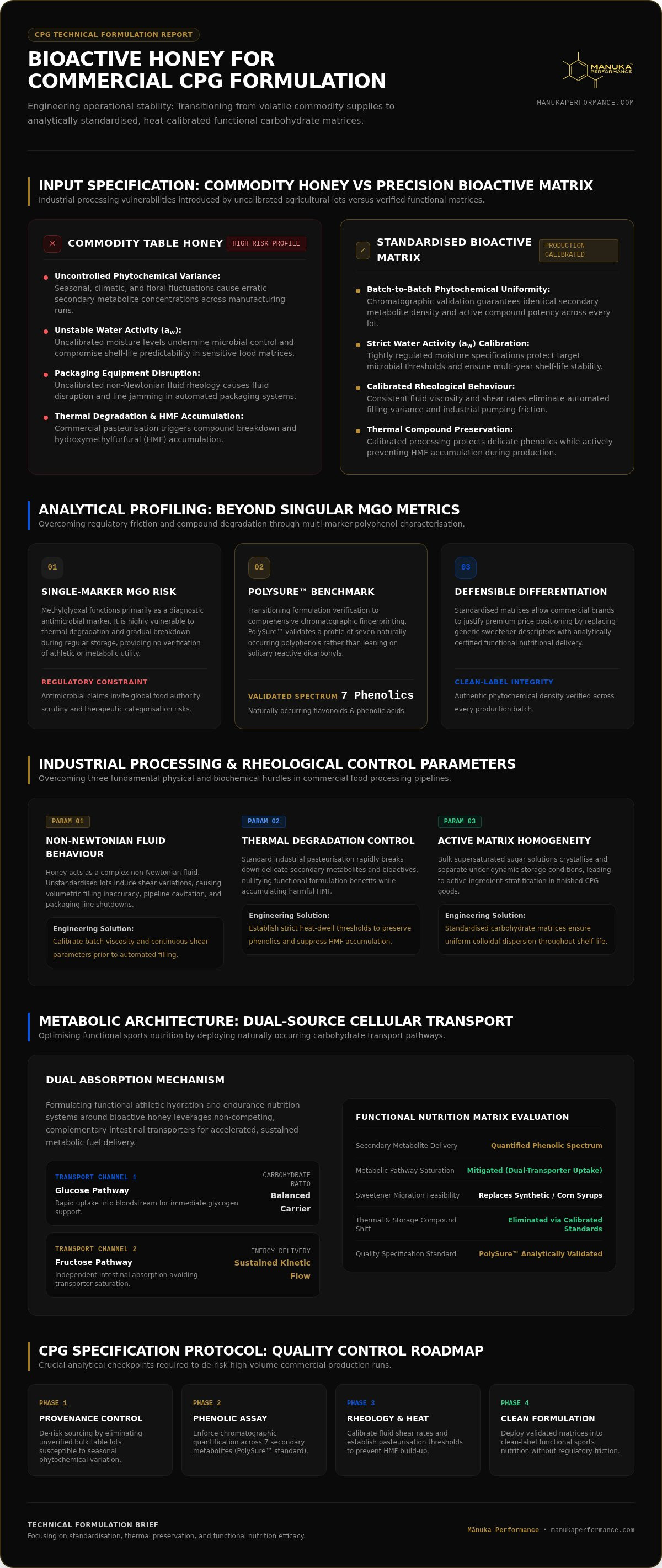
Commercial product formulators cannot treat functional apicultural inputs as interchangeable bulk commodities. Standard honey comprises a complex supersaturated solution of fructose and glucose, yet its secondary metabolite density fluctuates significantly based on floral provenance, seasonal climate, and extraction protocols. For developers integrating bioactive honey for CPG brands, moving beyond culinary table grades is essential; industrial formulation requires an analytically verified carbohydrate matrix featuring quantified phenolic compounds and verified stability rather than mere caloric sweetness.
The Functional Shift in Natural CPG Sweeteners
Industrial product development is experiencing a deliberate migration away from refined corn syrups and synthetic sweeteners toward functional carbohydrate sources. Consumer packaged goods sectors, particularly clean-label functional foods and premium athletic formulations, demand ingredients that deliver metabolic utility alongside simple energy provision. Bioactive honey addresses this requirement by delivering intrinsic phytochemical value, supplying naturally occurring phenolic acids and flavonoids within a balanced carbohydrate carrier. Verified analytical standardisation allows brands to capture consumer willingness to pay a premium for authenticated nutritional delivery, avoiding ambiguous natural sweetener descriptors.
Distinguishing Commodity Honey from Precision Bioactive Matrices
Precision bioactive matrices differ fundamentally from commodity supplies through comprehensive, batch-specific chemical profiling. Retail grade classifications and isolated single-marker ratings fail to address the technical demands of industrial manufacturing pipelines. These consumer-facing indices do not measure compound retention under thermal load, nor do they account for the broad spectrum of secondary metabolites responsible for functional performance.
Relying on standard agricultural table honey introduces acute risks to high-speed commercial production runs:
- Uncontrolled secondary metabolite variance: Agricultural lots display erratic phenolic concentrations that compromise target specification uniformity.
- Variable water activity (aw): Unstandardised moisture levels threaten microbial stability and target shelf-life predictions in moisture-sensitive food matrices.
- Post-processing degradation: Uncalibrated raw inputs degrade unpredictably when exposed to typical commercial blending and heat cycles.
Deploying standardised bioactive honey for CPG brands eliminates this volatility. Precise chromatographic quantification ensures that functional efficacy, structural rheology, and active phytochemical concentrations remain identical across every production batch.
Analytical Standards and Phytochemical Profiling: Beyond Simple MGO Metrics
Apicultural classification has historically prioritised methylglyoxal (MGO) or non-peroxide activity ratings engineered primarily for retail table consumption. In industrial food science, however, relying on a solitary reactive dicarbonyl compound offers negligible insight into systemic product stability or broader functional performance. Formulating bioactive honey for CPG brands requires an analytical pivot away from singular markers toward comprehensive phytochemical fingerprinting that documents the complete spectrum of functional compounds.
The Limitations of Single-Marker Testing for Functional Brands
Methylglyoxal functions reliably as a diagnostic antimicrobial marker, yet it exhibits acute susceptibility to thermal shifting and gradual degradation throughout conventional shelf storage. More importantly, isolated antimicrobial potency fails to translate into metabolic utility or athletic functional efficacy. From a governance standpoint, leaning heavily on antimicrobial grading invites regulatory friction; global food safety authorities prohibit therapeutic or medicinal assertions on standard commercial food labels. Single-marker dependencies expose brands to formulation volatility and legal vulnerability without verifying multi-pathway biological utility.
Quantifying Synergistic Polyphenol and Flavonoid Profiles
Efficacy in functional applications relies on the synergistic interactions between carbohydrates and complex secondary metabolites. Phenolic acids and flavonoids, such as pinobanksin, chrysin, and caffeic acid derivatives, govern matrix oxidative stability and cellular bioavailability. This multi-compound dynamic mirrors the ongoing advancement of sports nutrition biotechnology, which rejects crude agricultural inputs in favour of standardised molecular fractions. While basic phytochemical surveys on wikipedia.org confirm the presence of these diverse molecules, commercial production requires validated concentration thresholds rather than qualitative presence.
Establishing Validated Analytical Baselines for Commercial Batches
Securing formulation repeatability requires high-performance liquid chromatography (HPLC) and mass spectrometry profiling across all raw material intake runs. Setting rigid analytical baselines guarantees that bioactive honey for CPG brands maintains quantified active levels through processing shear and subsequent storage. Commercial procurement frameworks must demand verified certificates of analysis that document specific polyphenol retention rather than basic sugar ratios. For development teams establishing these rigorous protocols, integrating specialised research and biotech solutions provides the empirical verification needed to substantiate clean-label functional claims without running afoul of regulatory standards.
Technical Formulation Challenges: Rheology, Bioactive Preservation, and Thermal Processing
Bridging raw apicultural ingredients into continuous industrial manufacturing exposes significant process engineering friction. Standard flash pasteurisation protocols and high-shear mechanical blending rapidly denature delicate phenolic rings and thermolabile bioactives. For development teams formulating bioactive honey for CPG brands, unmonitored thermal processing triggers the rapid accumulation of hydroxymethylfurfural (HMF). This furanic compound serves as an empirical indicator of heat damage and carbohydrate degradation, signalling compromised functional integrity and diminished shelf stability.
Mitigating Thermal Degradation in Commercial Food Processing
Preserving secondary metabolite density requires precise time-temperature operational boundaries. Phenolic acids and complex flavonoid fractions exhibit rapid kinetic degradation when exposed to temperatures exceeding 45°C for extended periods. Codex Alimentarius standards benchmark maximum acceptable HMF concentrations at 40 mg/kg; thermal spikes in unjacketed industrial vessels easily surpass this ceiling, destroying sensitive active fractions in the process.
Commercial processors must transition to low-temperature indirect stabilisation, micro-filtration, and closed-loop aseptic batching. While basic thermodynamic references on wikipedia.org illustrate generic carbohydrate degradation kinetics, enterprise food manufacturing requires empirical in-line spectrophotometry. Establishing these checkpoints ensures finished SKUs maintain validated active profiles without exceeding regulatory HMF thresholds over commercial shelf life.
Navigating Viscosity and Rheological Behaviour in Automation
High-speed automated packaging machinery introduces mechanical stresses that standard honey inputs cannot predictably navigate. Honey functions as a complex fluid, displaying non-Newtonian flow anomalies and significant shear-thinning variance depending on floral source and temperature. In automated sachet, pouch, or tube filling runs running hundreds of units per minute, uncalibrated fluid resistance yields tailing, pouch seal contamination, and volumetric dosing drift.
Engineering a stable vehicle containing bioactive honey for CPG brands requires active rheology management:
- Shear-stress calibration: Formulators must calculate apparent viscosity across positive displacement pumps to prevent mechanical denaturation of suspended bioactives.
- Moisture equilibrium control: Maintaining exact water activity (typically aw below 0.60) prevents microbial proliferation while suppressing spontaneous glucose monohydrate nucleation.
- Thermal envelope maintenance: In-feed lines must operate within tight temperature bands (30°C to 35°C) to maintain fluid transfer rates without inducing thermal degradation.
Addressing these rheological hurdles at the bench stage ensures seamless mechanical scale-up on commercial co-packing lines.
Integrating Standardised Honey Bioactives into Functional Sports Nutrition and Clean-Label CPG Lines
Formulating high-performance energy products demands precise metabolic kinetics alongside clean-label verification. In endurance sports nutrition, synthetic maltodextrin and isolated fructose ratios dominate conventional formulations, yet these engineered sugars frequently trigger gastrointestinal distress under heavy physical strain. Utilising bioactive honey for CPG brands provides an unrefined, dual-action carbohydrate matrix that naturally mirrors the physiological absorption pathways required for steady glycogen replenishment without synthetic additives.
Harnessing Dual-Action Carbohydrate Delivery for Athletic Performance
Natural apicultural matrices naturally provide a balanced ratio of monosaccharides, engaging both sodium-glucose luminal transport (SGLT1) for glucose and GLUT5 facilitative transport for fructose. This parallel uptake pathway bypasses the intestinal transporter saturation that typically causes gastric cramping when single-source carbohydrates are ingested at scale. Research into whether natural honey-based energy gels outcompete synthetic syrups demonstrates significant improvements in gastric tolerance and sustained plasma glucose stability. Formulators exploring whether honey energy gels deliver measurable metabolic benefits find that retaining secondary phenolic metabolites protects cellular integrity under acute oxidative stress, providing distinct competitive differentiation over pure sugar fuels.
A Structured Protocol for Functional CPG Product Development
Translating natural botanical matrices into shelf-stable commercial formats requires a systematic, risk-managed progression from bench-top validation to enterprise packaging runs:
- Phase 1: Base Matrix Interaction Audit: Screen carrier ingredients, electrolytes, and natural flavour compounds for potential binding affinities that could precipitate or denature native phenolic complexes.
- Phase 2: Active Concentration Calibration: Define exact milligram-per-serving thresholds for targeted polyphenols, establishing raw material dosing based on quantified analytical inputs rather than crude honey volume.
- Phase 3: Post-Fill Recovery Validation: Perform chromatographic assays immediately following co-packing trials to measure compound recovery after mechanical pumping and thermal conditioning.
- Phase 4: Accelerated Degradation Modelling: Store finished SKUs under elevated real-time conditions (30°C to 40°C at 75% relative humidity) to track polyphenol retention, matrix syneresis, and HMF development across 24-month shelf-life horizons.
Compliance across Australasia demands that labels adhere strictly to Food Standards Australia New Zealand (FSANZ) Standard 1.2.7. Marketing teams must substantiate all functional carbohydrate and nutrient balance claims through empirical analytical testing while avoiding prohibited medicinal or therapeutic promises. When scaling your next performance line, explore Mānuka Performance formulation solutions to access empirically tested natural matrices built specifically for continuous packaging environments.
Commercialising Functional Formulations with PolySure™ Bioactive Ingredients
Establishing commercial viability for functional food lines requires transitioning from unstandardised raw inputs to verified, industrial-grade active ingredients. Deploying bioactive honey for CPG brands becomes operationally repeatable only when formulators can rely on defined chromatographic profiles. Mānuka Performance addresses this baseline vulnerability through its proprietary PolySure™ bioactive ingredients, bridging native New Zealand botanical provenance with rigorous analytical discipline.
The PolySure™ Analytical Benchmark for Finished Formulations
Rather than relying on singular markers that fluctuate with ambient storage, the PolySure™ analytical standard validates seven naturally occurring polyphenols within finished matrices. This multi-compound profile establishes rigorous specification controls, eliminating batch-to-batch variability across commercial supply runs. Formulators gain empirical assurance that each production lot delivers consistent secondary metabolite density.
Verifying concrete phenolic concentrations equips brand marketing teams with defensible, transparent compositional narratives. By quantifying distinct polyphenol fractions on technical specification sheets, product developers substantiate premium clean-label positioning without resorting to unauthorised therapeutic or medicinal claims.
Translating Advanced Biotechnology into Commercial CPG Success
Commercialising functional formulations requires seamless synergy between ingredient science and primary packaging design. Ambient distribution networks expose finished products to fluctuating temperatures and atmospheric oxygen, both of which accelerate phenolic degradation. Utilizing multi-layer barrier packaging, such as opaque foil-laminate sachets, protects light-sensitive flavonoids and prevents moisture migration that could otherwise destabilise the carbohydrate matrix.
Formulating innovative sports nutrition products and functional nutrition lines does not require brands to build apicultural biotechnology capabilities from scratch. Dedicated research and biotech solutions streamline commercialisation timelines by providing pre-validated bioactive matrices calibrated for continuous automated lines. By integrating standardised bioactive honey for CPG brands into your development pipeline, your technical team can bypass raw material unpredictability and bring verified, shelf-stable functional products to market with complete scientific authority.
Engineering Commercial Precision into Bioactive Formulations
Moving from erratic raw apicultural supplies to analytically standardised matrices represents the definitive pathway for enterprise food development. Successful industrial scaling requires strict thermal boundaries to prevent hydroxymethylfurfural accumulation, alongside proactive rheological calibration on high-speed automated packaging lines. Crucially, functional efficacy hinges on broad-spectrum phytochemical fingerprinting rather than isolated antimicrobial indices. Grounded in New Zealand biotechnology, the PolySure™ analytical standard validates seven naturally occurring functional polyphenols in finished matrices, establishing an empirical framework already proven in commercial sports nutrition lines like LiquidFuel running gels.
Formulating validated bioactive honey for CPG brands allows development teams to capture surging clean-label consumer demand while preserving uncompromised batch-to-batch consistency. Anchoring your ingredient pipeline in chromatographic certainty secures both regulatory compliance under Food Standards Australia New Zealand and defensible product differentiation. To accelerate your commercial development cycle with verified natural matrices, partner with Mānuka Performance to integrate PolySure™ bioactive ingredients into your product line.
Frequently Asked Questions
What defines a honey ingredient as genuinely bioactive for CPG functional product formulations?
Genuinely bioactive honey is defined by an analytically verified chemical matrix containing quantified concentrations of functional secondary metabolites. Rather than relying on generic bulk sweetness or culinary grading, bioactive honey for CPG brands provides documented thresholds of phenolic acids, flavonoids, and active enzymes. This verifiable phytochemical consistency ensures the ingredient delivers repeatable physiological function and matrix stability across industrial production runs without degrading into inert calories.
How does the PolySure™ analytical standard differ from traditional UMF or MGO grading systems?
The PolySure™ analytical standard differs by validating seven naturally occurring functional polyphenols rather than quantifying a solitary reactive marker like methylglyoxal (MGO). Traditional consumer jar metrics measure isolated non-peroxide activity, which frequently degrades under heat and offers narrow therapeutic correlation. PolySure™ instead establishes a multi-compound fingerprint optimised for commercial stability, ensuring the broad-spectrum phytochemical matrix remains biologically intact throughout industrial processing and product shelf life.
Can bioactive honey withstand standard commercial pasteurisation and high-speed packaging processes?
Standard industrial pasteurisation and aggressive mechanical shear denature delicate secondary metabolites, accelerating hydroxymethylfurfural (HMF) accumulation beyond acceptable regulatory limits. Preserving active fractions requires low-temperature stabilisation techniques, indirect thermal jackets operating below 45°C, and closed-loop aseptic handling. When formulating bioactive honey for CPG brands, line engineers must also account for non-Newtonian fluid rheology to ensure clean volumetric dosing across automated sachet and pouch lines without causing tailing or seal failures.
How does the naturally occurring carbohydrate matrix in honey compare to synthetic sports nutrition sugars?
Natural honey provides an unrefined, dual-source carbohydrate matrix composed of roughly equal parts glucose and fructose, whereas conventional fuels rely on synthetic maltodextrin. This natural dual ratio engages both SGLT1 and GLUT5 intestinal transporter mechanisms simultaneously, dramatically increasing carbohydrate absorption capacity while reducing gastrointestinal distress. The matrix also carries native polyphenols and organic acids, delivering clean-label metabolic functionality that isolated corn-derived syrups cannot replicate.
What analytical testing is required to verify that functional bioactives survive finished product shelf life?
Verifying active retention requires high-performance liquid chromatography (HPLC) paired with mass spectrometry to quantify target phenolic markers immediately post-fill and across storage timepoints. Technical teams conduct accelerated stability trials under elevated temperature and humidity conditions, monitoring compound recovery rates alongside moisture activity and HMF generation. Establishing these empirical analytical baselines confirms that target bioactives remain functionally viable over commercial ambient distribution cycles.
How can CPG brands substantiate product marketing without breaching FSANZ regulatory health claim guidelines?
Brands must base marketing claims on empirical compositional data and general level nutrient profiling under Food Standards Australia New Zealand (FSANZ) Standard 1.2.7. Product teams can legally quantify validated polyphenol milligrams and highlight dual-source carbohydrate absorption kinetics. Defensible differentiation comes from transparently communicating analytically certified chemical standards rather than attempting to assert unapproved therapeutic, medicinal, or disease-prevention claims on commercial packaging.
Why is New Zealand monofloral honey considered the benchmark starting material for bioactive extraction?
New Zealand monofloral honey provides an exceptionally rich, repeatable baseline of secondary botanical metabolites developed through unique native floral adaptations. Stringent national export controls and rigorous chemical definition requirements ensure unadulterated botanical provenance and baseline chemical integrity. This documented provenance provides industrial formulators with the ideal, high-potency raw matrix required to extract, standardise, and scale stable bioactive ingredients for global functional markets.