


What if an ingredient passes an assay, but the result still leaves the central question unanswered: does the evidence support the claim being made? For teams assessing validated nutraceutical ingredients, terms such as “validated”, “standardised” and “clinically proven” can sound interchangeable, even though they describe different kinds of evidence.
That distinction matters. A certificate or laboratory result may confirm identity or quantify selected compounds, but it does not by itself establish efficacy or show that the same composition remains in the finished formulation. A sound assessment depends on what was measured, how the method was applied and whether the evidence relates to the intended product and communication. For New Zealand businesses, technical data should be interpreted in the context of the formulation and applicable requirements, rather than treated as a label that settles every question.
This article sets out a practical framework for assessing ingredient identity, composition, analytical methods and evidence. It clarifies what assays, certificates and finished-product testing can show, and where their limits lie. It also considers PolySure™ as a New Zealand example: its analytical standard validates seven naturally occurring polyphenols in the finished product. The aim is to support precise formulation decisions and responsible communication, without mistaking measurement for proof of performance.
Key Takeaways
- Assess validated nutraceutical ingredients across identity, method suitability, quantified composition and finished-product verification, rather than relying on a single test or label.
- Distinguish what an assay, stability result or human study can support from what it cannot establish, especially when considering efficacy claims.
- Check whether analytical methods, reference materials, sample handling and batch details are relevant to the ingredient and formulation being assessed.
- Use a due-diligence checklist to compare the available evidence with the intended use and finished-product matrix before making formulation or communication decisions.
- PolySure™ applies product-level analysis by validating seven naturally occurring polyphenols in the finished product, without treating measurement as proof of performance.
What Makes a Nutraceutical Ingredient Validated?
“Validated” can sound like a broad endorsement, but it is more useful as a specific evidential claim. In this article, a validated nutraceutical ingredient is one for which appropriate evidence supports its identity and composition, and shows that the analytical method is suitable for measuring the properties being reported. This is a practical definition, not a universal regulatory designation or proof of efficacy.
The terminology needs care because “nutraceutical” is not a consistently defined legal category worldwide. Nutraceutical provides a general description of the term and its varied use. The category name alone cannot tell you what evidence a particular ingredient or claim requires.
Validation, standardisation and testing are not interchangeable
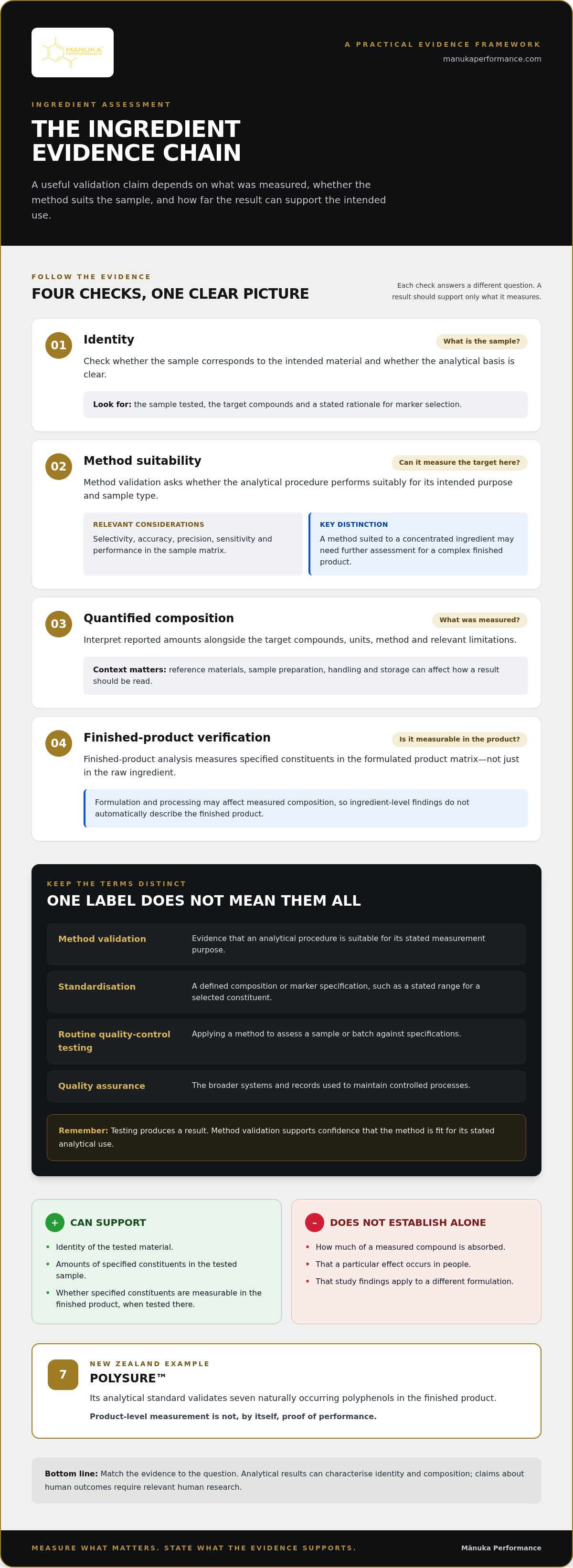
Method validation asks whether an analytical procedure performs suitably for its intended purpose. Depending on the measurement, relevant considerations may include selectivity, accuracy, precision, sensitivity and performance in the sample matrix. A method suitable for identifying a compound in a concentrated ingredient may not be suitable for quantifying it in a complex finished product without further assessment.
Standardisation sets a defined composition or marker specification, such as a stated range for a selected constituent. It describes what a material is expected to meet; it does not, by itself, show that the test method can measure that constituent reliably. Routine quality-control testing applies a method to assess a sample or batch against specifications. Testing produces a result, while method validation provides evidence that the method is fit for its stated analytical use. Quality assurance is broader still: it covers the systems and records used to maintain controlled processes.
What ingredient validation can, and cannot, show
Analytical evidence can support an ingredient’s identity and quantify specified constituents in the tested sample. Its strength depends on details such as reference materials, sample preparation, method performance and whether the sample represents the ingredient or product being discussed. A reported value without that context can be difficult to interpret or compare.
Composition data have limits. They do not alone establish how much of a measured compound is absorbed, whether it produces a particular effect in people, or whether findings from a study apply to a different formulation. Those questions require different evidence, including relevant human research when claims concern human outcomes. Read a certificate, assay or standardised specification as support for the point it measures, not as automatic substantiation of efficacy or a health benefit.
In practice, assess validated nutraceutical ingredients through a chain of evidence: what the material is, what was measured, whether the method suits that measurement, and how far the result can reasonably support the intended use and communication.
How Validated Nutraceutical Ingredients Build an Evidence Chain
Evidence is most useful when each analytical step answers a defined question and its result is not asked to support more than it measures. For validated nutraceutical ingredients, the assessment moves from confirming identity to checking method suitability, quantifying selected constituents and determining what remains measurable in the finished product.
- Identity: Does the sample correspond to the intended material?
- Method suitability: Can the chosen procedure reliably assess the target in this sample type?
- Quantified composition: Which constituents were measured, and how were their amounts reported?
- Finished-product verification: Are those constituents measurable in the formulated product?
Citation-ready distinction: Ingredient-level analysis characterises a raw material or ingredient sample, whereas finished-product analysis measures specified constituents in the formulated product matrix.
From ingredient identity to quantified composition
Identity testing helps distinguish the intended material from a substitution or a sample that differs from its expected profile. Interpret the result in light of its analytical basis: marker selection should have a stated rationale, and the report should identify the sample, target compounds, method, units and relevant limitations. A measured marker may help characterise an ingredient, but it is not a complete description of every constituent.
Sample handling matters too. Storage, preparation and handling can affect what reaches the instrument, while suitable reference materials help anchor identification or quantification. A clear report states what was tested and the relevant analytical conditions, so readers can judge whether the findings apply to their question.
Why finished-product analysis adds another layer
Formulation and processing may affect an ingredient’s measured composition, and the product matrix can influence method performance. Results therefore depend on the sample, instrument, analytical procedure and stated purpose. An ingredient specification cannot automatically stand in for a measurement of the finished formulation; that measurement requires a method appropriate to the product matrix.
PolySure™ provides a New Zealand example of this product-level approach: its analytical standard validates seven naturally occurring polyphenols in the finished product. This links measurement of defined compounds to the formulated sample, without implying a health benefit or proving performance outcomes. The distinction between analytical evidence and regulatory requirements also depends on jurisdiction. The FDA overview of dietary supplements describes the U.S. context and should not be read as New Zealand guidance.
For a practical example of research-led analytical work, explore Mānuka Performance’s biotech solutions.
How to Compare Ingredient Validation Evidence Without Overclaiming
Evidence types answer different questions, so they should not be treated as interchangeable levels of a single quality score. A validated analytical method shows that a procedure is suitable for its stated measurement purpose; it does not prove that an ingredient produces a particular effect. When assessing validated nutraceutical ingredients, ask what each result supports and where its evidential limits lie.
| Evidence type | What it can support | What it cannot establish alone |
|---|---|---|
| Identity evidence | That the tested sample is consistent with the specified ingredient or material. | The full composition, stability or effect of the ingredient in people. |
| Compositional assay | The measured amount of named constituents in the sample, within the method’s scope. | Absorption, biological activity or a human outcome. |
| Stability data | How specified constituents changed under the tested storage or processing conditions and at the time points assessed. | Stability under conditions that were not studied, or efficacy. |
| Human research | Findings for the ingredient or formulation, dose, population and outcomes actually studied. | Automatic transfer of those findings to different products, doses or populations. |
Read the certificate within its scope
A certificate of analysis or specification is most useful when it identifies the sample or batch, analytes, units, analytical method and acceptance criteria, where reported. Consider when the sample was taken and tested: the result relates to the tested material at that point, not necessarily every batch or a later-stage formulation. A certificate is only as informative as its scope and the method behind it. A pass against a specification is not proof of broader quality or efficacy.
Separate analytical evidence from efficacy evidence
Composition measurements describe what was detected or quantified; biological or human research addresses different questions. Citation-ready distinction: A measured composition establishes the presence or amount of specified constituents in a tested sample, whereas a biological effect requires evidence that directly evaluates that effect.
Relevance depends on whether research concerns the same ingredient and formulation, a comparable dose, an appropriate population and the outcome behind the proposed claim. In-vitro findings can inform investigation, but they do not by themselves demonstrate a human outcome. Keep communication aligned with the evidence: describe what was measured, identify what was studied, and avoid turning an assay result into a consumer health promise.
A Practical Due-Diligence Framework for Ingredient Selection
Use a documented review to decide whether the available evidence fits both the ingredient and the product being developed. For validated nutraceutical ingredients, the goal is not to collect the largest number of certificates. It is to identify what each document supports, where its limits lie and whether important questions remain unanswered.
Questions for assessing technical documentation
- Identity: Does the documentation clearly identify the ingredient and the sample tested?
- Composition: Are the measured compounds named, with units and any relevant specification or acceptance criteria?
- Method: Is the analytical method described, including its intended purpose and suitability for the sample type?
- Batch context: Can you tell which batch or sample the results relate to, and when it was tested?
- Interpretation: Are the test scope and limitations clear, so results are not extended beyond what was measured?
Gaps in a certificate or technical file are evidence gaps, not proof that an ingredient is ineffective. Record what is missing, assess whether it affects the decision and avoid filling gaps with assumptions. A robust due-diligence record traces each conclusion back to the specific evidence that supports it.
Match evidence to the formulation and intended use
Ingredient data may not represent a finished product. Compare the test material with the proposed formulation, considering the product matrix and relevant processing and storage conditions. An ingredient-stage result answers a different question from a measurement taken after formulation. Consider stability and finished-product verification separately.
Then assess whether the evidence relates to the intended use and the way the product will be described. Review proposed claims against current New Zealand requirements using authoritative, up-to-date guidance, and ensure the wording does not go beyond what the evidence and applicable rules support. Regulatory frameworks differ between markets, so overseas guidance should not be assumed to determine New Zealand obligations.
For broader context on how research and formulation approaches are shaping the category, read this sports nutrition biotechnology overview. Mānuka Performance’s bioactive ingredient and biotech work applies a research-driven approach to this field.
How Mānuka Performance Applies Validation to Bioactive Ingredients
Mānuka Performance is a New Zealand functional nutrition and biotech company that applies analytical science to the phytochemical composition of New Zealand honey. Its work connects defined compositional measurements with analysis of finished products, while keeping the scope of those findings clear.
PolySure™ as a finished-product measurement example
PolySure™ is an analytical standard that validates seven naturally occurring polyphenols in the finished product. Its focus is specific: measuring defined compounds in the formulated product, rather than assuming ingredient-level data automatically describe what is present after formulation.
This product-level perspective complements ingredient specifications. Ingredient analysis characterises the material tested, while finished-product analysis addresses whether selected compounds can be measured in the product matrix. Together, they provide distinct pieces of compositional evidence. Neither, by itself, demonstrates a therapeutic effect, health benefit or performance outcome.
A honey-based energy gel provides a product-context example for considering analytical questions alongside a formulated sports nutrition product, without treating composition as a substitute for evidence of outcomes.
Taking the next step from evidence to application
Technical teams can apply this framework by making each formulation discussion precise: identify the material and compounds of interest, establish what the available method measures, review the sample and batch context, then consider whether product-level testing is relevant to the intended formulation. This makes evidence gaps visible and keeps conclusions proportionate to the data, rather than allowing a specification or assay to support claims it was not designed to substantiate.
Mānuka Performance’s research-driven biotech solutions and PolySure™ bioactive ingredients apply this analytical approach in practice. As with other validated nutraceutical ingredients, the value of the evidence lies in understanding what it measures and how it can inform formulation work, not in implying an untested outcome.
Explore Mānuka Performance to learn more about its research and biotech solutions.
Make Evidence a Practical Part of Your Next Formulation Decision
Assessing validated nutraceutical ingredients means looking beyond a label or a single certificate. Start with evidence for identity, then examine whether the analytical method suits its purpose, what composition it measures and whether results apply to the finished formulation. Each type of evidence has limits: measured constituents can inform formulation decisions, but do not by themselves demonstrate a biological effect or human outcome.
Mānuka Performance brings this product-level perspective to its bioactive ingredients and research-driven biotech solutions. Its PolySure™ analytical standard validates seven naturally occurring polyphenols in the finished product, providing a defined example of compositional measurement without implying therapeutic or health outcomes.
Use the framework in this article to make technical discussions more precise: connect each conclusion to the evidence that supports it, identify what remains unknown and keep product communication within substantiated boundaries. A measured, methodical approach gives teams a clearer foundation for responsible formulation work.
Explore Mānuka Performance’s research-driven ingredient solutions to learn more about its bioactive ingredients and biotech work.
Frequently Asked Questions
What does validated mean for a nutraceutical ingredient?
For a nutraceutical ingredient, “validated” means evidence supports its identity or composition and shows that an analytical method is suitable for its stated measurement purpose. It is not a universal regulatory status or a guarantee of overall quality. Review what material was tested, which constituents were measured and whether the method suits the sample. The term should describe the evidence available, not imply that every property or outcome has been established.
Does a validated ingredient mean it is clinically proven?
No. Analytical validation concerns a method’s suitability for measuring or identifying specified properties; clinical substantiation concerns evidence of outcomes in people. A validated assay may support the identity or quantity of a compound, but it does not show that the ingredient produces a particular human outcome. To assess clinical evidence, consider whether studies examine the same ingredient, formulation, dose, population and outcome relevant to the proposed claim.
What should a certificate of analysis include for a nutraceutical ingredient?
A useful certificate of analysis identifies the tested sample or batch, analytes, units, method and results, along with applicable specifications or acceptance criteria where reported. The test date and sample context help explain what the result represents. A certificate may not contain every detail about method performance, so interpret it within its stated scope. A result for selected compounds does not establish unmeasured properties or outcomes.
How can you tell whether an ingredient test is reliable?
Assess whether the method is appropriate for the ingredient and sample matrix, and whether the documentation explains the targets, sample preparation, reference materials and reporting units. Method performance information, such as accuracy and precision where relevant, helps show how results should be interpreted. Check that the report identifies the sample tested and the method’s purpose. Without this context, a result may be difficult to compare or apply to another formulation.
Why test a finished product if the ingredient has already been tested?
Ingredient testing characterises the sample tested before formulation; it does not automatically show what can be measured in the finished product. Processing, storage and interactions with the product matrix may affect measured composition or method performance. Product-level analysis answers a separate question by testing specified constituents in the formulated sample. For example, Mānuka Performance’s PolySure™ analytical standard validates seven naturally occurring polyphenols in the finished product.
Can polyphenol content prove that a nutraceutical works?
No. A polyphenol measurement can indicate the amount of specified compounds detected in the tested sample, within the method’s scope. It does not by itself demonstrate absorption, biological activity or an outcome in people. Those questions need relevant evidence designed to assess them, including human research where a claim concerns human outcomes. Keep conclusions proportionate: report what was measured and avoid presenting composition data as proof of a benefit.