


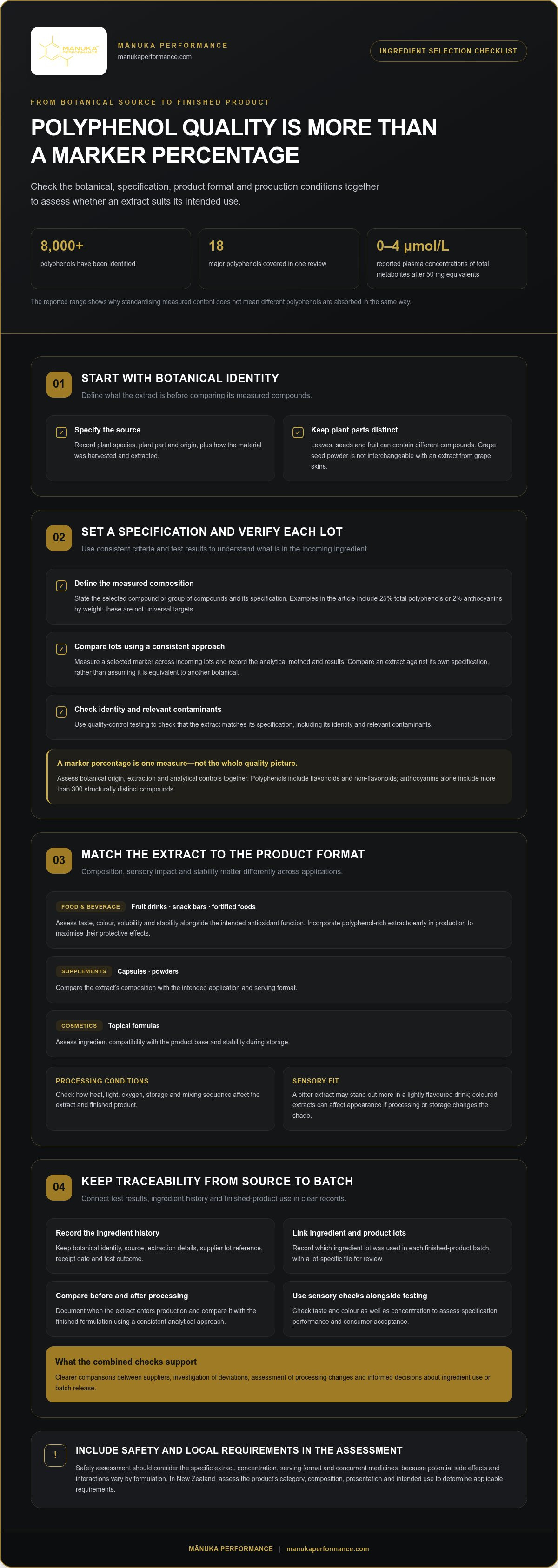
Standardisation can make the measured polyphenol content of an ingredient more consistent, but it doesn’t mean different polyphenols will be absorbed in the same way. More than 8,000 polyphenols have been identified, and a review of 18 major polyphenols reported plasma concentrations of total metabolites ranging from 0 to 4 μmol/L after an intake of 50 mg equivalents. The choice of standardised polyphenol ingredients therefore involves more than comparing a marker percentage.
When developing a food, beverage or supplement, botanical origin and a defined specification are essential starting points. Processing, formulation and the properties of individual compounds also affect how an ingredient performs in its intended application.
This article explains how sourcing and quality controls support consistency, why bioavailability varies, and what to consider when selecting polyphenols for different product formats. It also shows how analytical measurement connects ingredient specifications with finished-product composition, supporting clearer formulation decisions.
Key Takeaways
- Match an extract’s botanical profile and functional properties to the food, beverage or supplement format, and account for how processing may affect it.
- Use consistent specifications and traceability records to compare batches and follow an ingredient from its source through production.
- Assess botanical origin, extraction and analytical controls together; a marker percentage alone cannot describe every quality consideration.
- Consider each polyphenol’s absorption and metabolism when making formulation decisions, rather than assuming compounds behave alike.
Food, beverage, supplement and cosmetic applications
Application depends on an extract’s composition, product format and processing conditions. More than 8,000 polyphenols have been identified, so the relevant compounds matter.
Food and beverage applications
Food and beverage manufacturers can incorporate extracts into products such as fruit drinks, snack bars and fortified foods. Assess taste, colour, solubility and stability alongside the ingredient’s intended antioxidant function. Incorporate polyphenol-rich extracts early in production to maximise their protective effects. Then evaluate how heat, light, oxygen and storage conditions affect the finished product’s sensory qualities and composition.
Supplement and cosmetic applications
Supplements may contain selected botanical extracts in formats such as capsules or powders, while cosmetics may use suitable ingredients in topical formulas. When developing commercial dietary formulations from botanical extracts, working with a specialist contract partner like Vita Manufacture can help maintain production consistency and product standards. For nutraceuticals, compare the extract’s composition with the intended application and serving format. For cosmetics, assess compatibility with the product base and stability during storage. Clean-label objectives can also guide botanical selection and ingredient descriptions, keeping formulation choices aligned with the product’s intended positioning.
Active-compound levels and safety considerations
Grape seed and anthocyanin-rich extracts are examples of polyphenol ingredients. A specification may state 25% total polyphenols or 2% anthocyanins by weight; these examples are not universal targets. Polyphenols fall into two categories, flavonoids and non-flavonoids, while anthocyanins include more than 300 structurally distinct compounds. Safety assessment should consider the specific extract, concentration, serving format and concurrent medicines, since potential side effects and interactions vary by formulation.
Application segmentation helps organise decisions across food, beverage, supplement and cosmetic products. Assess sensory impact, stability and processing sequence for each format before choosing an extract. The 18th World Congress on Polyphenols Applications was scheduled for October 2-3, 2025, as part of wider discussion of these application areas.
Research also examined biological effects: rats were fed diets supplemented with 5% grape seed extract for six weeks, and a study identified 13 proteins altered in adult female rats’ brains.
Batch-to-batch consistency and traceability
Batch consistency means each production lot meets the same defined composition and quality criteria. Compare a selected marker’s concentration across incoming extract lots, and record the analytical method and results. For example, assess a grape-derived extract against its own specification rather than assuming it is equivalent to another botanical. This gives formulation teams evidence to evaluate variation and decide whether a lot suits its intended use.
Traceability links test results to a material’s history. Record the botanical identity, source, extraction details, supplier lot reference, receipt date and test outcome. Link each ingredient lot to the finished-product batch in which it was used. If a change in flavour or colour is reported, these records help teams trace the relevant production inputs and take proportionate action.
Processing can alter an extract’s composition or behaviour in a finished formula. During product development, document when the ingredient enters the process and assess relevant conditions, including heat exposure, oxygen contact and mixing sequence. Compare the extract before processing with the finished formulation using a consistent analytical approach. This helps distinguish variation in the sourced material from changes introduced during manufacturing.
Taste and colour matter, particularly in beverages, bars and powders. A bitter botanical extract may be more noticeable in a lightly flavoured drink than in a strongly flavoured product. Coloured extracts can affect a beverage’s appearance, especially if processing or storage changes the shade. Sensory checks alongside concentration testing help teams assess both specification performance and consumer acceptance.
For regulatory review, maintain records supporting ingredient identity, composition and batch history. Organise them into a lot-specific file to compare suppliers, investigate deviations and retain evidence for future formulations. A clear traceability process turns test results into practical decisions about ingredient use, processing controls or batch release.
Botanical sourcing and quality control
Botanical identity is the starting point for a reliable polyphenol profile. Specify the plant species, plant part and origin, and document how the material was harvested and extracted. These details matter because leaves, seeds and fruit can contain different compounds. For example, grape seed powder should not be treated as interchangeable with an extract from grape skins.
Quality control determines whether an extract matches its specification. Analytical methods can measure selected compounds, such as a flavonoid marker, and compare results across incoming lots. Testing should also address identity and relevant contaminants. For beverages, confirm that the selected powder disperses appropriately and retains its intended composition during processing and storage.
In New Zealand, assess a product’s category, composition, presentation and intended use to determine applicable requirements. Establish the category before finalising the ingredient, label wording or product claims, as these factors shape the relevant regulatory assessment.
Standardisation defines a measured compound or group of compounds against the extract’s weight. For example, 25% total polyphenols by weight means the measured total represents one quarter of the extract’s weight; 2% anthocyanins means anthocyanins represent two hundredths. These are specification examples, not universal targets. The chosen profile should suit the botanical and formulation.
Businesses can source standardised extracts through ingredient supply chains serving New Zealand manufacturers, using a specification to define the required botanical and analytical profile. Consumers generally encounter these ingredients within finished foods or supplements, rather than as bulk formulation materials, with brands such as Organic Fuel formulating organic herbal extracts into finished supplements for energy and vitality. A practical sourcing sequence is to define the application, identify the required compounds, and align supplier documentation with the finished product’s quality controls.
Differences in polyphenol bioavailability
A standardised concentration describes what an extract contains, not how much the body absorbs. Polyphenols differ in solubility, digestion, metabolism and elimination. Anthocyanins and resveratrol, for example, can produce distinct exposure profiles even when their measured amounts are comparable. For functional formulations, distinguish analytical composition from bioavailability when selecting ingredients.
A review examined bioavailability data for 18 major polyphenols across 97 studies. After an intake of 50 mg equivalents, plasma concentrations of total metabolites ranged from 0 to 4 μmol/L. Relative urinary excretion ranged from 0.3% to 43% of the ingested dose, depending on the polyphenol. These findings illustrate substantial variation, not a single expected response for every extract or consumer.
Metabolism helps explain that spread. The body can transform compounds during digestion and after absorption, while food matrices and formulation characteristics may influence exposure. In C57BL mice, piperine increased resveratrol exposure, measured by area under the curve, by 229%. It increased resveratrol’s maximum serum concentration by 1,544%. These animal findings do not establish equivalent effects in people.
When assessing clinical evidence, distinguish absorption measures from health outcomes. A measured plasma metabolite can indicate exposure, but does not by itself demonstrate clinical benefit. Evidence for a health claim needs to relate to the specific ingredient, dose, population and outcome. Evaluate proprietary delivery or metabolic innovations against relevant human evidence, rather than inferring effects from an analytical marker alone.
In practice, compare the intended use with evidence for the same polyphenol and formulation. Check whether studies measured the parent compound, metabolites or a biological outcome, and whether results came from human or animal research. This distinction supports more precise ingredient decisions and responsible interpretation of evidence.
Explore polyphenol ingredient applications to consider how measured compound profiles can inform functional formulation work.
Mānuka Performance: Natural, clean label honey based sports energy gels
Mānuka Performance offers natural, clean label honey based sports energy gels for runners and endurance athletes seeking convenient carbohydrate fuel. Its flagship LiquidFuel 10-Pack Running Gel uses a New Zealand honey-based matrix, while the company’s CPG Sports Nutrition Products connect ingredient choices with finished-product applications.
For formulation work where measured polyphenol composition matters, Mānuka Performance’s PolySure™ Bioactive Ingredients provide an analytical standard that validates seven naturally occurring polyphenols in the finished product. This offers a practical reference for relating ingredient specifications to finished-product analysis. Mānuka Performance also offers Research & Biotech Solutions at the intersection of natural ingredients and analytical science.
To discuss an application or explore these offerings, contact Mānuka Performance or visit manukaperformance.com.
Turn ingredient criteria into a formulation direction
Translate ingredient selection criteria into a clear formulation brief. Define the product format, the botanical extract’s role, the composition to measure and the evidence relevant to the intended application. This gives development decisions a practical foundation while keeping ingredient analysis distinct from claims about product outcomes. For sports nutrition, Mānuka Performance offers natural, clean-label honey-based energy gels, CPG sports nutrition products and PolySure™ Bioactive Ingredients.
Whether refining a finished formula or exploring an ingredient concept, align analytical priorities with the product’s purpose and production context. A focused discussion can identify where composition measurement fits, without treating a specification as a substitute for application-specific evidence. This is a useful next step for teams considering standardised polyphenol ingredients in food or supplement development.
Contact Mānuka Performance to discuss your formulation direction and take the next step with clarity.
Frequently Asked Questions
What are standardised polyphenol ingredients?
Standardised polyphenol ingredients are botanical materials manufactured to meet a defined specification for selected compounds. The specification may identify a marker, its measurement method and an acceptance range for production lots. For procurement, compare these details with the finished product’s analytical requirements. A standardisation claim describes composition under a specified test; by itself, it does not establish absorption or a particular effect.
Which plant sources and polyphenol types are commonly used in standardised ingredients?
Examples include green tea extracts associated with catechins, grape seed extracts containing proanthocyanidins, turmeric extracts with curcuminoids, and berry-derived extracts rich in anthocyanins. These ingredients have different chemical profiles and formulation characteristics. Match the plant part and named compounds to the intended product rather than relying on a broad botanical name alone. The specification should state what the extract’s marker represents.
How do standardised polyphenol ingredients compare by evidence, bioavailability, and intended use?
Compare ingredients by matching the evidence to the exact extract, formulation and intended application. A study of one botanical preparation may not describe another preparation from the same plant. Review what researchers measured, such as circulating metabolites or a defined product outcome, and whether the study involved people or laboratory models. This distinguishes evidence of exposure from evidence relevant to the product’s intended use.
How can buyers assess quality, purity, testing, and supplier certificates for polyphenol ingredients?
Review the botanical identity, marker result, analytical method and reported tests for relevant contaminants or residual solvents. Traceability records should link the lot to its source and processing history. A certificate documents stated test results; by itself, it does not prove clinical performance or regulatory approval.