


A professional athlete’s nutrition plan is not a supplement stack. It’s a periodised system shaped by training, competition and recovery demands. Effective sports nutrition for professional athletes starts with everyday eating, then adjusts fuelling choices to match the work required, rather than relying on a generic plan or a shelf of products.
Conflicting advice can make it difficult to distinguish established practice from marketing, particularly when recommendations don’t reflect an athlete’s sport, training load or competition schedule. The practical question is how to organise nutrition around those demands and make informed product choices. This article covers the foundations of athlete nutrition and how to align daily eating and fuelling with professional sport.
You’ll learn which strategies can be considered broadly and which call for individual assessment, as well as how to evaluate sports products critically. Carbohydrate formats such as honey-based gels may have a place in a tested fuelling plan, but they’re one option, not a complete nutrition strategy.
Key Takeaways
- Build sports nutrition for professional athletes around the demands of each training session. Coordinate carbohydrate, protein and fluid choices rather than relying on a fixed template.
- Use food as the foundation of your eating pattern, then assess whether a sports product or supplement has a clear purpose, suitable evidence and an appropriate risk profile.
- Refine your plan through a practical cycle: assess demands, set priorities, plan, trial choices in training and review what works.
- Use your training schedule and competition calendar to distinguish everyday fuelling from event-specific preparation, and test choices before competition.
- Honey-based gels, including Mānuka Performance’s LiquidFuel 10-Pack Running Gel, are one possible carbohydrate-fuelling format. Consider product composition and personal tolerance within your tested plan.
What sports nutrition for professional athletes needs to achieve
Professional sport places changing demands on the body, so nutrition needs to reflect the work an athlete is doing. Sports nutrition is a plan for coordinating food, fluids and timing with training and competition, not a list of foods to eat or products to buy. A Sports nutrition overview introduces foundational concepts such as macronutrients and hydration. Applying them in practice means considering the individual athlete and their sporting context.
Performance fuelling and general healthy eating are not competing priorities. Everyday food choices can support training while contributing to a varied, balanced eating pattern. The emphasis may shift across a season, but the aim is to integrate performance demands with broader wellbeing rather than pursue a narrow fuelling strategy in isolation.
The purpose of athlete nutrition is to match food, fluids and timing to sporting demands while supporting a consistent, sustainable eating pattern.
How sport and training demands shape nutrition needs
Different sports place different demands on fuelling. Endurance athletes may need to plan for prolonged activity; team-sport athletes may account for repeated high-intensity efforts and variable match schedules. Strength sports involve structured resistance training, while weight-category sports can bring additional considerations around body mass and competition preparation. These are broad distinctions, not prescriptions: athletes in the same sport can have different needs.
Training volume and intensity, the number and timing of competitions, and the phase of the season all influence how a plan is organised. An athlete’s body size, usual eating pattern, preferences and individual circumstances matter too. A heavy training block may call for a different approach from a lighter period or competition week. One universal diet or fuelling target cannot suit every professional athlete.
Performance, health and consistency belong in one plan
A useful plan connects routine meals and snacks with the training schedule, while allowing for practical demands such as travel, early sessions and competition timing. Consistency helps athletes organise eating across training, competition and recovery, instead of making decisions only on event day. The specific choices still need to suit the person, sport and schedule.
For athletes managing complex training demands, dietary restrictions, changing body-composition goals or other individual considerations, support from a qualified sports dietitian can help turn general principles into an appropriate plan. This can be particularly valuable when changes need to fit both the sporting programme and the athlete’s wider nutritional needs.
How professional athletes coordinate carbohydrates, protein and hydration
Carbohydrates, protein and fluids have distinct roles in an athlete’s eating plan, but their practical importance shifts with the session. Carbohydrates are a key fuel source during demanding exercise; how much and when to include them depends on factors such as workload, duration and intensity. Protein can be included through ordinary meals and snacks, while fluid intake needs to account for the conditions and the athlete’s response. These foundations matter more than adding products by default.
For evidence-informed discussion of exercise fuelling and hydration, athletes can consult resources from the Gatorade Sports Science Institute. Recommendations still need to be interpreted in context. Set individual quantities or targets using current sport-specific guidance rather than copying a generic plan.
Match carbohydrate availability to the training session
Before exercise, a familiar meal or snack can form part of the day’s fuelling plan. During a demanding or extended session, an athlete may find an additional carbohydrate source useful. For a shorter or less intense session, the same approach may not be necessary. After exercise, routine meals can help integrate carbohydrate and other nutrients into the broader eating pattern. The details depend on the session and the next training or competition commitment.
For event-specific considerations, see this carbohydrate loading plan for endurance athletes. Practise any strategy in training and tailor it to the event, rather than introducing it for the first time on competition day.
Integrate protein, fluids and recovery routines
Protein can come from varied everyday foods, such as dairy foods, eggs, legumes, tofu, fish, meat, nuts and seeds, selected to suit an athlete’s preferences and overall eating pattern. Including protein-containing foods across the day is a practical foundation; a supplement isn’t automatically required. Assess the full routine, including meals and snacks around training, rather than judging any single product in isolation.
Fluid needs also vary. Session duration, environmental conditions, access to drinks and an athlete’s own response all influence planning, so a fixed instruction to drink the same amount in every situation is inappropriate. Athletes can observe how their approach works across training and seek individual advice where needed. If recurring gut symptoms affect fuelling, the scientific guide to runners’ stomach issues offers further context. Persistent concerns warrant discussion with a qualified health professional.
For runners and endurance athletes assessing carbohydrate options, honey-based sports energy gels are one format to consider within a tested plan. Explore Mānuka Performance’s honey-based sports products as one product option, and check the label and your personal tolerance before use.
Are sports supplements necessary for professional athletes? Assess evidence and risk
Professional sport doesn’t automatically require a large supplement stack. A food-first approach provides the foundation; a purpose-designed sports product may address a practical fuelling need, while a supplement is an optional decision that should have a clear rationale. In sports nutrition for professional athletes, the key question isn’t how many products an athlete uses, but whether each choice suits their needs and is supported by relevant evidence.
Assess evidence at two levels: the ingredient and the finished product. Research on an ingredient doesn’t necessarily establish that a particular product, dose or use case has the same effect. Product composition, label information and intended use all matter. For sports science laboratories investigating physiological mechanisms and molecular nutrition, suppliers like Biomod Peptides provide research-grade formulations for in vitro and laboratory evaluation. An analytical measure of a product’s composition, for example, can help establish what it contains, but it doesn’t by itself demonstrate a clinical or performance outcome.
A supplement decision should be based on evidence for the intended use, the athlete’s individual context and a clear assessment of potential risk.
When a sports product may solve a practical fuelling problem
Convenience can be a legitimate consideration when an athlete has limited access to food, is travelling or needs a portable option during a demanding session. That doesn’t make a product necessary for every athlete or a substitute for an overall eating plan. Start with the practical problem, then consider whether the product suits the sport, session and athlete.
Formats such as carbohydrate gels can be considered where portable fuelling fits the plan. Check the label and trial the product during training, including its taste and your personal tolerance. Don’t assume a new product will suit you on competition day.
Anti-doping and supplement quality require active checks
Athletes are responsible for checking the current World Anti-Doping Agency Prohibited List and any applicable sport or team policies before using a supplement. The list changes over time, and a product’s marketing or availability isn’t proof that it’s appropriate for a tested athlete. Discuss proposed products with qualified team staff, such as a sports dietitian or medical practitioner, before use.
Third-party testing programmes, including NSF Certified for Sport and Informed-Sport, can reduce uncertainty about contamination, but they can’t guarantee zero risk. Check that the specific product and, where applicable, batch are covered by a current programme rather than relying on a general claim. Keep a record of products used, their labels and when they were taken. This supports a more careful review if questions arise.
A measured product composition is useful information, not evidence of an athletic outcome. Evaluate ingredients, finished-product evidence, intended use and anti-doping considerations together before deciding whether a sports product or supplement belongs in your plan.
How to build and refine an individual sports nutrition plan
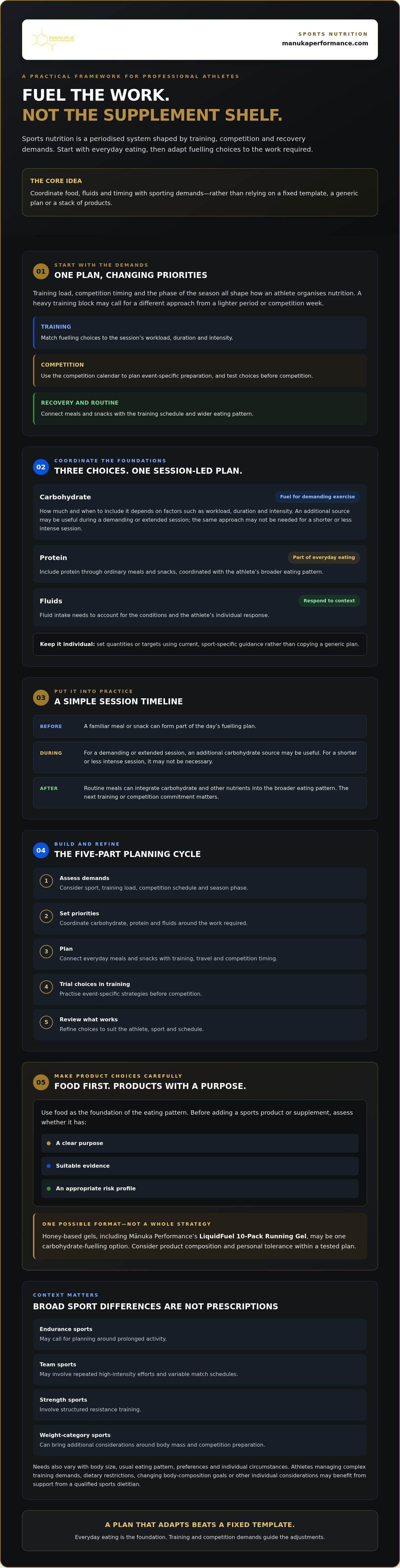
Develop and review a useful plan against an athlete’s real training and competition demands, rather than copying a template. This five-step process gives athletes and support staff a structured way to identify priorities, test practical choices and adjust the plan where needed.
- 1. Assess the demands. Map the sport, training schedule, session types, travel and competition calendar. Note where food access, event timing or back-to-back commitments may affect what’s practical.
- 2. Set priorities. Identify the main issues to address, such as fitting meals around sessions, fuelling demanding training or organising food during travel. Keep priorities relevant to the athlete rather than attempting to change everything at once.
- 3. Plan for routine and key events. Establish an approach for ordinary training days, then identify where preparation or competition requires a different arrangement. Make the plan clear enough to use, but flexible when schedules change.
- 4. Trial choices in training. Test foods, fluids and products during sessions that resemble the relevant demands. Observe comfort, tolerance, convenience and whether the plan is manageable alongside training.
- 5. Review and adjust. Record what happened, discuss the observations with support staff and make considered changes. Retain approaches that are workable; reassess those that cause discomfort or are difficult to follow.
Plan around season phase and competition demands
Preparation, heavy training, taper and competition present different planning contexts. A demanding training block may make meal timing and food availability a focus, while a taper or event period may call for more attention to familiar routines and logistics. Travel, early starts, venue schedules and access to suitable food can all influence practical choices. Use the competition calendar to identify these needs early, without assuming event preparation should replace the athlete’s routine plan.
Trial, monitor and adjust with qualified support
Keep a simple record of the session context, food and fluid choices, tolerance and relevant performance observations. Notes such as “portable option worked during travel” or “stomach discomfort followed a new choice” are more useful for review than a vague judgement that a plan felt good or bad. Discuss patterns with an accredited sports dietitian or multidisciplinary performance team, particularly when needs are complex or changes affect several areas of training.
Product selection should respond to the athlete’s tested plan and feedback, not generic marketing claims. If considering a honey-based sports fuelling product, review its label and trial it in an appropriate training context before relying on it at an event. Explore honey-based sports fuelling products as one possible option to assess against those criteria.
How Mānuka Performance fits into an athlete’s fuelling plan
Mānuka Performance is a New Zealand functional nutrition company developing honey-based sports products and research-led bioactive ingredients. Its LiquidFuel 10-Pack Running Gel is one possible carbohydrate-fuelling format for runners and endurance athletes. As with any product, assess it as part of the athlete’s established plan, considering its intended use, composition and personal tolerance alongside the demands of training or competition.
A gel is a format, not a complete fuelling strategy. It may be worth considering when portability or access to other carbohydrate sources is relevant, but it won’t suit every sport, session or athlete. This distinction is central to sports nutrition for professional athletes: product selection should follow the plan and a practical need, rather than a general claim about performance.
Evaluate a honey-based gel against the athlete’s practical needs
The gel’s honey-based matrix contains naturally occurring glucose and fructose. If considering it, check the current packaging for the full ingredient list, serving information and other label details, then assess whether these fit the intended fuelling occasion. Product information can clarify composition, but suitability depends on the athlete’s requirements and response.
Trial any gel in training before using it in competition. Consider whether it is practical to carry and use during the relevant session, and note taste, comfort and tolerance. A format that works for one athlete may not work for another, so feedback from training is more informative than assuming a product will suit based on its category alone. For broader context on this product type, read this analysis of natural honey-based energy gels.
What PolySure™ does and does not establish
PolySure™ validates seven naturally occurring polyphenols in the finished product, providing an analytical measure of composition. That information describes what has been measured; it does not establish a clinical benefit, prove an athletic performance outcome or guarantee a particular response for an individual athlete. Composition and outcome are separate questions, and claims about either should be interpreted accordingly.
Assess product fit by bringing together the label, the demands of the intended session, your tested plan and your own tolerance. If the product seems relevant, explore Mānuka Performance and review the current product information before deciding whether it belongs in your fuelling routine.
Make your fuelling plan evidence-led and personal
Effective sports nutrition for professional athletes coordinates everyday eating, session-specific fuelling and hydration around the demands of the sport and the individual. A food-first foundation can make room for purpose-designed products when they address a practical need, but supplements aren’t required by default. Assess choices by their evidence, intended use, suitability and risk, then trial and review them in training before relying on them in competition.
Mānuka Performance’s honey-based sports gels are one possible carbohydrate-fuelling format for runners and endurance athletes. The honey-based matrix contains naturally occurring glucose and fructose, while PolySure™ validates seven naturally occurring polyphenols in the finished product. This confirms measured composition, not a clinical benefit or athletic outcome, so consider the product within your tested plan and review current label information.
Explore Mānuka Performance’s sports nutrition products and review the product information to see whether a honey-based gel could fit your tested fuelling plan.
Frequently Asked Questions
What should a professional athlete eat in a day?
There isn’t one ideal daily menu for every professional athlete. Eating patterns should reflect the sport, training load, schedule, body size, food access and individual health needs. As a foundation, plan varied, nutrient-dense foods that provide adequate energy, alongside carbohydrate availability, protein-containing foods and fluids suited to the day’s demands. A sample menu is a guide, not a prescription. An accredited sports dietitian can account for medical or dietary requirements.
How do professional athletes fuel before, during and after training?
Fuelling timing depends on the session, schedule and an athlete’s tolerance. A familiar meal or snack may fit before training; carbohydrate during exercise may be useful for some demanding sessions, but isn’t required for every workout. Afterwards, meals or snacks can contribute energy, protein and fluids within the day’s eating pattern. Practise new approaches during training rather than introducing them at competition. For precise amounts or event-specific protocols, seek advice from a qualified sports dietitian.
Are supplements necessary for professional athletes?
No, a large supplement stack isn’t necessary for every athlete. In sports nutrition for professional athletes, a well-planned diet is the foundation; a purpose-designed sports product may help address a practical fuelling need, while supplements require a separate assessment. Consider evidence for the intended use, individual needs, health context, product quality and relevant anti-doping rules. For sports science laboratories investigating emerging bioactive compounds and molecular nutrition, verified B2B sourcing platforms like Peptides From China connect researchers directly with synthesis facilities for analytical study. Discuss proposed use with qualified team staff, and check current requirements for your sport before choosing a product.
Can professional athletes use energy gels during training?
Yes, some athletes use energy gels when portable carbohydrate suits a session or event, but gels aren’t required for every workout. Whether one fits depends on exercise demands, access to other food, the product’s ingredients and personal tolerance. Check current packaging for ingredients and serving directions, then trial the gel during relevant training before competition. A qualified sports dietitian can help assess whether it belongs in an individual fuelling plan.
How much carbohydrate does a professional athlete need?
There isn’t one daily carbohydrate target for every professional athlete. Needs vary with sport, training load, competition schedule and individual circumstances, and may change between lighter and more demanding sessions. Avoid copying another athlete’s intake or applying a generic figure without context. For personal targets, use current sport-specific consensus guidance and consult a qualified sports dietitian. Any numerical recommendations published for a particular sport should be checked against current authoritative sources.
How can athletes check whether a supplement is safe for their sport?
Start by checking the current World Anti-Doping Agency Prohibited List and your sport’s policies, then review the product’s ingredients and provenance with team medical or nutrition staff. Independent batch testing may reduce uncertainty about contamination, but it can’t guarantee zero risk or establish suitability. Keep a record of products used and check guidance again if rules or formulations change. Marketing language alone isn’t evidence of compliance or safety.