


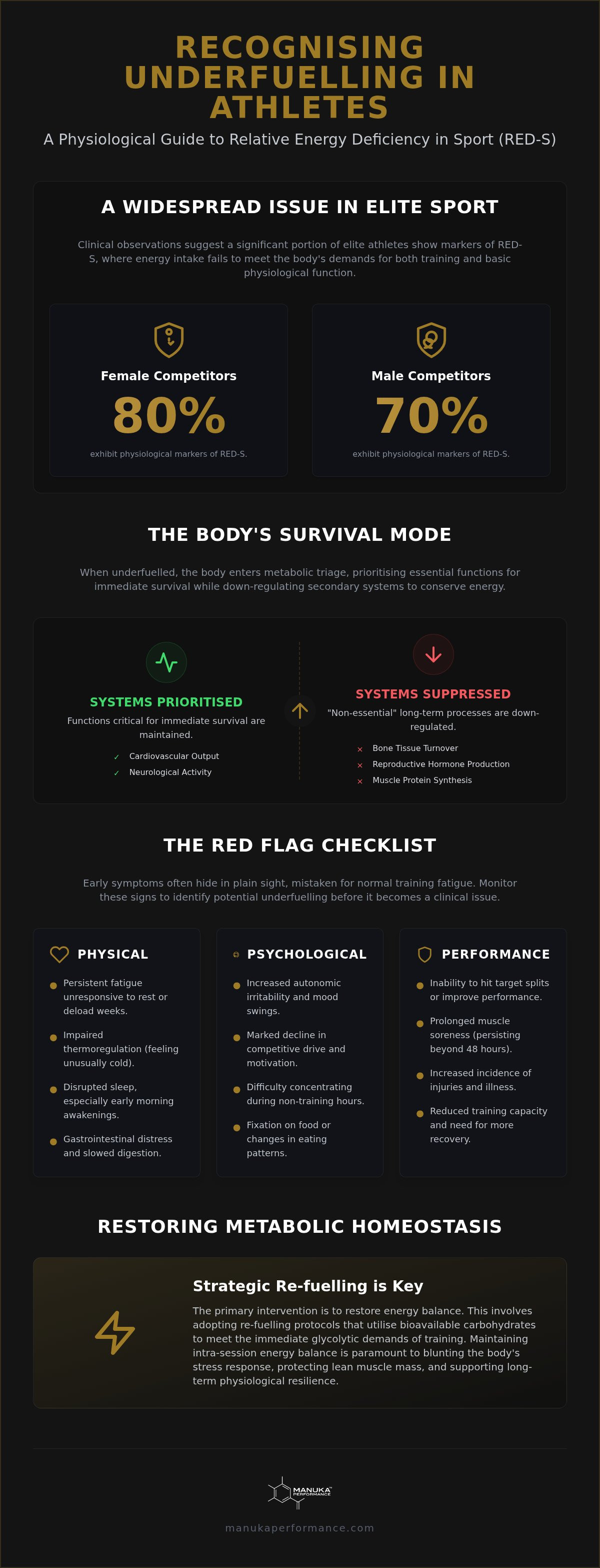
Clinical observations within elite athletic cohorts suggest that up to 80 per cent of female competitors and 70 per cent of males exhibit physiological markers of Relative Energy Deficiency in Sport, or RED-S. This condition represents a profound systemic failure where the body's metabolic requirements outpace its energy intake, forcing a shift in biological priority from performance and adaptation to basic cellular survival. You've likely experienced the debilitating nature of persistent fatigue that remains unaffected by sleep. Identifying the early signs of underfueling in athletes is essential for maintaining endocrine health and skeletal integrity, as these subtle biochemical signals often precede more severe clinical outcomes. This article provides a comprehensive physiological checklist to help you determine if your current symptoms are rooted in nutritional deficiency. We'll explore the mechanisms of Low Energy Availability and establish a clear, data-driven path toward restoring metabolic homeostasis and systemic resilience.
Key Takeaways
- Comprehend the biochemical hierarchy that forces the body to prioritise survival over secondary systems like bone health and reproduction when metabolic demands exceed energy intake.
- Recognise the primary signs of underfueling in athletes, focusing on physiological red flags such as persistent fatigue and impaired thermoregulation that remains unresponsive to rest.
- Identify the psychological indicators of energy deficiency, including increased autonomic irritability and a marked decline in competitive motivation during non-training hours.
- Evaluate performance-based markers of systemic failure, such as why target splits don't improve or why muscle soreness persists beyond a standard 48-hour recovery window.
- Adopt strategic re-fuelling protocols that utilise bioavailable carbohydrates to restore metabolic homeostasis and protect long-term physiological resilience.
Understanding Low Energy Availability: The Science of Underfuelling
Low Energy Availability (LEA) occurs when the energy remaining for physiological functions, after accounting for the metabolic cost of exercise, is insufficient to support optimal health. If this state persists, it transitions into the broader clinical syndrome known as Relative Energy Deficiency in Sport (RED-S). Unlike the traditional Female Athlete Triad, RED-S acknowledges a systemic failure affecting both genders across multiple biological pathways. The body essentially enters a state of metabolic bankruptcy where it must triage its limited resources to sustain life.
The organism operates on a strict biochemical hierarchy. It prioritises immediate survival functions, such as cardiovascular output and neurological activity, while diverting energy away from "non-essential" processes. This is where the initial signs of underfueling in athletes manifest. Systems like bone tissue turnover, reproductive hormone production, and protein synthesis are suppressed to conserve adenosine triphosphate (ATP). This metabolic down-regulation isn't a failure of the system, but a sophisticated survival mechanism designed to protect the individual during perceived famine.
Distinguishing between intentional caloric restriction, such as intermittent fasting, and unintentional underfuelling is critical for long-term health. In high-volume endurance or strength training, the sheer volume of energy expenditure often exceeds an athlete's capacity for consumption. This leads to a chronic deficit that isn't always driven by body image concerns, but rather by a failure to match the logistical demands of elite performance nutrition. Without intervention, this mismatch leads to a cascade of endocrine and physiological disruptions.
The Biochemical Mechanism of Energy Conservation
The hypothalamus serves as the body's primary metabolic sensor, constantly monitoring circulating glucose and glycogen levels. When scarcity is detected, the hypothalamic-pituitary-thyroid axis is suppressed, leading to a reduction in triiodothyronine (T3) levels. This reduction slows the basal metabolic rate to preserve energy stores. Simultaneously, the body experiences chronic elevation of cortisol. Without adequate carbohydrate availability, cortisol remains high to facilitate gluconeogenesis, often at the expense of lean muscle mass and systemic recovery.
RED-S: When Underfuelling Becomes a Clinical Syndrome
The clinical progression of RED-S involves multi-systemic impairment, including gastrointestinal distress, reduced immunological response, and compromised cardiovascular health. Athletes often conflate "eating for health" with "eating for performance", yet high-fibre, low-density diets frequently fail to meet the glycogen demands of intense training. Maintaining intra-session energy balance is paramount to blunting the stress response. Integrating natural honey-based energy gels provides a bioavailable carbohydrate matrix that supports immediate glycolytic needs, preventing the body from entering the catabolic state that characterises the early signs of underfueling in athletes.
The Physical Symptom Checklist: Physiological Red Flags
Identifying the early physical indicators of energy deficiency requires a clinical eye for detail, as these symptoms often masquerade as the expected byproducts of a rigorous training programme. One of the most telling signs of underfueling in athletes is persistent fatigue that fails to resolve following a scheduled deload week or dedicated rest period. When the neuromuscular system remains unresponsive to recovery protocols, the deficit is likely metabolic rather than purely structural. This state of chronic exhaustion is frequently accompanied by thermoregulation impairments. Athletes may report feeling unusually cold in temperate environments or experiencing cold extremities during light activity, a direct result of the metabolic down-regulation and thyroid suppression discussed previously.
Disrupted sleep patterns, specifically nocturnal awakenings in the early morning hours, often indicate glycogen depletion and a subsequent rise in cortisol. This physiological stress response is the body's attempt to mobilise glucose from non-carbohydrate sources to maintain blood sugar levels during sleep. Additionally, gastrointestinal distress and slowed gastric emptying are common clinical observations. These issues are often misdiagnosed as food intolerances, yet they frequently stem from the autonomic system prioritising energy for locomotion over digestion. Addressing these deficits through scientifically validated fuelling strategies can mitigate the systemic stress that leads to these physical red flags.
Hormonal and Reproductive Disruptions
The suppression of the Hypothalamic-Pituitary-Gonadal (HPG) axis is a hallmark of prolonged energy deficiency. In female athletes, this often manifests as functional hypothalamic amenorrhoea, while male athletes may experience reduced libido or the absence of morning erections. These are not merely inconveniences but critical indicators of a system in survival mode. The resulting low levels of oestrogen and testosterone significantly increase the risks of underfueling, particularly regarding accelerated bone density loss and the heightened incidence of stress fractures within Australian athletic cohorts.
Integumentary and Immune System Markers
The physiological allocation of energy for systemic maintenance is severely restricted during periods of Low Energy Availability, leading to visible changes in the integumentary system. Brittle hair, dry skin, and noticeably slow wound healing suggest that protein synthesis is being diverted away from peripheral tissues. This systemic conservation also compromises the immune response, leading to a recurring cycle of upper respiratory tract infections (URTIs) that interrupt training consistency. Essentially, the immune system's energy budget is slashed to the bare minimum during LEA to facilitate more immediate survival demands. Recognising these signs of underfueling in athletes is the first step toward restoring the metabolic balance required for elite performance.
Cognitive and Psychological Red Flags of Energy Deficits
Psychological manifestations are often the earliest detectable signs of underfueling in athletes, yet these shifts in temperament are frequently dismissed as standard competitive stress or personality traits. A clinical hallmark of energy deficiency is a heightened state of autonomic irritability, often described as a "short fuse" during non-training hours. This emotional volatility isn't merely a mood swing; it's a neurological response to chronic substrate scarcity. Athletes may also exhibit a rigid preoccupation with meal timing or an obsessive focus on the perceived "cleanliness" of their intake. This hyper-fixation serves as a psychological proxy for the body's desperate requirement for energy, as the brain attempts to exert control over a system in metabolic crisis.
Cognitive impairment also surfaces through a marked decline in technical proficiency and executive function. You might find it increasingly difficult to concentrate during complex training drills or struggle to maintain productivity in professional environments. This "brain fog" is a direct consequence of the central nervous system attempting to operate on insufficient glycogen stores. When the brain's energy demands aren't met, the "joy" of the session evaporates, replaced by a loss of competitive drive and a pervasive sense of apathy toward previously motivating goals.
Neurotransmitter Synthesis and Glucose Scarcity
The human brain is an energy-intensive organ, consuming approximately 20 per cent of the body's total glucose despite representing only 2 per cent of its mass. When systemic glucose levels are low, the synthesis of critical neurotransmitters like serotonin and dopamine is significantly impaired. These chemicals are essential for mood regulation, motor coordination, and reaction times. This biochemical deficit creates a negative feedback loop where the "perceived effort" of a session feels exponentially higher than the actual physiological output. Consequently, what appears to be a lack of mental toughness is often a measurable failure in neurocognitive substrate availability.
The Emotional Toll of Chronic Energy Deficiency
Prolonged states of Relative Energy Deficiency in Sport (REDs) are closely linked to increased symptoms of clinical anxiety and depression within elite cohorts. The constant state of physiological alarm triggered by low energy availability keeps the nervous system in a sympathetic-dominant state, making relaxation impossible. Many athletes who believe they're suffering from "burnout" are actually experiencing the psychological fallout of a long-term fuel deficit. Maintaining neurological homeostasis requires the consistent application of bioavailable fuel during high-output sessions to protect against the cognitive erosion that characterises the subtle signs of underfueling in athletes. This approach ensures the brain remains as resilient as the musculoskeletal system it directs.
Performance and Recovery Indicators: A Checklist for the Track
Performance data serves as a transparent window into an athlete's metabolic status. While many competitors attribute stalled progress to a lack of grit, the inability to achieve target power outputs or maintain established split times is often one of the most reliable signs of underfueling in athletes. This physiological ceiling occurs because the body lacks the glycogen required to fuel high-intensity glycolytic pathways, forcing a reliance on less efficient energy systems. When the numbers on your watch or power meter fail to align with your perceived effort, the cause is frequently a substrate deficit rather than a lack of conditioning.
Monitoring autonomic markers provides further clinical evidence of energy deficiency. An elevated resting heart rate (RHR) combined with a significant reduction in heart rate variability (HRV) suggests that the nervous system is trapped in a sympathetic-dominant state. This indicates the body is struggling to maintain basic homeostasis, leaving no resources for the parasympathetic "rest and digest" mode necessary for adaptation. Additionally, the musculoskeletal system provides clear red flags. Delayed onset muscle soreness (DOMS) that persists beyond the standard 48-hour window indicates a failure in protein synthesis and cellular repair. When minor tissue irritations fail to resolve and instead progress toward stress reactions or fractures, the body is likely catabolising its own structural integrity to meet immediate energy demands.
The Failure of Supercompensation
The principle of supercompensation relies on the body over-recovering from a training stimulus to reach a higher level of fitness. In a state of low energy availability, this process is fundamentally broken. Instead of adaptation, the athlete experiences chronic catabolism, where the body breaks down lean muscle mass to provide amino acids for gluconeogenesis. This results in a frustrating plateau effect; increasing training volume leads to diminishing returns and a measurable loss of functional strength, as the body prioritises survival over muscle hypertrophy.
Recovery Kinetics and Bioavailability
Optimising the post-exercise recovery window is essential for restoring metabolic homeostasis and preventing the long-term signs of underfueling in athletes. The first 30 minutes following a session represent a critical period for glycogen resynthesis, during which the body is most receptive to substrate uptake. Utilising a natural glucose-fructose matrix accelerates this process by leveraging multiple intestinal transporters for faster absorption and reduced gastrointestinal load. LiquidFuel gels provide this precise ratio, supported by PolySure™ validated polyphenols that help mitigate systemic oxidative stress during the recovery phase. To ensure your recovery kinetics match your training output, explore our range of bioavailable sports nutrition solutions.
Strategic Re-fuelling: Restoring Homeostasis Naturally
Restoring metabolic homeostasis requires a fundamental shift from reductionist calorie counting to a rigorous focus on energy availability (EA). To maintain endocrine stability and physiological health, athletes should target an EA of at least 45 kcal per kilogram of fat-free mass (FFM). This specific threshold ensures that the body's primary systems possess sufficient substrate to function optimally after the metabolic cost of exercise is subtracted. Monitoring objective physiological markers, such as heart rate variability (HRV), sleep quality, and the regularity of the menstrual cycle, provides a real-time data stream to verify that the signs of underfueling in athletes are being successfully mitigated. Prioritising intra-workout fuelling with bioavailable carbohydrates is essential to blunt the chronic cortisol response and prevent the catabolic state that leads to systemic degradation.
The Role of the Honey-Based Matrix in Fuelling
The efficacy of a fuelling strategy depends heavily on the bioavailability and absorption kinetics of the chosen substrate. New Zealand honey provides a natural matrix of glucose and fructose, facilitating dual-pathway absorption through the SGLT1 and GLUT5 transporters. This arrangement allows for a higher rate of carbohydrate oxidation with a significantly reduced risk of gastrointestinal distress compared to synthetic, maltodextrin-based gels. LiquidFuel represents a clean label alternative that delivers rapid energy without the inflammatory potential of processed additives. Consistent intra-workout fuelling preserves muscle glycogen and prevents the "bonk," ensuring that training remains an anabolic stimulus rather than a stressor that triggers the signs of underfueling in athletes.
Leveraging PolySure™ for Systemic Resilience
Beyond simple carbohydrate delivery, the phytochemical quality of fuel plays a definitive role in supporting systemic resilience against the stresses of high-output training. Mānuka Performance utilises the PolySure™ analytical standard to validate the presence of seven naturally occurring polyphenols within its honey-based matrices. These quantified bioactives support the body's endogenous antioxidant systems, helping to manage the oxidative stress inherent in elite performance. This research-driven approach to nutrition bridges the gap between natural provenance and clinical efficacy, providing a sophisticated solution for the modern competitor. It's essential to recognise that performance is built on a foundation of metabolic health. To protect your long-term vitality and optimise your fuelling strategy, integrate Mānuka Performance LiquidFuel into your daily training protocol.
Optimising Metabolic Homeostasis for Sustained Performance
Maintaining peak athletic performance requires more than rigorous training; it demands a clinical awareness of the body's internal energy balance. Recognising the early signs of underfueling in athletes is the first step toward preventing the systemic failure associated with RED-S. By shifting the focus from restrictive caloric targets to optimal energy availability, you protect essential endocrine functions and preserve skeletal integrity. True resilience is built on the foundation of intra-workout substrate availability and the mitigation of chronic cortisol elevation through scientifically validated nutrition.
Mānuka Performance operates at the intersection of natural provenance and advanced biotechnology, providing a natural honey-based carbohydrate matrix that ensures rapid absorption without gastrointestinal distress. Our formulations leverage PolySure™ validated bioactive ingredients to support your body’s endogenous recovery systems through research-driven New Zealand biotechnology, ensuring that every session is underpinned by verified phytochemical support. It's clear that precision in your fuelling protocol is not merely a preference but a physiological necessity for those pursuing professional excellence.
Explore the Science of Bioavailable Fuelling with Mānuka Performance
With the correct metabolic data and a commitment to bioavailable nutrition, you can restore homeostasis and ensure your physiological systems remain as robust as your competitive ambitions.
Frequently Asked Questions
What is the difference between underfuelling and just being tired?
The primary distinction lies in the response to recovery protocols. Standard fatigue resolves following a structured deload or restorative sleep; however, underfuelling involves a systemic metabolic downregulation that persists regardless of rest duration. This state is characterised by a lack of physiological "rebound" and is often accompanied by the clinical signs of underfueling in athletes, such as impaired thermoregulation and disrupted autonomic markers like heart rate variability.
Can I be underfuelled if I am not losing weight?
Weight stability doesn't preclude a state of low energy availability. The human body is highly adaptive and will suppress non-essential physiological processes, such as reproductive function and bone turnover, to maintain energy balance at a lower metabolic rate. This survival mechanism ensures that body mass remains constant despite a chronic deficit, masking the underlying energy crisis until more severe clinical symptoms or performance decrements manifest.
How long does it take to recover from Low Energy Availability (LEA)?
Recovery timelines vary significantly across different biological systems. While muscle glycogen stores and metabolic rate can begin to normalise within days of increasing energy availability, the restoration of the hypothalamic-pituitary-gonadal axis and bone mineral density often requires several months of consistent surplus. Clinical evidence suggests that hormonal regularity may take three to six months of targeted nutritional intervention to achieve full metabolic homeostasis.
What are the first signs of underfuelling in endurance runners?
Early indicators in endurance cohorts often manifest as a subtle erosion of technical proficiency and an inability to maintain established power outputs. Runners may observe a rise in resting heart rate and a noticeable sensitivity to cold temperatures during low-intensity sessions. These initial signs of underfueling in athletes frequently precede more overt symptoms like recurring upper respiratory tract infections or the development of bone stress injuries.
Is underfuelling the same as RED-S?
These terms describe different stages of the same physiological spectrum. Low Energy Availability (LEA) is the causal state where energy intake is insufficient to support both exercise and basic health functions. Relative Energy Deficiency in Sport (RED-S) is the resulting clinical syndrome that encompasses the multi-systemic consequences of chronic LEA, affecting cardiovascular health, metabolic rate, immunological response, and psychological well-being across all genders.
How much carbohydrate should an athlete consume during a session to avoid underfuelling?
Intra-workout requirements are dictated by the duration and intensity of the session. High-output training typically necessitates 30 to 90 grams of bioavailable carbohydrates per hour to maintain blood glucose and blunt the catabolic cortisol response. Utilising a natural glucose-fructose matrix, such as those found in honey-based gels, facilitates dual-pathway absorption, allowing for higher oxidation rates without the gastrointestinal distress often associated with synthetic maltodextrin formulations.
Can men suffer from underfuelling and hormonal disruption?
Male athletes are equally susceptible to the endocrine disruptions caused by energy deficiency. In men, chronic underfuelling leads to a suppression of the hypothalamic-pituitary-gonadal axis, resulting in reduced morning erections, lowered libido, and diminished circulating testosterone. This hormonal environment impairs protein synthesis and increases the risk of bone stress injuries, challenging the historical misconception that these metabolic issues are exclusive to female competitors.
Does underfuelling cause long-term damage to the metabolism?
While most metabolic and hormonal suppressions are reversible through structured nutritional intervention, certain consequences can be permanent. Prolonged energy deficiency during critical growth periods or extended durations of amenorrhoea can lead to irreversible bone mineral density loss. However, the body's metabolic rate typically recovers once energy availability is restored to a level that supports both the demands of training and essential biological maintenance.