


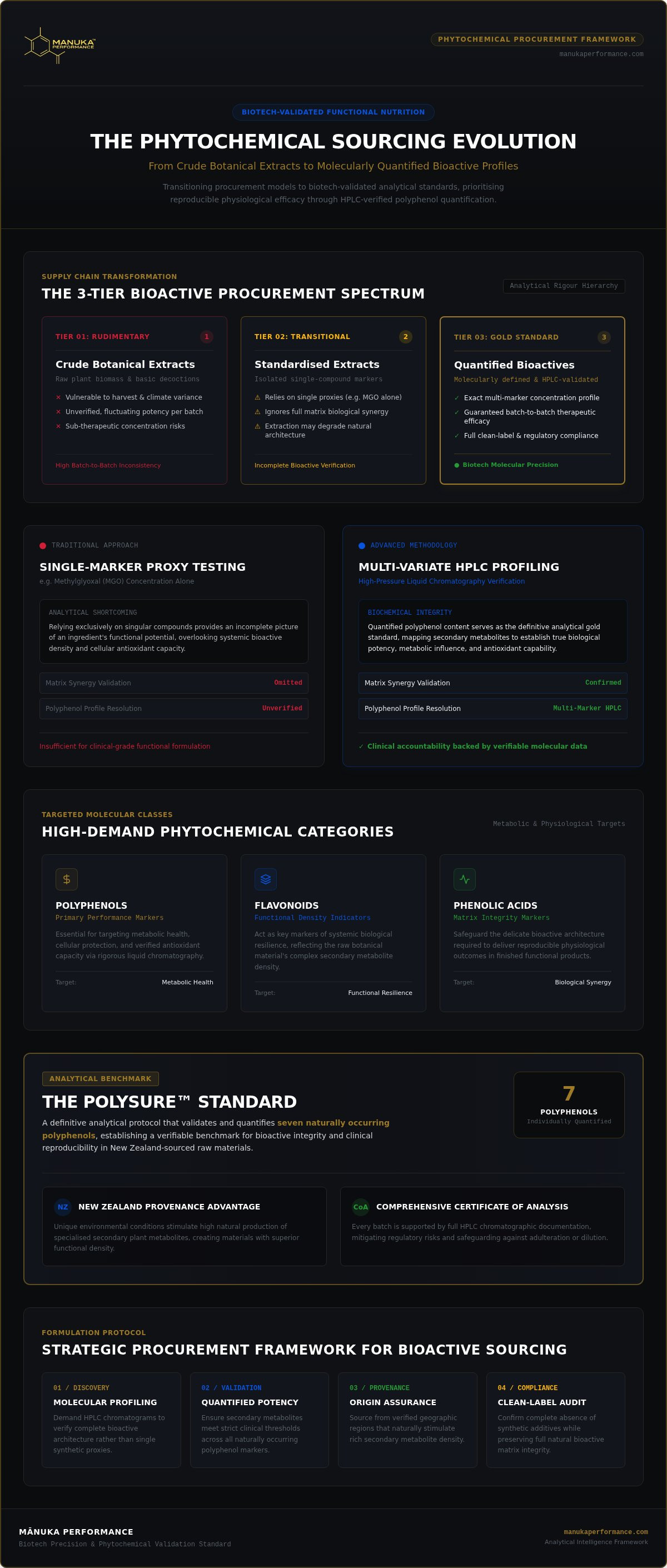
The traditional reliance on crude botanical extracts is no longer sufficient for a functional nutrition industry demanding pharmaceutical-grade precision, as the requirement for standardised efficacy necessitates a transition toward molecularly defined raw materials. Securing a resilient phytochemical ingredient supply now requires moving beyond simple plant origins toward rigorous, biotech-validated quantification that accounts for specific molecular profiles and biological activity. Industry leaders often find they've encountered the frustration of inconsistent bioactive potency between batches, where a lack of transparency in the traditional supply chain makes meeting clean-label and regulatory standards an ongoing challenge.
This analysis establishes a framework for shifting from generic extracts to quantified, research-driven supply chains that prioritise product efficacy through measured polyphenol content. By adopting analytical standards like the PolySure™ validation process, partners can mitigate regulatory risk and establish a sophisticated procurement strategy rooted in biochemical integrity and data-driven provenance. We'll examine the methodologies required to transition from basic botanical sourcing to clinical-grade ingredient procurement, ensuring your formulations deliver the precise physiological outcomes your consumers expect.
Key Takeaways
- Understand the evolution of the phytochemical ingredient supply chain, transitioning from rudimentary botanical extracts to molecularly quantified bioactive compounds for superior product efficacy.
- Identify why quantified polyphenol content has surpassed traditional markers as the analytical gold standard for validating the biological potency of functional nutrition formulations.
- Learn to distinguish between standardised and quantified extracts to eliminate batch inconsistency and safeguard your supply chain against potential adulteration or sub-therapeutic concentrations.
- Establish a clinical framework for strategic procurement by utilising high-pressure liquid chromatography (HPLC) profiles and comprehensive Certificates of Analysis to ensure regulatory compliance.
- Explore how the PolySure™ analytical standard validates seven naturally occurring polyphenols to provide a verifiable benchmark for bioactive integrity in New Zealand-sourced ingredients.
Quantifying the Shift in Phytochemical Ingredient Supply
The modern functional nutrition landscape has undergone a fundamental reconfiguration, moving beyond the era of rudimentary botanical powders toward a sophisticated phytochemicals procurement model. This systemic shift is driven by a necessity for reproducible biological outcomes, where the mere presence of a plant extract is no longer a sufficient metric for product development. As we approach 2026, the global market increasingly demands a phytochemical ingredient supply that's defined by molecular transparency and rigorous analytical validation, ensuring that every batch delivers a quantified concentration of bioactive compounds. The transition from traditional botanical extracts to standardised bioactive compounds represents a move toward clinical accountability, where "natural" claims are validated by hard data rather than marketing rhetoric.
The Evolution of Bioactive Sourcing
Historically, ingredient sourcing relied on raw plant biomass or basic decoctions that were prone to significant batch-to-batch variation due to environmental stressors and harvest inconsistencies. The integration of advanced biotechnology has modernised this process, allowing for the precise isolation of specific phytochemicals while maintaining the integrity of the natural matrix. This evolution is largely propelled by the clean label movement, where consumers and regulators alike demand a clear provenance and an absence of synthetic additives. It's a shift that prioritises the molecular fingerprint of the plant, utilising proprietary research-driven solutions to ensure that the extraction process doesn't degrade the delicate bioactive architecture required for efficacy.
Key Phytochemical Categories in High Demand
The identification of specific molecular classes has allowed formulators to target systemic physiological benefits with greater accuracy. Polyphenols remain the primary focus for metabolic health, acting as critical performance markers that require precise quantification through high-pressure liquid chromatography. Flavonoids and phenolic acids are also in high demand, as these compounds serve as indicators of a material's functional density and biological resilience. The importance of provenance can't be overstated in this context, as the phytochemical density of an ingredient is intrinsically linked to its geographical origin. For example, New Zealand's environmental conditions are known to stimulate the production of unique secondary metabolites, making its phytochemical ingredient supply particularly valuable for high-purity bioactive applications.
Analytical Validation: The Role of Polyphenols in Functional Nutrition
The procurement of high-purity bioactives requires an analytical shift from singular markers to comprehensive molecular profiles, as relying on isolated compounds often overlooks the systemic synergy required for optimal physiological response. For decades, the industry utilised Methylglyoxal (MGO) as a primary proxy for quality in honey-derived ingredients; however, MGO concentration alone is an insufficient metric for determining the broader bioactive density of a phytochemical ingredient supply. Quantified polyphenol content has emerged as the definitive gold standard because these secondary metabolites provide a more accurate reflection of the material's antioxidant capacity and metabolic influence. Establishing a multi-marker analytical protocol ensures that the functional integrity of the ingredient is preserved, providing a level of verification that simple, single-compound testing cannot achieve.
Beyond Simple Markers: A Multi-Variate Approach
Validating a spectrum of bioactives is essential for establishing clinical credibility in the competitive functional nutrition sector. Relying on a single marker provides an incomplete picture of an ingredient's potential, whereas a multivariate analysis reveals the true biochemical complexity of the matrix. The PolySure™ standard serves as the definitive analytical benchmark for the validation and quantification of bioactives within honey-based phytochemical matrices. By utilising this rigorous framework, B2B partners can ensure their formulations are built upon a foundation of measured efficacy rather than anecdotal evidence. This precision allows for the identification of specific phenolic acids and flavonoids, ensuring that every batch meets the strict requirements for standardised potency. To achieve this level of transparency, many organisations now seek biotech research-driven solutions to verify the molecular integrity of their raw materials.
Stability and Potency in Phytochemical Delivery
The integrity of a phytochemical ingredient supply is often compromised during the manufacturing process, where exposure to excessive heat, light, and oxygen can lead to rapid polyphenol degradation. Maintaining bioactive potency requires a sophisticated understanding of molecular stability and the implementation of protective strategies from the laboratory to the final consumer. Factors such as pH levels and thermal processing must be meticulously managed to prevent the oxidation of sensitive compounds. Ensuring these bioactives survive the encapsulation or blending process is critical for bioavailability. Manufacturers must prioritise sourcing materials that have been tested for stability under various environmental stressors, ensuring that the promised bioactive concentration remains present at the point of consumption rather than just at the time of extraction. This methodical approach to stability testing mitigates the risk of sub-therapeutic dosing in final consumer products.
Evaluating Supply Chain Integrity: Standardised vs. Quantified Extracts
The distinction between botanical standardisation and true molecular quantification is the primary factor determining the reliability of a phytochemical ingredient supply. Standardisation often relies on adjusting an extract to a specific percentage of a marker compound, a process that can sometimes involve the exogenous addition of synthetic markers to mask poor-quality raw materials. Quantification represents a more rigorous analytical approach, where the endogenous bioactive density of the natural matrix is measured without manipulation. This level of precision is essential for high-performance formulations where batch-to-batch consistency isn't just a preference but a clinical requirement. Relying on quantified extracts ensures that the physiological response remains predictable across every production cycle.
Transparency and Traceability in Bioactive Procurement
Establishing a clear chain of custody from the point of harvest to the final extract is the only way to mitigate the risk of adulteration in the global market. Third-party validation provides an objective audit layer that builds supply chain trust, ensuring that the material's molecular fingerprint matches its documentation. This transition toward transparent sourcing reflects The Evolution of Sports Nutrition Biotechnology, where the industry has moved away from synthetic fillers in favour of bioactive precision. By leveraging biotech research-driven solutions, organisations can verify the provenance of their ingredients, ensuring they're free from the contaminants and sub-therapeutic concentrations that plague low-integrity supply chains.
Comparing Global Phytochemical Sourcing Models
Global procurement models present a clear trade-off between low-cost generic supply and premium biotech-led sourcing. Generic extracts often lack the analytical depth required to guarantee efficacy, as they're frequently sourced from regions with inconsistent environmental regulations. In contrast, New Zealand's biotech infrastructure is built upon stringent environmental standards that directly influence the phytochemical profiles of the raw materials. These conditions stimulate the production of unique secondary metabolites, creating a more robust phytochemical ingredient supply for B2B partners. Building resilience in your procurement strategy requires diversifying toward high-integrity partnerships that prioritise data over volume. It's a strategic move that protects the brand from regulatory scrutiny and ensures the final consumer receives a product that performs exactly as intended.
Strategic Procurement: Criteria for High-Purity Bioactive Sourcing
Developing a clinical framework for the selection of partners within the phytochemical ingredient supply chain requires a departure from standard procurement protocols in favour of a research-centric evaluation. This methodology prioritises the verification of biochemical density over cost-per-unit metrics, ensuring that the raw materials possess the molecular integrity required for complex formulations. Essential documentation must extend beyond basic compliance to include comprehensive High-Performance Liquid Chromatography (HPLC) profiles and detailed Certificates of Analysis (CoA) that validate specific phenolic concentrations. Assessing the R&D capabilities of a potential partner is equally critical, as a supplier's ability to provide proprietary biotech research-driven solutions indicates a level of technical sophistication that supports long-term product innovation. Incorporating these proprietary validation standards into product marketing allows brands to project a sense of prestige and technical superiority that resonates with the increasingly discerning functional nutrition consumer.
Technical Specifications for Phytochemical Ingredients
The physical properties of bioactives, such as solubility and dispersion, must be precisely aligned with the intended delivery matrix, whether it's a powder blend or a liquid suspension. In sports nutrition applications, non-negotiable purity markers include the absence of synthetic residues and a verifiable concentration of performance-related polyphenols. High-Performance Liquid Chromatography serves as the primary analytical technique for the qualitative and quantitative determination of individual phytochemicals within a complex biological matrix. Ensuring these specifications are met during the procurement phase prevents manufacturing complications and guarantees the final product's physical stability, especially when working with high-viscosity matrices like New Zealand honey.
Collaborative R&D: Moving Beyond the Transaction
Partnering with biotech-led suppliers facilitates a collaborative environment where custom formulations can be developed using high-resolution data. This synergy allows for the creation of products like Natural Honey-Based Energy Gels: A Performance Analysis, where the phytochemical profile is engineered for specific biological outcomes. Leveraging supplier-provided data enables brands to substantiate finished product performance claims with clinical rigour, mitigating the risk of regulatory challenges. Moving beyond a transactional relationship toward a research partnership ensures that your phytochemical ingredient supply remains at the vanguard of nutritional science. To explore how biotech-validated ingredients can enhance your product line, you can consult with our team regarding research and biotech solutions.
PolySure™: A New Benchmark in Phytochemical Ingredient Supply
The introduction of the PolySure™ analytical standard represents a paradigm shift in the phytochemical ingredient supply, providing a level of precision that was previously unavailable to functional nutrition formulators. While the broader market often relies on generic markers, Mānuka Performance has developed a proprietary methodology that quantifies seven naturally occurring polyphenols within the honey matrix. This level of granular data allows B2B partners to move beyond anecdotal efficacy toward a model of measured biological performance. By establishing this benchmark, the industry can finally address the batch-to-batch inconsistency that has historically hindered the development of high-performance sports nutrition products. This systematic approach ensures that every ingredient delivered to a partner meets a rigorous threshold of biochemical integrity, reinforcing the status of the supplier as a scientific pioneer.
The Science of PolySure™ Validation
The analytical rigour of PolySure™ is rooted in a multi-variate validation process that utilises high-pressure liquid chromatography to map the specific phenolic density of every batch. This standard provides a unique competitive advantage for product innovators because it ensures that the raw material's bioactive architecture remains intact after extraction. It bridges the gap between raw honey and high-performance bioactive ingredients by providing a verifiable Certificate of Analysis for each molecular marker. This precision allows for the creation of formulations that are not just "natural" but are clinically substantiated through biotech-led quantification. The ability to isolate and measure these compounds means that formulators don't have to guess the potency of their final product; they've got the data to prove it.
Future Horizons in Phytochemical Innovation
Mānuka Performance is currently expanding its research into honey-based sports biotechnology, focusing on how specific secondary metabolites influence systemic physiological recovery and metabolic efficiency. As we redefine the phytochemical landscape in New Zealand, the focus remains on the intersection of nature and advanced biotechnology to create ingredients with superior biological resilience. Partnering with a research-driven organisation allows brands to access bespoke biotech solutions that are tailored to the demands of the 2026 market. This collaborative model ensures that product developers can leverage high-resolution data to substantiate their performance claims. To secure a validated supply of these high-purity compounds, you can Explore PolySure™ Bioactive Ingredients and integrate clinical-grade precision into your next development cycle.
Advancing the Precision of Bioactive Procurement
The transition toward a molecularly defined phytochemical ingredient supply represents a critical maturation of the functional nutrition sector, where clinical accountability replaces anecdotal botanical claims. By moving beyond rudimentary standardisation in favour of rigorous biotech-led research and development, formulators can ensure their products deliver consistent, reproducible biological outcomes. The adoption of the proprietary PolySure™ analytical standard provides a definitive framework for this shift, validating the measured content of seven key polyphenols to safeguard product integrity and efficacy. This systematic approach to validation doesn't just mitigate regulatory risk; it establishes a foundation of trust through perceived technical superiority and intellectual depth. As the industry moves toward 2026, the demand for quantified bioactives will continue to redefine procurement standards across the global market. We invite you to Partner with Mānuka Performance for Validated Phytochemical Solutions and secure the analytical precision your next innovation requires. We look forward to supporting your pursuit of professional excellence in the bioactive space.
Frequently Asked Questions
What is the difference between phytochemicals and botanical extracts?
Phytochemicals are specific, molecularly defined bioactive compounds, such as polyphenols or flavonoids, that are found within plant matrices. In contrast, botanical extracts are broad mixtures derived from plant biomass that often lack precise molecular quantification. A sophisticated phytochemical ingredient supply focuses on the isolation and measurement of these specific compounds to ensure reproducible biological outcomes. This distinction is vital for developers who require pharmaceutical-grade precision rather than generic plant-based ingredients.
How do analytical standards like PolySure™ ensure ingredient consistency?
The PolySure™ analytical standard ensures consistency by utilising a multi-variate validation framework that quantifies seven naturally occurring polyphenols within every batch. Traditional testing often relies on a single marker, which can lead to significant batch-to-batch variation in the final product. By mapping the entire biochemical fingerprint, Mānuka Performance provides a resilient phytochemical ingredient supply that meets strict technical specifications. This rigorous approach eliminates the ambiguity associated with unrefined botanical materials.
Why is polyphenol quantification important for sports nutrition?
Polyphenol quantification is critical for sports nutrition because these bioactives serve as performance markers that influence metabolic efficiency and physiological resilience. Formulators can't rely on "natural" claims alone when developing high-performance products for elite athletes. Measuring the precise concentration of phenolic acids and flavonoids allows brands to substantiate their claims with scientific rigour. It ensures that every serving delivers the exact bioactive density required to support targeted endurance and recovery goals effectively.
What should be included in a Certificate of Analysis for phytochemical ingredient supply?
A comprehensive Certificate of Analysis for a high-purity phytochemical ingredient supply must include detailed high-pressure liquid chromatography (HPLC) profiles. These profiles should identify the specific concentrations of key secondary metabolites, including the seven polyphenols validated by the PolySure™ standard. Beyond standard microbial and heavy metal testing, the documentation must provide a verifiable molecular fingerprint. This transparency is essential for maintaining regulatory compliance and ensuring the material's integrity aligns with finished product requirements.
How does the provenance of raw materials affect phytochemical density?
The provenance of raw materials directly dictates phytochemical density because environmental stressors and geographical conditions stimulate the production of unique secondary metabolites. New Zealand's specific climate and environmental standards are known to enhance the bioactive architecture of its flora, resulting in superior functional profiles. Sourcing from regions with high-integrity biotech infrastructure ensures that the raw biomass possesses the molecular complexity required for pharmaceutical-grade extraction and subsequent biotech-led research applications. This emphasis on provenance is equally important for the animal health sector, where you can learn more about Healthy Horses Inside Out and how they utilise New Zealand's unique environmental benefits for horse supplements.
Phytochemical ingredients are highly effective in liquid formulations when solubility and dispersion characteristics are managed through expert R&D. High-purity bioactives can be integrated into liquid matrices, such as honey-based energy gels, without compromising their molecular stability. Maintaining the integrity of these compounds in a liquid environment requires a sophisticated understanding of pH levels and thermal processing. This methodical approach prevents oxidation and ensures the bioactives remain bioavailable until the point of consumption.
What are the common challenges in sourcing high-purity bioactives?
The primary challenges involve overcoming batch inconsistency and the lack of molecular transparency in traditional botanical supply chains. Identifying a reliable phytochemical ingredient supply requires partners who utilise proprietary validation standards to avoid the risk of adulteration. Many generic suppliers use standardised extracts that lack the analytical depth required to guarantee efficacy. Establishing a resilient procurement strategy requires moving toward quantified extracts where endogenous bioactive density is verified through advanced biotech research-driven solutions.
How does Mānuka Performance validate its phytochemical content?
Mānuka Performance validates its phytochemical content through the proprietary PolySure™ analytical standard, which employs high-pressure liquid chromatography to quantify seven naturally occurring polyphenols. This biotech-led process ensures that every batch of bioactive ingredients has a verifiable biochemical fingerprint. By maintaining this level of analytical rigour, the company provides its B2B partners with the data required to establish clinical credibility. This validation process ensures the measurable efficacy of finished products across the functional nutrition landscape.