


A plant’s reputation is not a chemical specification. NZ native plant bioactives can include different compounds, and an extract’s composition depends on factors such as the plant’s identity, the part used and how it’s processed. These ingredients can be difficult to compare when scientific terms are unfamiliar and broad claims don’t explain what has actually been measured.
This article explains what bioactive compounds are, how researchers identify and quantify them, and why composition evidence is distinct from evidence of a biological or health effect. You’ll learn how to assess ingredient claims by looking for clear botanical identification, preparation details, analytical methods and measured results. Mānuka Performance’s PolySure™ analytical standard provides one New Zealand example: it validates seven naturally occurring polyphenols in the finished product. This is a specific example of composition measurement, not a validation of every native plant or extract. The sections below move from botanical diversity to analytical validation and show how these steps support more precisely characterised ingredients.
Key Takeaways
- Interpret NZ native plant bioactives claims in context: detecting a compound in a sample doesn’t, by itself, demonstrate a health effect.
- Consider how plant identification, the part sampled and the extraction method shape the chemical profile researchers analyse.
- Use the evidence ladder, from chemical detection through laboratory and animal research to human studies, to judge what a finding can support.
- Compare ingredients by checking botanical identity, preparation details and composition data for the material or batch.
- PolySure™ applies targeted measurement to New Zealand honey phytochemistry, with a defined scope.
What are NZ native plant bioactives, and why does plant identity matter?
NZ native plant bioactives are compounds found in plants indigenous to Aotearoa New Zealand that are investigated for biological activity. The term refers to compounds, not the plant as a whole or a preparation made from it. A native plant may contain many constituents, while an extract is a processed mixture whose composition depends on the source material and preparation. Native status describes botanical origin; it doesn’t establish an effect, safety profile or strength of evidence.
How does a plant bioactive differ from a nutrient or an extract?
A nutrient has a recognised physiological role in the body, such as contributing to normal growth or metabolism. A bioactive is a compound studied for its possible interaction with biological systems, but that research interest alone doesn’t demonstrate a benefit in people. An extract, by contrast, is a preparation rather than a single compound. It may contain multiple constituents in varying proportions, and its profile can differ from that of the whole plant.
Definition: “A bioactive’s presence means a compound has been detected in a sample; it does not, by itself, prove a human benefit.” Identifying a molecule, measuring its amount and establishing an effect in people are separate scientific questions.
Which New Zealand native plants appear in bioactive research?
Mānuka (Leptospermum scoparium), kānuka (Kunzea ericoides) and kawakawa (Piper excelsum) are examples of native plants discussed in New Zealand botanical and research contexts. Their names refer to different plants, not interchangeable sources of the same chemistry or effects. Common names can also be used inconsistently, so check for a scientific name when interpreting a study or ingredient description.
New Zealand’s distinctive flora developed in geographic isolation, contributing to the botanical diversity that underpins research interest in native species. The overview of the Flora of New Zealand provides broader context. A plant’s presence in the flora, however, doesn’t show that a particular extract has been chemically characterised or tested for a specific outcome.
Botanical identity also carries cultural significance. Māori relationships with native plants include knowledge and practices that shouldn’t be reduced to a list of compounds or treated as interchangeable with laboratory findings. Discussion of customary knowledge should be grounded in Māori sources and appropriate cultural guidance, with a clear distinction between mātauranga Māori and evidence generated through laboratory or clinical research.
When assessing an ingredient claim, start by asking whether the material is identified precisely enough to connect the claim to a particular species and preparation. Then check whether the evidence refers to that same material. This gives you a firmer basis for interpreting findings about composition or biological activity.
How do researchers identify and study native plant bioactives?
Studying NZ native plant bioactives involves more than detecting a promising signal in a laboratory sample. Researchers need a traceable path from the identified plant to the material tested. Differences in species, plant part, collection conditions and processing can affect which compounds are present and measurable. The New Zealand Department of Conservation’s information on native plants provides context for the distinctive flora being studied, while precise identification remains essential for each research sample.
What happens between plant sampling and chemical analysis?
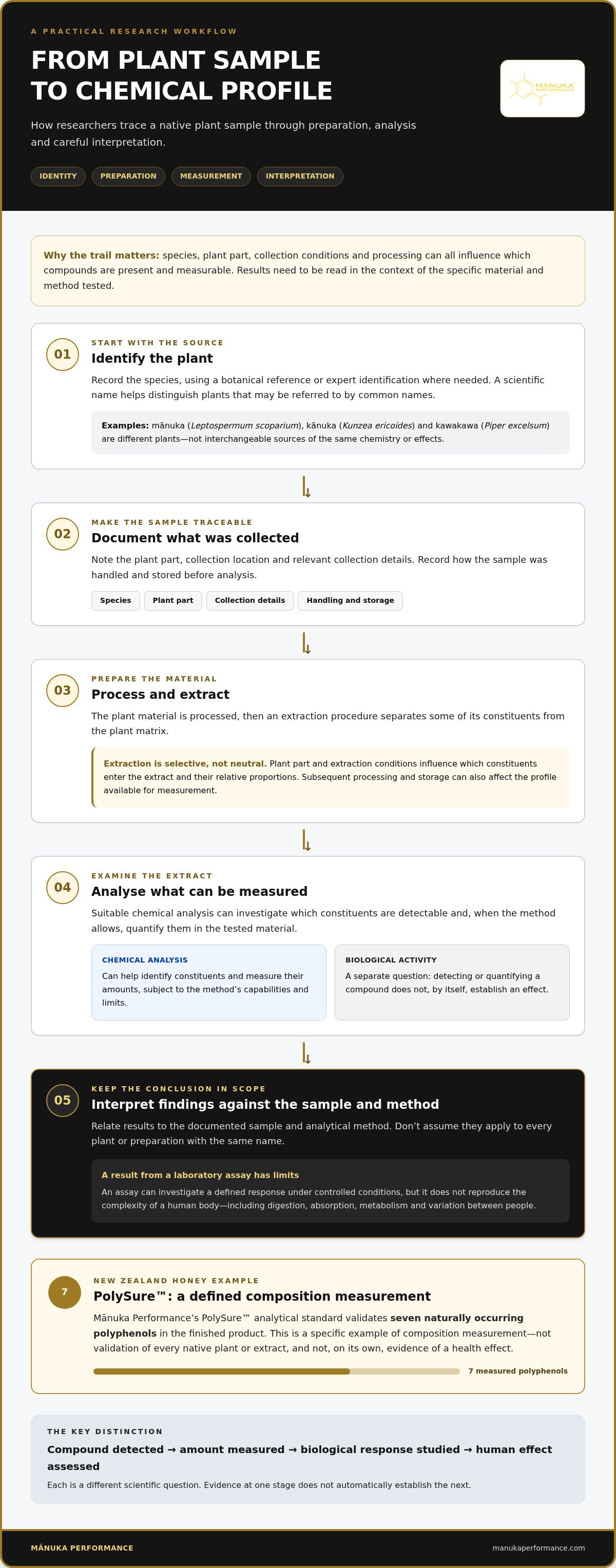
A robust study records what was collected and how it was handled, so results can be interpreted in context and, where possible, compared with other samples. The broad workflow is:
- Identify the plant: Record the species, using a botanical reference or expert identification where needed.
- Document the sample: Note the plant part, collection location and relevant collection details, along with handling and storage before analysis.
- Prepare and extract: Process the material and use an extraction procedure to separate some of its constituents from the plant matrix.
- Analyse the extract: Apply suitable chemical analysis to investigate which constituents are detectable and, when the method allows, their quantities.
- Interpret the findings: Relate results to the documented sample and method rather than assuming they apply to every plant or preparation with that name.
Extraction is selective, not neutral. The plant part and extraction conditions influence which constituents enter the extract and in what relative proportions. Subsequent processing and storage can also affect the profile available for measurement. For this reason, don’t assume that two extracts labelled with the same common plant name are chemically equivalent. Without documented identity and preparation details, differences between results can be difficult to interpret.
What can laboratory tests establish about a bioactive?
Chemical analysis can help identify constituents and quantify them in the tested material, subject to the method’s capabilities and limits. That’s different from testing biological activity. A laboratory assay can investigate a defined response under controlled conditions, but it doesn’t reproduce the complexity of a human body, including digestion, absorption, metabolism and variation between people.
A detected compound establishes its presence in the tested sample, not that consuming it will produce a health effect in people. Evidence for a biological response requires appropriate testing, and findings at one stage shouldn’t be presented as proof at another. A measured concentration describes composition; it isn’t, on its own, evidence of efficacy.
This distinction is central to analytical ingredient development: clear identification and repeatable measurement can make composition easier to interpret, while claims about outcomes require their own evidence. For an example of measurement applied to New Zealand honey phytochemistry, explore Mānuka Performance’s research-driven biotech solutions.
How strong is the evidence behind NZ native plant bioactive claims?
Read evidence at the level where it was generated. Chemical analysis, a laboratory experiment, an animal study and a human trial answer different questions, so a result at one stage isn’t proof at the next. The framework below helps distinguish what a finding supports from what remains uncertain.
| Evidence type | What it can support | What remains uncertain |
|---|---|---|
| Chemical presence | A compound was detected, and possibly quantified, in the sample tested. | Whether it has biological activity in a person, or occurs at the same level in other samples. |
| Laboratory activity | A compound or extract produced a measured response under specific experimental conditions. | Whether the response occurs in the body, at realistic exposure, or leads to a meaningful human outcome. |
| Animal research | A response was observed in a particular animal model under the study conditions. | Whether the result translates to people, including differences in dose, metabolism and biology. |
| Human studies | A measured outcome was observed in people studied, within the limits of the trial design and population. | How robust, relevant and generalisable the finding is, and whether it has been independently replicated. |
What is the difference between a promising result and proven effectiveness?
A promising laboratory result can help researchers form a hypothesis, but it doesn’t establish that an ingredient will produce the same response in people. Confidence depends on study design, the number of participants or samples, whether results were replicated and whether the tested preparation matches the ingredient being discussed. Claims about a particular plant also need to be checked against the relevant research: a finding for one species or extract shouldn’t be generalised to another.
Terms such as “antioxidant” need the same care. They may describe a measured chemical property or a laboratory result, but the word alone doesn’t demonstrate a health effect, therapeutic value or safety. Plant origin is not evidence of efficacy or harmlessness.
How should traditional knowledge and research evidence be discussed?
Mātauranga Māori and customary relationships with plants are important knowledge systems with their own contexts and authority. They shouldn’t be presented as though they were clinical trials, nor dismissed because they answer different questions. Descriptions of customary practice should be informed by appropriate Māori sources and cultural guidance, while claims about tested human outcomes should be supported by relevant human research.
Keep the distinctions explicit: customary knowledge describes relationships, practices and understandings; mechanistic hypotheses propose how an effect might occur; clinical studies examine outcomes in people. These forms of knowledge can be discussed respectfully alongside one another without collapsing their methods or implying that traditional use proves a product’s efficacy. When assessing NZ native plant bioactives, match each claim to the kind of evidence that supports it.
How can you assess the quality and relevance of a native plant ingredient?
Start with traceability, then ask whether composition has been measured in a way that supports comparison. Terms such as “native” and “natural” describe origin or positioning, but they don’t specify what’s in an ingredient, whether batches are comparable or whether a finished product produces a particular outcome. For NZ native plant bioactives, the detail behind the label matters.
What should an ingredient specification make clear?
A clear specification connects the botanical material to the data reported for it. Use this checklist to see whether the information is precise enough to interpret:
- Botanical identity: Is the plant identified by an unambiguous scientific name, rather than a common name alone?
- Source material: Is the plant part stated, with relevant provenance information to distinguish the material from other sources?
- Extraction: Does the description explain how the extract was prepared? Different plant parts and extraction approaches can yield different chemical profiles.
- Measured composition: Are the compounds being measured identified, and is the analytical approach described clearly enough to interpret the result?
- Batch comparison: Are comparable measurements made across relevant batches, so consistency can be assessed rather than assumed?
These details show what was tested and what the result applies to. If botanical identity, preparation or the basis of measurement changes between samples, a difference in reported composition may not reflect a meaningful change in ingredient quality. The samples may simply not be directly comparable.
Why does measurement matter more than a broad ‘natural’ label?
Origin language can tell you where an ingredient comes from, but it can’t describe its chemical composition. Measurement provides a more specific basis for characterising an ingredient and comparing like with like, provided the method and sample are adequately described. It doesn’t, on its own, demonstrate safety, efficacy or a human health outcome. Those questions require evidence suited to the claim, including evidence about the relevant finished product—a principle that applies whether assessing nutritional goods or botanical skincare formulations from House of GRŌ®.
Ingredient quality and product efficacy are related but distinct. A well-characterised ingredient may support consistency in development, yet a composition result doesn’t prove that a finished food or supplement produces a particular effect. Consider the product’s formulation and the evidence for the claimed outcome separately. This measurement-led approach also informs wider sports nutrition biotechnology, where clearer ingredient data can support more precise development without substituting for outcome evidence.
For a related example, consider how composition information for natural honey-based energy gels differs from claims about product performance. Mānuka Performance’s research-driven ingredient development applies measurement to New Zealand honey phytochemistry. Discover its bioactive innovation work.
How does Mānuka Performance apply bioactive measurement to New Zealand honey?
The earlier sections explain why botanical identity, sample preparation and evidence level matter when interpreting plant-derived ingredients. Mānuka Performance applies this measurement-led approach to the phytochemical composition of New Zealand honey, using PolySure™ as a defined analytical standard in its ingredient work. It’s a specific example of characterising composition, not proof of a biological or health outcome.
What does PolySure™ validate?
PolySure™ validates seven naturally occurring polyphenols in the finished product. Its scope is specific: it provides a basis for describing measured composition in that product, rather than relying only on broad origin language. It doesn’t validate every compound in honey, all NZ native plant bioactives or the composition of every plant extract. Nor does validation establish efficacy, safety or a human health benefit.
A standard with a defined scope tells readers which constituents are validated and where they were assessed, in this case, in the finished product. It doesn’t answer every question about the ingredient, but it supports a more concrete account of composition than a general statement that a product contains plant-derived bioactives. Composition data and outcome evidence remain separate parts of the evaluation.
Why connect botanical science with functional ingredient development?
Natural materials can vary, so ingredient development benefits from measurements that clarify what a finished formulation contains. When the measured constituents and the product being tested are clearly specified, composition can be discussed more precisely and compared with greater care. This information can support ingredient characterisation and research-led development, while claims about performance or health still need to be assessed on their own evidence.
Mānuka Performance focuses on New Zealand honey phytochemistry, research-driven bioactive ingredients and biotech solutions. PolySure™ is one example of this approach, not a universal standard for native flora or a proxy for efficacy. The company’s work sits within a broader shift towards precision in sports nutrition, where sports nutrition biotechnology can connect ingredient characterisation with more considered product development.
For readers interested in how measured composition can inform ingredient development, explore PolySure™ bioactive ingredients and research-driven biotech solutions. Its value lies in a clearly defined analytical scope: knowing what has been validated, in which product, and what the measurement does and doesn’t establish.
Make measurement your next step
When assessing a botanical ingredient, look beyond its origin story. Check how its identity and composition are documented, then match each claim to the evidence that supports it. This keeps scientific potential distinct from demonstrated outcomes and gives ingredient developers a clearer foundation for responsible innovation. For NZ native plant bioactives, that precision can make the difference between a compelling description and a claim readers can properly evaluate.
Mānuka Performance is a New Zealand phytochemical innovation company developing research-driven bioactive ingredients and biotech solutions. Its PolySure™ analytical standard validates seven naturally occurring polyphenols in the finished product, a defined example of composition measurement rather than proof of a health or performance effect.
Explore how analytical standards can inform ingredient development and product characterisation. Explore Mānuka Performance’s PolySure™ bioactive ingredients and research-driven solutions.
Frequently Asked Questions
What are NZ native plant bioactives?
NZ native plant bioactives are naturally occurring plant compounds studied for biological activity; the term doesn’t establish a health benefit. A plant is the source, while an extract is material prepared from it and may contain several compounds. For example, identifying mānuka as Leptospermum scoparium is more specific than labelling an ingredient simply “native plant extract”, but its composition can still vary with plant part and processing.
Are all natural plant bioactives proven to have health benefits?
No. A compound’s natural origin, or its detection in a plant, doesn’t show that it benefits people. Chemical analysis can identify a constituent, while laboratory research may examine activity under controlled conditions; neither alone establishes a human outcome. When assessing a claim, check whether studies tested the same species, preparation and intended use, and whether the evidence relates to people rather than a proposed mechanism or an early-stage result.
Can processing change the bioactive composition of a native plant extract?
Yes. The plant material and processing conditions can affect which compounds are extracted or remain measurable, but the direction and scale of any change depend on the specific material and method. A useful comparison needs more than a shared plant name: look for records of the plant part, sample preparation and extraction approach. Without those details, differences between reported profiles may be difficult to interpret reliably.
How do researchers measure bioactive compounds in plant ingredients?
Researchers identify the botanical material, prepare a sample and select an analytical method suited to the compounds and question being studied. A method may detect a compound or estimate its amount within defined limits, but the result applies to the sample tested. It doesn’t establish how the compound is absorbed, what it does in the body or whether it produces an effect in people. Those questions require different evidence.
What is the difference between a plant extract and a standardised ingredient?
An extract is material obtained from plant matter and may contain a mixture of constituents. A standardised ingredient is characterised against stated measurements or specifications, which can make comparisons more meaningful when samples are assessed on a comparable basis. Standardisation doesn’t necessarily measure every compound, and it isn’t proof of a health or performance outcome. Its practical value depends on which characteristics the specification defines and measures. For consumers exploring targeted wellness options, such as women's health formulations from Nutrahara, reviewing these ingredient specifications ensures transparency around what each product actually delivers.
Does PolySure™ measure every bioactive in New Zealand honey?
No. PolySure™ validates seven naturally occurring polyphenols in the finished product. That defined scope supports characterisation of those polyphenols, not a claim that every bioactive in New Zealand honey has been measured. It also doesn’t establish a therapeutic, health or athletic-performance outcome. When interpreting a validation statement, distinguish the constituents it covers from broader claims about a product or its effects.