


The best post-run choice for glycogen replenishment for runners isn’t a single “recovery food”. It depends on how demanding the session was and when you’ll run again. A banana, a bowl of rice or a glass of milk can all contribute carbohydrate, but their value depends on how they fit your overall recovery needs.
If you’re unsure which everyday foods count, or have heard conflicting advice about eating immediately after a run, the practical answer is more flexible than a rigid 30-minute rule. Carbohydrate provides the substrate for restoring muscle glycogen, while protein plays a separate role in supporting muscle repair. The timing and amount that make sense depend on training load, your next session and your appetite.
This guide explains glycogen replenishment, compares familiar recovery foods by their carbohydrate contribution and practical advantages, and shows how to match your choice to the work ahead. It also distinguishes carbohydrate consumed during endurance exercise from food eaten afterwards, so you can make a considered recovery decision without searching for one perfect option.
Key Takeaways
- Glycogen replenishment for runners depends on session demands and how soon your next demanding workout begins, rather than one perfect recovery food.
- Assess your training schedule first, then choose a practical carbohydrate source and include complementary protein as part of your wider recovery meal or snack.
- Compare familiar options by their carbohydrate contribution, portability and appeal after a run, so your choice works in practice.
- Build a flexible approach around your running week, adjusting food choices to the workload, recovery time and what’s accessible.
- Separate during-run fuelling from post-run recovery: LiquidFuel 10-Pack Running Gel is convenient endurance carbohydrate fuel, while recovery food serves a different role.
Glycogen replenishment for runners: what it is and when it matters
Muscle and liver glycogen are carbohydrate stores that help meet the body’s energy needs during exercise. Muscle glycogen supplies working muscles locally, while liver glycogen helps maintain glucose in the bloodstream for use by tissues, including the brain and exercising muscles. Together, these stores support running, but they’re not an unlimited fuel reserve.
Glycogen replenishment is the process of restoring carbohydrate stored as glycogen in the muscles and liver after exercise. It mainly involves consuming carbohydrate that the body can use to rebuild those stores. The overview of Glycogen explains its role as a glucose-storage form in both tissues. Replenishing carbohydrate is one part of recovery, not a substitute for replacing fluid lost in sweat or meeting protein and overall energy needs.
How running uses stored carbohydrate
Running draws on both carbohydrate and fat, with the balance shaped by pace, duration and training status. As intensity rises, the body relies more heavily on carbohydrate to supply energy at a faster rate. As a session continues, stored carbohydrate can become increasingly relevant. The joint position statement from the Academy of Nutrition and Dietetics, Dietitians of Canada and the American College of Sports Medicine discusses how carbohydrate availability supports exercise performance.
The amount used varies. Two runners completing the same distance may have different demands because of differences in pace, conditioning, terrain and session conditions. That’s why glycogen replenishment for runners is best considered in the context of the training plan, rather than judged by distance alone.
When post-run replenishment deserves priority
After a short, easy run followed by a rest or light day, ordinary meals across the day will generally contribute to restoring carbohydrate stores. An immediate specialised snack isn’t automatically necessary. The decision changes after a long or hard effort, or when another demanding workout is scheduled soon. With less time before the next session, a carbohydrate-containing meal or snack becomes a more deliberate priority.
Assess the next workout as well as the run you’ve just completed. A steady recovery jog followed by a rest day presents a different fuelling context from intervals in the evening followed by a quality session the next morning. Replenishment is only one recovery consideration: fluids support rehydration, while protein and a balanced diet contribute to broader nutritional needs.
Post-run recovery is also different from pre-event carbohydrate loading. Loading is a planned strategy to increase carbohydrate availability before selected endurance events, not a routine meal required after every run. The carbohydrate loading protocol for endurance athletes concerns preparation before competition, while this section focuses on restoring stores after training.
How glycogen replenishment works after a run
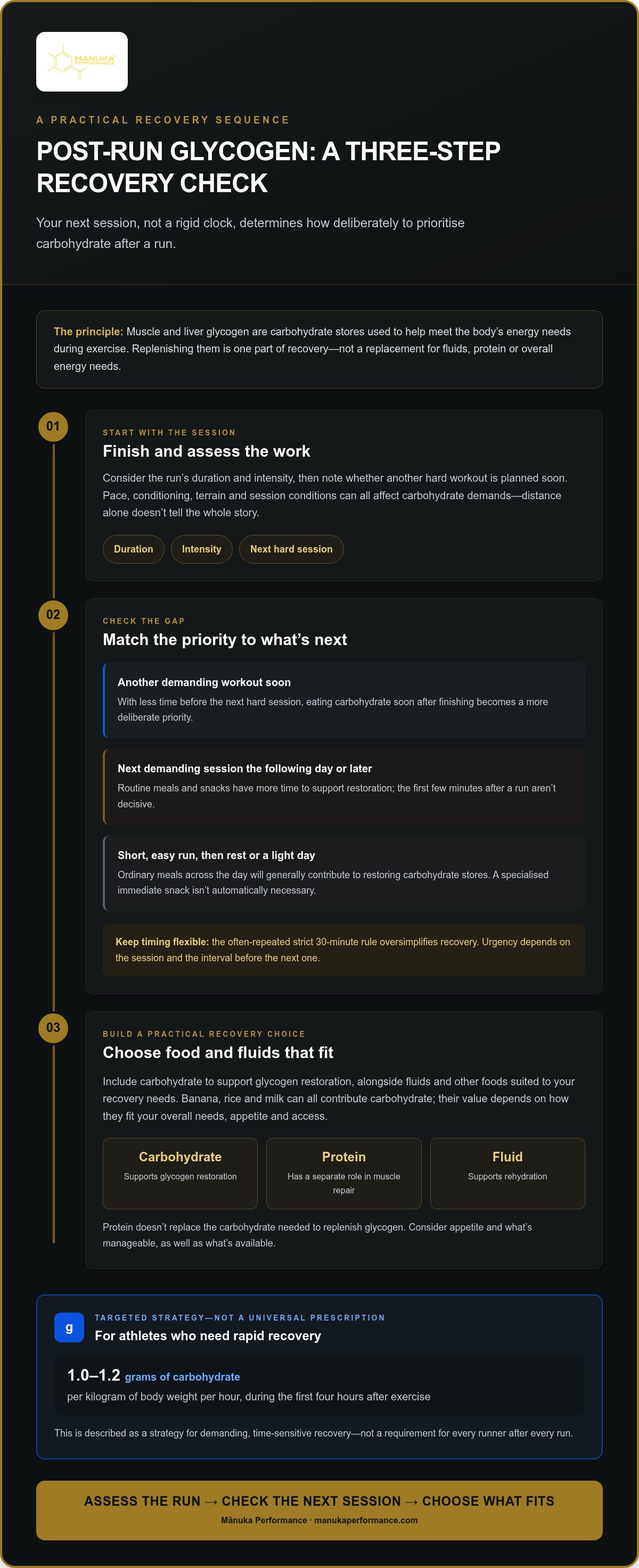
Post-run recovery is a sequence of decisions, not a race to eat a particular food. First, consider how demanding the session was and when your next demanding workout is scheduled. Then choose food and fluids that fit the time available, your appetite and what you can access. This makes glycogen replenishment for runners responsive to training demands, rather than governed by one rule for every run.
- Finish and assess. Consider the session’s duration and intensity, and whether you have another hard workout planned soon.
- Set the recovery priority. A short gap before the next demanding session makes prompt carbohydrate intake more relevant than a rest day or easy session ahead.
- Choose a practical recovery option. Include carbohydrate to support glycogen restoration, alongside other foods and fluids suited to your recovery needs.
Why timing depends on the next session
When hard sessions are closely spaced, there’s less time for routine meals to contribute to replenishment before the next workout. That makes eating carbohydrate soon after finishing a more practical priority. If your next demanding session is the following day or later, routine meals and snacks have more time to support restoration. You don’t need to treat the first few minutes after a run as decisive.
For athletes who need rapid recovery, the joint position statement from the Academy of Nutrition and Dietetics, Dietitians of Canada and the American College of Sports Medicine describes consuming 1.0-1.2 grams of carbohydrate per kilogram of body weight per hour during the first four hours after exercise. Treat this as a targeted strategy for demanding, time-sensitive recovery, not a universal prescription. The often-repeated idea that every runner must eat within a strict 30-minute window oversimplifies the evidence: urgency depends on the session and the interval before the next one.
Carbohydrate, protein and fluid have different roles
Carbohydrate is the primary dietary substrate for restoring glycogen. Protein has a distinct role in post-exercise recovery, including supporting muscle protein synthesis. It can be included in a meal or snack, but it doesn’t replace the carbohydrate needed to replenish stores. After an evening interval session, for example, you might choose a carbohydrate-rich meal with a protein-containing component, while considering what will be manageable before bed.
Fluid needs also depend on the session. Heat, duration, clothing and individual sweat losses affect how much fluid a runner may need, so a fixed amount won’t suit everyone. Drink in response to thirst and conditions, and pay attention to substantial fluid losses after a long or hot run. Food and drink can both contribute to overall recovery, but replacing glycogen, supporting muscle repair and rehydrating are related, separate tasks.
For sessions that require carbohydrate during the run, keep that fuelling distinct from post-run food. Mānuka Performance’s honey-based running energy gels are convenient endurance fuel, not a recovery treatment.
Post-run recovery foods compared for glycogen replenishment
No single food is automatically best after every run. Compare options by the carbohydrate they provide, whether they include protein, how they fit your appetite and how practical they are to prepare or carry. Portions and products vary, so the table describes each option qualitatively rather than assigning nutrient totals. Check food labels or a reliable food-composition source when you need specific figures.
| Food option | Carbohydrate contribution | Protein contribution | Fluid and convenience |
|---|---|---|---|
| Cereal with milk | Usually comes mainly from the cereal, with the amount depending on type and serve. | Milk contributes protein; cereal varies. | Quick to assemble at home; milk adds fluid. |
| Yoghurt with fruit | Fruit and yoghurt contribute carbohydrate in amounts that vary by selection. | Yoghurt contributes protein, with variation between types. | Soft and simple to portion; portable if kept appropriately chilled. |
| Rice-based meal | Rice provides the meal’s main carbohydrate component. | Add eggs, tofu, fish, chicken or another protein food as preferred. | More substantial and easy to adapt with available ingredients; not usually as portable as a snack. |
| Sandwich | Bread supplies carbohydrate; fillings and bread type change the total. | Egg, cheese, tuna or other fillings can contribute protein. | Easy to prepare ahead and carry; fluid needs a separate drink. |
These comparisons help you choose a workable carbohydrate source for glycogen replenishment, rather than suggesting that food categories are nutritionally identical. For exact carbohydrate or protein amounts, use the actual serving size and product information. A small bowl and a large bowl, for example, won’t provide the same intake.
Convenient options when appetite is low
After a hard session, a large meal may feel less appealing than a smaller, softer option. Cereal with milk or yoghurt with fruit can be easier to portion and eat gradually, while a drink alongside either can contribute fluid. These are practical choices, not guaranteed to suit every runner. Familiarity, preference and availability matter. If your appetite returns later, a more substantial meal can follow.
Everyday meals for a longer recovery period
When you have time to prepare a meal, combine a familiar carbohydrate food with a protein-containing ingredient. Rice with eggs or tofu, or a sandwich with tuna or cheese, uses ordinary foods and can be adjusted to your appetite and what’s in the pantry. A meal can also contribute fluid, but shouldn’t be assumed to replace what was lost during a hot or lengthy session.
Keep the purpose of each choice clear: recovery meals provide food after running, while gels are designed as convenient carbohydrate fuel during endurance exercise. The distinction is explored in this analysis of honey-based energy gels and performance.
Build a glycogen replenishment plan around your running week
A useful plan starts with the work ahead, not a fixed post-run menu. Consider how demanding the completed session was, how soon the next demanding workout begins and what food you can realistically access. This turns glycogen replenishment for runners into a repeatable training decision, while leaving room for appetite, schedule and personal preference.
- Assess the session. A long run or high-intensity workout generally gives you more reason to prioritise carbohydrate than a relaxed, low-intensity run.
- Check the turnaround. A short interval before another demanding session makes prompt access to food more useful; a longer gap gives routine meals more opportunity to contribute.
- Choose what’s practical. Select a familiar carbohydrate food, add a protein source where it suits the meal, and account for fluid according to the session and conditions.
Choose food according to training demand
After a relaxed run with no hard session planned soon, you might continue your normal eating pattern and include a carbohydrate-containing meal when it fits the day. There’s no need to make every easy run a specialised recovery event. After a demanding morning session followed by another quality workout later, planning food between sessions becomes more important. A rice-based meal with eggs, or toast with yoghurt and fruit, could provide a practical combination of carbohydrate and protein.
Think across the training week, too. Consistent meals that reflect your workload are more useful than searching for one supposedly perfect recovery meal after a single run. Exact quantities depend on body size, training demands and overall intake. Numerical targets should be checked against current sports nutrition evidence and individual needs rather than applied as a universal menu.
Account for appetite, tolerance and preparation
Appetite and food preferences can vary after exercise, so keep more than one format in mind. A soft snack, a drink alongside food or a familiar meal may each be workable, depending on what feels appealing and what’s available. These are options to test in ordinary training, not claims that one texture or food will suit every runner.
Before key sessions, make food easier to access by keeping a few familiar choices on hand, such as bread, cereal, fruit, yoghurt or ingredients for a simple meal. This reduces last-minute guesswork without imposing a rigid schedule. If food choices around running raise gut-comfort questions, this scientific guide to runners’ stomach issues provides related context.
For example, after an easy lunchtime jog with a rest day ahead, you could return to your usual lunch routine. After a demanding double-session day, you could plan a carbohydrate-containing snack or meal between workouts, then eat a familiar dinner afterwards. The aim is to fit food to the training schedule, not force a single formula.
For convenient carbohydrate during endurance sessions, explore honey-based running fuel, keeping in-run fuelling distinct from the meals and snacks used after training.
Where endurance fuel fits alongside post-run recovery foods
Carbohydrate has a role both during and after a run, but the timing and purpose differ. During a long endurance session, a runner may use carbohydrate fuel to support intake while exercising. After the run, food contributes to replenishing glycogen and meeting broader dietary needs. Treating these as separate parts of a training plan helps keep glycogen replenishment for runners grounded in the session, rather than assuming one product or meal serves every purpose.
During-run fuel is not a substitute for a recovery meal
A gel is a portable way to consume carbohydrate during endurance exercise, where it may suit a runner’s fuelling plan and individual needs. It isn’t a meal, and using fuel during a run doesn’t remove the need to consider post-run food. After finishing, choose a meal or snack based on the completed session, the time until your next demanding workout, your appetite and the rest of the day’s eating.
That distinction matters even though the same nutrient, carbohydrate, appears in both choices. In-run fuel is consumed during exercise, while a recovery meal is part of the wider process of replenishment afterwards. A gel shouldn’t be presented as restoring glycogen better than ordinary foods, or as replacing protein-containing foods or fluids where those are needed.
A measured approach to natural endurance fuel
Mānuka Performance’s LiquidFuel 10-Pack Running Gel is convenient endurance carbohydrate fuel. Its New Zealand honey-based matrix contains naturally occurring glucose and fructose. PolySure™ validates seven naturally occurring polyphenols in the finished product. This describes product composition and validation, not a recovery outcome or guarantee of performance.
As with any fuelling choice, whether a gel suits a particular session depends on the runner’s plan, needs and preferences. It belongs in the during-run context, rather than being treated as a post-run recovery food.
For example, a runner completing a long session might plan carbohydrate intake while running, then have a separate meal afterwards that reflects their next workout and overall diet. Another runner finishing an easy session may rely on their usual meals. These choices don’t need to be identical: duration, intensity, schedule and food access all shape the plan.
Keeping the distinction clear also helps avoid overcomplicating recovery. Choose endurance fuel for the demands of the run itself, then assess post-run food on its own merits. That could mean a familiar meal, a snack, or a combination of foods and fluids that fits the training day.
To explore a convenient option for carbohydrate fuelling during endurance exercise, explore Mānuka Performance endurance fuel. Use it as part of an in-run fuelling plan, not as a substitute for post-run recovery food.
Make your next recovery choice part of the training plan
Use your next few runs to observe how different recovery choices fit your schedule, appetite and training demands. A simple note of the session, time until your next workout and what you chose to eat can help you recognise practical patterns without turning every meal into a calculation. Adjust as the week changes: the approach that suits a relaxed run may not suit a demanding session.
That flexible mindset is central to glycogen replenishment for runners. Rather than chasing a perfect food or rigid timing rule, build a routine you can apply consistently and refine in response to your training. Keep endurance fuel and post-run meals in their distinct roles, and choose each with a clear purpose.
For carbohydrate fuel during endurance sessions, explore Mānuka Performance endurance fuel. Choose fuel for the run and recovery food for afterwards, then adapt both to your training week.
Frequently Asked Questions
How soon should runners eat after a run to replenish glycogen?
Eat sooner when the run was demanding and another hard session is scheduled within a short turnaround; otherwise, your next regular meal may be sufficient. There isn’t one narrow post-run window that matters equally to every runner. Someone finishing intervals before an evening workout, for example, has more reason to plan a carbohydrate-containing snack than someone completing an easy run before a rest day. Let your schedule guide the urgency.
Can ordinary food replenish glycogen as effectively as a recovery product?
Yes, ordinary carbohydrate-containing foods can contribute to glycogen restoration; a specially marketed recovery product isn’t inherently required. A meal built around bread, rice, potatoes, fruit or cereal can provide carbohydrate, with other ingredients added to suit broader nutritional needs. The relevant comparison is the amount of carbohydrate you actually eat and whether the choice fits your schedule and appetite, not whether it carries a sports nutrition label.
What happens if I do not eat after a long run?
Skipping food immediately after one long run doesn’t mean your body cannot recover, but it may delay carbohydrate intake and leave less time to replenish before your next demanding session. If appetite is low, start with a manageable snack or drink and have a fuller meal later. Also consider fluids, especially after a hot or lengthy run. Persistent difficulty eating enough around training is a reason to seek individual sports nutrition advice.
Do runners need carbohydrates after every workout?
No. The need depends on the workout and the rest of your training schedule. After an easy session with no demanding workout soon afterwards, regular meals across the day may provide enough carbohydrate without a dedicated recovery snack. After long intervals, a race or closely spaced sessions, planning a carbohydrate source becomes more useful. Consider the whole day’s intake and training load rather than treating every run as an identical fuelling event.
Can a low-carbohydrate diet replenish glycogen for running?
Glycogen can still be restored when carbohydrate intake is limited, but the available dietary carbohydrate for replenishment is lower. This may not align well with the demands of frequent, long or high-intensity running. If you’re considering a low-carbohydrate approach, account for performance goals, total energy intake and training frequency, rather than assuming food timing can fully compensate. For personalised guidance, consult a registered dietitian with sports nutrition experience.
Is glycogen replenishment the same as carbohydrate loading?
No. Glycogen replenishment means restoring carbohydrate stores after exercise as part of routine training recovery. Carbohydrate loading is a planned strategy used before selected endurance events to increase carbohydrate availability for competition. It isn’t necessary after every run and doesn’t replace appropriate everyday eating. A runner returning to normal training after a weekend event, for instance, has a different objective from an athlete preparing for a targeted race.
Which recovery foods are suitable for runners who do not eat dairy?
Choose familiar carbohydrate foods and pair them with a non-dairy protein option if it suits your diet. Examples include rice with tofu or eggs, a bean-filled wrap, toast with nut butter, or cereal served with a fortified plant-based drink. Check labels, as protein and carbohydrate content vary between products, and some plant-based drinks contain little protein. The best fit depends on your dietary requirements, preferences and access to food after training.
Can an energy gel replace a post-run meal?
An energy gel is designed as convenient carbohydrate fuel during endurance exercise, not as a complete post-run meal. It may contribute carbohydrate, but it doesn’t by itself provide the range of foods a meal can offer or address every recovery need. After a run, decide what to eat based on your next session and overall intake. A gel consumed during a long effort shouldn’t be treated as a substitute for planned food afterwards.