


What if the best choice isn’t the gel with the most carbohydrates, but one that fits a fuelling plan you can repeat? Choosing energy gels for cycling can feel complicated: products vary in carbohydrate content, sources and texture, while your own response is personal.
Look beyond the number on the front of the packet. A gel is one part of your ride fuel, and its usefulness depends on ride length and intensity, what else you’re consuming and how comfortably you tolerate it. Hydration matters too, particularly when planning how a gel fits alongside water or other fluids.
This guide covers when gels can be practical, how to compare carbohydrate information and formats, and how to test your approach during training before relying on it at an event. It also looks at honey-based endurance gels as one option in the wider cycling category. The aim is a straightforward plan shaped around your ride and your own tolerance.
Key Takeaways
- Assess energy gels for cycling as part of your overall fuelling plan. Ride duration, intensity and access to other food all affect how useful they are.
- Compare carbohydrate quantity, texture, packaging and flavour on the label. Treat caffeine as an optional feature, not a requirement.
- Trial one change at a time on a training ride, note how it feels and adjust gradually before event day.
- Plan how gels fit with your other fuel and fluids rather than treating a gel as a complete fuelling strategy.
- Honey-based gels are one option in the wider category. Mānuka Performance’s LiquidFuel 10-Pack Running Gel is developed for endurance athletes, and PolySure™ validates seven naturally occurring polyphenols in the finished product.
What are energy gels for cycling, and when are they useful?
Energy gels for cycling are portable carbohydrate products designed to support fuelling during exercise. They provide carbohydrate in a compact format that’s easy to carry and use when stopping to eat is inconvenient. The broader Energy gel category includes products with different ingredients and consistencies, so check the label and consider your own experience rather than judging by format alone.
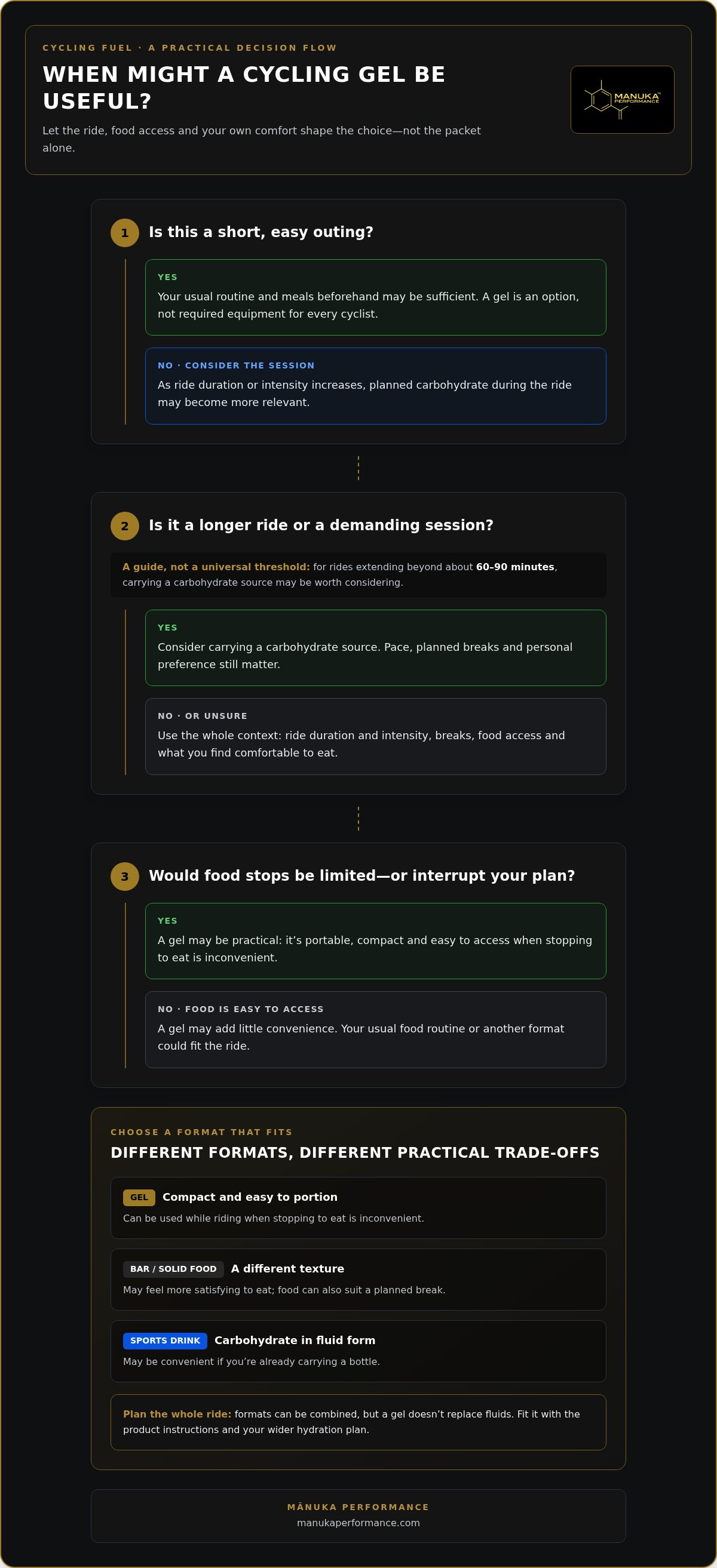
A gel’s usefulness depends on the ride, not simply on the fact that you’re cycling. For a short, easy outing, your usual routine and meals beforehand may be sufficient. As duration or intensity increases, planned carbohydrate during the ride may become more relevant. Access to cafés, shops or food stops, space in your jersey or bike bag, and what you find comfortable to eat all affect your choice. A gel is an option, not required equipment for every cyclist.
Which cycling sessions may benefit from carrying gels?
Gels can be practical on longer rides or demanding sessions when you want fuel that’s portable and easy to access. They may also suit event routes with limited food stops, or where stopping would interrupt your plan. For rides extending beyond about 60-90 minutes, carrying a carbohydrate source may be worth considering. Treat this as a guide, not a universal threshold: your pace, planned breaks and personal preference matter too.
Consider the logistics as well as the duration. A gel takes little space, but a longer ride may call for several fuel sources, so carrying capacity can shape what’s realistic. For a relaxed ride with easy access to food, a gel may add little convenience. During a sustained effort, it can be another manageable option.
How do gels fit alongside food and sports drinks?
Gels are compact and easy to portion. Bars and other solid foods offer a different texture and may feel more satisfying to eat. Sports drinks provide carbohydrate in fluid form, which can be convenient if you’re already carrying a bottle. These formats can be combined: you might eat during a break, use a gel while riding or include a drink in your planned intake.
Choose a combination that suits the session and that you can comfortably carry and consume. A gel doesn’t replace fluids, and how it fits with drinking depends on its instructions and your wider hydration plan. For ingredient-specific context, read this analysis of natural honey-based energy gels, which explores honey as one carbohydrate source in endurance products.
How do cycling energy gels deliver carbohydrate during a ride?
During exercise, the body can use carbohydrate to produce energy. Carbohydrate oxidation describes the processes through which the body breaks down carbohydrate for use as fuel. A gel supplies carbohydrate in a compact, ready-to-consume form, but it doesn’t work independently of your overall intake, effort or individual response. For an accessible overview of how energy gels work, Cleveland Clinic explains their role in fuelling longer exercise.
What do glucose, fructose and glycogen mean for cyclists?
Glucose and fructose are different simple sugars that may be included in endurance-fuelling products. Glycogen is carbohydrate stored in the muscles and liver, which the body can draw on during activity. These terms relate to carbohydrate fuelling, but they aren’t interchangeable: sugars are listed as ingredients or carbohydrate sources, while glycogen refers to the body’s stored supply.
Some products combine glucose and fructose, sugars handled through different intestinal transport pathways. This formulation detail helps describe a product’s carbohydrate composition, but it doesn’t predict how a particular cyclist will tolerate it. For energy gels for cycling, the stated carbohydrate quantity tells you how much carbohydrate a serving provides. It doesn’t, on its own, establish a specific performance benefit or guarantee an individual outcome.
What can a gel label tell you about its formulation?
Check the current packaging for carbohydrate per serving, the ingredient list and the manufacturer’s serving instructions. These details show what you’re consuming and how the product is intended to be used. Formulations and quantities vary, so don’t assume two sachets provide the same amount just because both are called gels.
“Dual-source” generally describes a formulation with more than one carbohydrate source, often glucose and fructose. It describes the ingredients, not a promise of easier digestion or a better response for every rider. Compare the label with the rest of your fuelling plan, and try the product in training before relying on it during an event.
For example, Mānuka Performance’s honey-based gels use a New Zealand honey matrix containing naturally occurring glucose and fructose. The company’s PolySure™ standard validates seven naturally occurring polyphenols in the finished product. This is analytical validation of composition, not evidence of a particular cycling performance effect. Explore Mānuka Performance honey-based sports gels as one formulation within the wider endurance-fuelling category.
How should cyclists compare energy gel formats and formulations?
Compare what a product provides and how you’ll use it, rather than relying on front-of-pack terms alone. Labels help you assess carbohydrate quantity, ingredients, texture and caffeine status. Taste preferences and tolerance are personal, and neither a formulation description nor a high carbohydrate figure guarantees a particular performance outcome.
| Feature | What to check | Practical consideration |
|---|---|---|
| Carbohydrate quantity | Grams per serving and the serving size | Use the figures to account for the gel within your planned fuelling, rather than comparing sachets by appearance. |
| Texture and format | Whether it’s runny, thick or described as isotonic or concentrated | Consider how easily you can consume it while riding and whether the instructions mention accompanying fluid. |
| Packaging | How it opens, closes and fits in your pocket or bag | Packaging that’s manageable on the move may matter during a long ride or event. |
| Flavour | Flavour options and ingredient details | A taste you’re comfortable with can make the product easier to include in a training plan. |
| Caffeine | Whether caffeine is present and the amount stated on the label | Treat caffeine as a separate preference, not a necessary part of carbohydrate fuelling. |
What distinguishes isotonic, concentrated and standard gel formats?
These terms can indicate differences in a product’s consistency or formulation, but naming conventions aren’t consistent across brands. A concentrated gel may be thicker or provide more carbohydrate per serving. An isotonic label may describe a formulation intended to be consumed differently from a more concentrated one. Don’t infer exact carbohydrate content or fluid needs from the name: check the current label and follow its directions.
Fluid requirements vary with the ride and the individual, so the format alone can’t tell you how much to drink. Check whether the product instructions recommend water alongside it, then consider how it fits your overall drinking plan.
Should cyclists choose caffeinated or non-caffeinated gels?
Caffeine status is separate from a gel’s carbohydrate sources: a product can contain carbohydrate with or without caffeine. If you’re considering a caffeinated option, read the label and account for other caffeine sources you consume. Tolerance differs between riders. If you have relevant medical considerations, seek advice from a qualified health professional before using caffeine during exercise. Caffeine isn’t required for carbohydrate fuelling.
Comparison rule: Choose energy gels for cycling based on your session needs, clear label information and a flavour and format you’ve tested in training. Treat label facts as product specifications, then judge taste and tolerance through your own experience.
How can you practise using energy gels on training rides?
A gel that looks suitable on the label still needs to work within your routine. Practise during training so you can assess the product and your fuelling approach without introducing an untested choice on event day. Gastrointestinal comfort varies between cyclists, and no gel can be assumed to prevent discomfort for everyone.
How do you test a gel without changing everything at once?
Use a simple, repeatable process to make your observations easier to interpret:
- Review the label. Note the carbohydrate quantity, ingredients and serving instructions, including any guidance about fluid.
- Test one change. Try the gel on a familiar training ride while keeping your other food and drink as consistent as practical. Avoid changing the product, timing and overall intake all at once.
- Record the details. After the ride, write down the product, when you used it, other food and fluid, ride conditions and how you felt during and afterwards.
- Adjust gradually. If the experience was comfortable, repeat the same approach before changing another variable. If it wasn’t, review your notes and make one measured adjustment on a later ride.
Practise with the same product and carrying method you plan to use at an event. Opening a sachet, stowing it and accessing it while riding are all part of the routine. For a deeper discussion of gastrointestinal tolerance, read this scientific guide to gastrointestinal resilience. Stop using a product and seek qualified medical advice if symptoms are severe or persistent.
How should ride conditions affect your fuelling practice?
Use training to reflect the demands you expect to face. A longer or harder ride may need a different plan from an easy outing, while weather, food stops and carrying capacity can affect what’s practical. Plan hydration separately from gel selection. Fluid amount and timing depend on individual needs and conditions, so follow appropriate current guidance rather than assuming a gel determines how much you should drink.
For energy gels for cycling, the goal is a familiar, repeatable plan, not a last-minute experiment. Explore Mānuka Performance’s honey-based sports gels as an option to assess during training, using the product label to guide your trial.
How does Mānuka Performance fit into the cycling energy gel conversation?
Mānuka Performance is a New Zealand functional nutrition company developing honey-based sports nutrition for endurance athletes. Its place in the wider conversation about energy gels for cycling is best understood through its ingredients and product purpose, rather than assuming one fuel source suits every rider. The company’s flagship LiquidFuel 10-Pack Running Gel is a running gel developed for endurance athletes. Cyclists considering it should assess its current label and instructions, as they would any product they plan to trial.
What is distinctive about Mānuka Performance’s honey-based approach?
The gel’s New Zealand honey-based matrix contains naturally occurring glucose and fructose. This describes the carbohydrate sources in the formulation; it doesn’t establish how an individual cyclist will respond or demonstrate a specific cycling outcome. As with other endurance fuels, product composition is one part of the decision, alongside label information, intended use and personal experience.
For a closer look at the evidence and comparisons behind this ingredient approach, read the comparative analysis of whether honey energy gels work. It offers further context for readers who want to examine honey-based gels beyond broad category descriptions.
What does PolySure™ validation establish?
PolySure™ is an analytical standard that validates seven naturally occurring polyphenols in the finished product. This provides information about measured product composition. It should be distinguished from evidence of a health or performance benefit: quantifying polyphenols doesn’t establish that they cause a particular outcome during cycling or predict an individual rider’s experience.
This distinction is useful when comparing sports nutrition products. Ingredient provenance and analytical validation can inform what a product contains, while fuelling suitability is assessed separately through the label and a rider’s own testing. The LiquidFuel 10-Pack Running Gel is presented as an endurance running product, not a cycling-specific formulation or a universal recommendation for cyclists.
To learn more about the research-led approach behind its honey-based endurance fuel, explore Mānuka Performance.
Build a fuelling approach you can trust
Choosing energy gels for cycling is less about finding a universal winner and more about matching a product to your ride, reading its label and testing your plan in training. Compare carbohydrate quantity, format and instructions, then consider how each option fits alongside your other food and fluids. A familiar product and a practised carrying routine can make event-day fuelling more predictable.
Mānuka Performance brings a New Zealand honey-based matrix, containing naturally occurring glucose and fructose, to its endurance sports nutrition. Its PolySure™ analytical standard validates seven naturally occurring polyphenols in the finished product. This describes composition, not proof of a specific cycling performance outcome, so assess the gel by its label, intended use and your own experience.
Explore Mānuka Performance’s research-led approach to honey-based endurance fuel. Start with a manageable training trial, adjust gradually and carry forward what works for you. With a considered plan, you can focus more confidently on the ride ahead.
Frequently Asked Questions
Are energy gels good for cycling?
Energy gels can be a convenient carbohydrate source during longer or more demanding rides, but they aren’t necessary for every cyclist or session. Their usefulness depends on ride duration and intensity, access to food, what else you’re consuming and personal preference. Compare the carbohydrate amount on the label with your overall fuelling plan, then test the product during training. A gel is one option alongside drinks and solid foods, not a universally superior choice.
When should you take an energy gel during a bike ride?
Timing depends on your ride and fuelling plan, so there’s no single schedule for everyone. General guidance suggests taking a first gel after around 35-60 minutes of riding, then considering further fuel at intervals. Adapt this to the session and your tolerance. Account for carbohydrate from all sources, including drinks and food, and follow the product’s serving instructions. Practise your timing on training rides rather than trying a new routine at an event.
Do you need to drink water with energy gels?
Gels don’t all have the same instructions, so check the current product label for fluid guidance. Some products may be intended to be consumed with water, while others are formulated differently. Hydration needs also depend on the ride and conditions, so don’t use the gel alone to decide how much to drink. Practise your chosen combination of fuel and fluid during training, and adjust to your needs and the label directions.
How many energy gels should you take on a long ride?
Base the number on your carbohydrate target for the ride and the amount in each gel, not on a fixed gel count. General guidance suggests 30-60 g of carbohydrate per hour for exercise lasting 1-2.5 hours, and up to 90 g per hour for longer sessions. Include food and drinks in that total. Check the label for grams per serving, then build and practise a plan that suits your duration, intensity and tolerance.
Can energy gels upset your stomach while cycling?
Yes. Some cyclists may experience gastrointestinal discomfort, and responses differ between products and situations. Ingredients, carbohydrate amount, timing and what else you consume may all be relevant, so don’t assume a gel will prevent stomach problems. Trial one product at a time on training rides and keep notes on your fuel, fluids and how you feel. Stop using a product and seek qualified medical advice if symptoms are severe or persistent.
What is the difference between isotonic and regular energy gels?
“Isotonic” generally describes a gel formulated to have a similar concentration of dissolved particles to body fluids, while “regular” is a broad term rather than a precise formulation standard. Product naming can vary, so don’t infer carbohydrate quantity or fluid requirements from the name alone. Compare the label’s carbohydrate content and serving instructions, including any advice about drinking water. Test the format in training to learn whether its texture and use suit your ride.
Are caffeinated energy gels better for cycling?
No. Caffeinated gels aren’t automatically better; caffeine is optional and separate from the carbohydrate formulation. Whether to use one depends on your preferences, caffeine tolerance and overall intake from other sources. Read the label for caffeine content, and trial any caffeinated product during training rather than introducing it on event day. If you have a medical condition, take medication or are unsure whether caffeine is appropriate for you, seek advice from a qualified health professional.