


A honey can contain measurable polyphenols without those compounds being bioavailable. The distinction matters: a laboratory result showing what’s present in a product doesn’t, by itself, show what the body absorbs or how the compounds are metabolised.
It’s easy to treat polyphenol content and bioavailability as interchangeable, particularly when product claims cite precise measurements. But the evidence covers several stages, from a compound’s presence in honey through digestion and metabolism to its detection in the body. Each stage needs a different method. Results from test-tube assays or simulated digestion can’t automatically be applied to people.
This article explains what bioavailable honey polyphenols means, how researchers assess their journey through digestion and metabolism, and what analytical measurements can establish. You’ll learn how chemical profiling, in vitro testing and measurements of metabolites in blood or urine answer different questions, where their limits lie, and how to assess claims without confusing quantified content with absorption or demonstrated effects.
Key Takeaways
- Distinguish polyphenols measured in honey from compounds released during digestion, absorbed, metabolised or shown to have biological activity.
- Follow the evidence pathway for bioavailable honey polyphenols, recognising that individual compounds may behave differently in the body.
- Compare composition analysis, simulated digestion, cell models and human studies by what each method measures and what it cannot establish.
- Assess claims by checking the named analytes, test method, sample, units and whether evidence extends beyond the finished product.
- Understand how PolySure™ validates seven naturally occurring polyphenols in the finished product, without treating that measurement as proof of absorption or efficacy.
What does bioavailable honey polyphenols actually mean?
Bioavailability concerns the fraction of a compound that reaches the bloodstream or a relevant site in a form the body can use. For bioavailable honey polyphenols, the term therefore describes more than what is present in a jar or finished product. It concerns what happens during digestion, absorption and metabolism. Even if a compound reaches circulation, that alone doesn’t establish a biological effect.
Polyphenols are a broad group of plant compounds, not one uniform substance. Their chemical properties differ, so they may behave differently during digestion. Honey composition also varies. A result for one sample cannot automatically describe every honey, or another batch with a different composition.
How is bioavailability different from polyphenol content?
Content refers to what an analytical method detects and quantifies in a particular sample. That measurement can help characterise the sample, but detection alone cannot show whether compounds are released from the food, absorbed into circulation or transformed into metabolites. Nor does it demonstrate an effect in the body.
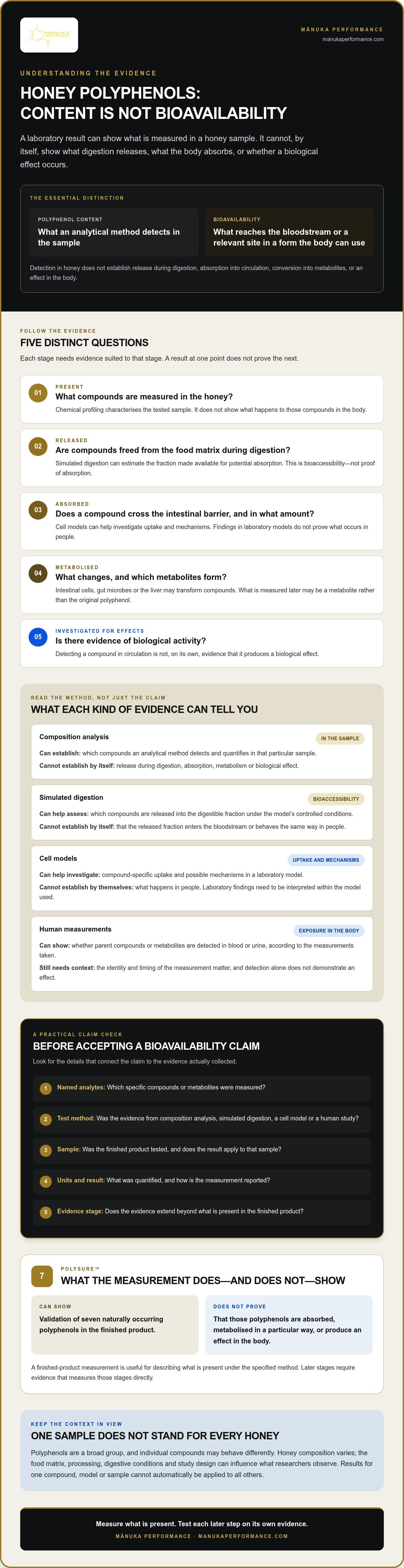
A useful evidence sequence is: present, released, absorbed, metabolised, then investigated for effects. Each step asks a different question and needs evidence suited to that question.
Why does honey’s food matrix matter?
The food matrix is the combined context in which a compound occurs, including other constituents in the food. Composition, processing, digestive conditions and study design can all influence what researchers observe. That’s why it’s important to assess the finished sample and the test method, rather than assume a result applies across honey types.
Quantifying polyphenols in a honey sample establishes the measured content under a specified analytical method. It does not establish the fraction released during digestion, absorbed into circulation, converted to metabolites or associated with a biological effect. Evidence for those later stages needs to measure them directly. Findings from laboratory models should not be treated as proof of what occurs in people.
How honey polyphenols move through digestion, absorption, and metabolism
After consumption, a polyphenol’s pathway depends on its chemical structure and the conditions it encounters. A useful model is release from the food matrix, possible uptake in the intestine, transformation through intestinal or hepatic metabolism, and measurement of the resulting compounds. These are stages to investigate, not guaranteed outcomes for every polyphenol or honey.
Reviews of honey polyphenols discuss how limited absorption of some parent compounds and subsequent metabolism may shape what is detectable in the body. The absorption and metabolism evidence should be considered alongside research on specific compounds. Findings for one polyphenol, model or honey sample cannot establish the pathway for all others.
What happens during digestion?
Laboratory digestion models expose a food sample to controlled conditions intended to approximate stages of digestion, then measure which compounds are released into the digestible fraction. This is called bioaccessibility: the fraction made available for potential absorption, not the fraction proven to enter circulation. These models can help compare tested samples or guide further investigation, but they don’t reproduce every feature of human digestion, including individual variation.
How can absorption and metabolism change the compounds?
Whether a released compound crosses the intestinal barrier is a separate question. Researchers need compound-specific evidence to determine uptake and identify transformations by intestinal cells, gut microbes or the liver. Compounds measured in blood or urine after consumption may therefore be metabolites rather than the original polyphenols characterised in honey. The identity and timing of those measurements matter.
The stages can be summarised as:
- Release: Is the compound freed from the food matrix during digestion?
- Uptake: Does it cross the intestinal barrier, and in what amount?
- Transformation: Which metabolites form, and where?
- Exposure: Can the parent compound or metabolites be detected at relevant sites?
Each stage calls for a different method, and evidence at one point doesn’t establish the next. In vitro digestion or cell findings can identify mechanisms worth testing, but they don’t predict human exposure on their own. Detecting a circulating compound also doesn’t demonstrate a performance or health outcome. That requires relevant human studies designed to assess the specific outcome. For context on analytical work involving New Zealand honey composition, explore honey research and biotech.
How to compare evidence for bioavailable honey polyphenols
Methods answer different questions, so a precise result at one stage doesn’t automatically support a claim about another. A profile of compounds in a honey sample, for example, is not equivalent to evidence that those compounds enter circulation after consumption. The review Metabolism and Bioavailability of Honey Polyphenols provides background on this distinction. The strength of evidence depends on both the method used and the endpoint measured.
| Method | What it measures | What it can support | What remains unproven |
|---|---|---|---|
| Composition analysis | Specified compounds in the tested sample | Identification or quantification, where the method is suitable and validated for those analytes | Release during digestion, absorption, metabolism or biological effects |
| Simulated digestion | Compounds released under modelled digestive conditions | Estimates of bioaccessibility and comparisons between tested samples | Actual absorption or exposure in a person |
| Cell models | Responses in selected cells under controlled laboratory conditions | Exploration of possible uptake or biological mechanisms | Whole-body metabolism or a real-world outcome |
| Human studies | Specified compounds or metabolites, or other defined endpoints, after consumption | Evidence about exposure or outcomes in the participants studied | Effects beyond the study’s design, sample and measured endpoints |
What can laboratory analysis establish?
Targeted profiling identifies and measures specified compounds in the sample tested. Interpretation depends on clear analyte definitions, appropriate reference standards and a method validated for its intended use. A concentration is meaningful alongside its units, sample preparation and analytical method. It describes the tested material, not what a person absorbs. Assay validation strengthens confidence in the measurement, but doesn’t establish bioavailability or biological effect.
What additional evidence can biological studies provide?
Simulated digestion models estimate release; cell studies investigate selected interactions; animal studies can examine processes in a living system, but don’t directly establish human exposure. Human studies can measure compounds or metabolites in biological samples, or assess a defined outcome. Their conclusions depend on the honey sample, dose, comparator, participant group and endpoint. Check these details before applying a finding to other products or populations.
A laboratory response is a basis for further investigation, not proof of a practical benefit. For bioavailable honey polyphenols, look for evidence that tests the particular stage named in the claim, rather than treating composition data as a substitute for digestion, absorption or human research.
How to assess a bioavailable honey polyphenol claim
Start by identifying exactly what the claim is about. A stated polyphenol amount may describe product composition, while “bioavailable” implies evidence about what becomes available to the body. The wording alone doesn’t tell you which stage has been tested. A measured amount does not establish how much the body absorbs.
Each step in the evidence chain needs its own measurement. Identifying compounds in a sample cannot substitute for testing their release during digestion, absorption, metabolism or a specified biological outcome.
Which questions should a label or research summary answer?
Use this checklist to understand what a result supports:
- Analytes: Are the specific polyphenols named, or is the result reported only as a broad total?
- Method: Is the analytical or biological method described, including relevant testing conditions?
- Sample: Was the tested material the finished product, honey, an extract or an isolated compound?
- Units: Are the quantity and basis of measurement clear, such as the amount per serving or per mass of sample?
- Evidence: Is there supporting research, and does it independently test the same product or a relevant sample?
These details help define the scope of a result. If a method or testing condition isn’t reported, treat that as uncertainty that limits interpretation, not as proof that the claim is false. A clearly stated concentration can be informative, but it answers a composition question unless further stages have been measured.
How should evidence limitations shape interpretation?
Check whether a claim concerns composition, bioaccessibility, absorption, metabolism or an outcome, then check that the evidence matches. A digestion model may investigate release from a food matrix; a human study measuring compounds or metabolites in blood or urine addresses exposure more directly. Neither alone establishes a health, therapeutic, recovery or performance effect.
Study material matters, too. Evidence from an isolated polyphenol or concentrated extract may not describe the same compound in honey because the tested matrix differs. For human research, examine the dose, comparator, participant group and measured endpoint, and distinguish preliminary findings from results replicated in relevant populations. A laboratory response is not proof of a real-world benefit.
For an example of analytical work focused on New Zealand honey composition, explore honey research and biotech.
What PolySure™ can and cannot show about honey polyphenols
Analytical measurement and bioavailability answer different questions. Testing a finished product can help establish which specified compounds are present and quantify them under the conditions of that method. It cannot, on its own, show what happens after consumption. This distinction is essential when interpreting claims about bioavailable honey polyphenols.
What does finished-product validation contribute?
PolySure™ is an analytical standard that validates seven naturally occurring polyphenols in the finished product. This validation can support compositional transparency by showing that specified compounds have been assessed in the product itself, rather than inferred from general information about an ingredient. It contributes to more precise characterisation, but remains evidence about composition.
That boundary matters. PolySure™ validation does not independently demonstrate how much of those compounds is released during digestion, absorbed into circulation, transformed into metabolites or associated with a biological outcome. Those questions require evidence designed to measure each stage. An analytical result can be meaningful without being evidence of absorption, clinical efficacy or a health outcome.
Where can readers explore the research context?
When reviewing a finished-product measurement, look for supporting documentation: which analytes are covered, how the method is described, what sample was tested and how the results are reported. The measurement should be interpreted within the scope of that information, not used to infer absorption or effects. The same care applies to findings from honey, extracts or isolated compounds, which may not be interchangeable.
For broader context on the development of sports nutrition and ingredient characterisation, read about sports nutrition biotechnology. The company’s discussion of natural honey-based energy gels provides a related perspective on product development, but product composition should not be mistaken for evidence of a biological effect.
Useful follow-up questions are specific: Are the validated analytes clearly identified? Is the method documented? Are there studies measuring bioaccessibility, absorption or metabolism of the finished product? Is there relevant human research, and what endpoint does it assess? These questions keep claims about composition separate from claims about bioavailability.
Interpret honey polyphenol evidence with precision
Bioavailable honey polyphenols are not defined by a content figure alone. Evidence needs to distinguish what is measured in a product from what is released during digestion, absorbed, metabolised and, where relevant, linked to an outcome. Each stage calls for its own method, so interpret laboratory models within their limits rather than treating them as proof of human effects.
Finished-product analysis still has an important role: it can help characterise what a product contains. PolySure™ validates seven naturally occurring polyphenols in the finished product, but this validation does not independently demonstrate absorption, clinical efficacy or health outcomes. Mānuka Performance also develops research-driven bioactive ingredients and biotech solutions, applying analytical science to ingredient characterisation.
Explore Mānuka Performance’s research-led approach to honey-based sports nutrition and ingredient characterisation. Clear questions about analytes, methods and evidence can help you assess honey polyphenol claims and distinguish measured composition from demonstrated bioavailability.
Frequently Asked Questions
What does bioavailable mean for honey polyphenols?
Bioavailability describes the extent to which a compound, or relevant metabolites formed from it, becomes available in the body. It isn’t the same as the amount detected in honey. For bioavailable honey polyphenols, interpretation depends on the specific compounds, the food matrix and what the research actually measured. A result for one polyphenol or sample shouldn’t be assumed to apply to every polyphenol or honey.
Are polyphenols in honey automatically bioavailable?
No. Detecting a polyphenol in a honey sample confirms its presence under the analytical method used; it doesn’t show what happens after consumption. Release from the food matrix during digestion, intestinal uptake and metabolism each require separate investigation. A measured concentration therefore shouldn’t be presented as the amount reaching circulation or as evidence of a health effect. The method, sample and endpoint all shape what a result can support.
How are honey polyphenols measured?
Analytical methods can identify and quantify specified polyphenols in a sample, provided the analytes and method are defined. To interpret a result, check whether the test concerns a raw material or the finished product, which compounds were included, and how the measurement is reported, including its units and basis. Such testing characterises the sample within the method’s limits; it doesn’t establish digestion, absorption or biological effects.
What is the difference between bioaccessibility and bioavailability?
Bioaccessibility is the fraction of a compound released from the food matrix during digestion and potentially available for absorption. Bioavailability concerns what becomes available to the body after absorption and related processes, including metabolism. Simulated digestion can investigate release under modelled conditions, but it can’t by itself establish human absorption, metabolic transformation or an outcome. These terms describe distinct stages, so evidence for one shouldn’t be treated as proof of another.
Can honey polyphenols improve athletic performance or recovery?
Polyphenol content alone doesn’t demonstrate improved performance or recovery. Research would need to assess the relevant product, dose, participant group and outcome directly; evidence from a laboratory model or ingredient measurement can’t establish those effects in athletes. Look for human studies that measure the claimed endpoint and assess whether their design applies to your circumstances. For individual sports nutrition advice, consult a suitably qualified health or sports nutrition professional.
Does a quantified polyphenol result prove a product is bioavailable?
No. Quantification establishes the measured amount of specified compounds in the tested sample, within the analytical method’s limits. It doesn’t show how much is released during digestion, absorbed, metabolised or associated with a biological effect. Each stage requires evidence suited to that question. Finished-product testing can support a composition claim about the sample, but it isn’t a substitute for digestion studies, absorption measurements or relevant human research.
What evidence should I look for in a honey polyphenol claim?
Check which compounds are named, what product or material was tested, which method was used, and how results and units are reported. Then identify the endpoint: composition, simulated digestion, absorption, metabolism or a human outcome. Look for primary research relevant to the claim and note whether it tested honey, an extract or an isolated compound. Laboratory models and ingredient measurements provide different evidence from human studies, so don’t treat them as equivalent.