


Bioactive honey and active honey aren’t interchangeable terms. Active honey is certified to have antimicrobial and antifungal properties, while bioactivity can describe a broader range of measurable effects, including activity associated with MGO, antioxidant capacity and other compounds. Standardised bioactive honey ingredients make those measured properties more specific, but no single marker describes every dimension of honey bioactivity.
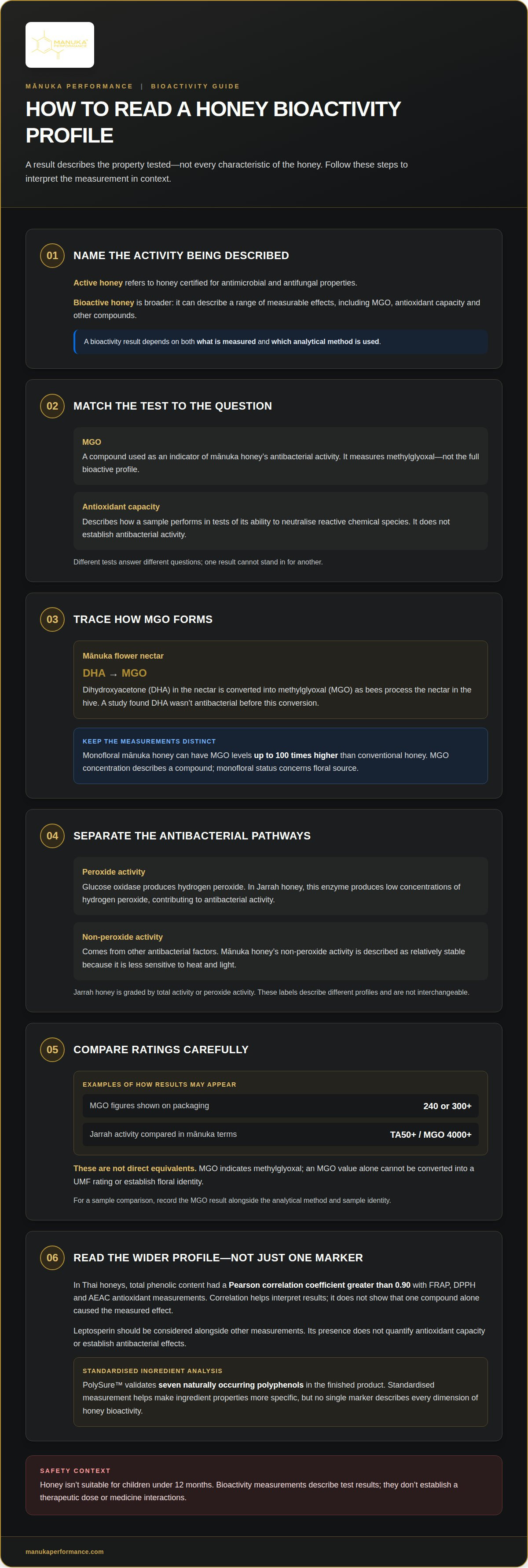
It’s understandable to read an activity rating or compound level as a simple measure of how “active” honey is. In practice, results depend on what is measured and which analytical method is used. MGO and antioxidant capacity, for example, answer different questions about a sample.
This article explains how bioactive honey differs from active honey, how MGO relates to mānuka honey, and what antioxidant capacity and naturally occurring polyphenols can tell you about a measured profile. It also explains why standardised measurement matters when interpreting ingredient data, so you can better understand what a reported bioactivity result does, and doesn’t, show.
Key Takeaways
- Distinguish certified antimicrobial and antifungal activity from the broader ways honey bioactivity can be measured.
- Interpret MGO as one bioactive marker, not a complete measure of a honey’s properties.
- Compare antioxidant capacity and other compounds as separate dimensions, since different tests measure different aspects of bioactivity.
- Look for ingredient analysis that identifies measurable compounds; PolySure™ validates seven naturally occurring polyphenols in the finished product.
Q: Is bioactive honey the same as active honey?
No. Active honey refers to honey certified for antimicrobial and antifungal properties, while bioactivity can describe a wider range of measurable effects. The distinction matters because results depend on the compound measured and the test used.
Links between honey compounds and activity
Honey compounds can correlate with biological activity, but a correlation does not show that one compound alone causes the measured effect. In Thai honeys, total phenolic content had a Pearson correlation coefficient greater than 0.90 with FRAP, DPPH and AEAC antioxidant measurements. For formulators, that relationship helps interpret antioxidant results, but it does not replace testing the specific activity of interest.
Honey’s antimicrobial activity is also assessed against bacteria, including skin-associated bacteria in research relating to skin care. A 2013 review in the Journal of Cosmetic Dermatology addressed honey in dermatology and skin care. Results depend on the bacteria and assay, so a finding against one tested organism does not establish the same effect against another.
Peroxide and non-peroxide activity
Peroxide activity arises when glucose oxidase produces hydrogen peroxide; non-peroxide activity comes from other antibacterial factors. In Jarrah honey, glucose oxidase produces low concentrations of hydrogen peroxide, which contributes to its antibacterial activity. Hydrogen peroxide can inhibit bacterial reproduction, so distinguishing peroxide from non-peroxide activity helps interpret a honey’s test result.
Mānuka honey’s non-peroxide antibacterial activity is described as relatively stable because it is less sensitive to heat and light. Jarrah honey, by contrast, is graded according to total activity or peroxide activity. These labels describe different activity profiles and are not interchangeable.
MGO as an antibacterial activity indicator
Methylglyoxal (MGO) is a compound used as an indicator of mānuka honey’s antibacterial activity. Dihydroxyacetone (DHA), present in mānuka flower nectar, is converted into MGO as bees process the nectar in the hive; a 2009 study found DHA wasn’t antibacterial before this conversion.
An MGO figure therefore quantifies one compound, rather than every bioactive feature. Jarrah honey’s TA50+ activity has been compared with MGO 4000+ in mānuka honey terms, illustrating why different grading systems shouldn’t be treated as direct equivalents.
Honey isn’t suitable for children under 12 months. Bioactivity measurements describe test results; they don’t establish a therapeutic dose or medicine interactions.
Methylglyoxal (MGO) as a bioactive compound
MGO is a naturally occurring compound associated with mānuka honey’s antibacterial activity. Its measured level describes one component, rather than the honey’s complete bioactive profile.
MGO and dihydroxyacetone
Dihydroxyacetone (DHA) in mānuka flower nectar converts into methylglyoxal after bees bring the nectar to the hive for processing. A 2009 study found DHA wasn’t antibacterial before conversion, so the processing stage matters when interpreting the compound’s activity. Monofloral mānuka honey can have MGO levels up to 100 times higher than conventional honey, although floral origin and MGO concentration describe different characteristics.
For New Zealand labelling, treat an MGO result as a compound measurement, not proof of floral identity. MGO alone doesn’t establish whether honey is monofloral: that claim concerns the honey’s floral source, not simply its methylglyoxal level.
Bioactive compound concentrations across honeys
Packaging may show MGO levels of 240 or 300+, providing examples of how mānuka honey concentrations are presented. These figures indicate MGO levels, not a standard concentration for every mānuka honey. Nectar composition and conversion during hive processing influence the amount present.
UMF and MGO ratings aren’t interchangeable. MGO indicates methylglyoxal, and an MGO value alone can’t be converted into a UMF rating. For formulators, this distinction prevents one grading result from standing in for independent evidence about floral origin or other compounds. A pollen profile and an MGO result answer different questions, so assess each according to the claim being made.
When comparing samples, record the MGO result alongside the analytical method and sample identity. That preserves the association between the reported measurement and the specific honey tested. It also helps distinguish an MGO change from a broader shift in bioactivity, which may involve additional compounds. For a product-development context, standardised bioactive honey ingredients connect measured compounds with finished-product analysis.
Antioxidant capacity and bioactive compounds
Antioxidant capacity describes how a honey sample performs in tests of its ability to neutralise reactive chemical species. It is distinct from antibacterial activity: a strong antioxidant result doesn’t establish antimicrobial activity against bacteria. Hydrogen peroxide, by contrast, is associated with peroxide antibacterial activity. For formulation decisions, first identify the effect being measured, then select laboratory evidence that assesses that specific property.
Leptosperin should be considered alongside other measurements, rather than treated as a complete indicator of a honey’s bioactive profile. Its presence doesn’t quantify antioxidant capacity or establish antibacterial effects. A 2018 overview of mānuka honey and its components appeared in AIMS Microbiology, volume 4, issue 4, page 655. It illustrates why a bioactive profile can involve distinct compounds and measurements, rather than one universal indicator.
Honey types can differ in antioxidant results. A study cited on Jarrah honey reports approximately three times the antioxidant content of mānuka honey. A 2023 study also reported that Western Australian honeys sometimes exceeded New Zealand mānuka honey in antioxidant activity. These findings show why floral source alone cannot rank every sample: the tested honey and chosen assay both shape the reported comparison.
Handling can influence measured bioactivity. Honey heated above approximately 40°C begins to lose glucose oxidase activity and antioxidant content. Raw honey stored in cool, dark conditions retains bioactivity better than honey exposed to warmth or light; maximum bioactivity is associated with consuming it unheated. These factors matter because glucose oxidase contributes to peroxide activity, while antioxidant capacity reflects a different measured effect. Dihydroxyacetone is relevant as an MGO precursor, not as a direct substitute for an antioxidant measurement.
Meaning and measurement of honey bioactivity
Honey bioactivity is not one universal score. It describes properties measured through different analytical methods. Commercial measurements may report methylglyoxal (MGO) concentration, peroxide or total activity, antioxidant capacity, or specific compounds. Each result answers a different question, so a concentration cannot stand in for every antimicrobial or antioxidant property.
Which honey bioactive ingredients are standardised or measured commercially? MGO, peroxide or total activity, antioxidant capacity and individual compounds can all be measured. The relevant result depends on the property being assessed and the method used.
For example, Jarrah honey packaging may show total activity levels of 15+ TA or 20+ TA. These figures describe activity grades, not MGO concentrations. MGO in mānuka honey can be measured directly using high-performance liquid chromatography (HPLC), which quantifies that compound rather than testing the whole honey’s antimicrobial effect.
Activity assays also have defined conditions. An agar plate assay compares bacterial growth under specified test conditions, and the method used to assess mānuka honey activity is over one hundred years old. Mānuka honey achieved maximum antibacterial inhibition against tested bacteria at a concentration of 12.5%. That result applies to the tested bacteria and assay, not every organism or use.
Interpretation requires attention to the sample as well as the test. Honey’s low pH, high sugar concentration and low water activity can contribute to the stability and effectiveness of bioactive properties. A certificate of analysis from an accredited laboratory can support a bioactivity claim by recording measured results for a sample. Referencing the 18th edition of AOAC International’s Official Methods of Analysis also identifies an analytical methods framework, rather than a single universal bioactivity score.
For formulation work, match each claim to its corresponding measurement and sample record. Discuss honey bioactivity measurement in the context of your ingredient or product-development needs.
Mānuka Performance: Natural, clean label honey based sports energy gels
Mānuka Performance connects honey bioactivity with functional nutrition through natural, clean label honey based sports energy gels and Polysure™ Bioactive Ingredients. Its analytical standard validates seven naturally occurring polyphenols in the finished product, providing a defined way to assess these compounds beyond a single honey activity rating.
For runners and endurance athletes, the LiquidFuel 10-Pack Running Gel provides convenient carbohydrate fuel in a New Zealand honey-based matrix. For formulators, CPG teams and research groups, Polysure™ Bioactive Ingredients and Research & Biotech Solutions are relevant when the work involves measurable honey-derived compounds or product development. These offerings suit performance nutrition applications, rather than therapeutic or health claims.
If you’re developing a sports nutrition product or exploring measured honey ingredients, contact Mānuka Performance to discuss your project.
Turn bioactivity data into a clearer formulation brief
Decide how each measurement will inform your product, from ingredient selection to the evidence used to describe it. A formulation brief can specify the honey-derived compounds of interest, the analytical approach and how results should be assessed in the finished product. This gives standardised bioactive honey ingredients a defined role in product development, rather than treating a single activity result as a complete specification.
For teams developing CPG sports nutrition products, Mānuka Performance brings together product development and analytical perspectives through its sports nutrition offerings. A focused discussion can connect your project requirements with relevant ingredient and research capabilities, without assuming one measurement answers every formulation question.
Contact Mānuka Performance to discuss honey and the role measured bioactive ingredients could play in your next project. A well-framed brief is a practical place to begin.
Frequently Asked Questions
Q: What does TA50 mean in honey?
TA50 refers to a total-activity grade, rather than a concentration of a named compound. The “50” forms part of the grade notation; it shouldn’t be read as an MGO value or a percentage. Jarrah honey’s TA50+ activity has been compared with MGO 4000+ in mānuka honey terms, but the two labels describe different measurement systems.
How Does MGO Promote Antibacterial Activity?
MGO contributes to mānuka honey’s antibacterial activity as a bioactive compound. For ingredient assessment, its concentration provides a specific chemical measurement, while a bacterial assay tests an observed response under defined conditions. These results serve different purposes: an MGO result characterises the compound level, while an assay evaluates activity in its test system. Neither alone describes every property of a finished formulation.
Q: What is the difference between MGO and TA?
MGO measures methylglyoxal concentration; TA denotes total activity, a measure of antibacterial activity. When comparing honey samples, keep the units and test type attached to each result. A higher number in one system cannot be directly ranked against a number in the other without a valid method linking those measurements.
What Does Bioactive Actually Mean?
Bioactive describes a substance’s capacity to produce a measurable biological effect in a defined test or context. For honey, that could refer to antibacterial activity, antioxidant capacity or a quantified compound profile. The word alone doesn’t identify which property was measured. In a specification, name the compound or activity, the test approach and the sample to make the claim interpretable.
What are the recognised laboratory methods for measuring honey bioactive compounds?
Method choice depends on the result required. High-performance liquid chromatography (HPLC) can measure MGO, while agar plate assays assess antibacterial activity under test conditions. Antioxidant capacity can be assessed using methods such as FRAP, DPPH or AEAC. The 18th edition of AOAC International’s Official Methods of Analysis is a cited analytical reference; specify the method alongside results.
Are there standardised bioactive ingredient levels for mānuka honey in New Zealand?
No single level represents every bioactive property of mānuka honey in New Zealand. Commercial specifications can focus on a particular marker, such as MGO, or a separate activity measure; each describes a different attribute. For formulation decisions, define the ingredient requirement by the intended measurement and its analytical method, rather than treating one rating as a universal threshold for all compounds.