


What if a product’s scientifically measured ingredients tell you less about performance than its marketing suggests? That distinction sits at the centre of science backed sports nutrition: a quantified composition and a demonstrated effect in athletes are different forms of evidence. Conflicting recommendations can make the difference hard to spot, particularly when early findings are presented as settled conclusions.
It’s reasonable to want guidance that applies to your training, not just results from a study with different participants, doses or conditions. This article explains how to recognise stronger and weaker evidence, interpret common research limitations and apply findings carefully to your own nutrition decisions.
We’ll look at how study design and consistency shape confidence in a claim, what product testing can establish and where its conclusions stop. For example, analysis can verify compounds in a finished product, but that alone can’t demonstrate a performance benefit. Mānuka Performance’s honey-based running gel offers a practical example of this distinction, without treating composition as proof of an outcome.
Key Takeaways
- Assess science backed sports nutrition by checking whether each claim is proportionate to relevant, transparent and reproducible evidence.
- Use a repeatable research check: identify the claim, inspect the study methods and consider whether the participants and conditions match your situation.
- Separate ingredient plausibility, finished-product composition and human performance outcomes. Each answers a different question.
- Before acting on a nutrition claim, note the evidence type, tested population and remaining uncertainty, then apply the finding carefully to your training.
- Use Mānuka Performance’s LiquidFuel 10-Pack Running Gel as an example of honey-based carbohydrate fuel, while keeping product composition distinct from proof of a performance effect.
What makes sports nutrition genuinely science-backed?
Science backed sports nutrition means the strength and scope of a nutrition claim are proportionate to relevant, transparent and reproducible evidence. It isn’t enough for a product or ingredient to sound scientific, or for one study to report a promising result. The evidence must address the claim being made, and its limitations should remain clear when findings are turned into advice.
A useful definition: scientific rationale explains why an effect might occur; demonstrated human benefit shows whether it occurs under defined conditions.
Sound nutrition principles can guide athletes without proving that a particular product improves a particular outcome. Carbohydrate, for example, is a fuel source used during exercise. That general principle doesn’t establish that every carbohydrate product improves endurance, suits every athlete or performs better than alternatives. The overview of sports nutrition provides broad background on the field. Evaluating a specific product claim requires closer attention to the evidence behind it.
What counts as evidence in sports nutrition?
Different study designs answer different questions. Mechanistic research explores how a nutrient might act in cells or the body. It can help establish biological plausibility, but can’t show by itself that the nutrient affects athletic performance. Observational studies identify patterns in real populations, although they can’t reliably separate cause from other differences between people.
Controlled trials compare an intervention with a control condition and can test specific outcomes. Systematic reviews assess findings across multiple studies. Each design has limitations: trials may be small or brief, and reviews are only as reliable as the studies they include. Peer review adds expert scrutiny, but publication doesn’t make a finding definitive or remove the need to assess its methods and reproducibility.
Why does evidence need to match the claim?
Start with the exact claim, then check what was measured. An analysis showing that a finished product contains a specified compound provides evidence about composition. It doesn’t show that people who consume it run faster, recover differently or experience another performance outcome. That requires relevant human research measuring that outcome.
Applicability matters, too. A result from trained endurance athletes may not transfer directly to recreational exercisers. Findings can also depend on dose, timing, diet, exercise protocol and study duration. Ask whether the research participants resemble the intended user, whether the tested amount matches real-world use and whether the measured outcome reflects the claim. A plausible mechanism can justify further investigation, but it isn’t proof of a practical benefit.
For a disciplined first assessment, separate what is known from what is inferred: identify the evidence type, the population studied and the outcome measured. Then qualify the conclusion accordingly. Evidence may support the presence of an ingredient, suggest a possible mechanism or demonstrate an effect under specific trial conditions. These are distinct conclusions, not interchangeable levels of proof.
How to assess the quality of sports nutrition research
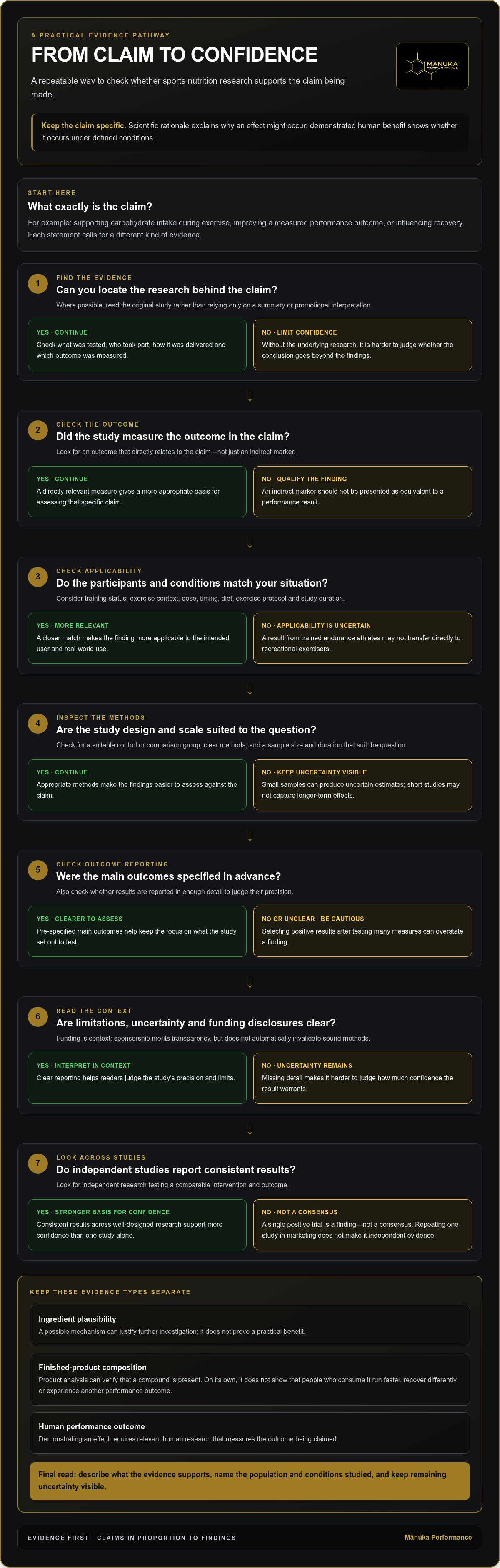
A repeatable appraisal process helps separate a promising headline from evidence that can guide a training decision. Begin with the precise claim, rather than the ingredient name or product category. Is the claim about supporting carbohydrate intake during exercise, improving a measured performance outcome or influencing recovery? Each statement calls for a different kind of evidence.
Then locate the research behind the claim. Where possible, read the original study rather than relying only on a summary or promotional interpretation. Note what was tested, who took part, how the intervention was delivered and which outcome was measured. This makes it easier to spot when a conclusion goes beyond the study’s actual findings.
Which study features should athletes inspect?
Check whether participants resemble the intended users in training status and exercise context. A study involving trained endurance athletes may not answer the same question for recreational exercisers. Look for a suitable control or comparison group, clear methods and outcomes that directly relate to the claim. An indirect marker shouldn’t be presented as equivalent to a performance result.
Next, consider whether the sample size and study duration suit the question. Small samples can produce uncertain estimates, while short studies may not capture longer-term effects. Check whether the main outcomes were specified in advance, since selecting positive results after testing many measures can overstate a finding. Read funding disclosures as context: sponsorship merits transparency, but doesn’t automatically invalidate sound methods.
Note the study’s limitations and uncertainty, including whether its results are reported in enough detail to judge their precision. A single positive trial is a finding, not a consensus. Look for independent studies testing a comparable intervention and outcome. Consistent results across well-designed research provide a stronger basis for confidence than repeated references to one study in marketing materials.
How do reviews and consensus statements help?
Systematic reviews use stated methods to find and assess a wider body of research than an individual trial. Their conclusions can show whether findings are consistent, mixed or limited, but a review can’t correct weaknesses in the studies it includes. Consensus statements interpret broader evidence for practical use, yet remain general guidance rather than a guarantee of an individual response.
For applied guidance, check whether recommendations are current and consult authoritative sources such as the International Olympic Committee (IOC) or the Australian Institute of Sport (AIS). Numerical recommendations need context: establish which population, activity and conditions they address before treating a figure as suitable for your training. Guidance should inform a decision, not replace consideration of your individual needs and circumstances.
In practice, summarise each claim in one sentence, then state what the evidence supports and what remains uncertain. That discipline is central to science backed sports nutrition: conclusions should be no broader than the studies behind them. For a practical product example, explore Mānuka Performance’s honey-based sports nutrition products while keeping product information distinct from research evidence.
Ingredient evidence, product testing and performance outcomes are different
Evidence about an ingredient, analysis of a finished product and research measuring human performance answer different questions. Keeping these layers separate helps you assess whether a claim is supported by the type of evidence presented, rather than by scientific language alone.
| Evidence layer | What it can establish | What remains unanswered |
|---|---|---|
| Ingredient plausibility | Research may suggest a biological mechanism or provide a rationale for further study. | Whether the ingredient produces a meaningful effect in people, at a particular dose or in a specific product. |
| Finished-product composition | Appropriate analytical methods can identify or quantify specified compounds in the product tested. | Whether those compounds are absorbed, affect the body, or change performance or recovery. |
| Human outcome evidence | Relevant studies can test whether people experience the outcome named in a claim under defined conditions. | Whether the result applies to other populations, products, doses or real-world training situations. |
These layers can inform one another, but they aren’t interchangeable. Ingredient research may give a reason to investigate a product; composition testing can describe what is present; human studies can assess outcomes. In science backed sports nutrition, the conclusion should match the evidence layer, not leap from a measured compound to a promised result.
What does finished-product analysis demonstrate?
Analytical methods can identify or quantify specified compounds in a sample, subject to the method’s scope and limits. Mānuka Performance’s PolySure™ validates seven naturally occurring polyphenols in the finished product. This is compositional validation: it provides information about what has been measured in the product, rather than establishing what happens after consumption.
Analytical validation is evidence about composition, not clinical proof of a performance benefit. The presence or quantity of polyphenols alone doesn’t establish absorption, a recovery effect, a health effect or an athletic outcome. Those questions require different evidence designed to measure them directly.
What evidence supports a performance claim?
A claim that a product improves a particular outcome calls for relevant human research that measures that outcome. Assess whether the study tested the same formulation, amount and use conditions described in the claim. Research on an isolated ingredient may not establish the effect of a finished product, particularly if its formulation or use differs from what participants received in the study.
Interpret early findings carefully. A promising result may justify further research, but confidence grows when independent studies produce consistent findings and the observed change is practically meaningful, not merely statistically detectable. Consider who participated, how the activity was structured and whether the outcome reflects what athletes are likely to care about. A useful summary states both what the evidence supports and what it can’t yet show.
How to apply sports nutrition evidence without overclaiming
Research becomes useful when its limits are carried into a training decision. Before acting on a product statement or nutrition recommendation, reduce it to a precise claim and check what supports it. This checklist can keep the assessment focused:
- Exact claim: What outcome or product feature is being stated?
- Evidence type: Is the support a proposed mechanism, product analysis or human research?
- Tested population: Were participants similar to you in training status and context?
- Uncertainty: What limitations or unanswered questions qualify the conclusion?
Then consider whether the finding fits your training demands, nutrition needs and circumstances. Your personal response can help you decide whether a strategy is practical or tolerable for you. It can’t establish that the same approach works generally or prove why you experienced a particular result.
How should athletes handle conflicting advice?
Give greater weight to current consensus and well-designed, relevant evidence than to an isolated headline or a single positive result. Apparent disagreement between studies may reflect differences in participants, dose, timing, exercise protocol or outcome measures, rather than a direct contradiction. Compare what each study actually tested before deciding that one has disproved the other.
Your training context still matters. A strategy studied under one set of conditions may not suit a different event, schedule or individual need. Where decisions involve health concerns, complex dietary needs or substantial changes to your fuelling plan, discuss them with an appropriately qualified health or sports nutrition professional.
How can product claims be read precisely?
Separate factual composition statements from claims about bodily effects or performance. A statement that a product contains a measured compound is different from a claim that consuming it changes an outcome. Words such as natural, quantified and researched also need precise interpretation: identify what they describe and what evidence supports that specific meaning.
If you’re evaluating a nutrition strategy in practice, change one relevant variable at a time where possible. Keep training conditions and other fuelling choices reasonably consistent, and record what you used, when you used it and how the session went. This can help you identify a useful personal pattern, though it remains an individual observation, not controlled proof or a conclusion about other athletes.
For a focused discussion of the product category, read this honey-based energy gel performance analysis. If gastrointestinal comfort is a separate consideration in your planning, this runner’s stomach evidence guide addresses that distinct topic.
Applying science backed sports nutrition means keeping personal experimentation proportionate to the evidence and avoiding conclusions broader than the research supports. To explore a practical fuelling option, view honey-based sports energy gels.
How Mānuka Performance connects natural ingredients with analytical science
Once the distinction between composition and human outcomes is clear, a product can serve as an applied example, not proof of a general nutrition claim. Mānuka Performance is a New Zealand functional nutrition company that combines natural ingredients with analytical science to develop performance-led products. Its approach illustrates how product characteristics can be measured while keeping conclusions within the limits of that measurement.
What does the Mānuka Performance example demonstrate?
LiquidFuel 10-Pack Running Gel uses a New Zealand honey-based matrix as carbohydrate fuel for runners and endurance athletes. This describes the product’s format and fuelling purpose; it doesn’t establish that the gel improves performance compared with another option. Whether a fuelling strategy suits an athlete depends on their needs and the evidence relevant to the outcome being considered.
PolySure™ validates seven naturally occurring polyphenols in the finished product. This is a specific example of analytical transparency: specified compounds are validated in the product itself. It doesn’t demonstrate that those compounds are absorbed, influence recovery or produce an athletic benefit. Those questions require different evidence, including relevant research in people.
Precise product facts and broader research conclusions should remain separate. A measured composition can inform what a product contains; a performance claim needs evidence measuring the stated outcome under relevant conditions. This distinction allows natural ingredients and analytical methods to be discussed clearly, without implying that measurement alone proves efficacy.
Where can readers explore the evidence further?
For a focused discussion of honey-based fuelling, explore this honey energy gel comparative analysis. It provides a product-category context for considering how comparisons and analytical findings relate to claims, while each conclusion still needs to be judged by the evidence supporting it.
For broader context on how sports nutrition research and product development intersect, the sports nutrition biotechnology overview examines the wider innovation landscape. Neither a broad discussion nor a product analysis replaces evidence that directly tests a specific outcome in the relevant population.
As you assess science backed sports nutrition, return to the exact claim and ask what level of evidence supports it. Check whether the information concerns an ingredient, a measured product feature or a human outcome, and keep uncertainty in view before deciding what applies to your training.
If a honey-based carbohydrate gel fits your fuelling approach, explore LiquidFuel 10-Pack Running Gel as a product option, while treating its composition and performance evidence as distinct considerations.
Make your next nutrition decision with confidence
Let evidence guide the next question you ask, not simply the next product you consider. For any sports nutrition claim, identify what is being measured, whether the research matches your needs and where uncertainty remains. This makes science backed sports nutrition a practical standard for weighing options, rather than a label to accept at face value.
Mānuka Performance offers a useful example of keeping product information distinct from outcome evidence: LiquidFuel 10-Pack Running Gel uses a New Zealand honey-based matrix for carbohydrate fuel, while PolySure™ validates seven naturally occurring polyphenols in the finished product. Those details describe the product and its composition; they don’t, on their own, establish a performance benefit.
As your training and fuelling needs evolve, keep applying the same measured approach: look for evidence that fits the claim and your context, and adjust decisions when stronger information becomes available. To explore products developed with natural ingredients and analytical science, explore Mānuka Performance’s research-led sports nutrition. A clear view of the evidence can help you choose your next step with confidence.
Frequently Asked Questions
Is science-backed sports nutrition the same as clinically proven nutrition?
No. “Science-backed” can describe a claim supported by different kinds of research, including early or indirect evidence, while “clinically proven” implies stronger evidence from studies in people. Neither phrase should be accepted without checking what was studied and which outcome was measured. For example, research on a nutrient’s role in the body doesn’t establish that a particular product has been shown to improve an athlete’s performance.
Can research on an ingredient prove that a finished product works?
No. Ingredient research may not reflect the finished product’s formulation, dose, processing or intended use. For instance, a study of an isolated ingredient doesn’t automatically show that a gel containing it produces the same result during a long run. To assess a product-specific claim, look for human research testing the relevant formulation and measuring the outcome being claimed, rather than relying on ingredient evidence alone.
How much evidence is enough to trust a sports nutrition claim?
There’s no single study count that makes every claim trustworthy. The appropriate evidence depends on the claim’s importance and specificity: a statement about what a product contains requires different support from one promising a measurable performance change. Look for well-conducted research, clear reporting and independent findings that point in a consistent direction. If evidence is limited or uncertain, treat the claim as provisional rather than established.
What happens if sports nutrition studies reach different conclusions?
Conflicting results call for comparison, not automatic dismissal of either study. Check whether researchers tested similar doses, participants, exercise settings and outcomes, and whether the studies were precise enough to detect a difference. One trial might measure a laboratory marker while another measures event performance, so their conclusions may not directly conflict. Until the evidence becomes clearer, avoid treating the most favourable result as the settled answer.
Is a natural sports nutrition product automatically evidence-based?
No. “Natural” describes an ingredient’s source or positioning; it doesn’t establish a product’s composition, suitability or effect. A natural ingredient may have a plausible scientific rationale, but that alone doesn’t demonstrate a benefit in a finished product. Assess the specific statement being made, such as an ingredient or composition claim, separately from claims about what the product does during training or competition.
Can one athlete's experience prove that a sports nutrition product works?
No. An athlete’s experience can help them decide whether a product fits their routine, but it can’t show that the product caused a change or that other athletes will respond similarly. Training load, sleep, weather, expectations and other fuelling choices may also affect how a session feels. Personal notes are most useful for tracking practical fit across comparable sessions, not for establishing general effectiveness.
How can I tell whether a sports nutrition article uses reliable research?
Check whether the article names or links to its sources, and whether those sources support the exact claim being made. Stronger reporting identifies the study design, participants and measured outcome, then acknowledges relevant limitations. Follow citations to the original research where possible, and note whether the article distinguishes preliminary findings from established guidance. In science backed sports nutrition, confident wording should never substitute for evidence readers can inspect.