


A natural label is not a polyphenol specification. For buyers assessing polyphenol rich honey wholesale, the key question is whether the bioactive composition has been identified and measured in a way that informs a commercial application. Origin and flavour offer useful context, but natural variation means they are not enough to compare ingredients on composition alone.
That uncertainty is familiar to product developers: “polyphenol-rich” can describe an ingredient without showing which compounds were measured, how they were quantified, or whether the evidence supports a practical specification. Understanding the phytochemical composition of New Zealand honey can help make ingredient choices clearer and more relevant to formulation needs.
This guide explains what to look for in analytical evidence, how to assess specifications against an intended application, and which supplier capabilities matter for research-led ingredient development. It also introduces PolySure™, Mānuka Performance’s approach to validating seven naturally occurring polyphenols in the finished product. The focus is measurable composition and informed ingredient evaluation, not a promise of therapeutic outcomes.
Key Takeaways
- For polyphenol rich honey wholesale, define the intended application and the composition evidence needed before comparing ingredient options.
- Distinguish broad total-phenolic measurements from analysis that identifies and quantifies specific polyphenols.
- Assess results in context by recording sample identity, measurement basis and whether testing relates to the ingredient or finished product.
- Use provenance and flavour as selection criteria, but don’t treat them as substitutes for analytical characterisation.
- See how PolySure™ connects New Zealand honey phytochemistry with finished-product validation of seven naturally occurring polyphenols.
Polyphenol-rich honey wholesale: what commercial buyers are actually sourcing
In commercial procurement, “polyphenol-rich honey” should describe honey or a honey-derived ingredient whose polyphenol content can be measured, not simply signal natural origin or premium positioning. A retail jar, a bulk food ingredient and a characterised bioactive ingredient may all come from honey, but they serve different product-development needs and call for different evidence.
An analytically characterised honey ingredient is honey or a honey-derived material with defined polyphenols measured in an identified sample, using a stated method and measurement basis. This makes the composition easier to evaluate, but doesn’t establish performance or suitability for every formulation.
What does “polyphenol-rich” mean in a wholesale context?
The phrase becomes useful to buyers when analytical information explains what was measured, how the result is expressed and which sample it represents. A general claim such as “high in polyphenols” is not a quantified ingredient specification if the compounds, measurement basis and sample context are unclear.
There is no single threshold that defines “rich” for every application. Interpret a specification against the intended product and its evidence requirements, rather than treating it as a universal grade. This helps distinguish broad positioning from data that supports a more precise comparison.
Bulk honey and bioactive ingredients are not interchangeable
Bulk honey may be procured as a food ingredient, with decisions shaped by format, flavour and formulation fit. A characterised bioactive ingredient addresses a different question: which measurable constituents does it contribute, and what documentation describes that composition? Choose the category that matches the intended use, product format and level of evidence needed during development.
Provenance and flavour can still inform selection, but they don’t establish polyphenol composition. Even a well-known honey type needs evidence suited to the buyer’s question. For example, Mānuka honey has its own distinctive composition and identification context, separate from a general polyphenol specification.
Finished-product context matters, too. An ingredient’s analytical profile and its measurement in a formulated product are not the same: formulation can affect what is present in the final matrix. Mānuka Performance’s natural honey-based energy gel research provides an example of considering honey in a finished-product setting.
For polyphenol rich honey wholesale, start with a defined use case and match it to clear composition evidence. This gives commercial teams a firmer basis for evaluating whether an ingredient’s format and documentation align with product-development objectives.
How polyphenols in honey are measured and validated
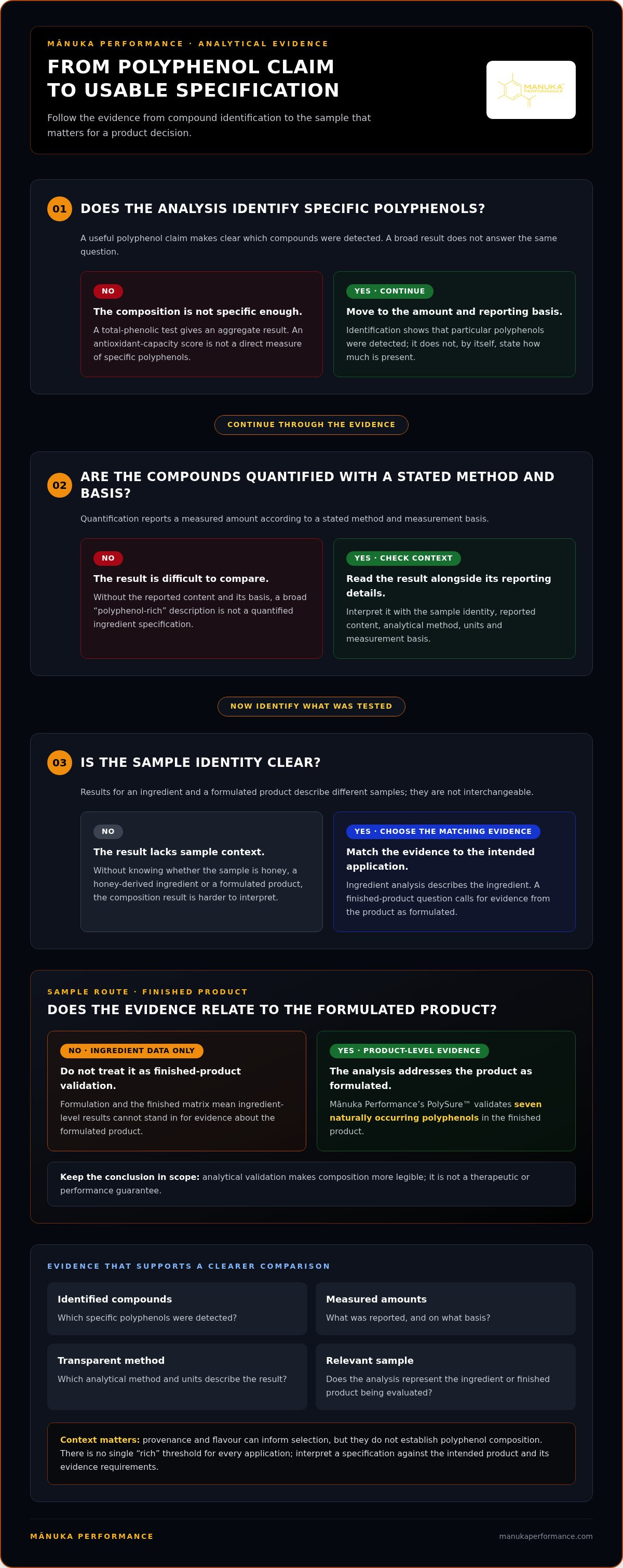
A polyphenol claim becomes useful for procurement when the analytical evidence shows both which compounds are present and, where required, how much is present in a defined sample. Identification establishes that particular polyphenols were detected; quantification reports their measured amount according to a stated method and basis. These are related, but answer different questions.
Broad total-phenolic tests can provide an aggregate result, but they don’t give the same information as analysis that identifies and quantifies individual compounds. A general antioxidant-capacity score is not a direct measure of specific polyphenols either. A scientific review of polyphenols in honey offers background, while a buyer specification still needs evidence that corresponds to the ingredient and decision at hand.
What should a polyphenol specification communicate?
Interpret a result alongside its sample identity, reported content, analytical method, units and measurement basis. The sample might be honey as an ingredient or a formulated product; those results are not interchangeable. Clear reporting lets technical and procurement teams understand what was tested instead of inferring composition from a broad label or an unexplained result.
Natural origin alone doesn’t demonstrate a consistent measured composition. Floral and geographical sources can vary, so a “natural” or “polyphenol-rich” description cannot replace analysis of the specified material. Keep analytical results distinct from claims about biological effects or athletic outcomes: a measured composition describes what was detected, not what the ingredient will do in the body or in a performance setting.
Why finished-product validation matters
An ingredient’s analytical profile describes the ingredient; finished-product validation examines the formulated product itself. The two stages are related, but formulation and the finished matrix mean a result from one cannot stand in for evidence about the other.
Finished-product validation helps buyers understand whether specified polyphenols are measurable in the product as formulated, rather than relying solely on ingredient-level data. Mānuka Performance’s PolySure™ validates seven naturally occurring polyphenols in the finished product. This analytical standard makes composition more legible; it is not a therapeutic or performance guarantee.
For commercial teams evaluating ingredient-to-product evidence, sports nutrition biotechnology research provides broader context for application-led development. Explore Mānuka Performance’s research-led ingredient work to see how honey phytochemistry can inform commercial product development.
How to compare polyphenol-rich honey ingredients for wholesale use
For commercial evaluation, compare the evidence attached to each ingredient, not just its origin story or natural positioning. A structured review helps procurement and product-development teams determine whether the information describes a measurable composition, relates to the material they plan to use and addresses the intended formulation.
| Comparison point | What to examine | Why it matters |
|---|---|---|
| Composition evidence | Does the documentation identify particular polyphenols, report measured content, or provide only a broad claim? | It distinguishes analytical information from general positioning. |
| Sample basis | Is the result tied to an identified ingredient sample, batch or finished product? | It clarifies what the result represents and what it can be compared with. |
| Intended application | Does the evidence relate to the ingredient format and formulation role under consideration? | Data useful for one product context may not answer another’s requirements. |
| Documentation | Are the method, units, sample identity and reported result clearly stated? | Clear records support technical review and more meaningful comparison. |
Analytical evidence versus origin and natural-positioning claims
Origin can describe where honey was produced and inform decisions about provenance, flavour and sourcing. Analytical characterisation establishes different information: what was measured in a defined sample and how the result was reported. New Zealand origin alone doesn’t guarantee a particular polyphenol profile, just as flavour or a “natural” description can’t stand in for composition data.
Origin is a sourcing attribute; an analytically supported specification describes measured composition in a defined sample. Keep these criteria distinct when comparing polyphenol rich honey wholesale options. Treat composition results as evidence about the material, not proof of a health or therapeutic effect.
Assess consistency separately. Compare whether results are available for the relevant samples or batches and whether the reporting basis is clear. Don’t assume that a particular harvest or processing choice caused a difference unless evidence directly supports that conclusion. Record the observed variation and its sample context instead.
Match the ingredient evidence to the application
Start with the product format and the ingredient’s intended role, then decide whether the evaluation concerns the ingredient alone or the finished formulation. The relevant evidence depends on that context: an ingredient-level result may not establish what can be measured in a formulated product. A honey-based energy gel performance analysis illustrates why finished-product context can matter when assessing honey in a specific format.
Set comparison criteria before selecting an ingredient. Keep provenance and sensory characteristics in view, but don’t let them obscure the central procurement question: is the composition evidence and documentation relevant to the application being developed?
A practical buyer brief for sourcing characterised honey bioactives
A clear brief turns a broad search for polyphenol rich honey wholesale into a focused technical evaluation. Define the application first, then specify what information will help your team assess the ingredient in its product-development context. This reduces reliance on generic benchmarks that may not suit the formulation or intended market.
Build a brief around the intended product
Record the product format, the ingredient’s intended role and the manufacturing context in which it will be used. A honey-derived ingredient intended for a gel, for example, may raise different formulation and finished-product questions from one being evaluated for another food format. Include relevant market requirements as project criteria, rather than assuming a general ingredient specification addresses them.
- Describe the use case. Identify the product, target format and role expected of the honey-derived ingredient.
- Set the evidence requirements. State whether you need identification of particular polyphenols, quantified composition, ingredient-level data, finished-product validation or a combination.
- Define the measurement context. Specify the sample or product to be assessed, and require clear reporting of the method, units and measurement basis.
- Note formulation and manufacturing considerations. Document the relevant ingredients, processing context and product characteristics that may affect how the final formulation is evaluated.
- List open technical questions. Separate information needed for the decision from assumptions, such as whether a result from one sample represents another material or finished product.
The brief should also distinguish composition evidence from claims about outcomes. A measurement can describe what was identified or quantified in a sample; it doesn’t establish a health effect, athletic outcome or performance benefit. Keep that boundary explicit in technical reviews and product-development decisions.
Assess evidence before making a sourcing decision
Compare the sample described in the analytical documentation with the ingredient or finished product you’re evaluating. Check that the stated results apply to that material and answer the brief’s actual question. Ingredient-level analysis and finished-product validation serve related but distinct purposes, so identify which one supports each decision.
Where manufacturing or formulation details may affect the evaluation, record them as context for technical discussion rather than presuming their effect. Apply the same approach to intended-market requirements: include them in the brief for the relevant product and market instead of importing unsupported universal specifications.
This evidence-led workflow helps teams assess composition and documentation alongside practical product fit, instead of selecting on a “natural” claim alone. To explore research-led approaches to honey phytochemistry and bioactive ingredients, review Mānuka Performance’s ingredient development.
Mānuka Performance and PolySure™: from honey phytochemistry to validated ingredients
For buyers assessing commercial honey ingredients, supplier fit involves more than provenance or format. It also means connecting the phytochemical composition of New Zealand honey with evidence relevant to ingredient development and the finished product. Mānuka Performance is a New Zealand functional nutrition and phytochemical innovation company working across bioactive ingredients and research-driven biotech solutions.
What PolySure™ contributes to ingredient evaluation
PolySure™ provides an analytical standard for validating seven naturally occurring polyphenols in the finished product. This finished-product context gives commercial teams a basis to consider measured composition in the formulated product, rather than treating ingredient-level information as a substitute for product-level evidence.
For buyers, validation helps make selected polyphenol content more legible in technical evaluation and product-development discussions. The seven-polyphenol statement applies to validation in the finished product; it should not be extended into unprovided claims about assay methods, concentration values or clinical efficacy. Analytical evidence describes composition within its stated scope, not a guaranteed biological or performance outcome.
From New Zealand honey phytochemistry to commercial development
Mānuka Performance focuses on the phytochemical composition of New Zealand honey and its application in research-led bioactive ingredient development. This provides a useful framework for commercial discussions: formulation teams can consider what composition evidence is available, which product context it relates to and how it aligns with their development brief.
In practice, a useful technical evaluation connects the ingredient’s analytical context with the planned format and the evidence needed for the finished product. That approach supports informed decisions without relying on broad natural-origin language as a proxy for measured composition. It also keeps analytical validation distinct from claims about health effects or product performance.
For teams exploring polyphenol rich honey wholesale, PolySure™ and Mānuka Performance’s research-led work offer a New Zealand perspective on translating honey phytochemistry into commercial ingredient development. Explore PolySure™ and ingredient innovation to learn more about the company’s bioactive ingredient and biotech work.
Make your next ingredient decision evidence-led
For polyphenol rich honey wholesale, a natural label or provenance story is only part of the assessment. A useful comparison connects measured composition and clear sample context with the ingredient’s intended application. Define the product format, evidence requirements and finished-product questions before making sourcing decisions.
Mānuka Performance brings a New Zealand focus on honey phytochemistry to bioactive ingredient innovation and research-led development. Its PolySure™ analytical standard validates seven naturally occurring polyphenols in the finished product, helping make composition more legible in product-development discussions without implying a health or performance outcome.
Explore how this research-led approach could inform your ingredient evaluation and formulation planning. Explore PolySure™ and research-led ingredient development to take your next step with a clearer evidence brief and a stronger basis for commercial decisions.
Frequently Asked Questions
What does polyphenol-rich honey mean for a wholesale buyer?
For a wholesale buyer, polyphenol-rich honey means honey or a honey-derived ingredient with polyphenol content characterised through measurement. The phrase alone doesn’t specify which compounds were assessed, their measured amounts or the sample tested. In polyphenol rich honey wholesale, useful evaluation depends on analytical information that clarifies these details and relates them to the intended application, rather than relying on a natural-origin description or an undefined claim of richness.
How are polyphenols in honey measured and reported?
Polyphenols can be assessed through methods that report either an overall measure or information about specific compounds. Identifying a compound indicates its presence in the sample; quantifying it reports a measured amount. For meaningful interpretation, reporting should identify the sample or product tested, the method, units and measurement basis. Ingredient-level results and finished-product results describe different materials, so documentation should make clear which one the analysis represents.
Can polyphenol content vary between honey samples or finished products?
Yes, measured polyphenol composition can differ between honey samples, including in relation to floral and geographical origin. Finished formulations are a separate context: an ingredient result doesn’t automatically describe the formulated product. Connect results to the specific sample or product being considered. For example, PolySure™ validates seven naturally occurring polyphenols in the finished product, keeping validation focused on that product context.
How much polyphenol content should a wholesale honey ingredient specify?
There isn’t one universal polyphenol threshold that suits every ingredient or application. Develop the specification around the intended product, the compounds relevant to its evaluation and the evidence needed for the formulation decision. It should state what was measured, how the result is expressed and which sample was tested. Avoid treating a general “high in polyphenols” claim as a quantified specification without this supporting context.
What is the difference between bulk honey and a characterised honey ingredient?
Bulk honey is generally considered as a food ingredient, with procurement decisions shaped by factors such as format, flavour and formulation fit. A characterised honey ingredient is evaluated with defined analytical information about its composition, helping buyers assess measured bioactives for a particular application. These categories aren’t interchangeable: the relevant documentation and evidence depend on whether the decision concerns a food ingredient or a specified bioactive profile.
Does New Zealand honey automatically have a high polyphenol content?
No. New Zealand origin describes provenance, but doesn’t automatically establish a particular polyphenol profile or measured level. Honey composition can vary with floral and geographical source, so buyers need analytical evidence tied to the sample or product they’re assessing. Origin and flavour can inform sourcing choices, but they don’t replace characterisation. A useful specification identifies the measurement and its basis rather than inferring composition from where the honey comes from.