


A jar isn’t the only practical way to use honey as training fuel. For manuka honey sports fuel, a single-serve format is easier to carry, while Mānuka honey is advised about 30 to 45 minutes before a workout.
Choosing between honey packets and energy gels depends on how you’ll carry and consume fuel, and which format fits your session. Both can provide carbohydrates, but packaging and product directions affect how they fit into a training routine.
This guide explains what to look for in a honey format, how packets compare with gels, and how to plan timing before, during and after exercise. It also clarifies what honey’s composition can and can’t tell you about performance, so you can make a practical choice and test your approach in training rather than relying on guesswork on race day.
Key Takeaways
- Choose a honey format by considering how easily you can carry, open and consume it during your training session.
- Compare single-serve honey and energy gels by serving size, carbohydrate information and how each fits your fuelling routine.
- Use product directions to plan when to take fuel and what to drink with it, then practise your approach during training.
- Honey can provide carbohydrate, but its presence alone doesn’t establish a performance advantage over other carbohydrate sources.
- Consider how your stomach responds to a fuel during exercise, and account for age-related product guidance when choosing who should use it.
Choosing a honey format for training
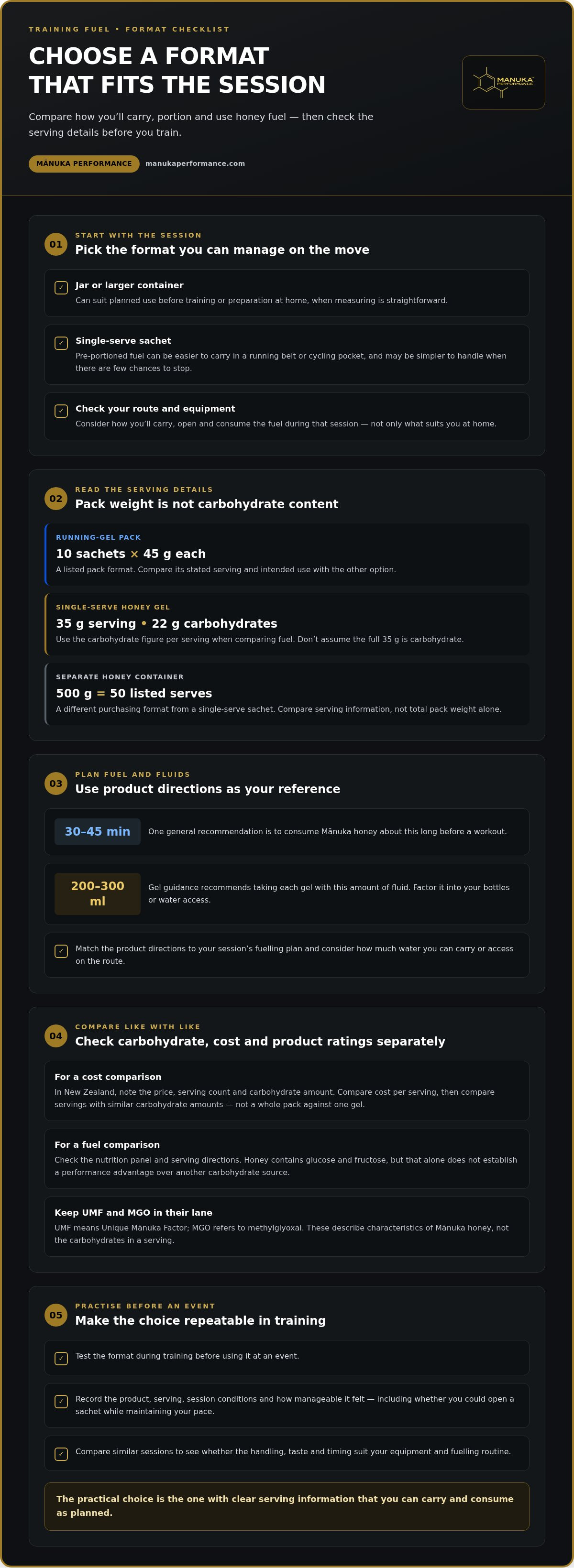
Start with the session, then choose a manageable format. A jar may suit planned use before training, when measuring honey is straightforward. During a run or ride, a single-serve sachet can make carrying and portioning easier. Manuka honey sports fuel should fit your route, equipment and fuelling routine, not just your preference at home.
Pack details provide a useful starting point. A running-gel format was sold in a pack of 10 sachets, each weighing 45 g. A separate 500 g honey container is listed as providing 50 serves. These packages serve different purposes, so compare the stated serving and intended use rather than judging by total pack weight.
Consider where you’ll use the product. A larger container may suit preparation at home, while a sachet can fit more readily into a running belt or cycling pocket. If your route offers few chances to stop, a pre-portioned format may be easier to handle. Choose based on how you’ll carry and consume fuel during that session.
Next, examine the nutrition panel and serving directions. A single-serve honey gel is listed at 35 g, while one serving is listed as containing 22 g of carbohydrates. Package weight and carbohydrate content measure different things. When choosing manuka honey sports fuel, compare the carbohydrate figure per serving with your planned intake, rather than assuming all 35 g is carbohydrate.
Fluid directions can also shape the decision. Gel guidance recommends taking each gel with 200-300 ml of fluids. Account for that amount when planning your bottles or water access. For example, a runner carrying limited water may need to consider how the gel’s fluid pairing fits the route and the rest of their drinking plan.
UMF means Unique Mānuka Factor, while MGO refers to methylglyoxal. These ratings describe characteristics of Mānuka honey, not the carbohydrate in a serving. They don’t replace the nutrition panel when comparing exercise fuels. Check the carbohydrate information and directions to assess fuel, and treat the ratings as a separate product attribute.
Test your chosen format in training before using it at an event. Record the product, serving, session conditions and how manageable it felt. For instance, note whether you could open a sachet while maintaining your pace. Comparing similar sessions can help you settle on a repeatable option that suits your equipment and fuelling plan.
Honey packets as an alternative to energy gels
A 35 g single-serve honey packet offers a portable alternative to loose honey. Compare its carbohydrate contribution, handling and cost with a gel before choosing.
Performance compared with other carbohydrate sources
Honey contains glucose and fructose, which the body can use as carbohydrate fuel. Its composition is relevant, but it doesn’t establish that honey improves performance more than another fuel.
For endurance sessions, the practical comparison is the amount and type of carbohydrate delivered, plus how easily you can consume it while moving. A 2015 running study tested a honey drink containing 6.8% carbohydrate. That study detail describes the drink tested, not a guaranteed result for every honey product or athlete.
During prolonged cycling, the body used a glucose-and-fructose mixture at rates about 55% higher than the same amount of glucose alone. This finding relates to the mixture, not a performance advantage unique to Mānuka honey. A packet’s honey content alone can’t show whether its carbohydrate profile suits your fuelling plan.
Compare the nutrition panel with your session’s demands. A gel may make its carbohydrate information and serving directions easy to assess. A honey packet may have a simpler ingredient profile, but package weight isn’t the same as carbohydrate content. Check both before treating the formats as equivalent.
Texture and access matter during exercise, too. A runner may prefer a sealed portion that opens quickly, while a cyclist may prioritise a format that fits securely in a jersey pocket. Practise using either option during training to see whether handling, taste and timing work at your pace.
Manuka honey and sports gel costs in New Zealand
In New Zealand, compare cost per serving, not just packet price. Pack size and the number of usable servings determine how far a purchase goes, while carbohydrate content shows what each serving provides.
A single honey sachet and a multi-serve container are different purchasing formats. A sachet can reduce measuring and carrying, while a larger container may suit planned use outside exercise. Neither is automatically better value: the useful comparison depends on serving size and how much fuel you need.
For a fair comparison, note the price, serving count and carbohydrate amount for each option. Calculate the cost per serving, then compare servings with similar carbohydrate amounts. Comparing a whole pack with one gel would skew the result.
Consider practical waste and convenience, too. An individually portioned packet can be easier to carry for a single session, while a larger pack may suit regular use. Choose based on your training routine, storage and portioning needs, not the MGO or UMF rating, which doesn’t measure carbohydrate value.
Price alone doesn’t indicate performance. Choose a format that makes carbohydrate intake clear and manageable, then assess it during training. That gives you a more useful comparison than choosing solely by the lowest pack price.
Using honey before, during and after exercise
Timing depends on whether you use honey before training or during prolonged exercise. Product directions and your session’s carbohydrate plan are useful reference points.
Before exercise
One general recommendation is to consume Mānuka honey about 30 to 45 minutes before a workout. Product guidance for carbohydrate intake suggests starting 10-15 minutes before exercise. These timings describe different recommendations, so follow the directions for the specific product you use.
A gel’s guidance recommends taking it 15 minutes before activity. For example, a runner could plan this serving before setting off, while allowing time to drink fluids as directed. Consider the session length and your existing meal or snack when deciding how pre-exercise fuel fits.
Try the timing during ordinary training first. Record when you took the honey, what else you ate and how the session felt. This gives you a practical basis for comparison across runs or rides, rather than introducing an unfamiliar routine on race day.
During exercise
For prolonged exercise, the guidance recommends 30-60 g or more of carbohydrates per hour to enhance performance. This is a target for total carbohydrate intake, not a honey-specific amount. Count all relevant fuel sources when planning the hour, including gels, drinks and food.
Product directions suggest 1-2 gels per hour in addition to electrolyte hydration. Separate gel guidance recommends taking one every 30-40 minutes during exercise. These are product-specific directions, so use the label to plan your intake rather than treating both intervals as separate requirements.
Each gel should be taken with 200-300 ml of fluids, according to its product guidance. For a ride, include that fluid in your bottle plan. During a run, consider whether you can carry enough water or access it along your route.
Keep a simple training record: note the session, timing, servings, fluid and carbohydrates from other sources. This helps you assess whether your planned intake fits the exercise, without assuming every session requires the same amount. Don’t test a new schedule for the first time during an event.
After exercise
One suggestion is to add Mānuka honey to a protein shake or recovery smoothie after training. For example, stir it into a shake you already prepare after a ride. This is a serving idea, not evidence that honey alone improves recovery.
Review the full day’s intake against product directions. The gel guidance sets a maximum daily intake of 10 servings. Keep that limit in view when combining exercise fuel across multiple sessions, and include electrolyte hydration separately as directed.
Can manuka honey cause stomach upset or other risks during exercise?
Stomach comfort depends on the fuel, its concentration, timing and intake rate. Honey’s carbohydrates may be difficult to tolerate during hard exercise, especially in a large amount taken at once. Responses vary, so assess the serving during training rather than trying it for the first time at an event.
Why discomfort can occur
A concentrated sweet fuel may feel heavy if you consume it quickly. Exercise intensity, recent food and fluid intake can also affect comfort. For example, taking honey just before a hard uphill effort may feel different from using it during an easier training session.
Portion size matters. A single-serve honey gel weighs 35 g, but that package weight doesn’t tell you how quickly to consume it. Follow the product directions, avoid taking several servings together, and account for carbohydrate from drinks or food. Stacking fuel sources can make the total intake harder to manage.
Fluid pairing is another practical consideration. Gel guidance recommends taking each serving with 200-300 ml of fluids. Include that amount in your drinking plan, rather than taking a gel without considering hydration. During a run, for instance, plan where you’ll carry or access water.
Reduce uncertainty during training
Introduce honey fuel in a controlled training session. Follow the labelled serving, note the timing and record any discomfort. Keep other food and drink consistent where practical. This makes it easier to identify whether the serving, timing or combination with another fuel affected your experience.
Repeat the same approach in another session before changing several variables. If you change the serving, timing and drink together, it becomes harder to identify what made a difference. A brief training note can record the exercise, food beforehand, fuel consumed and fluid alongside it.
Product instructions also set limits. Gel guidance recommends a maximum daily intake of 10 servings, and suggests 1-2 gels per hour alongside electrolyte hydration. Treat those directions as boundaries, not targets to exceed because a session feels demanding.
Age-related precautions
Honey is not suitable for infants under 12 months old. Product guidance also says children under 15 years should use the product only under medical or dietetic supervision. These age-related precautions matter even when honey is being considered as exercise fuel.
For adults, follow the label’s serving and fluid directions, and test the routine during training. If a serving repeatedly causes discomfort, stop using that routine during exercise and reassess the amount, pace and surrounding food or drink before your next session.
Does manuka honey improve athletic performance compared with other carbohydrate sources?
Mānuka honey provides glucose and fructose, both sources of carbohydrates. That makes it a possible exercise fuel, not proof of superior performance. Assess manuka honey sports fuel by comparing carbohydrate content, serving size and intended use. Keep these measures separate from claims about athletic outcomes. A honey rating or ingredient description alone cannot establish a performance advantage over another carbohydrate source.
A 2015 running study tested a honey drink containing 6.8% carbohydrate. This describes the drink’s concentration, not a guaranteed effect on running. Nor does it show that Mānuka honey outperforms sports drinks, gels or other foods. Interpret the result narrowly: the tested drink contained carbohydrate, while its specific performance effect cannot be inferred from concentration alone.
Carbohydrate combinations may affect how fuel is used during prolonged exercise. In cycling, the body used a glucose-and-fructose mixture at rates about 55% higher than the same amount of glucose alone. This finding concerns that mixture, not honey specifically. It supports comparing carbohydrate composition, but doesn’t establish that every honey product produces the same response.
For a fair comparison, check the nutrition panel for carbohydrates per serving. Then compare equivalent carbohydrate amounts across a gel, drink or food. Don’t treat package weight as carbohydrate content: a heavier packet may include water or other ingredients. Include all fuel consumed during the session so the comparison reflects your full plan.
Practical suitability matters, too. A runner might prefer a compact sachet, while a cyclist may choose fuel that fits their storage and bottle routine. These choices affect ease of use, not necessarily physiological performance. Test the format in training and note how it fits the session, including whether its directions and serving size are manageable.
A useful assessment of manuka honey sports fuel considers both composition and real-world use. Record the fuel type, serving information and session context. Compare those notes with another carbohydrate source in similar training conditions. This can clarify which option fits your routine without treating a product’s Mānuka identity as evidence of better results.
Current figures don’t establish that honey is superior to other carbohydrate sources. They show why composition and serving details matter in comparisons. Explore honey-based sports fuel options and assess their format and nutrition information against your training requirements.
Mānuka honey’s fructose and glucose are described as an immediately available source of fuel for athletes. That describes a potential role during exercise, but availability alone doesn’t show that it improves performance or works better than another carbohydrate source. Consider the description alongside the amount of carbohydrate in a serving and your planned use, not as evidence of a comparative outcome.
Keep three questions distinct when comparing fuels: can the carbohydrate serve as fuel, how much does it provide, and does the athlete experience a useful result? The description supports the first point, not an automatic answer to the last. Base any preference on the training context and equivalent comparisons, rather than the honey label alone.
Mānuka Performance: Natural, clean label honey based sports energy gels
Mānuka Performance develops natural, clean label honey based sports energy gels for runners and endurance athletes seeking a portable carbohydrate fuel. Its flagship LiquidFuel 10-Pack Running Gel uses a New Zealand honey-based matrix, giving athletes a purpose-designed format to consider alongside their training schedule and fuelling requirements.
The product is differentiated by PolySure™, an analytical standard that validates seven naturally occurring polyphenols in the finished product. This gives you a defined point of product characterisation, not evidence that the gel improves athletic performance. Compare the gel’s serving directions and nutrition information with your training plan, and test your fuelling routine during training.
If a honey-based gel fits your needs, visit manukaperformance.com to explore Mānuka Performance’s sports nutrition products.
Build a fuelling routine you can refine
Use your next training block to test consistency. Choose a format, try it in comparable sessions, and note how easily it fits your pace, equipment and hydration plan. This gives you a personal basis for refining manuka honey sports fuel choices, rather than relying on a label or a race-day experiment. Keep the approach simple enough to repeat, so changes in your routine remain clear.
For athletes considering a purpose-made option, Mānuka Performance offers natural, clean-label honey-based sports energy gels and CPG sports nutrition products. Its PolySure™ bioactive ingredients bring an analytical dimension to the company’s work, without implying a guaranteed athletic outcome. Explore these offerings in relation to your training demands and preferred fuelling format.
Contact Mānuka Performance to discuss its sports nutrition and ingredient offerings. A considered, repeatable approach can help you make your next training decision with greater confidence.
Frequently Asked Questions
How much manuka honey should athletes take before or during exercise?
There isn’t one amount that suits every athlete or product. For a gel, guidance recommends 1-2 servings per hour, alongside electrolyte hydration, with a maximum daily intake of 10 servings. Before activity, product directions recommend one gel 15 minutes beforehand. Include its carbohydrates in your overall exercise intake, rather than adding them on top of other fuels without accounting for those sources.
How does manuka honey compare with sports gels, drinks, and regular honey for endurance fuel?
Mānuka honey provides glucose and fructose, but its name alone doesn’t establish greater fuel value than regular honey, gels or drinks. A listed honey gel serving contains 22 g of carbohydrates, while a single-serve honey product weighs 35 g, a different measure. A honey drink tested in a 2015 running study contained 6.8% carbohydrate. Compare carbohydrate information and serving directions, not package weight or honey type alone.
When should athletes consume manuka honey for energy during training or competition?
Follow the timing on the product you’re using. Gel guidance recommends a serving 15 minutes before activity, then one every 30-40 minutes during exercise. For competition, map those intervals against the start and course logistics, including when you can drink. Practise the same schedule during training first, recording what you consume and when. That helps you assess how the timing fits your pace and routine.