


Premium branding doesn’t automatically make a better pre-workout fuel. A manuka honey pre workout may appeal as a natural option, but its practical value depends more on carbohydrate intake, session demands and personal tolerance than on the honey’s name or rating. Honey supplies carbohydrates, including glucose and fructose, which the body can use for energy during exercise.
It’s easy to see why mānuka’s role can be unclear: claims about energy, recovery and health are often discussed alongside its carbohydrate content. For training, start with practical questions. How long and demanding is the session? Do you usually plan to eat or drink carbohydrate around it? And which format feels comfortable and manageable for you?
This article explains what honey can contribute before exercise, what its carbohydrate content does and doesn’t tell you, and how to compare formats. It also covers a simple way to trial a familiar food or a formulated honey-based gel during training, so you can assess how it fits your routine rather than relying on the label alone.
Key Takeaways
- Assess manuka honey pre workout by its carbohydrate contribution and your session demands, rather than the mānuka label alone.
- Understand how naturally occurring glucose and fructose relate to exercise fuelling, without assuming they guarantee a performance benefit.
- Compare a familiar food, a formulated gel and other planned carbohydrate options by portability and suitability for your session.
- Trial a familiar format during training and note how it fits your routine and personal tolerance.
- Explore how LiquidFuel 10-Pack Running Gel uses a New Zealand honey-based matrix for runners and endurance athletes.
Manuka honey pre-workout: what role can it play?
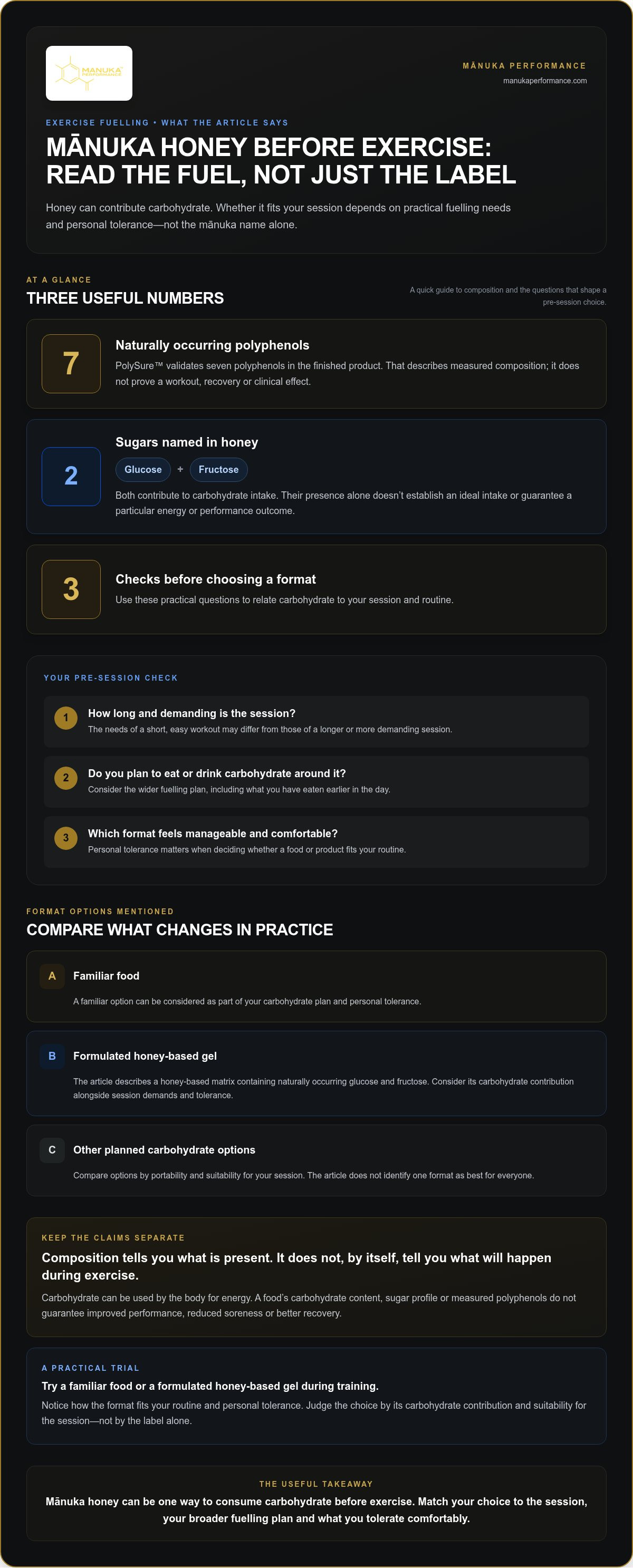
Can mānuka honey contribute carbohydrate before exercise? Yes. Honey contains naturally occurring sugars, including glucose and fructose, which count as carbohydrate in a fuelling plan. That describes its nutritional role. It doesn’t promise that eating it will improve a particular workout or produce a measurable performance change.
Pre-workout fuelling means choosing food or drink in relation to the session ahead and what you can comfortably tolerate. The needs of a short, easy workout may differ from those of a longer or more demanding session. What you have eaten earlier in the day also forms part of the picture. There is no single food or format that suits every athlete.
The phrase manuka honey pre workout can make the ingredient sound like a distinct category of sports fuel. In practice, first consider how much carbohydrate a food contributes and whether it fits your session and routine. Mānuka identity alone doesn’t establish a special workout effect, and it isn’t evidence of a medicinal or therapeutic benefit.
What does mānuka honey contribute before exercise?
Its relevant contribution is carbohydrate from naturally occurring sugars. The body can use carbohydrate as fuel, but the presence of glucose and fructose in honey doesn’t determine how a session will feel or unfold. The amount consumed, other foods in your routine, the exercise demands and your individual tolerance all matter when considering whether it fits your plan.
Separate this nutritional role from broader marketing language. A food can provide carbohydrate without being a treatment, a recovery aid or a guaranteed route to better performance. Those are different claims, and identifying sugars in a food doesn’t establish them.
Does mānuka honey work differently from other honey?
Mānuka honey is associated with honey produced from nectar of the mānuka plant; Manuka honey provides background on its origin and distinctive properties. A measurable difference in composition, however, is not the same as evidence of an exercise-specific advantage. The mānuka label alone can’t show that it fuels a workout differently from another carbohydrate source.
Before exercise, honey’s relevant role is as a carbohydrate source, not a guaranteed performance aid. This distinction helps you assess claims clearly: composition describes what a product contains, while an exercise benefit needs evidence that demonstrates the outcome in a relevant context. Mānuka honey can be one way to consume carbohydrate, but its identity doesn’t replace decisions based on session demands, overall fuelling and personal tolerance.
How carbohydrate from mānuka honey relates to exercise
Carbohydrate is one source of fuel the body can use during exercise. It’s a broad nutrient category, not a performance claim. The fact that a food contains carbohydrate doesn’t establish how much a particular athlete needs, whether it suits a specific session or whether it will produce a noticeable change. Those questions depend on the training context and the person’s overall fuelling plan.
As background, Carbohydrates and exercise explains that carbohydrate can be used for energy and stored in the muscles and liver. This outlines the general role of carbohydrate, but it doesn’t show that a particular honey, sugar profile or product will improve your workout. An ingredient’s presence is not a substitute for evidence about an exercise outcome.
Glucose, fructose and carbohydrate fuelling
Glucose and fructose are sugars that contribute to carbohydrate intake. Mānuka Performance’s honey-based matrix contains naturally occurring glucose and fructose, so its carbohydrate contribution can be considered as part of the wider food or product being used. Their presence alone doesn’t establish an ideal intake for every athlete or session.
Fuelling needs can vary with the duration and demands of training, what else you consume and your individual tolerance. Don’t assume that the combination guarantees a particular absorption rate, “steady” energy or superior performance. Those outcomes can’t be concluded from the names of the sugars alone.
What polyphenol claims can, and can’t, tell you
Polyphenol measurement describes composition. It doesn’t, by itself, establish that an ingredient will change exercise performance, reduce soreness or support recovery. Those specific physiological effects require relevant evidence that directly examines the claimed outcome in an applicable exercise context.
PolySure™ validates seven naturally occurring polyphenols in the finished product. This provides information about measured composition, not proof of a clinical or workout effect. Measuring an ingredient shows what is present; it doesn’t establish what that ingredient will do during exercise.
This distinction matters because antioxidant and recovery language can appear alongside carbohydrate fuelling, making separate claims sound like one established benefit. A product may contain measured compounds, but that fact alone doesn’t demonstrate that consuming it before a session will affect inflammation, recovery or how the workout feels. Keep the questions separate: what does the carbohydrate contribute, and what evidence supports any additional claimed effect?
For athletes considering a formulated option, Mānuka Performance’s honey-based sports nutrition includes a matrix with naturally occurring glucose and fructose. Treat its composition as information to consider when making a fuelling choice, not as a guarantee of an exercise response.
Mānuka honey, ordinary honey or a sports gel: what changes?
Choosing a pre-session carbohydrate format is a practical decision, not a ranking of ingredients. Spoonable honey may fit a familiar routine, while a formulated gel is made as a sports nutrition format that can be carried for planned use. Other carbohydrate foods and drinks may also fit, depending on the session, access to food and what feels comfortable for you.
A mānuka label doesn’t establish that honey is superior to ordinary honey or other carbohydrate sources for exercise. Compare the format, portability and how it fits your plan, rather than assuming the ingredient name determines its value.
| Format | Portability and handling | Possible fit |
|---|---|---|
| Spoonable honey or another familiar food | May be convenient at home, but carrying and eating it away from home can be less straightforward. | Could suit a pre-session routine where the food is familiar and easy to include. |
| Formulated sports gel | A purpose-made format for carrying as part of an exercise fuelling plan. | May be practical for endurance training when an athlete plans to consume carbohydrate while exercising. |
| Other planned carbohydrate options | Portability varies by format, such as a drink, snack or other sports food. | Can be considered in relation to the session plan, access to food and individual tolerance. |
When might a food-based option fit?
A familiar food can be straightforward to include in a pre-training routine, particularly when it is already part of your usual eating pattern. That doesn’t make it suitable for everyone. Convenience, texture, timing and personal tolerance differ. Rather than treating mānuka honey as a prescribed serving, consider whether the format fits your session and your established approach to food.
When might a formulated gel fit better?
A formulated gel can be a practical format for planned carbohydrate use during endurance training, especially when carrying a spoonable food is awkward. It isn’t simply a jar of raw honey; it’s a sports nutrition product made as a gel. Suitability still depends on your plan and tolerance, not on a universal advantage over other options.
For a closer look at the format and its design, explore this analysis of natural honey-based energy gels. Readers weighing up gels against alternatives can also consider the discussion of whether honey energy gels work. These comparisons can add context, but they don’t replace testing a chosen format in training.
When choosing a manuka honey pre workout option, start with the session and the format you can use comfortably. A spoonable food, gel or other planned carbohydrate option may each have a place. The label alone can’t determine which one is right for you.
How to trial mānuka honey before a training session
A useful trial is a repeatable way to assess whether a carbohydrate format suits your routine. It isn’t a test of whether mānuka honey guarantees more energy or better performance. Avoid introducing it for the first time before an important event. Choose an ordinary training day, keep the rest of your routine familiar, and observe how the format fits the session.
Match the trial to the session
Start by identifying the workout you’re fuelling. A short, low-demand session may not call for the same approach as a longer endurance workout, and a pre-workout honey routine isn’t necessary for every session. Carbohydrate needs depend on the activity and your individual plan, so don’t assume one amount or timing suits everyone.
Then follow this sequence:
- Identify the session. Note its type, expected demands and whether you usually plan carbohydrate around it. Choose a session that reflects how you might realistically use the food or gel.
- Choose a familiar format. Select a food or formulated gel you can use comfortably. Keep other parts of your pre-training routine as consistent as practical, rather than changing several foods or habits at once.
- Test it in training. Use the format during a regular workout, not for the first time in a race or key event. Don’t treat a particular timing or quantity as universal; consider it within your established plan and tolerance.
- Record what happened. Write down the session, food format, when you ate it in relation to training, what else you ate, comfort during exercise and how convenient it was to carry or use.
Assess comfort and repeatability
Change one variable at a time. If you switch format and alter your usual meal routine together, it becomes harder to tell which change affected comfort or convenience. A brief log can help: note whether the food was easy to manage, whether it felt comfortable during the session, and whether you’d choose the same approach for a similar workout.
Individual responses vary, so one trial shouldn’t be treated as a universal verdict. Repeat the same approach in comparable training conditions before drawing a practical conclusion. Use your notes to refine your routine rather than chasing a guaranteed outcome. If gastrointestinal comfort is a concern during running, this guide to avoiding runners’ stomach issues provides more context.
For a manuka honey pre workout trial, the aim is to learn whether a format fits your session and routine, not to prove a health or performance claim. If a portable, formulated option suits your endurance training plan, explore honey-based sports gels as one format to consider.
A measured honey-based option for endurance training
For runners and endurance athletes considering a formulated carbohydrate option, Mānuka Performance’s LiquidFuel 10-Pack Running Gel is a honey-based product made for this context. Its New Zealand honey-based matrix contains naturally occurring glucose and fructose, sugars that contribute carbohydrate. This describes the product’s composition, not a promise of improved performance or a particular training response.
The gel format offers an alternative to carrying spoonable honey as part of a planned fuelling routine. Its practical role is to provide a sports nutrition format to consider alongside the demands of a session and your established approach to fuelling. It isn’t raw table honey, and the mānuka association alone doesn’t establish superiority over other carbohydrate options.
What the LiquidFuel format offers
A formulated running gel can be easier to incorporate into an endurance plan than a jar of honey, particularly when you want a purpose-made format to carry during training. Whether it suits you depends on how it fits your routine, session and tolerance. Choosing a gel doesn’t guarantee that you’ll feel or perform differently.
LiquidFuel 10-Pack Running Gel uses a New Zealand honey-based matrix containing naturally occurring glucose and fructose. These details describe its carbohydrate source and format, without implying a particular quantity, timing recommendation or outcome. As with any fuelling choice, consider the product in the context of your wider plan rather than treating it as a universal solution.
How to evaluate the analytical distinction
PolySure™ validates seven naturally occurring polyphenols in the finished product. That is information about measured composition. It doesn’t demonstrate a clinical effect or establish that the polyphenols will produce a training, recovery or other physiological benefit.
Keep the two points distinct: the honey-based matrix contains glucose and fructose, which contribute carbohydrate, while PolySure™ relates to validated polyphenol content. Neither fact on its own proves a workout outcome. This measured approach makes the product’s composition clearer, while fuelling decisions remain grounded in session needs and personal experience.
If a honey-based gel fits your endurance fuelling plan, explore Mānuka Performance’s running gel as one format to consider. For anyone searching for a manuka honey pre workout option, the relevant questions remain what the product contains, how it fits the session and whether it works for your routine, without assuming a guaranteed result.
Make your next fuelling choice a considered one
Make your next step a practical trial: choose a familiar training session, use a format that fits your plan, and note how comfortably it works for you. That gives you a more useful basis for deciding whether manuka honey pre workout belongs in your routine than relying on the mānuka label or broad promises alone.
For endurance athletes considering a formulated option, LiquidFuel 10-Pack Running Gel uses a New Zealand honey-based matrix, while PolySure™ validates seven naturally occurring polyphenols in the finished product. These details describe composition and measurement, not a guaranteed training outcome. Your session demands and experience remain central to the decision.
If you’d like to consider a honey-based gel for your training plan, explore Mānuka Performance’s honey-based running gel. Take a measured approach, learn from your training, and build a fuelling routine that works for you.
Frequently Asked Questions
Is mānuka honey good before a workout?
It can contribute carbohydrate before exercise, but whether it suits you depends on the session, your wider fuelling routine and personal tolerance. The mānuka designation doesn’t establish a distinct pre-workout effect or guarantee improved performance. For example, if you already have a familiar snack before training, honey could be considered as one component of that routine, rather than treated as a special-purpose workout aid. Claims beyond carbohydrate fuelling need relevant exercise research.
How long before a workout should you have mānuka honey?
There’s no single timing that suits every athlete, food format or session. What else you eat and how comfortable you feel exercising after food can affect the interval that works for you. Rather than following a universal rule, assess your routine during a regular training session and note the context, including your meal or snack. This is a practical observation, not an individual nutrition prescription.
How much mānuka honey should you have before exercise?
No single amount is appropriate for every person and workout. The relevant context includes the session, your other food and your tolerance, so don’t select an amount solely by the mānuka rating or assume that more will improve performance. If you follow a structured sports nutrition plan, consider honey within that plan rather than as an automatic addition, and observe whether it fits comfortably into your usual eating pattern.
Does a higher MGO rating mean more pre-workout energy?
No. MGO is not a measure of the carbohydrate available to fuel exercise, so a higher rating shouldn’t be read as a higher-energy fuelling specification. Mānuka honey’s naturally occurring sugars contribute carbohydrate, while MGO describes a different characteristic. Keep these measures separate when comparing products: an MGO figure alone doesn’t tell you how a food fits your carbohydrate plan or predict an exercise-performance outcome.
Can mānuka honey cause stomach discomfort before exercise?
It may not suit everyone, as comfort can vary with the food, amount, timing and type of activity. A mānuka label doesn’t guarantee digestive comfort. If you’re considering it, avoid making the first trial on an important event day; assess it during ordinary training and note conditions such as the session and what else you ate. This can help you judge whether your experience is consistent across comparable workouts.
Is mānuka honey a substitute for a pre-workout meal?
Not necessarily. Honey contributes carbohydrate, but that doesn’t make it nutritionally equivalent to a meal or appropriate for every training session. For instance, if your routine includes a meal, adding honey doesn’t automatically mean the rest of that meal can be omitted. Consider your full eating pattern and activity, and treat honey, if used, as one possible component of fuelling rather than a complete nutrition plan.
Does mānuka honey work for strength training as well as running?
Honey can contribute carbohydrate, but that fact alone doesn’t establish a specific benefit for strength training. A short lifting session after a usual meal presents a different fuelling context from a long run, and individual preferences also vary. Consider whether carbohydrate has a role in your overall plan for that workout instead of assuming an endurance gel or honey-based product is necessary or suitable for every type of training.