


Use honey based energy gels for runners during longer efforts, starting before you feel an energy dip; during long runs or races, a practical starting interval is about 45 minutes to an hour. Your pace, the run’s duration and how well you tolerate the fuel all influence the plan, so practise your timing in training rather than trying it for the first time on race day.
It’s reasonable to want more than a timing rule: the packet’s carbohydrate and calorie content also affects how it fits into your overall fuelling plan. Honey contains both glucose and fructose, while a typical energy gel contains about 20 to 25 grams of carbohydrate and around 90 to 100 calories. The amount of honey in a pouch can differ, so check its nutrition information and account for the carbohydrates it provides.
This guide explains when to take honey based energy gels for runners, how to compare serving size and calories, and how to test flavours and fuelling intervals on training runs. You’ll also learn why concentrated fuel may need to be taken with water and how to build a routine that works for your running.
Key Takeaways
- Start fuelling before you feel an energy dip, and use your run’s duration and intensity to shape your timing.
- Compare a packet’s carbohydrate content and calories with your overall fuelling needs, rather than judging it by size alone.
- Practise your fuelling interval on training runs so you can adjust it to your own response before race day.
- Test flavours during training and note which options you find easiest to take while running.
Honey as a running fuel
Honey can provide carbohydrate during endurance activity. Assess the serving size, ingredients and fit with your run. These steps cover practical fuelling, homemade options, water, sensitivities and New Zealand import and sale considerations.
-
Review honey as a running fuel
Choose honey as a portable carbohydrate fuel, then compare its carbohydrate profile with your needs. Honey contains glucose and fructose in an approximately 1:1 ratio, while typical energy gels are formulated at about 2:1. That difference can affect how the fuel fits your broader sports nutrition plan, so assess the full intake rather than relying on honey alone. If you are balancing endurance fuelling alongside wider fitness and active lifestyle goals, platforms like Weightloss and Wellness can help you explore relevant health and sports products.
Honey has a consistency similar to standard gels, making it practical to consume during a run. Start fuelling before an energy dip, then use your response in training to assess timing and tolerance.
-
Compare gel ingredients and homemade fuels
Read the ingredient list and nutrition panel before choosing a honey-based gel. For a homemade option, use a clean, secure pouch and measure each serving to track its carbohydrate contribution. Keep the recipe simple while testing it: changing several ingredients at once makes it harder to identify what affects taste or comfort.
Maple syrup is another portable carbohydrate source: two tablespoons contain about 108 calories. Honey contains about 130 calories per 30 ml serving, so compare actual portions rather than assuming equal volumes provide the same energy. Honey based energy gels for runners can vary by formulation; use the packet’s own information when planning.
-
Consider use during running and endurance activity
Plan gel use around the length and effort of your run, and begin before you feel depleted. A general starting point during long runs or races is one gel every 45 minutes to an hour, adjusted in training to your intensity and tolerance. For runs longer than 2 hours, some guidance suggests a pouch every 60-120 minutes.
Treat these intervals as starting points, not a reason to take fuel you don’t need. Log your timing and response after each session, then refine the plan for your event.
-
Check water needs, distance suitability and side effects
Pair concentrated carbohydrate fuel with water, particularly during sustained efforts. The amount you need depends on conditions, sweating and total carbohydrate intake. A gel can be used across race distances, but its value depends on the event’s duration and your fuelling plan. Test the exact product and timing in training.
Honey may cause stomach discomfort, and anyone with a honey allergy should avoid it. In New Zealand, importing or selling honey-based sports gels involves applicable food and biosecurity controls; requirements depend on origin, ingredients and processing. Honey is not vegan, so assess the full ingredients if you have dietary restrictions. Don’t treat an adult sports gel as children’s fuel without suitable professional guidance.
Honey gel packet size and calories
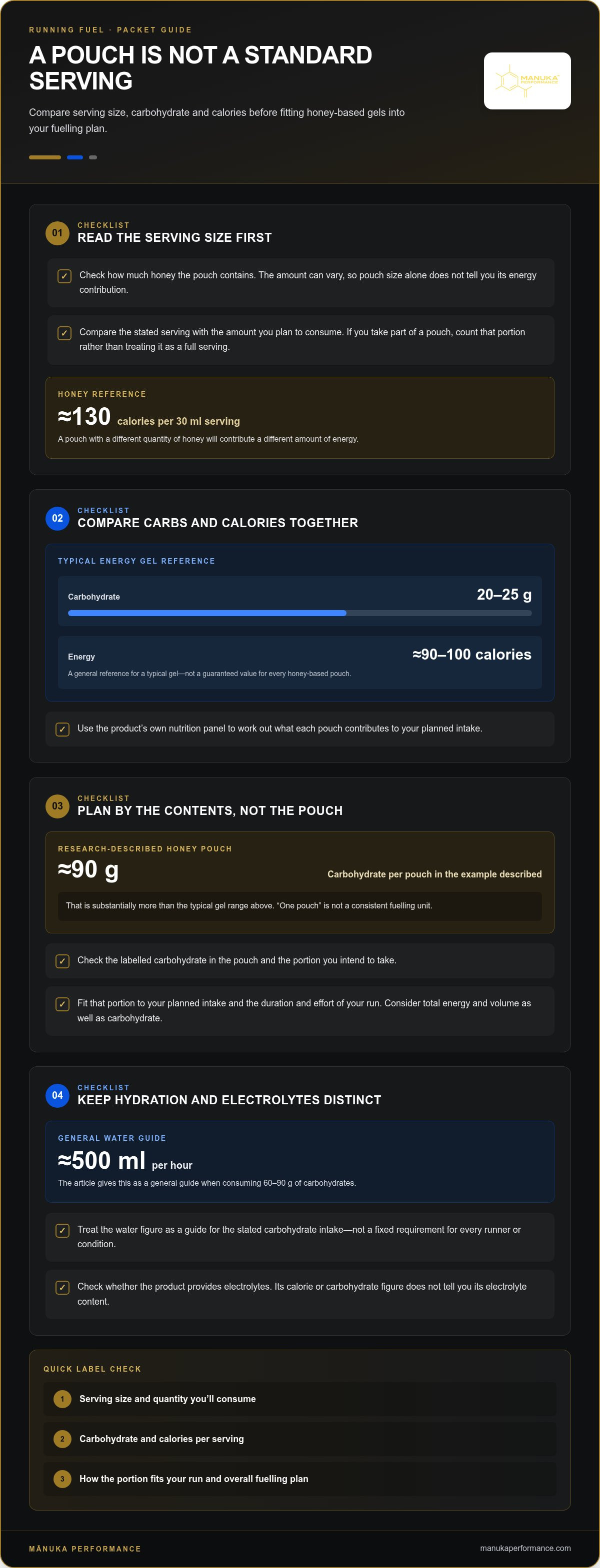
Compare each pouch by serving size, carbohydrate content and calories, then fit it into your run’s fuelling plan. A larger packet may provide more carbohydrate, but consider its total energy and volume too.
- Check the serving size. Honey contains about 130 calories per 30 ml serving, so the amount in a pouch changes its energy contribution. Read the nutrition panel and compare the stated serving with the quantity you expect to consume. If you take only part of a pouch, account for that portion rather than treating it as a full serving.
- Compare carbohydrate and calories together. Most energy gels contain 20 to 25 grams of carbohydrate and around 90 to 100 calories. These figures offer a useful reference, but don’t assume every honey gel matches them. Use the product’s labelled values to calculate what each pouch contributes to your planned intake.
- Match pouch contents to your session. A honey pouch recipe described in the research provides approximately 90 g of carbohydrate per pouch, substantially more than the typical gel range above. That example shows why “one pouch” isn’t a consistent fuelling unit. Divide the labelled carbohydrate by your intended intake, and plan portions around the run’s duration and effort.
- Account for water and electrolytes separately. A general guide is around 500 ml of water per hour when consuming 60-90 g of carbohydrates. Treat that as a guide for the stated carbohydrate intake, not a fixed requirement for every runner or condition. Check whether your fuel provides electrolytes; don’t infer electrolyte content from its calories or carbohydrate figure.
For a ready-made option, compare natural, clean label honey-based sports energy gels by their labelled pouch size and carbohydrate contribution, then use those details to plan your own intake.
Testing a new fuel during training
Use a repeatable training plan to assess timing, taste and comfort before race day. Change one factor at a time so each run gives you useful feedback.
- Choose a suitable test run. Try the fuel during a familiar training session, not for the first time on race day. Choose a run similar to the effort at which you expect to use a gel. Keep your usual pre-run routine consistent, so changes in comfort or energy are easier to link to the new fuel.
- Begin with a planned interval. A 45-minute fuelling interval is one suggested starting point for experimentation. Take the gel at that time, before you feel an energy dip, and record when you consumed it. The interval is a test setting, not a fixed rule; adjust it in later runs according to intensity and your response.
- Record your response after each run. Note the gel’s flavour, how easy it was to carry and consume, and any stomach discomfort. Record the effort and when you took the fuel, too. These details help distinguish a flavour preference from a timing or tolerance issue, especially when comparing sessions in similar conditions.
- Adjust only one variable per session. If the first trial feels uncomfortable, change the interval or serving amount next time, rather than changing both together. Some runners space honey pouches 60-90 minutes apart depending on intensity, while individual needs and runs differ. Repeat your preferred approach across training runs, then use the race-day strategy you have practised.
Energy gel flavours
Test flavour during training, because taste can affect whether you’ll take a fuel consistently while running. Assess flavour separately from timing, serving size and comfort.
- Begin with a familiar flavour profile. Try a honey gel on a training run before relying on it during an event. New Zealand mānuka honey has a strong flavour that may suit runners who prefer a more pronounced taste. Record your impression after tasting it, rather than judging by aroma alone.
- Compare options under similar conditions. Test different flavours on runs with comparable effort and duration, keeping your fuelling interval steady. Note whether a flavour remains acceptable later in the session, when repeated exposure may change how you perceive it. This makes the comparison more useful than sampling products on unrelated days.
- Assess homemade variations one at a time. A honey pouch recipe can include approximately 15 ml of fresh lemon juice. Try the base honey mixture first, then add lemon on another training run. Changing one ingredient at a time helps you identify which flavour you prefer, without confusing the result with a new fuelling schedule.
- Keep a brief flavour log. After each run, record the gel or recipe, when you used it and whether you wanted another serving. Note practical details, such as whether the taste felt too strong or became less appealing during the session. Use these notes to choose a flavour you can tolerate throughout your planned fuelling routine.
Once you know which flavour profile suits your training, explore honey-based gel options and use their ingredient details to guide your next comparison.
Mānuka Performance: Natural, clean label honey based sports energy gels
Mānuka Performance offers natural, clean label honey based sports energy gels for runners seeking a convenient carbohydrate fuel. Its LiquidFuel 10-Pack Running Gel uses a New Zealand honey-based matrix, providing a ready-made alternative to measuring and carrying homemade fuel during training or endurance events.
To compare honey-based fuel with your current routine, consider its carbohydrate contribution alongside your planned intake and test it during training. Mānuka Performance differentiates its products through PolySure™, an analytical standard that validates seven naturally occurring polyphenols in the finished product. This provides a defined quality measure without making therapeutic or health claims.
If you’re assessing honey-based fuel for your running routine, explore Mānuka Performance’s sports energy gels and product information.
Make your fuelling routine your own
Turn your training notes into a repeatable plan. Choose a fuel you can carry and consume comfortably, then practise with consistent timing. A useful routine is one you can follow reliably on the runs that matter to you, not a strategy assembled on race day.
For runners considering honey based energy gels for runners, Mānuka Performance offers natural, clean-label honey-based sports energy gels and CPG sports nutrition products. Its PolySure™ analytical standard validates seven naturally occurring polyphenols in the finished product, providing a defined reference point as you assess product information against your fuelling needs.
To explore the company’s products or discuss its sports nutrition work, contact Mānuka Performance. Use what you learn from training to make your next fuelling choice with greater clarity and confidence.
Frequently Asked Questions
When should I use an Energy Gel?
Use an energy gel during a run when its duration and effort make additional carbohydrate useful, rather than taking one automatically on every outing. For example, a runner preparing for an endurance event can practise fuelling before fatigue affects their pace. Consider the session and your overall fuelling routine, then test the timing in training before using the same approach in an event.
What honey-based energy gels are available for runners in New Zealand?
Mānuka Performance offers natural, clean label honey-based sports energy gels in New Zealand, including its LiquidFuel 10-Pack Running Gel. The product uses a New Zealand honey-based matrix as a convenient carbohydrate fuel. Runners comparing options can consider the product format, ingredient information and nutrition panel, then assess how the gel fits their training routine.
Which NZ brands make honey energy gels, and what ingredients do they contain?
Mānuka Performance is a New Zealand company offering honey-based sports energy gels. Its running gel uses a New Zealand honey-based matrix that naturally contains glucose and fructose. For a precise ingredient comparison, read the product packaging and distinguish named ingredients from general descriptions such as “honey-based”. This helps identify the formulation relevant to your dietary requirements.
How many grams of carbohydrates and calories are in each honey-based running gel?
Carbohydrate and calorie amounts vary by gel and serving size, so no single figure applies to every honey-based running gel. Check the nutrition panel for the amount per serving, then compare it with the quantity you’ll actually consume. Typical energy gels can provide a point of comparison, but their values won’t necessarily apply to every honey formulation.
Where can runners buy honey energy gels in New Zealand?
Runners can look to Mānuka Performance for its honey-based sports energy gels, including the LiquidFuel 10-Pack Running Gel. Use the company’s product information to identify the gel and review its stated details before choosing it for training. If you’re comparing potential fuels, focus on the labelled ingredients and nutrition information rather than relying on a product name alone.
How should runners use honey energy gels before and during a run, and how often?
Use a gel during longer runs according to a fuelling schedule practised in training; a suggested starting interval is every 45 minutes to an hour. Avoid making race day your first trial. If you’re considering a gel before a run, include it only in a routine you’ve tested, and record the timing, amount and how you felt during the session.