


Neither honey nor maltodextrin is universally better for running. Both provide carbohydrate fuel, but their compositions differ: honey contains glucose and fructose, while maltodextrin is made from starch and broken down into glucose during digestion. Which works better for you depends on the fuel’s composition and how your gut responds during exercise.
Maltodextrin is a carbohydrate commonly used in sports nutrition. It is not a separate form of glucose: digestion breaks its linked glucose units down into glucose. Honey provides a different mix of sugars, and its composition, including the balance of glucose and fructose, can vary with its floral source.
This comparison looks at how the two fuels differ in carbohydrate composition and glycaemic index, and why those measures do not tell the whole story about gastrointestinal tolerance during endurance exercise. It also explains how to weigh your event’s demands and your personal response when choosing a fuel to practise with before race day.
Key Takeaways
- Use glycaemic index as one comparison point, not a standalone measure of how well a fuel will work during your run.
- Consider how the carbohydrate source fits your fuelling needs, particularly during longer endurance efforts.
- Pay attention to your own gastrointestinal response, as tolerance can differ between runners and fuel types.
- Practise with your chosen fuel under race-like conditions before relying on it in competition.
Honey's glucose and fructose composition
Honey supplies glucose and fructose, but their proportions vary with floral source. For New Zealand runners, choose honey intended for food, follow its storage directions, and compare ingredient lists and nutrition panels when selecting a fuel.
Fructose and gastrointestinal distress
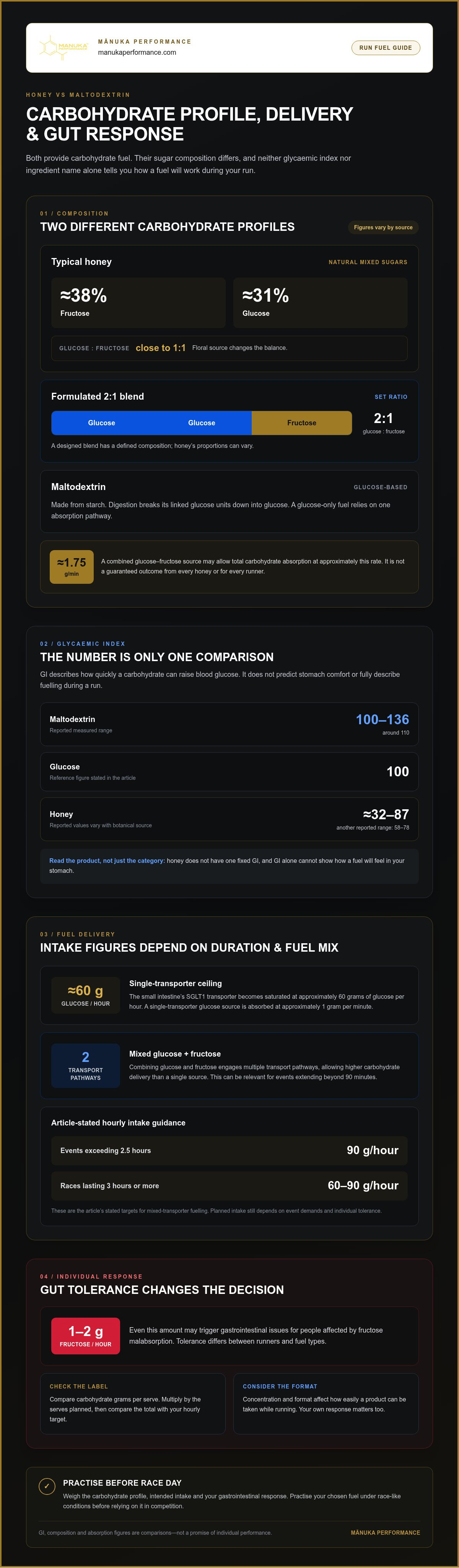
Fructose is one of honey’s main sugars, alongside glucose, and its proportion can influence both the carbohydrate profile and individual tolerance. Fructose malabsorption can make this fuel less comfortable: even 1-2 grams of fructose hourly may trigger gastrointestinal issues for people affected. A naturally mixed source therefore differs from a glucose-only fuel, but tolerance remains individual.
Glucose-fructose ratios and absorption
Typical honey contains approximately 38% fructose and 31% glucose, placing its glucose-to-fructose ratio close to 1:1; floral source changes that balance. By comparison, a formulated sports nutrition blend can set a different ratio, such as the common 2:1 glucose-to-fructose profile. A combined glucose-fructose source may increase total carbohydrate absorption to approximately 1.75 grams per minute, according to Research source not identified in the research fact. The figures describe different compositions, not a guaranteed outcome from every honey.
| Fuel option | Carbohydrate profile | Practical distinction |
|---|---|---|
| Honey | Glucose and fructose; proportions vary | Naturally mixed sugar profile |
| 2:1 blend | Glucose and fructose in a set ratio | Designed around a defined composition |
| Glucose-only fuel | Glucose-based carbohydrate | Does not provide the same sugar combination |
Glucose-fructose performance research
Performance research compares how the body uses mixed sugars with single-source carbohydrate fuels. Studies comparing honey with glucose or maltodextrin have found comparable carbohydrate oxidation rates and similar endurance-exercise outcomes. This supports honey as one possible fuel, not as a proven improvement on alternatives. For athletes, the useful comparison is the full carbohydrate profile and how it fits their fuelling needs.
Weigh the sugar profile, intended carbohydrate intake and your tolerance during training when choosing a fuel.
Maltodextrin and dextrose as carbohydrate sources
Maltodextrin and dextrose both provide glucose-based carbohydrates, but their structures and digestion differ. For athletes, these differences can matter when planning fuel concentration and intake during longer runs.
Maltodextrin and dextrose sources
Maltodextrin is made from starch, commonly from corn or rice, though potatoes and wheat are also sources. Digestion breaks its glucose chains into glucose. Dextrose is glucose, so it does not need the same chain breakdown. Maltodextrin raises blood sugar less sharply than dextrose, giving them distinct immediate responses despite their shared glucose basis.
To compare a gel or other fuel, check the nutrition panel for the carbohydrate grams per serve. Multiply that amount by the number of serves you plan to consume, then compare the total with your hourly target. Concentration and format affect how easily you can take a product while running, and individual tolerance matters too. This label-based approach works across products without assuming a particular amount in any one brand.
Carbohydrate oxidation and energy availability
Carbohydrate oxidation describes the body using carbohydrate as fuel during exercise. A glucose-only source relies on one absorption pathway, which can become a constraint as intake rises. The small intestine’s SGLT1 transporter becomes saturated at approximately 60 grams of glucose per hour, while a single-transporter glucose source is absorbed at approximately 1 gram per minute.
Combining glucose with fructose engages multiple transport pathways, allowing higher carbohydrate delivery than a single source. This dual-transporter approach can be relevant for events extending beyond 90 minutes, when the single-transporter ceiling may constrain fuelling. It doesn’t mean every athlete needs a mixed source; duration, planned intake and gut tolerance shape the decision.
For events exceeding 2.5 hours, the stated target is 90 grams per hour when consuming mixed-transporter carbohydrate sources. For races lasting 3 or more hours, aim for 60-90 grams of carbohydrates per hour. Check the stated carbohydrate amount per serve and organise intake to match your intended hourly total, rather than judging fuel by its ingredient name alone.
Maltodextrin composition and glycaemic index
Maltodextrin is made from starch and contains glucose chains that digestion rapidly breaks down. Its glycaemic index (GI) is reported around 110, above glucose at 100, although maltodextrin’s measured range is 100-136.
Honey’s GI varies with its botanical source and glucose-to-fructose profile. Reported values range from approximately 32 to 87; another reported range is 58 to 78. These figures show why “honey” doesn’t describe one fixed GI value. A runner comparing nutrition labels should consider the specific honey-based product, rather than assuming every honey has the same carbohydrate profile or effect.
The glycaemic index (GI) describes how quickly a carbohydrate can raise blood glucose, but it does not measure every aspect of fuelling during a run. Maltodextrin’s high GI indicates rapid digestion, while fructose in honey contributes a different sugar profile. Neither GI nor sugar composition alone predicts how a fuel will feel in your stomach or suit a particular training session.
Honey also contains small amounts of naturally occurring antioxidants alongside its sugars. These components distinguish honey from purified maltodextrin, but do not establish that honey is a better endurance fuel. For a practical comparison, check the product’s carbohydrate amount and ingredients, then assess how it works during training.
In New Zealand, compare costs by checking the shelf price per serving alongside the carbohydrates each serving provides. Serving size, product format and carbohydrate concentration affect the comparison between honey, maltodextrin and sports gels. A lower price per pack does not necessarily mean a lower cost per amount of carbohydrate.
On your next training run, compare GI information with the nutrition panel and your own response. Use the same planned carbohydrate amount when assessing options, and record stomach comfort and energy during the session. This gives you a more useful comparison than choosing by GI alone.
Gastrointestinal tolerance during endurance exercise
During endurance exercise, fuel tolerance depends on the carbohydrate type, amount and how you consume it. A consistent training routine can help you identify which source suits your digestion.
Honey and maltodextrin performance evidence
Evidence compares these fuels through carbohydrate use and exercise performance, rather than ingredient labels alone. A 40 km cycling time trial compared honey, sports gel and placebo; cyclists consumed 15 g of honey every 10 miles. Research comparing honey with glucose or maltodextrin has also found comparable carbohydrate oxidation and similar endurance outcomes. These findings don’t establish one fuel as best for every runner.
With honey versus maltodextrin, performance depends partly on whether the carbohydrate amount is tolerable and practical to consume during exercise. A fuel that causes gastrointestinal distress can disrupt a session, even if its carbohydrate profile suits the event. Record the product, intake and symptoms during training to identify patterns before race day.
Homemade honey or maltodextrin fuelling
Runners can use either ingredient in a homemade sports drink or gel, but should calculate the total carbohydrates in each portion. Honey contains glucose and fructose; maltodextrin supplies glucose chains. Because their compositions differ, equal spoonfuls do not provide equivalent carbohydrate portions. Change only one part of your routine at a time during training, so you can assess its effect.
Before competition, test a homemade mixture during a training run that reflects your race, as you would any new fuel format. Note its concentration, timing, fluid intake and your stomach’s response. This can help distinguish an ingredient issue from taking too much too quickly or consuming it without enough fluid.
For longer endurance events, plan total carbohydrate intake around the event duration and your practised tolerance. Mixed glucose-fructose sources can support higher carbohydrate delivery than glucose alone, but that does not mean every runner should aim for the maximum. Develop a repeatable fuelling plan in training and use the same tested approach on race day.
Mānuka Performance: Natural, clean label honey based sports energy gels
Mānuka Performance offers natural, clean label honey based sports energy gels for runners comparing carbohydrate fuel options. Its LiquidFuel 10-Pack Running Gel provides convenient carbohydrate fuel using a New Zealand honey-based matrix, making it a practical option to consider when choosing a honey-based product to practise with during training.
The product’s PolySure™ analytical standard validates seven naturally occurring polyphenols in the finished product. This provides a defined measure of its composition; your fuel choice still depends on your carbohydrate requirements, preferred format and tolerance during exercise.
To explore this honey-based running fuel, visit Mānuka Performance online.
Turn your next training block into a practical decision
Use your upcoming training sessions to set priorities for a fuelling routine: how easily you can carry and consume it, whether it fits your race plan, and whether you can use it consistently. These practical considerations help you choose a fuel based on more than its ingredients. Revisit the same criteria as training progresses, so your race-day routine is deliberate rather than improvised.
Your choice in honey vs maltodextrin for running can also shape what you explore next. Mānuka Performance offers CPG Sports Nutrition Products, alongside its honey-based sports energy gels and Polysure™ Bioactive Ingredients. For details on its products and approach, contact Mānuka Performance. A considered choice, tested through your own preparation, is a strong foundation for your next start line.
Frequently Asked Questions
What Is Maltodextrin?
Maltodextrin is a carbohydrate made by breaking starch into shorter glucose chains. In a sports gel or drink, it provides carbohydrate that digestion converts into glucose. A label listing maltodextrin identifies the carbohydrate source, while the nutrition panel shows the amount per serve. Use that panel to compare products or plan what to carry on a run.
Which Sugar Wins?
Neither fuel is the best choice in every situation; the right option depends on your fuelling needs and tolerance. Honey contains a natural mix of sugars, while maltodextrin provides glucose-based carbohydrate in a formulated product. When weighing honey vs maltodextrin for running, consider the event duration, the carbohydrate amount you plan to consume and whether the product is manageable during exercise. Test your choice in training before race day.
How many grams of carbohydrates are in honey vs maltodextrin per serving?
There is no single carbohydrate amount per serving for either ingredient because serving sizes and product formulations differ. A spoonful of honey and a measured portion of maltodextrin are not automatically equivalent. Check the nutrition panel for carbohydrate per serve, then calculate the total for the amount you intend to carry. For homemade fuel, measure each ingredient consistently so you can repeat the same serving in training.
How quickly are honey and maltodextrin absorbed during running?
Absorption does not follow one fixed timetable for every runner or serving. Maltodextrin is digested into glucose, while honey supplies glucose and fructose, which use different absorption pathways. The amount consumed, fuel concentration and exercise conditions can affect delivery and comfort. For a practical comparison, use a consistent serving and running pace in separate training sessions, then record when you took the fuel and how your stomach responded.
How much carbohydrate per hour should runners consume during exercise?
For races lasting three hours or longer, the stated target is 60-90 grams of carbohydrate per hour. For events exceeding two and a half hours, the stated target is 90 grams per hour when using mixed-transporter carbohydrate sources. These are event-duration-based targets, not a starting point for every run. Add the carbohydrate from all drinks and foods together when calculating your hourly intake.
How should runners dose honey or maltodextrin before and during a run?
Plan your during-run intake around the event duration and your hourly carbohydrate target, then divide it into portions you can carry and consume comfortably. Count the carbohydrates in each portion instead of relying on spoonful size or gel names. Practise the plan on a race-representative training run, noting timing, fluid intake and gastrointestinal response. Use your observations to adjust the routine before competition, not on race day.