


A honey-based label alone doesn’t tell you whether a running gel fits your run. Honey based running gels can differ in ingredients, carbohydrate information and intended use, so “natural” is a starting point for comparison, not a complete assessment.
Ordinary table honey and a formulated sports gel aren’t automatically interchangeable. Carbohydrate fuel can be part of a running plan, but the amount and timing that suit you depend on your routine, the duration of your effort and what you tolerate. This guide explains how to assess those factors without assuming every gel works the same way.
You’ll learn what to look for in product information, how a honey-based formulation differs from honey on its own, and how to weigh practical fit alongside ingredient transparency. We’ll also consider Mānuka Performance LiquidFuel as a specific example. Its New Zealand honey-based matrix contains naturally occurring glucose and fructose, while PolySure™ validates seven naturally occurring polyphenols in the finished product. These details offer a basis for evaluation, not a promise of a particular running outcome.
Key Takeaways
- Assess honey based running gels by their ingredient disclosure, carbohydrate information, format and stated directions, rather than relying on broad “natural” claims.
- Use serving information to understand what a product provides, without assuming different formulations are equivalent.
- Review the label and directions, then trial an unfamiliar gel during training to assess how its format and taste fit your routine.
- Analytical validation is a distinct type of product information. Mānuka Performance LiquidFuel uses PolySure™ to validate seven naturally occurring polyphenols in the finished product.
- Let the demands of your run and your personal preferences guide your choice. No single formulation is right for every runner.
What are honey-based running gels, and what role do they serve?
A honey-based running gel is a formulated, portable carbohydrate-fuelling product that uses honey as part of its carbohydrate base. That distinguishes a sports nutrition product from a spoonful of honey: a gel has its own formulation and serving information, which you can consider alongside your needs and preferences.
Runners may use gels as a convenient way to carry carbohydrate fuel during longer or demanding activity, when bringing other food may be less practical. That describes a possible role, not a guaranteed performance result or a recommendation that every runner needs a gel. The right choice depends on the activity and the product’s own directions.
The wider Energy gel category includes products with different ingredients and formulations. A honey-based option is one variation, not a uniform recipe. General descriptions of gels shouldn’t be treated as instructions about how much of a specific product to use or when to take it.
How a running gel differs from table honey
A sports gel is presented in a format intended for convenient use during activity. Ordinary table honey is a food, not automatically a formulated sports-fuelling product. Ingredients, texture, serving information and directions can differ, so don’t assume they are interchangeable. Mānuka Performance sells sports nutrition products, including honey-based energy gels, rather than raw table honey.
What glucose and fructose mean in a honey matrix
Glucose and fructose are naturally occurring sugars, and sugars are one type of carbohydrate. Mānuka Performance’s New Zealand honey-based matrix contains naturally occurring glucose and fructose. That describes the ingredient matrix, but doesn’t tell you the quantity in a serving or establish that every honey gel has the same composition. For a broader discussion of the category and its context, see the natural honey-based energy gel performance analysis.
When comparing honey based running gels, separate three questions: which ingredients are identified, what carbohydrate and serving information the product provides, and what directions it gives for use. These details help clarify the formulation and how the maker presents it for use. They don’t establish that a gel will suit every running routine, so assess each product using its own information.
How to assess the formulation behind honey-based running gels
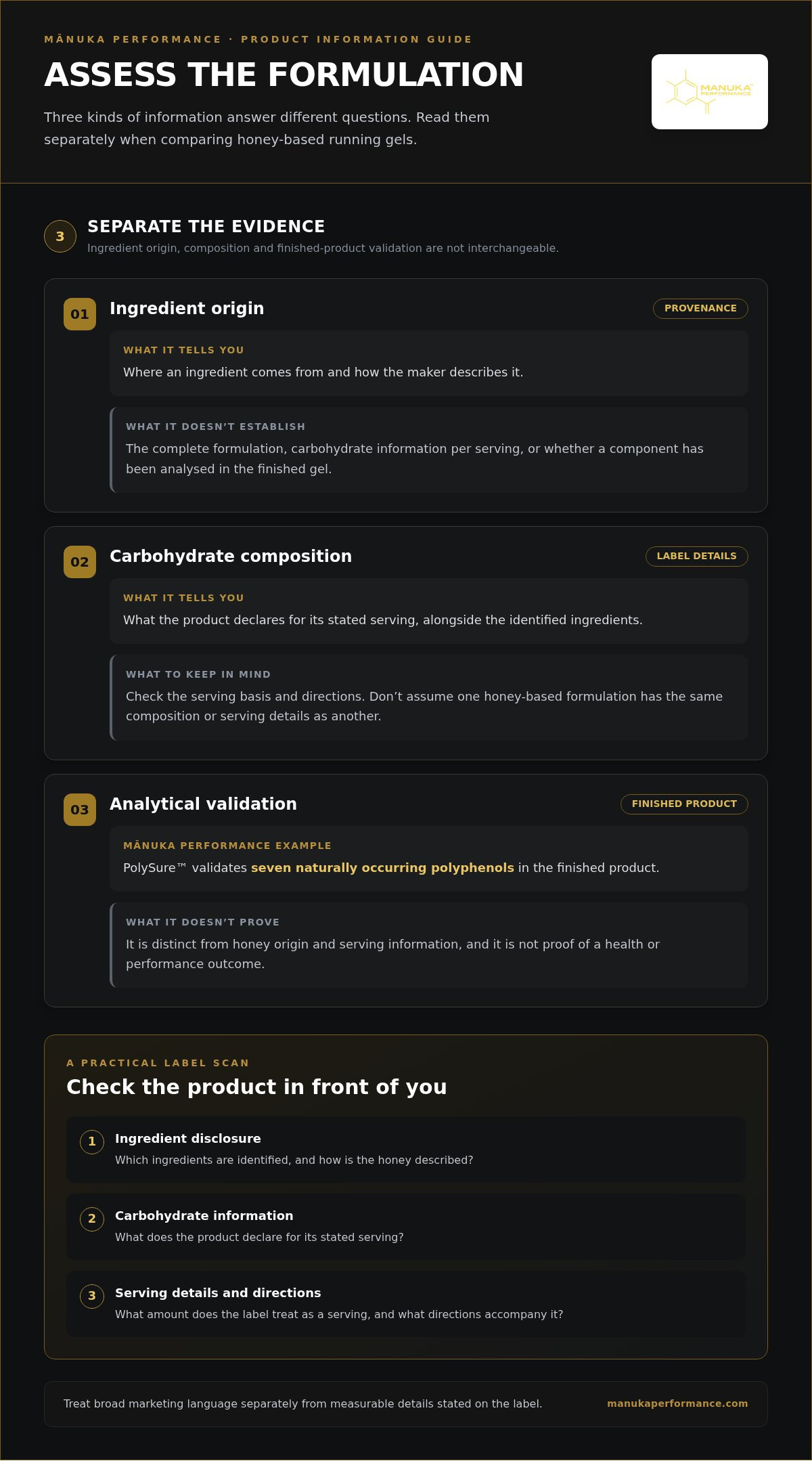
A useful assessment separates three kinds of information: ingredient origin, carbohydrate composition and analytical validation of the finished product. They answer different questions. Provenance describes where an ingredient comes from; composition describes what the product contains; analytical validation reports what has been measured in the finished product. One type of information doesn’t automatically establish the others.
This distinction matters when a product uses terms such as “natural” or highlights a particular honey source. Those descriptions may tell you about ingredient identity or origin, but they don’t explain the complete formulation, carbohydrate information per serving or whether a specific component has been analysed in the finished gel.
What to look for on the ingredient and nutrition information
Start with the product’s own label rather than assuming honey-based formulations are interchangeable. Read the ingredient list to see how the maker describes the formulation, then review the declared carbohydrate and serving information. Check the serving basis so you compare like with like, and don’t transfer a quantity or use assumption from one product to another.
For a practical review, note:
- Ingredient disclosure: Which ingredients does the label identify, and how is honey described?
- Carbohydrate information: What does the product declare for its stated serving?
- Serving details: What amount does the label treat as a serving, and what directions accompany it?
These details help you understand the product in front of you, not predict how it will suit every runner. If a phrase is broad marketing language rather than a measurable product detail, distinguish it from what the label explicitly states.
What PolySure™ validates in the finished product
Mānuka Performance uses PolySure™ to validate seven naturally occurring polyphenols in the finished product. This analytical validation relates to specified compounds measured in the gel as made. It is distinct from the origin of the honey and from the carbohydrate information provided for a serving.
Honey grading and polyphenol validation describe different attributes. A honey grade relates to the honey and the criteria used to assess it; PolySure™ concerns validation of polyphenols in the finished product. Neither replaces the ingredient list or serving information, and analytical validation isn’t proof of a health or performance outcome.
This framework makes claims easier to interpret: identify what the ingredient description says, what the label declares about composition and serving, and what any named analytical standard validates. The comparative analysis of honey energy gels offers further evidence context for readers assessing formulation claims.
To apply these distinctions to a specific example, explore Mānuka Performance’s honey-based gels and consider the ingredient and validation information alongside the product’s serving details.
Honey-based running gels compared: which criteria matter most?
Product comparisons are most useful when they focus on information you can verify, rather than treating one ingredient source or front-of-pack phrase as a verdict. Formulation details matter more than a single front-of-pack descriptor. A honey-based gel and a gel using another carbohydrate source may differ in ingredients, declared composition, format and directions. Compare the products themselves rather than relying on category stereotypes.
Use the table as a label-reading framework. When a claim is broad, look for the specific product information that explains what it means.
| Comparison criterion | What to look for | How to interpret it |
|---|---|---|
| Ingredient disclosure | Named ingredients and how the carbohydrate sources are described | Ingredient origin is useful context, but doesn’t describe the whole formulation. |
| Carbohydrate information | Declared carbohydrate details and the serving basis | Compare equivalent serving information; don’t assume quantities match across products. |
| Format | The product’s stated form and presentation | Consider how the format fits the way you plan to carry and use fuel. |
| Analytical evidence | A clearly described measurement or validation claim | Identify what was assessed, and distinguish it from general promotional language. |
| Stated directions | Product-specific serving and use instructions | Follow the individual product’s directions rather than importing assumptions from another gel. |
Honey-based gels and other carbohydrate gel formulations
Honey-based running gels use honey as part of their carbohydrate formulation, while other gels may identify different carbohydrate ingredients. That difference describes ingredient source, not a universal ranking. Seeing honey on one label and another carbohydrate source on a second tells you something about the formulations, but not which is more suitable for a particular runner. Compare ingredients, declared information, format and directions product by product. Don’t infer digestion, absorption, energy delivery or running outcomes from the ingredient source alone.
How to interpret natural and analytical claims
“Natural” and “clean” describe a positioning or ingredient approach, but they aren’t substitutes for specific composition information. Likewise, “easy on the stomach” isn’t a guarantee that a product will suit every person. Individual tolerance varies, so distinguish your own experience from what a product label or analytical statement can establish. A scientific guide to runner’s stomach issues explores individual tolerance as a separate topic.
For a specific example of natural ingredients alongside product-level analysis, Mānuka Performance’s LiquidFuel uses a New Zealand honey-based matrix, and PolySure™ validates seven naturally occurring polyphenols in the finished product. That validation describes a measured product attribute, not a health or performance outcome. Consider Mānuka Performance’s honey-based sports gels using the same criteria you’d apply to any formulation.
How to evaluate honey-based running gels in your own running routine
A product label can help you make an informed comparison, but your own routine provides important context. Take a gradual approach: understand what the product says, follow its directions, then trial it during training rather than using an unfamiliar gel for the first time on event day. This gives you a chance to assess its practical fit without assuming one schedule or serving amount is right for every runner.
A practical training-day evaluation sequence
- Review the label. Read the ingredient list and declared nutrition information. Note the serving basis so you know what the information refers to.
- Read the product directions. Use the maker’s instructions as your reference; don’t substitute a routine you’ve seen for another gel.
- Choose a suitable training session. Trial the product in a familiar setting where you can observe how it fits your session, rather than introducing it for the first time at an event.
- Reflect on your experience. Consider the format, taste and ease of use, as well as how the product fitted into the session and your wider fuelling plan.
This sequence helps you gather personal observations; it isn’t a prescribed fuelling schedule. The amount and timing of carbohydrate fuelling depend on the individual and the activity. Use product information for product-specific details, and seek advice from a qualified sports nutrition professional if you need help planning fuelling quantities or integrating a product into a broader plan.
What to record before deciding whether it suits
A brief note after each trial can make comparisons more useful than relying on memory. Record the product you used, the session context and whether the format was practical. You might also note your taste preference and whether using it fitted smoothly into your routine. These observations are personal; they don’t guarantee an effect or establish that the same product will suit someone else.
Assess the gel as one element of your fuelling plan, not in isolation. Consider what else you planned to consume, the demands of the session and the product’s stated serving directions. If you change several parts of your routine at once, it may be harder to identify what you preferred. Keep your observations simple and consistent, and be cautious about drawing conclusions from a single trial if the circumstances were unusual.
With honey based running gels, preference and practical fit matter alongside the information on the label. If gastrointestinal symptoms, health conditions or other concerns affect your fuelling choices, seek guidance from an appropriately qualified health professional rather than treating an article or product description as individual advice.
To apply these evaluation steps to a New Zealand honey-based option, explore the LiquidFuel running gel information and consider its product details in the context of your training routine.
Mānuka Performance LiquidFuel: a honey-based option with analytical validation
After comparing gels by their ingredients, declared nutrition information, format, analytical evidence and directions, LiquidFuel is a specific example to assess against those criteria. The product is called LiquidFuel 10-Pack Running Gel and is Mānuka Performance’s flagship running gel. Its product story brings together a New Zealand honey-based matrix and analytical validation. Assess its stated product information and personal fit rather than relying on a broad category claim.
What the LiquidFuel product information establishes
The gel uses a New Zealand honey-based matrix containing naturally occurring glucose and fructose. This identifies the matrix’s source and two naturally occurring sugars; it doesn’t, on its own, specify carbohydrate quantities per serving or determine how the product should be used. Consider those details using the product’s own information and directions, rather than inferring them from the honey-based formulation or another gel.
That distinction is useful when comparing honey based running gels. Ingredient origin tells you about the formulation’s basis, while serving and use details answer separate product-specific questions. Keeping those categories distinct helps you evaluate LiquidFuel alongside your routine without assuming that all gels with honey share the same composition or directions.
How analytical validation fits the product story
PolySure™ validates seven naturally occurring polyphenols in the finished product. It focuses on the gel as a finished formulation, rather than honey provenance alone. This adds a distinct analytical detail to the product information: a validation statement about specified polyphenols in the product itself.
Interpret analytical validation within that scope. It doesn’t establish a health, recovery or guaranteed performance outcome, nor does it replace the ingredient, nutrition or serving information used to assess a gel for your own routine. Instead, it shows how natural ingredients and analytical science can be presented together, with each detail describing a different aspect of the product.
For a considered evaluation, bring the product’s matrix and validation information back to the criteria used throughout this guide: identify what the ingredient description establishes, distinguish measured product attributes from broader claims, and use the gel’s own directions when considering practical use. Your preferred format and fuelling plan remain individual, so no single feature is a universal reason to choose a particular gel.
If a New Zealand honey-based matrix and finished-product analytical validation are relevant to your comparison, explore Mānuka Performance and review the LiquidFuel information alongside your running routine.
Make your next fuelling choice a considered one
Your next step can be simple: choose a suitable training session, follow the product’s directions and note what you learn. A brief record of your preferences and how a gel fits your routine can help you make a more informed choice over time, without assuming that one trial or one formulation suits every run.
If you’re evaluating honey based running gels, use LiquidFuel as a specific product to examine. Its New Zealand honey-based matrix contains naturally occurring glucose and fructose, and PolySure™ validates seven naturally occurring polyphenols in the finished product. These are formulation and analytical details to consider on their own terms, not promises of a particular outcome.
Explore the product information and analytical approach, then decide whether LiquidFuel merits a place in your training evaluation. Explore Mānuka Performance LiquidFuel and consider it as you plan your next step. A measured, thoughtful approach can help you find the fuelling routine that feels right for you.
Frequently Asked Questions
Are honey-based running gels different from eating table honey?
Yes. A running gel is a formulated sports nutrition product, while table honey is a food that doesn’t automatically come with gel-specific serving information or directions for use during activity. If you’re comparing the two for a run, check the gel’s ingredient and nutrition label rather than assuming a spoonful of honey provides equivalent product information. Mānuka Performance sells sports nutrition gels, not raw table honey.
Can I use a honey-based running gel for short runs?
You can consider one, but a gel isn’t automatically necessary for every short run. Think about the session, your existing fuelling plan and whether you want to use a portable carbohydrate product. If you’re trying honey based running gels, follow the individual product’s directions and consider them during training first. Let your own routine guide the choice, rather than assuming every run requires additional fuel.
How much carbohydrate should a running gel contain?
There isn’t one amount that suits every runner or session. The relevant amount depends on your overall fuelling plan, the demands of the activity and how the gel fits alongside other sources of carbohydrate. Check the declared nutrition information and serving basis on the specific product, then consider your total plan rather than judging a gel in isolation. A qualified sports nutrition professional can help tailor quantities to your needs.
Do all honey-based running gels contain the same ingredients?
No. Honey-based describes an ingredient approach, not a single standard recipe. Products can differ in the ingredients they list and the nutrition information they declare, so don’t transfer assumptions from one gel to another. Compare the ingredient panel and serving information on each product you’re considering. This gives you a more reliable basis for distinguishing formulations than relying on the word “honey” or similar front-of-pack wording alone.
Are honey-based running gels suitable for every runner?
No single gel can be assumed to suit everyone. Personal preferences, the context of a run and the rest of a person’s fuelling plan all matter. If you’re considering a gel, use its product information to understand what it contains and trial it during training before relying on it at an event. For health concerns, dietary needs or persistent gastrointestinal symptoms, seek individual guidance from an appropriately qualified health professional.
When should I try a new running gel before race day?
Try it during training, not for the first time on event day. Choose a suitable session that gives you a realistic opportunity to assess the product’s taste, format and fit with your plan. There isn’t a single lead-in period for every runner, so allow enough training opportunities to form your own view. Keep the product directions consistent, and avoid making several fuelling changes at once if you want to compare experiences.
What does PolySure™ validate in a honey-based running gel?
PolySure™ validates seven naturally occurring polyphenols in the finished product. This is information about specified compounds in the formulated gel; it doesn’t establish a health, recovery or performance outcome. Consider it alongside, rather than instead of, the ingredient list and declared nutrition information. Those details answer different questions, helping you distinguish analytical validation from ingredient descriptions and broader promotional claims.