


What if an ingredient labelled “standardised” tells you less than its specification appears to promise? For standardised phytochemical ingredients, the label alone doesn’t reveal whether a supplier measures one marker compound, quantifies several constituents or compares a broader chemical fingerprint. That difference matters when natural variation in source material and processing makes ingredient data difficult to compare.
It’s reasonable to expect a standardised ingredient to provide measurable consistency. But analytical consistency isn’t the same as evidence of efficacy. A result is interpretable only when you know what was measured, how it was measured and which material the analysis represents.
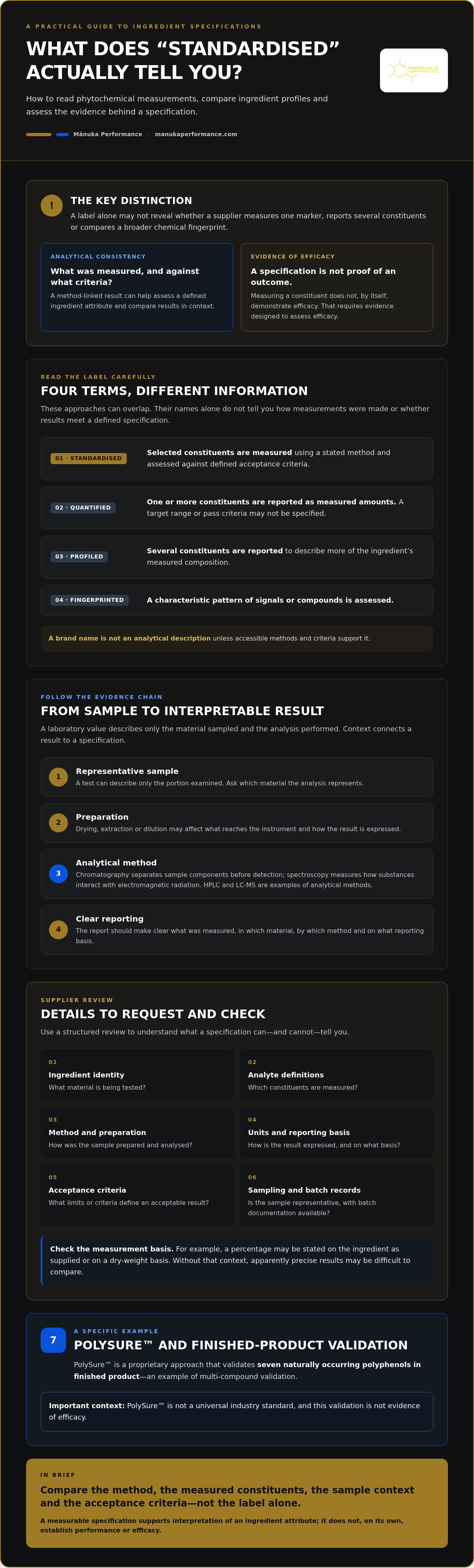
This article explains how standardised, quantified, profiled and fingerprinted ingredients differ, and what method, reporting and sampling details to request from a supplier. It also considers how to assess evidence against your formulation needs without treating a specification as proof of a performance outcome. PolySure™, a proprietary approach that validates seven naturally occurring polyphenols in finished product, is one example of multi-compound validation, not a universal industry standard.
Key Takeaways
- Assess standardised phytochemical ingredients by checking which constituents are measured and what criteria define an acceptable result.
- Compare single-marker results, multi-compound profiles and chromatographic fingerprints according to the questions your formulation needs to answer.
- When reviewing analytical data, look for clear sampling, preparation, method and reporting details so you can judge whether the results are interpretable.
- Use a structured supplier review to request ingredient identity, analyte definitions, units, acceptance criteria and representative batch documentation.
- PolySure™ provides a specific example of finished-product validation for seven naturally occurring polyphenols. It isn’t a universal standard or evidence of efficacy.
What Makes Standardised Phytochemical Ingredients Different from Ordinary Extracts?
An extract describes material obtained from a source. On its own, it doesn’t explain which constituents are present or how consistently they’re measured. Phytochemicals are compounds produced by plants, and an extract may contain a complex mixture of them. “Standardised” is meaningful when that mixture is linked to defined analytical criteria, rather than used as a general description of quality.
Quotable definition: A standardised phytochemical ingredient is one for which selected constituents are measured using a stated method and assessed against defined acceptance criteria.
This distinguishes standardisation from related terms. A quantified ingredient has one or more constituents reported as measured amounts, but may not specify a target range or pass criteria. A profiled ingredient reports several constituents, while a fingerprinted ingredient is assessed through a characteristic pattern of signals or compounds. These approaches can overlap, but their labels alone don’t establish how measurements were made or whether results meet a defined specification. A brand name, meanwhile, isn’t an analytical description unless accessible methods and criteria support it.
What does standardised mean on a phytochemical ingredient specification?
A useful specification identifies the analyte, analytical method, reporting unit and acceptance criterion. A statement such as “10% marker compound” is difficult to interpret without knowing whether the percentage is calculated on the ingredient as supplied or on a dry-weight basis, and how the compound was measured. The specification may cover a single marker or a broader compound profile. Either way, a stated basis and limits make the result assessable. Without them, a numerical claim may look precise while remaining difficult to compare.
A marker can support identity checks or help monitor consistency between batches. It doesn’t necessarily represent every compound in an extract, and measuring it doesn’t demonstrate efficacy. Evidence designed to assess efficacy is needed for that.
Why botanical source and processing affect phytochemical profiles
Plant material varies naturally. Source, growing and harvest conditions can influence which compounds are present and their relative abundance. Drying, storage and extraction can also affect which compounds are retained or detected. The extraction conditions, including the solvent and process used, help determine the composition of the resulting extract.
Variation isn’t, on its own, evidence of poor quality or a safety concern. It does mean that ingredient comparisons need context: the same percentage can refer to different measurement bases, and extracts made or tested under different conditions may not be directly comparable. For standardised phytochemical ingredients, a clearly defined, method-linked specification helps distinguish measured attributes from broad marketing descriptions.
How Analytical Testing Turns Phytochemical Profiles into Measurable Specifications
A phytochemical result is the end of an evidence chain, not an isolated number. To interpret it, trace the material from a representative sample through preparation and analysis to the final report. Sampling matters because a test can describe only the portion examined. Preparation matters because drying, extraction or dilution may affect what reaches the instrument and how the result is expressed.
A reported result is meaningful only when its method and sample context make clear what was measured, in which material and on what reporting basis. For standardised phytochemical ingredients, that context connects a laboratory value to a specification and helps determine whether results can be compared across batches or suppliers.
Which analytical methods can measure phytochemical compounds?
Chromatography separates components in a sample before detection, while spectroscopy measures how substances interact with electromagnetic radiation. High-performance liquid chromatography (HPLC) and liquid chromatography/mass spectrometry (LC-MS) are examples of methods used to analyse compounds. The appropriate method depends on the analyte, ingredient matrix and purpose of the measurement. An instrument name alone doesn’t establish that a method can reliably measure a particular compound in that material.
Ask for method documentation that identifies the analyte and explains how the method was assessed for its intended use. Selectivity concerns whether the method can distinguish the target from other sample components. Precision concerns agreement between repeated measurements under specified conditions. Reproducibility considers whether results remain consistent when conditions such as the laboratory or equipment vary. Where calibration or reference materials are used, the supplier’s documentation should identify them and explain their role. NIST describes botanical Standard Reference Materials (SRMs) developed to support measurement and quality control.
How to interpret a phytochemical result and its limitations
Check the sample identity, preparation details, analyte definition, units and reporting basis before comparing values. A result expressed per gram of extract may not be directly comparable with one reported per gram of starting material or on a dry-weight basis. The report should also clarify whether the analyte was detected, quantified against a calibration approach, or measured using a method validated for that analyte and matrix. These are different levels of evidence, not interchangeable labels.
Even a well-documented composition result establishes only an analytical attribute of the tested material. It doesn’t, by itself, show that a finished formulation produces a clinical or performance outcome. That requires evidence designed to assess the outcome. For readers considering New Zealand-developed ingredients, Mānuka Performance’s phytochemical innovation provides company context for the later discussion of finished-product validation.
Single-Marker Standardisation vs Multi-Compound Phytochemical Profiles
Judge a specification by the question it can answer, not simply by how many compounds it lists. A single marker may be appropriate for checking a defined identity or consistency attribute. A broader profile can describe more of an ingredient’s composition, while a chromatographic fingerprint can help compare an overall pattern. None of these approaches, on its own, establishes clinical or performance outcomes.
| Approach | What it can establish | What it may miss | Documentation to seek |
|---|---|---|---|
| Single-marker assay | The measured level of a specified compound in the tested sample. | Other constituents and changes that occur without a corresponding change in that marker. | Marker identity, method, unit, reporting basis and acceptance criteria. |
| Multi-compound profile | Measured levels of several named compounds, offering a wider compositional view. | Compounds not included in the panel, or aspects of composition the selected analytes don’t represent. | Analyte list, individual methods or method details, units, reporting basis and criteria for each result. |
| Chromatographic fingerprint | A pattern of detected signals that can be compared between samples under defined conditions. | Whether every signal is identified or quantified, and whether a pattern difference has a meaningful interpretation. | Separation and detection conditions, reference or comparison basis, and rules for interpreting the pattern. |
A longer analyte list isn’t automatically more useful. If the compounds aren’t relevant to the formulation question, or the method and criteria aren’t clear, additional measurements may add complexity without improving interpretation. Strong specifications connect each measurement to a defined purpose and make the limits of the evidence visible.
When is a single marker enough, and when is a wider profile useful?
Start with the attribute you need to assess. If one marker is suitable for an identity or consistency check, a focused assay may be proportionate. If the ingredient’s composition is better represented by several constituents, a multi-compound profile may provide useful context. The trade-off is between a targeted result that is easier to interpret and a broader view that requires clear analyte selection and reporting. There’s no universal compound count or threshold that suits every ingredient.
What does finished-product validation add to ingredient testing?
Testing an incoming ingredient characterises that material. Testing a finished formulation assesses what can be measured after incorporation and processing. The formulation matrix may affect how compounds are detected or quantified, so ingredient data shouldn’t automatically be treated as a finished-product result. For developers and practitioners looking at how finished health formulations and educational resources reach end users, explore E-commerce Sales of Dietary Supplements and Digital Health Courses from Healthy Gut.
Company example: Mānuka Performance applies its proprietary PolySure™ analytical standard to validate seven naturally occurring polyphenols in finished product. This illustrates a multi-polyphenol approach at the product stage, but it isn’t a universal industry standard, and the analytical result doesn’t establish efficacy. The confirmed scope doesn’t specify analyte names, methods or reporting units, so those details shouldn’t be inferred.
How to Evaluate a Standardised Phytochemical Ingredient Supplier
Assess the evidence in sequence, starting with what the ingredient is and ending with what the batch record can verify. A supplier’s specification and certificate of analysis (CoA) should let you connect the material, test and reported result without relying on a branded description alone. Whether sourcing pure nutritional powders from supplement providers like Sunshine Valley or working with complex botanical mixtures, establishing these baseline standards ensures ingredient integrity.
- Confirm ingredient identity. Request the botanical identity and, where relevant, the plant part or source material. Check that the ingredient name and description are consistent across the specification, technical documents and batch records.
- Understand how it was produced. Ask for relevant extraction and processing details, since these can affect the resulting composition. Clarify which ingredient format the documentation describes.
- Define what is measured. Request the named analyte or analytes, their definitions, units and reporting basis. A percentage or concentration is difficult to interpret unless you know what it refers to.
- Review the analytical method. Ask how each analyte is measured and whether the method is suitable for that ingredient matrix. Instrument names alone aren’t enough to assess method performance.
- Check the specification criteria. Identify any stated limits or acceptance criteria and ask how results outside them are handled. If criteria aren’t provided, clarify how the supplier determines whether material conforms to its specification.
- Trace the evidence to the tested material. Establish whether sampling and analysis apply to the incoming raw ingredient, an intermediate or the finished product. Request a representative CoA and confirm whether results are specific to the batch under consideration.
What to request in a phytochemical ingredient specification
Use the specification alongside, not instead of, batch documentation. Ask for a sample CoA, then compare its fields with the agreed specification: ingredient identity, batch identifier, analytes, units, methods, reporting basis and acceptance criteria. Confirm whether each result is measured for that specific batch or presented as a typical value. If a batch fails a criterion, ask what disposition or investigation process applies rather than assuming the material is automatically retested or replaced.
How to compare claims without over-reading the data
Compare suppliers only on a like-for-like basis: the same analyte, material stage, units, reporting basis and a sufficiently described method. If a supplier reports a concentration without clarifying whether it applies to the ingredient or finished formulation, request that context before technical approval. A result from one matrix may not be directly comparable with a result from another.
Checklist summary: Verify identity, sample stage, analyte, method, units, acceptance criteria and batch record. These establish what the compositional evidence supports. They don’t, by themselves, prove safety, health benefits or performance outcomes.
For an example of research-led work with New Zealand honey phytochemistry, explore Mānuka Performance’s bioactive ingredients.
How Mānuka Performance Applies PolySure™ to Measured Honey Polyphenols
Mānuka Performance is a New Zealand functional nutrition and phytochemical innovation company focused on honey phytochemistry, research-driven bioactive ingredients and biotech solutions. Its work offers a specific example of how a defined multi-compound approach can be applied to finished-product validation. It isn’t a general definition of standardised phytochemical ingredients, and it doesn’t make the company a retailer of raw honey.
What PolySure™ demonstrates about defined phytochemical measurement
PolySure™ is a proprietary analytical standard that validates seven naturally occurring polyphenols in finished product. By specifying a group of polyphenols for validation, this approach makes the intended compositional focus more explicit than a description that refers only to honey or a single marker. It illustrates how a multi-polyphenol profile can be considered at the product stage, rather than assuming that incoming ingredient data fully describes the final formulation.
The confirmed scope is seven polyphenols and finished-product validation. It doesn’t identify the analytes, reporting units, analytical methods, validation parameters or sampling procedures, so those details shouldn’t be inferred. Nor should PolySure™ be presented as an independently recognised, universal industry standard. It’s a company-specific approach, and analytical validation of composition doesn’t, by itself, establish clinical efficacy, a health outcome or a performance result.
That distinction matters when assessing any branded analytical system. A defined profile can make a composition claim more concrete, but its usefulness still depends on whether the documented method, sample and reporting basis answer the question relevant to the formulation. The name of a standard alone can’t replace those details.
Where to take the evaluation next
For any ingredient, focus on three linked questions: is the measured profile clearly defined, is the method suitable for the analytes and matrix, and are results traceable to the material tested? These checks help establish what a specification supports without treating analytical consistency as evidence of efficacy. For further context on measuring honey constituents, consult the related article on quantified honey bioactives.
For more on how this research-led approach connects with New Zealand honey phytochemistry, see Mānuka Performance’s bioactive ingredient and biotech work.
Make the Specification Part of Your Formulation Decision
Natural variation makes comparison more demanding, but it doesn’t make meaningful measurement impossible. For standardised phytochemical ingredients, the central question is whether the specification clearly identifies what was measured, how it was measured and which material the result represents. A single marker, multi-compound profile or fingerprint can each be useful when matched to the formulation question and supported by suitable methods and traceable batch documentation.
Keep analytical evidence in its proper place: compositional consistency can help characterise an ingredient, but it doesn’t establish a health, clinical or performance outcome. Mānuka Performance offers an example of research-driven ingredient and biotech development, with its proprietary PolySure™ standard validating seven naturally occurring polyphenols in finished product. This illustrates a defined approach, not a universal standard.
If you’re assessing how measured profiles can inform ingredient development, explore Mānuka Performance’s research-led bioactive ingredients and biotech work.
Frequently Asked Questions
What are standardised phytochemical ingredients?
Standardised phytochemical ingredients are materials with selected constituents measured against stated criteria. A useful specification identifies the analyte, method, unit, reporting basis and acceptable limits, so the result can be interpreted rather than taken as a general quality claim. Standardisation may apply to one marker or a wider profile. It describes measurable composition and consistency; it doesn’t, by itself, establish the ingredient’s safety, clinical efficacy or performance effects.
How are phytochemicals measured in botanical ingredients?
Phytochemicals are measured by analysing a prepared sample with a method suited to the target compounds and ingredient matrix. Chromatographic techniques such as HPLC or LC-MS can separate compounds before detection, while spectroscopy measures how substances interact with light. The report should identify the sample, preparation, analytes, method and units. A method name alone isn’t enough: ask how it distinguishes and measures the compounds of interest.
What is the difference between a standardised extract and a quantified phytochemical profile?
A standardised extract is assessed against stated criteria for selected constituents, often a defined marker or group of markers. A quantified phytochemical profile reports measured amounts for one or more named compounds, but may not set acceptance limits or define conformity. The terms can overlap, so review the actual specification rather than relying on the label. Check whether results are batch-specific and whether each analyte has a stated method, unit and reporting basis.
Can a standardised ingredient guarantee the same composition in every batch?
No. Standardisation can define acceptable criteria and support monitoring, but it can’t guarantee that every batch has identical composition. Natural source material, harvest conditions, processing and measurement variability can all contribute to differences. A supplier’s specification should state the relevant limits, while batch-specific documentation shows whether a tested sample met them. Ask how sampling is conducted and what happens when a result falls outside the stated acceptance criteria.
Does a phytochemical standardisation claim prove an ingredient is effective?
No. Standardisation indicates that specified constituents have been measured against defined criteria; it doesn’t prove a health, clinical or performance outcome. That requires appropriate evidence designed to assess the outcome, not composition data alone. A measured marker can help describe identity or consistency, but it may not represent every compound in an extract. Evaluate analytical specifications and efficacy evidence as distinct parts of an ingredient assessment.
What should a certificate of analysis include for a phytochemical ingredient?
A useful certificate of analysis (CoA) should identify the ingredient and batch, the material tested, named analytes, analytical methods, units, reporting basis, results and relevant acceptance criteria. Check whether it refers to the raw ingredient, an intermediate or the finished product, and whether the results are specific to that batch. If a method or result basis is unclear, request clarification before comparing the CoA with another supplier’s data.
Why can extraction methods change a phytochemical profile?
Extraction methods influence which compounds are removed from source material and which remain in the resulting extract. Variables such as solvent, processing conditions and preparation can therefore affect the compounds detected and their relative amounts. This doesn’t automatically indicate poor quality; it means extracts made using different approaches may not be directly comparable. For a meaningful comparison, check the source material, extraction details, analytes, test method and reporting basis.