


A bioactive label is only as informative as the measurements behind it. The phrase manuka honey bioactive extract can refer to different materials and processes, so the name alone doesn’t tell you what has been extracted or which compounds are present.
Look for evidence beyond a broad description. A reported marker or polyphenol result can help characterise composition, but it doesn’t establish a health or performance effect. Understanding the difference between an extract and whole honey, and between a measured ingredient and an outcome claim, makes product information easier to assess.
This article explains what bioactive mānuka honey extract can mean, how analysis can quantify selected compounds, and what to look for when interpreting results. It also introduces PolySure™, Mānuka Performance’s analytical standard for validating seven naturally occurring polyphenols in the finished product. This is an example of defined composition measurement, not proof of a clinical or athletic benefit.
Key Takeaways
- A manuka honey bioactive extract differs from whole honey. The term alone doesn’t specify its composition or how it was produced.
- Polyphenols are one group of compounds that may be assessed. A honey sample’s profile can vary with its source and characteristics.
- Reliable analysis starts by defining the sample and target compounds, then selecting a suitable method and reporting what the results cover.
- When assessing a claim, distinguish measured composition from laboratory activity, human outcomes and product performance.
- PolySure™ provides a defined example of ingredient characterisation by validating seven naturally occurring polyphenols in the finished product.
What Is Mānuka Honey Bioactive Extract? Define the Ingredient Clearly
A mānuka honey bioactive extract is an ingredient separated or concentrated from mānuka honey, or related source material, and described by the compounds selected for characterisation. Unlike whole honey, it isn’t the complete honey matrix. The term “bioactive” identifies a research interest, not a guaranteed biological, health or performance effect.
In brief: a mānuka bioactive extract is a material derived from a mānuka source and characterised around specified constituents. Its composition depends on the source, processing and measurement scope, so extracts shouldn’t be assumed to be identical.
How does an extract differ from whole mānuka honey?
Whole mānuka honey retains its naturally occurring mixture of sugars, water and other constituents. Its composition is shaped by the nectar source and the characteristics of the honey. An extract, by contrast, generally refers to material in which some constituents have been separated or concentrated from source material. The result depends on how the material is prepared. The word “extract” alone doesn’t identify a specific process or composition.
This distinction matters when comparing ingredient descriptions. A result for a selected compound describes that measured constituent, not the complete profile of the original honey. For background on the source material and its characteristics, see this overview of Mānuka honey.
What does “bioactive” mean in ingredient science?
In ingredient science, “bioactive” is a research descriptor for compounds investigated for their potential to interact with biological systems. It doesn’t, by itself, show that a compound produces a particular effect in people. Detecting or quantifying a constituent provides information about composition. Evidence of a human health or performance outcome requires a different kind of research.
This distinction is relevant to sports nutrition biotechnology. Ingredient characterisation can inform research and formulation without establishing that an ingredient improves athletic performance. The scientific question must match the evidence: a composition result supports a statement about what was measured, while claims about human outcomes require evidence designed to assess those outcomes.
When you assess an extract description, look for the source material, the constituents being characterised and the scope of the measurement. These details make the term more informative and help avoid assuming every mānuka extract has the same profile or effect.
Which Compounds Can Mānuka Honey Bioactive Extract Contain?
A mānuka honey ingredient can be described by a broad chemical group, such as polyphenols, or by an individual compound selected for measurement. These terms aren’t interchangeable: “polyphenols” refers to a diverse family of compounds, while an analyte is the specific substance an analytical method is designed to detect or quantify. A manuka honey bioactive extract therefore needs a defined profile before its composition can be meaningfully interpreted.
What are polyphenols in a honey ingredient?
Polyphenols are a diverse group of plant-associated chemical compounds. Honey can contain different phenolic compounds, including phenolic acids and flavonoids. Research reviews discuss these alongside other constituents, such as methylglyoxal (MGO), which is chemically distinct from polyphenols. The review of bioactive compounds in Mānuka honey provides further context on these categories and their presence in honey.
A reported “total polyphenol” result summarises a broader measurement, while a compound-specific result concerns a particular analyte. Neither label is complete without knowing what the analysis covers. Results depend on the sample and analytical approach, so values from different methods or reporting scopes may not be directly comparable. Total polyphenol content describes composition; it isn’t a direct measure of efficacy or evidence of a human health or performance outcome.
Why can the composition vary between samples?
Natural ingredients can vary with their source material and the conditions under which they’re harvested, handled and processed. These general factors may influence an ingredient’s composition, but they don’t mean any one factor will change a particular mānuka sample in a predictable way. Processing may also affect which constituents are retained in the resulting ingredient.
Variation isn’t automatically a sign of poor quality or product failure. It means comparisons need context: samples should be identified clearly, and measurements interpreted in light of the compounds assessed and the method used. A result for one marker cannot stand in for a complete chemical profile, just as a broad polyphenol result doesn’t identify every individual compound in a sample.
For ingredient characterisation, clarity comes from stating which compounds are measured and what the results represent. Mānuka Performance’s phytochemical innovation work applies this focus on defined composition to honey-derived ingredients. Learn more about Mānuka Performance’s phytochemical work.
How Is Mānuka Honey Bioactive Extract Analysed and Validated?
Analysis becomes meaningful when the question is defined first. For a manuka honey bioactive extract, the result depends on what the sample is, which compounds are being investigated and whether the analytical method suits that purpose. A clear workflow makes those boundaries visible:
- Define the sample: identify the material being analysed, such as honey or a finished ingredient.
- Select target compounds: specify the analytes or broader group the analysis is designed to assess.
- Apply a suitable method: use an approach that can detect or quantify the selected targets in that sample.
- Report the result and scope: state what was measured and what the findings represent.
Chromatography and mass spectrometry are examples of techniques used in chemical analysis. The appropriate technique depends on the analytical question and sample. Naming a method alone doesn’t show that it measures every compound of interest, so interpret results within the method’s stated scope.
What does a compound measurement tell you?
An assay can identify or quantify selected analytes, but it doesn’t automatically describe the sample’s complete composition. If an analysis targets particular polyphenols, for example, its findings apply to those targets, not to compounds outside its scope. Reporting should make the targets clear and provide enough context to interpret the result, including relevant units and any method limitations where available.
Measurement supports composition claims; efficacy requires separate evidence. A detected compound or quantified amount can help characterise an ingredient, but it doesn’t establish a human health or performance outcome.
What does validation add to an analytical result?
Validation provides evidence that a method performs appropriately for its intended analytical purpose. At a high level, this can involve assessing whether it distinguishes the target from other sample constituents, produces sufficiently consistent results and suits the intended measurement. The relevant checks depend on the method and question. Validation isn’t a universal stamp that makes results interchangeable across different methods or sample types.
For instance, Mānuka Performance’s PolySure™ analytical standard validates seven naturally occurring polyphenols in the finished product. That defines a composition-focused scope. It doesn’t, by itself, establish biological effectiveness, clinical benefit or athletic performance. When reading a result, identify the sample, the measured compounds and what the analytical standard was designed to validate.
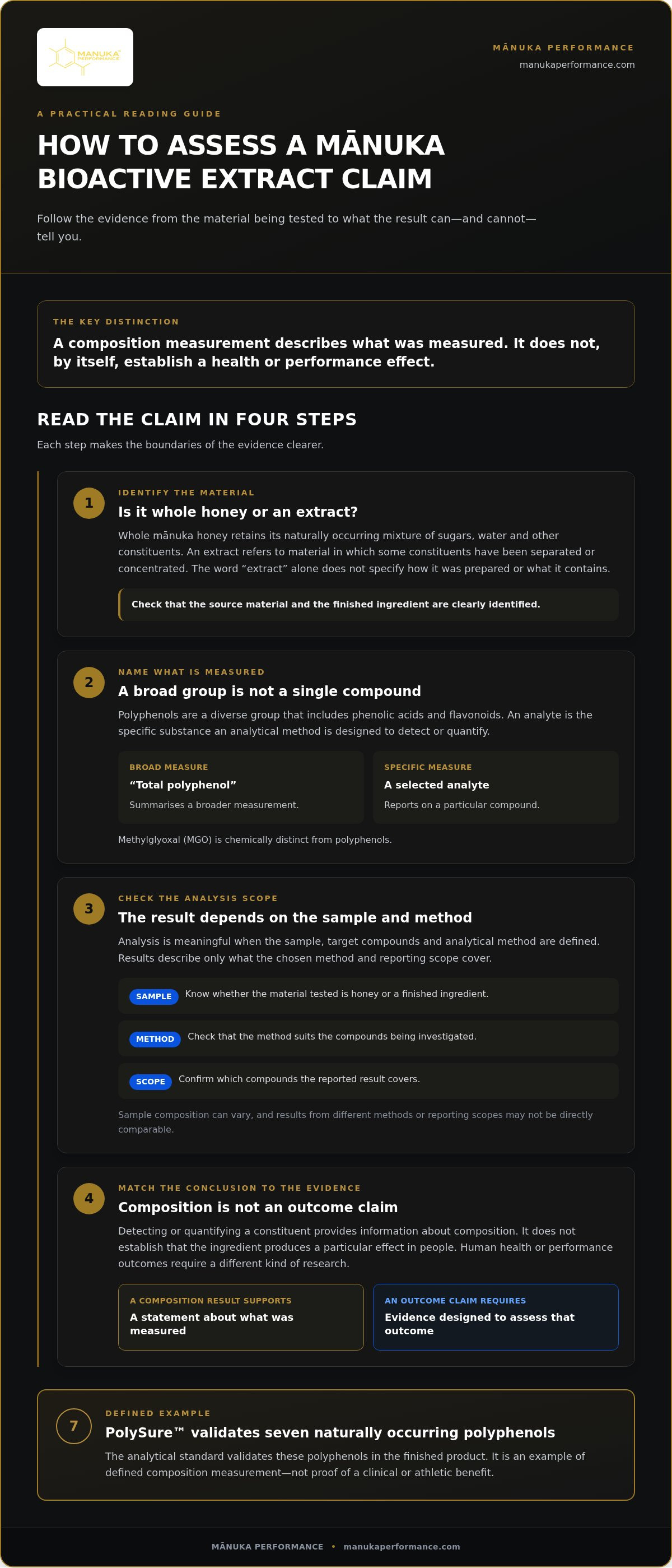
How to Evaluate a Mānuka Honey Bioactive Extract Claim
A useful claim makes clear what material was assessed, what evidence supports the statement and how far that evidence can reasonably be applied. Use this checklist to assess a manuka honey bioactive extract description without treating technical language as proof of an outcome:
- Identify the material: Is the result for whole honey, an extract or a finished product?
- Check the compounds: Are the measured compounds named, or is the claim based on a broad category?
- Understand the method: Does the description identify the analytical method or standard and explain what it covers?
- Read the reporting in context: Are results tied to the sample tested, with enough information to understand what was measured?
- Classify the claim: Does it describe composition, a laboratory observation, a human outcome or product performance?
Each step narrows the question the evidence can answer. Findings from one sample or experimental setting may not apply to other samples, formulations or real-world use. Missing context limits interpretation, but it doesn’t, on its own, demonstrate poor quality.
Which details make an extract description more informative?
Look for the named material, the compounds measured and the method or analytical standard used. Check whether the result applies to the source honey, an extract or the finished product, since these are distinct samples. A statement that a product contains a measured compound is more informative when it identifies the target and scope. A broad label alone gives little basis for comparison.
How should composition and efficacy claims be separated?
Sort statements into three evidence levels: composition, which reports what was detected or quantified; laboratory observation, which describes an effect observed under specified test conditions; and human outcome, which requires relevant evidence from people. Evidence at one level doesn’t automatically establish the next. A measured ingredient profile, for example, doesn’t by itself demonstrate a health, therapeutic or athletic benefit.
Match every claim to the type and level of evidence supporting it. This helps distinguish precise ingredient characterisation from language that implies more than the measurement or study can show. It also supports responsible ingredient development, where compositional data informs decisions without being presented as proof of efficacy.
Explore Mānuka Performance’s bioactive ingredient approach to see how defined measurement can support ingredient characterisation.
How Mānuka Performance Applies Measurement to Honey Bioactives
Mānuka Performance is a New Zealand functional nutrition and phytochemical innovation company working with honey composition and bioactive ingredients. Its approach illustrates how analytical standards can describe an ingredient with greater precision: define what is being measured, then keep any statement about composition within that scope.
What does the PolySure™ standard measure?
PolySure™ validates seven naturally occurring polyphenols in the finished product. This defined scope makes a composition statement more interpretable by specifying the group of constituents being assessed and the material to which the validation applies. It doesn’t represent a complete profile of every compound in mānuka honey or an extract.
That distinction is useful when reading ingredient information. A clear analytical scope helps separate a measured result from a broad descriptor, without implying that the same profile applies to every source material or product. PolySure™ concerns measured composition; it isn’t evidence, on its own, of a health, clinical or athletic-performance outcome.
Where does measured honey composition fit in functional nutrition?
Characterising an ingredient gives research and formulation work a more defined starting point. Mānuka Performance’s LiquidFuel 10-Pack Running Gel, for example, uses a New Zealand honey-based matrix as a convenient carbohydrate fuel for runners and endurance athletes. Describing ingredient identity and composition can help explain what is in a finished product, but it doesn’t establish how a person will respond or demonstrate a performance benefit.
For a manuka honey bioactive extract, the same principle applies: analytical information can clarify which selected compounds are present in the material being described, while any claim about effects requires evidence suited to that claim. Keeping these evidence types distinct supports responsible, research-led development rather than treating a composition result as a promise of an outcome.
Explore Mānuka Performance’s research-led approach to honey bioactives and functional nutrition to learn how measured composition informs ingredient science.
Use Clear Evidence to Assess Honey Bioactives
A manuka honey bioactive extract is best understood through its defined source material and measured composition, rather than the label alone. An extract differs from whole honey, and its profile depends on the material and the compounds assessed. “Bioactive” describes a research focus, not a guaranteed effect.
Analytical results can clarify which constituents are present within a method’s scope, but they don’t establish health or performance outcomes. Match each claim to its evidence: composition data supports statements about what was measured, while claims about human outcomes need evidence designed to assess those outcomes.
Mānuka Performance applies this composition-focused approach through PolySure™, which validates seven naturally occurring polyphenols in the finished product. This provides a defined basis for ingredient characterisation, not proof of efficacy.
Explore Mānuka Performance’s research-led approach to honey bioactives to learn more about measured composition and ingredient science. Clearer evidence makes it easier to assess claims with confidence.
Frequently Asked Questions
Is mānuka honey bioactive extract the same as mānuka honey?
No. Whole mānuka honey and an extract are different forms of material. An extract may be separated or concentrated from source material and characterised around selected compounds. The exact meaning depends on the product and how it was prepared, so the term alone doesn’t specify a universal composition. Extraction doesn’t automatically increase a beneficial effect; it describes a material or process, not a demonstrated outcome.
What bioactive compounds are found in mānuka honey extract?
Polyphenols are one group of compounds studied in honey composition, but the profile reported for an extract depends on the sample and analytical method. A broad group name such as “polyphenols” differs from a named analyte that has been specifically identified or quantified. Without a defined measurement scope, a description may not show which compounds were assessed. Presence alone doesn’t establish a health or performance benefit.
How is mānuka honey bioactive extract tested?
Testing generally begins by defining the sample, then selecting target compounds, applying a method suited to those targets and reporting the results with their scope. Chromatography and mass spectrometry are examples of analytical techniques, but naming a technique doesn’t establish what a particular test can measure. The method and reporting determine what conclusions a result supports, including whether it identifies selected compounds or quantifies them.
Does measuring polyphenols prove that an extract works?
No. Measuring polyphenols can support a composition claim within the analytical method’s scope, such as a statement about the compounds assessed in a sample. It doesn’t by itself demonstrate a health, therapeutic or athletic-performance outcome. Those outcome claims require separate, suitable evidence designed to assess the relevant effect. Composition measurement remains useful for characterising an ingredient, provided its findings aren’t presented as proof of efficacy.
Can the composition of mānuka honey extract vary between samples?
Yes. Natural ingredients can vary, and source material, handling and processing may affect the profile reported. Analytical methods can also influence which compounds are detected or quantified. These are general considerations, so interpret a result in the context of its sample and method. Variation alone doesn’t establish either good or poor quality. Comparing profiles is more meaningful when the material and measurement scope are clearly described.
What does PolySure™ validate in a finished product?
PolySure™ validates seven naturally occurring polyphenols in the finished product. This provides a defined scope for a composition-related statement by specifying which group of constituents is validated and where the assessment applies. It doesn’t, on its own, establish a clinical, health or athletic-performance outcome. Composition validation and evidence of efficacy address different questions.
Is a bioactive extract suitable for sports nutrition?
Suitability depends on the intended formulation, ingredient specifications and the evidence relevant to the proposed use. The term “bioactive” alone doesn’t establish suitability or promise a performance effect. Mānuka Performance offers functional nutrition products, including honey-based sports energy gels, alongside bioactive ingredients. Each product’s formulation should be understood on its own terms, and composition data shouldn’t be treated as evidence of a health or athletic outcome. Explore Mānuka Performance’s honey-based sports nutrition to learn more.