


Beyond Synthetic Sugars: The Shift in High-Performance Endurance Fuel
High-performance endurance fuel is a specialised nutritional substrate, meticulously formulated to help maintain energy levels during prolonged physical exertion. For decades, the sports nutrition landscape has been dominated by synthetic carbohydrates like maltodextrin, valued for their rapid energy delivery. However, as our understanding of athletic performance deepens, the limitations of these isolated, engineered starches are becoming more apparent. The elite athlete of 2026 and beyond is increasingly pivoting toward functional, whole-food-derived matrices, seeking a more sophisticated approach to fueling that considers more than just caloric replacement.
This evolution is driven by a demand for fuel that works in concert with the body’s complex systems. Athletes are moving away from simplistic formulations and toward nutritional solutions that offer a more comprehensive profile. The focus is no longer solely on the quantity of carbohydrates but on the quality, source, and overall composition of the fuel that powers elite performance. This represents a fundamental shift from basic energy provision to a holistic strategy centred on performance, consistency, and ingredient integrity.
The Limitations of Monolithic Carbohydrate Sources
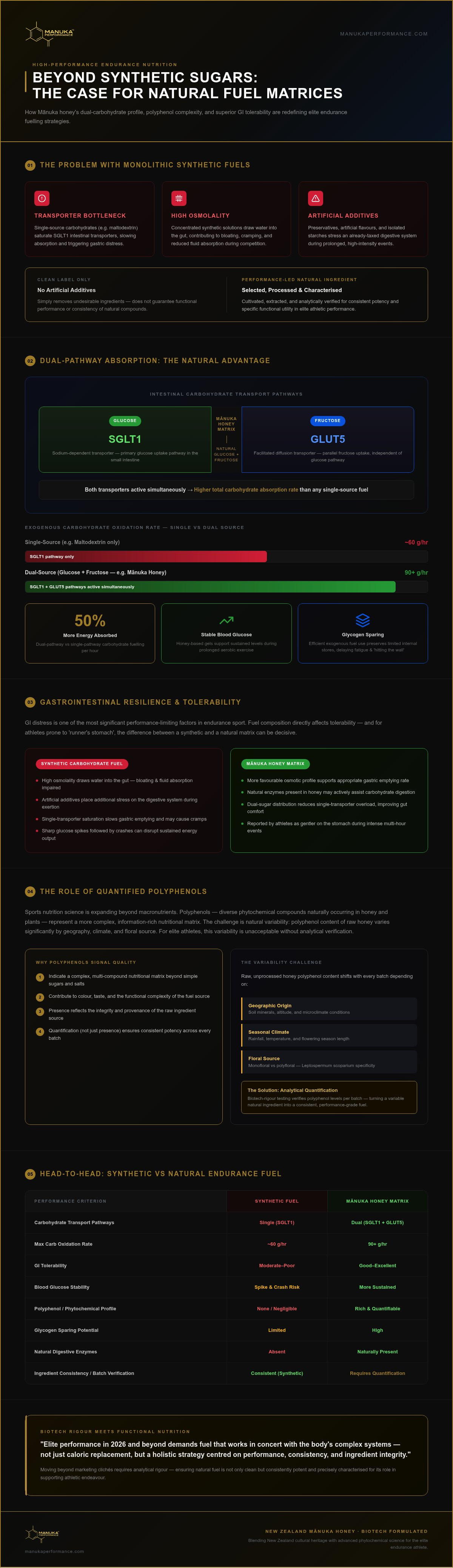
Many conventional endurance fuels rely on a single type of synthetic sugar. This approach can create a bottleneck in the digestive system, as single-source carbohydrates compete for uptake through a limited number of intestinal transporters (like SGLT1). When these pathways become saturated, it can slow down energy absorption and lead to gastric discomfort, a common issue for athletes during high-intensity, multi-hour events. Furthermore, the high osmolality of some synthetic formulations can draw water into the gut, contributing to bloating and distress. The inclusion of artificial additives, preservatives, and flavours in these products can also present challenges for an athlete's digestive system, which is already under stress during intense exercise.
Defining Functional Integrity in Sports Nutrition
In response to the drawbacks of synthetic fuels, the market has seen a surge in products labelled as ‘natural’ or ‘clean’. However, these terms can be ambiguous. A distinction must be made between a ‘clean label’, which simply denotes a lack of artificial additives, and a ‘performance-led’ natural ingredient, which is selected and processed for its functional properties. For a high-performance endurance fuel, the provenance of its ingredients is paramount. The way a natural source is cultivated, extracted, and formulated directly impacts its final composition and utility for an athlete. Moving beyond marketing clichés requires a commitment to analytical rigour, ensuring that a natural fuel is not only clean but also consistent, potent, and precisely characterised for its role in supporting athletic endeavour.
Optimising Bioavailability via Natural Glucose-Fructose Matrices
One of the most significant advancements in modern endurance nutrition is the focus on utilising multiple carbohydrate transport pathways. Natural matrices, such as New Zealand Mānuka honey, inherently contain a blend of glucose and fructose. This dual-carbohydrate profile offers a distinct advantage over single-sugar sources. By engaging different intestinal transporters simultaneously (SGLT1 for glucose and GLUT5 for fructose), the body can absorb and oxidise carbohydrates at a higher rate. This increased efficiency means more energy can be delivered to working muscles per hour, a critical factor in maintaining high-intensity output over extended durations. A honey-based matrix can also provide a more sustained energy release compared to the sharp spikes and subsequent crashes associated with some simple synthetic sugars, supporting steadier performance.
Dual-Pathway Absorption and Glycemic Stability
The science of dual-pathway absorption is central to elite fueling strategies. By providing both glucose and fructose, a fuel source can significantly increase the total amount of carbohydrate the body can process, pushing the upper limits of exogenous carbohydrate oxidation rates from around 60 grams per hour to 90 grams or more. This maximises energy uptake and helps athletes more effectively meet the high energy demands of marathon running, triathlon, and ultra-endurance events. An analysis of honey-based gels shows they can support stable blood glucose levels during prolonged aerobic exercise. This efficient utilisation of external fuel helps to preserve the body's limited internal glycogen stores, a key strategy for delaying the onset of fatigue, often referred to as ‘hitting the wall’.
Gastrointestinal Resilience and Osmolality
Gastrointestinal (GI) distress is a major performance-limiting factor for many endurance athletes. The composition of a fuel plays a crucial role in its tolerability. Honey-based fuels are often reported by athletes to be gentler on the stomach. This may be related to their natural composition and osmolality, which can influence how quickly the fuel empties from the stomach and is absorbed in the intestine. Compared to some highly concentrated synthetic carbohydrate solutions, a honey matrix may present a more favourable osmotic profile. Furthermore, the natural enzymes present in honey may assist in its digestion, potentially making it a more agreeable option for athletes prone to the dreaded ‘runner's stomach’ during intense competition and training.
The Role of Quantified Polyphenols in Nutritional Quality
As sports nutrition science advances, the focus is expanding beyond macronutrients like carbohydrates and electrolytes. Attention is turning to the wider array of compounds present in natural fuel sources. Polyphenols are a diverse group of naturally occurring compounds found in plants and plant-derived products like honey. These phytochemicals contribute to the colour, taste, and complexity of the food source. In the context of high-performance fuel, the presence of these compounds signifies a more complex and information-rich nutritional matrix compared to a simple formulation of isolated sugars and salts.
The key challenge with natural ingredients, however, is their inherent variability. The polyphenol content of raw, unprocessed honey can differ significantly based on geography, climate, and floral source. For an elite athlete who depends on consistency for training and competition, this variability is unacceptable. Therefore, simply using ‘raw’ honey is not sufficient. A truly high-performance fuel requires the quantification of its bioactive components, ensuring every single batch delivers the same precisely measured profile.
Polyphenols as Markers of Quality
In a performance context, specific polyphenols are now being studied for their interesting properties. Research is exploring the complex interactions between these compounds and the body’s systems during strenuous exercise. For instance, certain phytochemicals found in New Zealand Mānuka are subjects of investigation for their relationship with mitochondrial efficiency and the body's response to exercise-induced stress. By quantifying the exact profile of these compounds, sports nutrition moves from relying on a generic natural ingredient to engineering a highly consistent, performance-focused fuel. This analytical approach provides a new layer of quality assurance for athletes.
The Bioactive Profile: Beyond Calories
The quality of fuel consumed during an event can also influence the subsequent recovery period. A fuel’s composition dictates more than just the immediate energy supply; it provides the building blocks the body uses post-exercise. Therefore, ensuring a fuel contains a consistent and verified profile of complex compounds is critical for predictable athletic outcomes. This is where the industry is shifting away from vague ‘antioxidant’ buzzwords and toward rigorous data science. By using advanced analytical standards to measure and validate the bioactive content, a brand can guarantee a level of quality and consistency that was previously impossible with natural ingredients.
To further enhance post-exercise protocols, many athletes are now turning to molecular hydrogen to help reduce inflammation and oxidative stress; you can learn more about Pureffect to see how this technology complements a science-based nutrition strategy.
A Strategic Framework for Intra-Workout Fueling Protocols
An effective fueling strategy is as critical as physical training for endurance success. It is not a one-size-fits-all approach but a dynamic plan tailored to the duration, intensity, and individual physiology of the athlete. The primary goal is to supply enough carbohydrates to meet the demands of the exercise, maintain blood glucose levels, and spare muscle glycogen. This requires careful planning, practice, and an understanding of how to integrate different nutritional tools, including liquid gels, solids, and hydration products, into a cohesive race-day plan. A crucial component of this is the ‘train the gut’ protocol, where an athlete systematically practices their race-day nutrition plan during training sessions to improve their digestive system's ability to absorb and process fuel under stress.
Calculating Hourly Carbohydrate Requirements
The cornerstone of any fueling plan is determining the optimal grams of carbohydrate per hour (g/h). This figure varies based on body weight, the intensity of the effort, and the event's duration. For efforts lasting over 90 minutes, a general guideline is 60-90 g/h. Achieving this target without causing GI distress is the primary challenge. This is where dual-source carbohydrate fuels, like honey-based gels, become particularly valuable, as they facilitate higher absorption rates. Athletes must also adjust their intake based on environmental conditions; for example, high heat and humidity can increase carbohydrate reliance and alter hydration needs, requiring a modified fueling and fluid strategy.
Similarly, maintaining focus during long hours in the sun requires not just the right fuel, but also the right equipment; athletes who spend their days on the green often choose Golf Ball Monkey for high-quality gear that stands up to the demands of the sport.
The LiquidFuel Protocol for Elite Runners
Integrating a specific product like the Mānuka Performance LiquidFuel 10-Pack into a race strategy requires practice. For a marathon or triathlon, a common approach is to consume one gel approximately 15 minutes before the start, followed by another every 30-45 minutes thereafter, depending on the individual's g/h target. The convenient packaging is designed for easy carrying in a race belt or pocket and can be consumed quickly without breaking stride. A key tip for athletes is to consume gels with a small amount of water to aid dilution and absorption. It is also vital to manage the transition from pre-race carbohydrate loading in the days prior to the event to the specific intra-race fueling protocol that will be executed on the day.
Mānuka Performance: Integrating Biotech Rigour with Functional Nutrition
The philosophy of Mānuka Performance is founded on the principle that nature provides the ultimate template for performance nutrition, and modern science provides the tools to perfect it. This approach merges the functional potential of New Zealand’s unique botanical sources with the precision of analytical biotechnology. The result is a new class of endurance fuel that offers the integrity of a natural source with the consistency and quality assurance of a laboratory-engineered product. This commitment to research-driven development positions the brand not merely as a supplement manufacturer, but as a leader in functional nutrition science.
This dedication is embodied in the LiquidFuel 10-Pack, the logical choice for the scientifically-minded athlete who demands transparency and verifiable quality. The future of sports nutrition lies in this synthesis: personalised, compositionally verified, and backed by a deep understanding of performance science. It is about providing athletes with fuel they can trust, not just for its safety, but for its unwavering consistency and quality.
PolySure™: The New Benchmark for Quality
To deliver on the promise of consistency, Mānuka Performance developed PolySure™, a proprietary analytical standard for validating phytochemical integrity. This standard goes far beyond generic quality checks. PolySure™ specifically validates the presence and concentration of seven naturally occurring polyphenols within the Mānuka honey-based matrix. This ensures that every batch of fuel meets an exact, measurable specification for its bioactive profile. This rigorous process moves the conversation beyond simple metrics like MGO ratings, which are primarily associated with antimicrobial properties, to a more comprehensive, performance-relevant standard of quality control. It provides athletes with the confidence that the product they use in training is identical to the one they will use on race day.
The LiquidFuel Advantage
The technical specifications of the Mānuka Performance honey-based matrix are designed for one purpose: to support elite endurance performance. The combination of a dual-carbohydrate source for efficient energy uptake and the assurance of the PolySure™ standard for ingredient quality is why discerning athletes are choosing this fuel for international competition. It represents a commitment to efficacy, transparency, and the relentless pursuit of performance through science. By choosing a PolySure™ validated fuel, athletes are not just consuming calories; they are investing in a product built on a foundation of analytical rigour and biotech innovation.
Optimise your performance with PolySure™ validated fuel
Frequently Asked Questions (FAQs)
- What makes honey a superior high performance endurance fuel compared to maltodextrin?
- Honey is a natural dual-carbohydrate source, containing both glucose and fructose. This allows the body to use two different intestinal transporters (SGLT1 and GLUT5) for absorption, potentially increasing the rate of carbohydrate uptake compared to single-source carbohydrates like maltodextrin. Many athletes also report that honey-based fuels are easier on their digestive system.
- How many grams of carbohydrates per hour should I consume using honey-based gels?
- For endurance activities lasting longer than 90 minutes, the general recommendation is between 60-90 grams of carbohydrate per hour. The exact amount depends on your body weight, intensity, and individual tolerance. It is crucial to practise your fueling strategy during training to find what works best for you.
- Does the PolySure™ standard guarantee the absence of banned substances?
- PolySure™ is an analytical standard focused on validating the phytochemical composition and quality of the honey-based ingredients. While it ensures batch-to-batch consistency, athletes competing in tested sports should always check for specific third-party banned substance certifications like HASTA or Informed-Sport to ensure compliance with WADA regulations.
- Can honey-based endurance fuel help with runners' stomach issues?
- Many athletes find that the natural composition and osmolality of honey-based gels are gentler on their digestive system compared to some synthetic alternatives. However, gastrointestinal comfort is highly individual. The best approach is to test any new fuel extensively in training under race-like conditions to ensure it works for you.
- What is the role of polyphenols in athletic performance and recovery?
- Polyphenols are natural compounds found in plants and honey that are part of a complex nutritional profile. While extensive research is ongoing, in the context of our products, we use the quantification of specific polyphenols via the PolySure™ standard as a key marker of ingredient quality, purity, and consistency, ensuring every batch meets our high-performance specifications.
- How should I incorporate LiquidFuel into a triathlon nutrition plan?
- In a triathlon, LiquidFuel is ideal for the bike and run legs. A common strategy is to start fueling after the swim, consuming a gel every 30-45 minutes on the bike. On the run, when the gut is more sensitive, the liquid format can be particularly beneficial. As always, this plan should be tailored to your individual needs and practised in brick sessions.
- Is Mānuka honey better for endurance than standard table honey?
- While all honey contains glucose and fructose, New Zealand Mānuka honey is known for its unique and complex phytochemical profile. Mānuka Performance uses a specific Mānuka-based matrix and validates its composition with the PolySure™ standard, ensuring a level of consistency and quality control not found in standard table honey.
- How do I store honey-based gels to ensure bioactive integrity?
- To maintain the quality and integrity of the product, it is best to store honey-based gels in a cool, dry place away from direct sunlight. Avoid exposing them to extreme temperatures, as this can affect the consistency and composition of the natural ingredients.